

Table of Contents
SaaS isn’t saturated.
Generic SaaS is.
Walk into any “best CRM” or “best project management tool” search, and you’ll find dozens of mature, well-funded, deeply entrenched products.
But step outside the horizontal software categories that dominate G2 listicles, and the picture changes completely.
Entire industries- construction, agriculture, home healthcare, independent legal practices, small manufacturers- are still running on spreadsheets, paper forms, and software that hasn’t meaningfully changed in a decade.
AI has lowered the cost of building software dramatically.
At the same time, it’s raised customer expectations: buyers now assume a product will understand their workflow, not just digitize it.
That combination has created a strange gap.
It’s never been cheaper to build a SaaS product, and it’s never been harder to win with a generic one.
The market data backs this up.
The vertical SaaS segment, software built for a specific industry rather than a general business function, is growing at roughly 18–32% annually, compared with 12–15% for horizontal tools, according to SaaStr research cited in recent industry trend reports.
Some estimates put vertical SaaS at $143–164 billion in 2026, expanding faster than the broader $450–490 billion SaaS market it sits inside.
Vertical products also tend to retain customers 3x better and command 2–3x higher average contract values than horizontal equivalents, per data from OpenView and multiple SaaS benchmarking firms.
Instead of building another CRM or another project management tool, founders in 2026 have a better path: find an overlooked industry problem, understand it deeply, and build the narrow, unglamorous product that solves it.
In this guide, you’ll learn:
- 25 underserved SaaS niches with real market data behind them
- Why each one is underserved and who the ideal customer is
- Where AI creates a genuine (not cosmetic) advantage
- How to validate an idea before you build it
- The mistakes that sink most SaaS founders before they get traction
TL;DR
| What You’ll Learn | Why It Matters |
|---|---|
| 25 SaaS niches | Find overlooked opportunities before they get crowded |
| Market gaps | Build products people actually need, not another me-too tool |
| AI opportunities | Differentiate with automation that solves the real bottleneck |
| Validation tips | Reduce startup risk before writing a line of code |
| MVP advice | Launch faster by scoping ruthlessly |
Why Underserved SaaS Niches Are Winning in 2026
A few forces are converging to make vertical, industry-specific SaaS the more defensible bet right now.
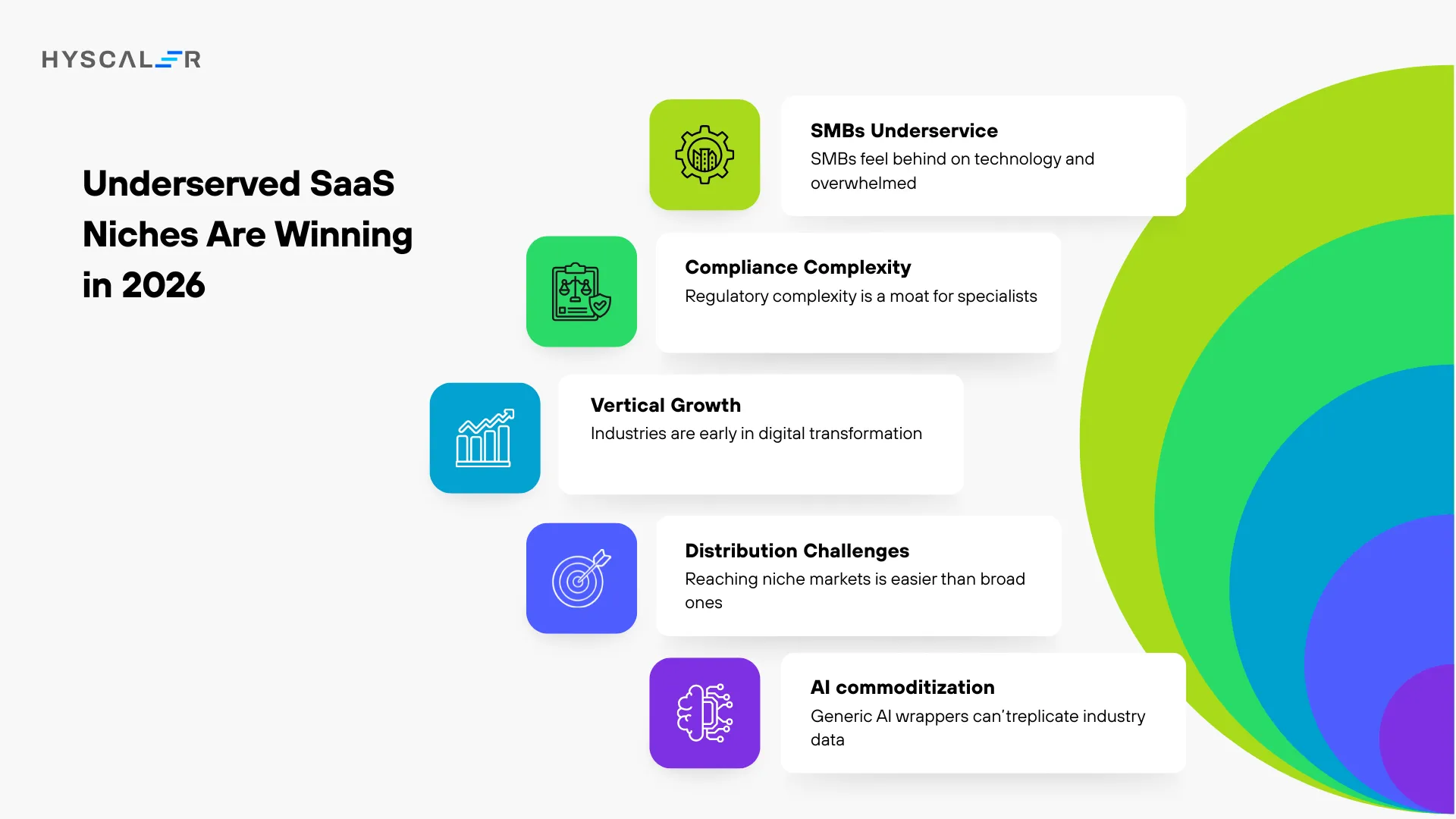
AI has commoditized the easy stuff: Chatbots, basic reporting, and generic automation; these used to be differentiators. Now, they’re table stakes that any competent team can ship in weeks. What’s left as a genuine moat is proprietary, industry-specific data and workflow knowledge that generic AI wrappers can’t replicate.
Distribution is now harder than development: Building software has never been cheaper. Getting someone to notice, trust, and pay for it is the real bottleneck, and niche markets with tight-knit communities and specific pain points are far easier to reach than the ocean of “businesses in general.”
Vertical SaaS is structurally outgrowing horizontal SaaS: Analysts, including Mordor Intelligence and Gartner, put vertical SaaS growth at roughly 1.5–2x the rate of horizontal platforms, driven by industries that are still early in their digital transformation, construction, healthcare, legal, agriculture, and field services among them.
Compliance-heavy industries still lack modern software: Regulatory complexity is often a wall for generic tool builders and a moat for specialists who understand it. New rules, like the CMS prior authorization mandates taking effect across 2026 and 2027, are actively forcing entire industries to adopt software they’ve put off for years.
SMBs remain underserved relative to enterprises: Despite widespread cloud adoption, research from Salesforce found that 75% of SMB leaders feel they’re falling behind on technology, and 88% feel overwhelmed by the number of disconnected tools they already use. That combination of urgency and dissatisfaction is exactly the setup a focused product can exploit.
How We Selected These Niches
Each niche below was evaluated against six criteria:
- Growing demand – the underlying industry is digitizing, not shrinking
- Low-to-moderate competition – no dominant, well-funded incumbent has locked up the category
- High willingness to pay – the pain is expensive enough that customers will pay to remove it
- AI automation potential – a real workflow bottleneck that AI can meaningfully shorten
- Recurring revenue potential – the problem repeats often enough to justify a subscription
- Scalable customer base – enough addressable buyers to build a real company, even if each one is a specialist
25 Underserved SaaS Niches
Healthcare & Compliance

1. AI Prior Authorization Automation
Why it’s underserved: Prior authorization remains one of the most expensive administrative burdens in U.S. healthcare, and new CMS interoperability rules effective in 2026 are forcing payers and providers to modernize fast.
Target customers: small-to-mid-size health systems, independent practices, pharmacy benefit managers.
Biggest pain point: manual document review and payer-specific criteria that change constantly.
Opportunity: the AI-based prior authorization market is projected to roughly triple by the early 2030s from its 2026 base, driven almost entirely by regulatory deadlines rather than optional upgrades.
AI features worth building: NLP-based clinical document review, payer-policy libraries that auto-update, and real-time status tracking.
2. Home Healthcare Operations
Why it’s underserved: home health agencies are growing fast as care shifts out of hospitals, but most still run scheduling and compliance on legacy or paper-based systems.
Target customers: home health and home care agencies with 10–200 caregivers.
Biggest pain point: caregiver scheduling across scattered locations plus visit documentation for reimbursement.
Opportunity: a lean, mobile-first platform built around caregiver routing and compliant visit notes.
AI features worth building: automated visit-note generation, smart scheduling that accounts for travel time, and caregiver skill matching.
3. Independent Therapy Practice Management
Why it’s underserved: solo and small-group therapy practices are squeezed between enterprise EHR systems built for hospitals and generic scheduling apps that ignore clinical documentation needs.
Target customers: independent therapists, counselors, and small behavioral health groups.
Biggest pain point: insurance billing complexity and progress-note documentation eating into clinical hours.
Opportunity: a focused practice management tool that treats billing and notes as first-class features, not add-ons.
AI features worth building: session-note drafting assistance, insurance eligibility checks, and claim-denial prediction.
4. Senior Living Facility Management
Why it’s underserved: mid-size assisted living and senior communities often can’t afford enterprise systems built for large chains, but still face heavy regulatory reporting.
Target customers: independent and small-chain senior living operators.
Biggest pain point: fragmented systems for care plans, staffing, billing, and state compliance reporting.
Opportunity: an all-in-one operations layer sized for facilities with under 200 beds.
AI features worth building: fall-risk and care-plan alerts, automated compliance report generation.
Construction

5. Construction Compliance Management
Why it’s underserved: construction software spending is rising fast, but most compliance tooling is bundled into expensive enterprise suites that smaller contractors can’t justify.
Target customers: mid-size general contractors and subcontractors.
Biggest pain point: tracking permits, safety documentation, and evolving local regulations across multiple job sites.
Opportunity: the construction software market is projected to grow from roughly $11–12 billion in 2026 toward $20–25 billion by the early 2030s, with compliance and safety tracking among the fastest-growing use cases.
AI features worth building: automated permit-deadline tracking, AI-flagged safety violations from photos or reports.
6. Subcontractor Document Automation
Why it’s underserved: General contractors spend enormous time chasing subcontractors for insurance certificates, lien waivers, and compliance paperwork.
Target customers: GCs managing 10+ subcontractors per project.
Biggest pain point: manual document collection, expiration tracking, and follow-up.
Opportunity: a narrow tool that only does subcontractor compliance, priced far below full project-management suites.
AI features worth building: automated document parsing and expiration alerts, smart chase-up messaging.
7. Equipment Maintenance Scheduling
Why it’s underserved: heavy-equipment fleets for mid-size construction firms are usually tracked in spreadsheets, leading to costly unplanned downtime.
Target customers: construction and industrial firms with 15+ pieces of equipment.
Biggest pain point: reactive rather than predictive maintenance.
Opportunity: IoT-enabled predictive maintenance is growing quickly as sensor costs fall, but most tooling still targets large fleets only.
AI features worth building: failure prediction from usage patterns, automated maintenance scheduling around project timelines.
Manufacturing

8. Predictive Maintenance for Small Manufacturers
Why it’s underserved: predictive maintenance platforms are built for large industrial customers with big budgets; small and mid-size manufacturers are priced out.
Target customers: manufacturers with 20–200 employees.
Biggest pain point: unplanned machine downtime with no affordable way to predict it.
Opportunity: a stripped-down, sensor-light version of enterprise predictive maintenance tools.
AI features worth building: anomaly detection from basic vibration or temperature sensors, maintenance-window optimization.
9. Factory SOP Assistant
Why it’s underserved: standard operating procedures on factory floors are often paper binders or PDFs that workers rarely reference correctly.
Target customers: small-to-mid manufacturers with frequent SKU or process changes.
Biggest pain point: inconsistent adherence to procedures, causing quality issues.
Opportunity: a mobile SOP tool that workers can query conversationally on the floor.
AI features worth building: natural-language SOP lookup, automatic flagging when a step is skipped.
10. Quality Inspection Copilot
Why it’s underserved: Computer-vision quality inspection has existed for years, but implementation costs have kept it out of reach for smaller manufacturers.
Target customers: manufacturers doing manual visual quality checks.
Biggest pain point: inconsistent human inspection and slow defect detection.
Opportunity: cheaper vision models and off-the-shelf cameras make a lighter-weight version viable for smaller production lines.
AI features worth building: defect detection from standard camera feeds, trend reporting across shifts.
Agriculture

11. Controlled Environment Agriculture Management
Why it’s underserved: indoor and vertical farms are a fast-growing niche with almost no software built specifically for their unique environmental and crop-cycle needs.
Target customers: indoor/vertical farm operators and greenhouse growers.
Biggest pain point: juggling climate control, nutrient dosing, and harvest planning across disconnected systems.
Opportunity: a unified operations platform for a category still mostly running on custom spreadsheets.
AI features worth building: yield prediction from environmental data, automated climate-control recommendations.
12. Livestock Health Monitoring
Why it’s underserved: Livestock operations, particularly mid-size ones, lack affordable health-tracking tools that connect to wearables or sensors.
Target customers: mid-size dairy, cattle, and poultry operations.
Biggest pain point: late detection of illness or distress, leading to losses.
Opportunity: sensor costs have fallen enough to make monitoring viable outside large industrial operations.
AI features worth building: early illness detection from movement and feeding patterns, automated vet-alert workflows, and feedlot management software that helps cattle operations track animal health, feeding, treatments, and performance in one place.
13. Farm Compliance Automation
Why it’s underserved: food safety and environmental regulations for farms are increasingly complex, but compliance software mostly targets large agribusiness.
Target customers: small-to-mid farms selling into regulated supply chains.
Biggest pain point: manual recordkeeping for audits and certifications.
Opportunity: a focused compliance layer priced for smaller operations.
AI features worth building: automated audit-ready report generation, deadline, and certification tracking.
HR & Workforce

14. Blue-Collar Workforce Scheduling
Why it’s underserved: most scheduling tools are built for office or retail shift work; field service, trades, and industrial labor scheduling have very different constraints (travel time, certifications, equipment).
Target customers: trades and field-service companies with hourly crews.
Biggest pain point: scheduling that ignores skill certifications, location, and union rules.
Opportunity: a scheduling tool purpose-built around trade-specific constraints rather than generic shift work.
AI features worth building: constraint-aware auto-scheduling, certification-expiry alerts.
15. Shift Compliance Platform
Why it’s underserved: predictive scheduling laws are expanding across states and cities, and most small employers have no system to track compliance.
Target customers: multi-location retail, hospitality, and service employers.
Biggest pain point: manual tracking of fair-workweek and predictive-scheduling requirements that vary by jurisdiction.
Opportunity: compliance-as-a-feature layered onto scheduling, sized for businesses too small for enterprise workforce suites.
AI features worth building: jurisdiction-aware rule checking, automated violation alerts before schedules are published.
16. Trade Certification Management
Why it’s underserved: tracking licenses, certifications, and renewal deadlines across a trades workforce is still largely manual, creating real liability risk.
Target customers: electrical, HVAC, plumbing, and construction contractors.
Biggest pain point: expired certifications discovered only after a project is flagged.
Opportunity: a narrow, high-trust tool solving one expensive problem.
AI features worth building: automated renewal reminders, document verification from photos of certifications.
Finance

17. SMB Cash Flow Forecasting
Why it’s underserved: Most accounting software shows historical data; very few affordable tools help small businesses forecast cash flow forward with any sophistication.
Target customers: SMBs with $1M–$20M in revenue.
Biggest pain point: reactive financial decision-making due to poor forward visibility.
Opportunity: enterprise-grade forecasting tools rarely trickle down to smaller businesses at an accessible price.
AI features worth building: scenario modeling, automated anomaly detection in spending patterns.
18. Vendor Risk Monitoring
Why it’s underserved: Vendor risk management tools are built for large enterprises with dedicated procurement teams; smaller companies have no lightweight equivalent.
Target customers: mid-size companies with complex supplier networks.
Biggest pain point: manual, infrequent vendor risk reviews that miss emerging problems.
Opportunity: a simplified monitoring layer for companies too small for full enterprise GRC suites.
AI features worth building: automated risk-signal monitoring from public data, renewal and reassessment reminders.
19. Grant Management Software
Why it’s underserved: Nonprofits and research institutions managing multiple grants often rely on spreadsheets, despite complex reporting requirements.
Target customers: nonprofits, universities, and research organizations.
Biggest pain point: tracking spending against grant restrictions and generating compliant reports.
Opportunity: purpose-built grant tracking with far lower overhead than enterprise nonprofit suites.
AI features worth building: automated compliance-report drafting, spend-categorization from receipts and invoices.
Logistics

20. Fleet Compliance Management
Why it’s underserved: DOT and safety compliance for small-to-mid trucking fleets is handled manually far more often than most people assume.
Target customers: fleets with 10–100 vehicles.
Biggest pain point: driver hours-of-service tracking, inspection records, and audit prep.
Opportunity: compliance-focused tools sized below enterprise fleet management platforms.
AI features worth building: automated hours-of-service violation alerts, audit-ready record generation.
21. Warehouse AI Assistant
Why it’s underserved: Warehouse management systems for smaller 3PLs and distributors are often clunky, decade-old software with no modern interface.
Target customers: small-to-mid 3PLs and distribution centers.
Biggest pain point: inefficient picking routes and inventory visibility gaps.
Opportunity: a modern, AI-assisted layer that can sit alongside legacy WMS systems rather than requiring a full rip-and-replace.
AI features worth building: conversational inventory lookup, pick-route optimization.
Legal

22. Contract Review for SMBs
Why it’s underserved: AI contract review tools are priced for large legal departments; small businesses signing vendor and lease contracts have no affordable equivalent.
Target customers: SMBs without in-house counsel.
Biggest pain point: signing contracts without understanding risky clauses.
Opportunity: a lightweight, affordable review tool that flags risk in plain language rather than legal jargon.
AI features worth building: clause-risk flagging, plain-language contract summaries.
23. Regulatory Change Monitoring
Why it’s underserved: Small businesses in regulated industries struggle to track changing rules that affect them, and most monitoring tools are built for large compliance teams.
Target customers: SMBs in healthcare, finance, and food service.
Biggest pain point: missing regulatory changes until they cause a violation.
Opportunity: an affordable, industry-filtered alert system.
AI features worth building: automated regulation summarization, relevance filtering by business type.
AI-Native

24. AI Agent Marketplace for SMBs
Why it’s underserved: Most AI agent tooling targets developers or enterprises; small businesses have no simple way to deploy pre-built agents for common tasks.
Target customers: SMBs wanting automation without technical staff.
Biggest pain point: lacking the technical resources to build or configure AI agents themselves.
Opportunity: a marketplace of narrow, pre-configured agents for specific SMB workflows (invoicing follow-up, review responses, appointment reminders).
AI features worth building: no-code agent configuration, performance monitoring dashboards.
25. AI Workflow Governance Platform
Why it’s underserved: as businesses adopt more AI agents and automations, almost nobody outside large enterprises has a way to monitor what those agents are doing or catch errors.
Target customers: mid-size companies with multiple AI tools in production.
Biggest pain point: no visibility into AI-driven decisions until something goes wrong.
Opportunity: a lightweight governance and audit layer for companies too small for enterprise AI-governance suites.
AI features worth building: automated audit trails, anomaly detection across agent outputs.
Industries with the Biggest SaaS Opportunity
| Industry | Demand | Competition | AI Potential |
|---|---|---|---|
| Healthcare | High | Medium | Very High |
| Manufacturing | High | Low | High |
| Agriculture | Medium | Low | High |
| Construction | High | Low | High |
| Logistics | High | Medium | High |
| Legal | Medium | Low | High |
How to Validate a SaaS Idea Before Building
Before writing a line of code, run the idea through these steps:
- Interview 20–30 potential users: Ask about their current workaround, not whether they’d use your product. People are polite and will say yes to almost anything hypothetical.
- Analyze competitor reviews: Read one-star and three-star reviews of adjacent tools; that’s where the unmet needs live.
- Identify manual workflows: Look for the spreadsheet, the paper form, or the “we just call each other” process, that’s usually where the willingness to pay is highest.
- Build a landing page: Describe the product before it exists and measure real interest through sign-ups or waitlist requests.
- Launch a no-code MVP: Use tools like Airtable, Bubble, or Retool to test the core workflow before investing in custom development.
- Measure willingness to pay: A soft “yes” means nothing. Ask people to pre-pay a deposit or sign a letter of intent.
Common Mistakes Founders Make
- Building horizontal SaaS without differentiation: Entering a crowded category with “the same, but slightly better” rarely works against entrenched incumbents.
- Ignoring distribution: A great product with no plan to reach buyers is a hobby, not a business.
- Adding AI without solving a real problem: A chatbot bolted onto a product that doesn’t otherwise work isn’t a moat.
- Overbuilding the MVP: Founders often spend six months building features nobody asked for before validating the core workflow.
- Choosing markets with low willingness to pay: Passionate users aren’t the same as paying customers; validate budget, not just enthusiasm.
How AI Changes SaaS Opportunities in 2026
Modern SaaS products increasingly ship with:
- AI agents that execute multi-step workflows autonomously rather than just responding to prompts
- Conversational interfaces that replace complex menus and dashboards for niche users
- Workflow automation that removes entire manual steps rather than just speeding them up
- Document intelligence that extracts and structures unstructured paperwork
- Voice AI for hands-busy environments like construction sites and warehouses
- Predictive analytics that shift operations from reactive to proactive
- Industry-specific copilots trained on domain data that generic AI tools can’t replicate
Industry analysts note this last point is becoming the real differentiator: as AI features become table stakes, the durable advantage shifts to proprietary, industry-specific data that trains models to deliver genuinely contextual outcomes, something horizontal, general-purpose tools struggle to match.
Build for a Problem, Not a Trend
The SaaS companies that last are built around painful, repeating workflows, not around whatever AI capability is trending that quarter.
Founders who deeply understand one industry’s operational reality have a durable advantage over those chasing the newest model release.
A prior-authorization platform still has to actually get authorizations approved faster.
A construction compliance tool still has to keep a contractor off a regulator’s radar. The AI is the how, not the why.
If you’ve spotted a niche in this list that fits your background or industry knowledge, the fastest path forward is usually validation first, then a lean MVP.
And if you’ve validated a promising niche but need help turning it into a real, scalable product, a team with SaaS and AI integration experience, like HyScaler, can help take it from MVP to a production-ready platform without the usual trial and error.
FAQ
What is an underserved SaaS niche?
An underserved SaaS niche is an industry or workflow where demand for software is growing but existing solutions are expensive, generic, or poorly suited to that specific use case, leaving room for a focused product to win.
What are the most profitable SaaS niches in 2026?
Vertical categories with high compliance burden and high willingness to pay tend to be the most profitable, including healthcare administration, construction compliance, legal tech for SMBs, and logistics compliance.
How do I find SaaS ideas with low competition?
Look for industries with heavy manual processes, high regulatory complexity, or a customer base too small for large SaaS vendors to prioritize. Reviewing complaints about existing tools in a given industry is often the fastest way to spot a gap.
Is vertical SaaS better than horizontal SaaS?
Neither is universally “better”, but vertical SaaS is currently growing faster, retaining customers longer, and commanding higher contract values than horizontal SaaS, largely because it solves problems generic tools can’t.
Which industries need AI-powered SaaS the most?
Industries with heavy documentation and compliance burdens, such as healthcare, construction, legal, and logistics, tend to see the fastest returns from AI-powered automation, since much of the pain is manual document handling and rule-tracking.
How much does it cost to build a SaaS MVP?
Costs vary widely, but a focused MVP built with modern tools and a lean scope can often be validated and launched for a fraction of what a full-featured platform would cost. The goal at the MVP stage is to prove the core workflow, not to build every feature.
Can solo founders build successful SaaS products?
Yes, particularly in narrow niches where deep industry knowledge matters more than a large team. Many successful vertical SaaS companies started as a single founder solving a problem they understood firsthand.
What features should every modern SaaS include?
At minimum: reliable core functionality solving the primary workflow, straightforward onboarding, security appropriate to the industry (especially for healthcare or finance), and increasingly, some form of AI-assisted automation that removes manual steps rather than just adding a chatbot.