
Table of Contents
The term “Workforce Management” refers to the formulation and arrangement of employees in an organization with a view to maximizing efficiency and productivity. From manual processes, it has come down to modern AI-based systems. Without adapting WFM efforts toward modern technology, organizations would fail in the competition and would not be able to optimize their workforce.
Traditionally, workforce management relied on manual processes such as spreadsheets, paper schedules, and human judgment. With the evolution of technology, including AI and cloud-based solutions, these processes have become streamlined, more data-driven, automated, and efficient.
It is very important to incorporate Artificial Intelligence and other technologies into the WFM systems since the present business environment becomes more complicated and demands flexibility in the application of this system. AI provides tools for organizations with which they can predict their needs better, manage their talent, and respond to up-to-the-minute changes in demand, which might boost the performance of an organization in operation, hence improving operational efficiencies.
The Role of AI in Shaping Workforce Management
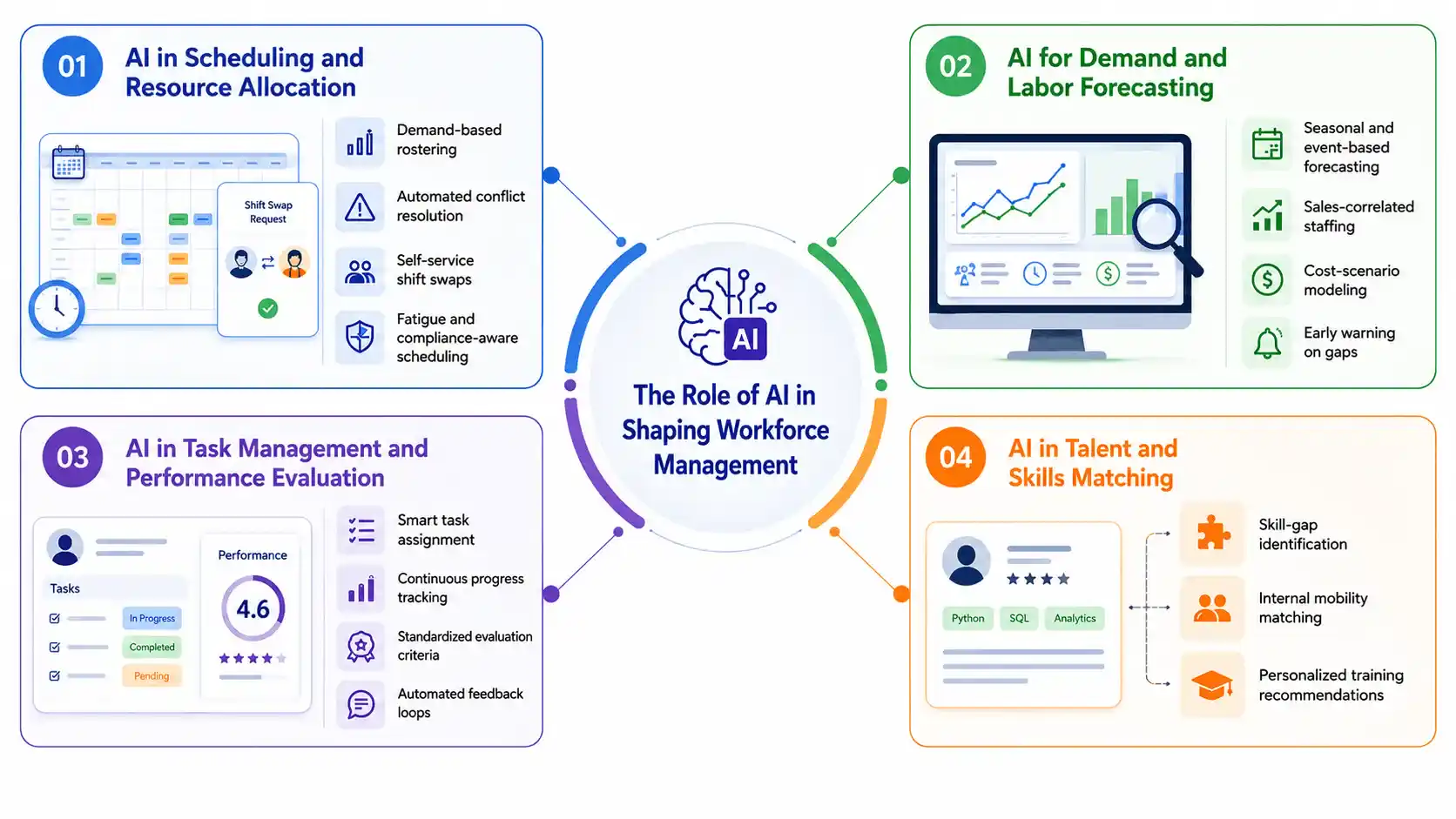
AI’s influence here shows up in four core operational areas today, with a fifth, more transformative layer now emerging on top of them. The sections below walk through each one, from the day-to-day mechanics AI already handles to where this capability is headed next.
1. AI in Scheduling and Resource Allocation
AI-based scheduling tools pull in historical attendance data, employee availability, and demand patterns to build rosters that avoid both overstaffing and understaffing. Rather than a manager manually juggling shift swaps and time-off requests, the system flags conflicts and suggests fixes automatically, cutting down the manual effort this work used to demand.
- Demand-based rostering: Shifts are built around real-time footfall, call volume, or production data instead of fixed templates.
- Automated conflict resolution: The system catches double-bookings, overtime risks, and availability clashes before a schedule is published.
- Self-service shift swaps: Employees trade shifts within pre-set rules, with AI checking eligibility automatically instead of routing every request to a manager.
- Fatigue and compliance-aware scheduling: Rules around rest periods, maximum hours, and labor law limits are enforced automatically as rosters are built.
2. AI for Demand and Labor Forecasting
Predictive analytics models look at seasonal trends, sales cycles, and historical labor data to forecast staffing needs before they become urgent. This forward-looking capability helps businesses allocate the right number of people to the right shifts, reducing both labor costs and the scramble that comes with last-minute scheduling changes.
- Seasonal and event-based forecasting: Models flag predictable spikes, such as holiday demand or product launches, well ahead of time.
- Sales-correlated staffing: Labor plans adjust automatically as sales or production forecasts shift, instead of relying on a fixed headcount.
- Cost-scenario modeling: Planners can compare staffing scenarios side by side to see the cost and coverage trade-offs before committing.
- Early warning on gaps: The system surfaces likely understaffed periods early enough to hire, cross-train, or reallocate in time.
3. AI in Task Management and Performance Evaluation
AI also automates task assignment, progress tracking, and performance evaluation, standardizing how employees are assessed and freeing managers from repetitive administrative review. This consistency is one of the quieter benefits of bringing AI into the process: fewer subjective judgment calls and more evidence-based feedback.
- Smart task assignment: Work is routed based on skill, availability, and current workload rather than a manager’s memory of who’s free.
- Continuous progress tracking: Dashboards update in real time instead of relying on end-of-week status reports.
- Standardized evaluation criteria: Performance scoring follows consistent, data-backed rules across teams, reducing rater bias.
- Automated feedback loops: Employees get performance signals continuously, not just during formal review cycles.
4. AI in Talent and Skills Matching
Beyond day-to-day scheduling, AI is increasingly used to match people to the right roles and projects based on skills data rather than gut instinct.
- Skill-gap identification: AI compares current team capabilities against project or role requirements to flag where training or hiring is needed.
- Internal mobility matching: Employees are surfaced for open internal roles based on skills and past performance, not just tenure.
- Personalized training recommendations: Learning paths are suggested based on an individual’s current gaps and career trajectory.
Benefits of Integrating AI into Workforce Management
The gains from bringing AI into this space aren’t limited to faster scheduling. They touch cost, culture, compliance, and decision quality all at once. Here’s how each benefit plays out in practice.
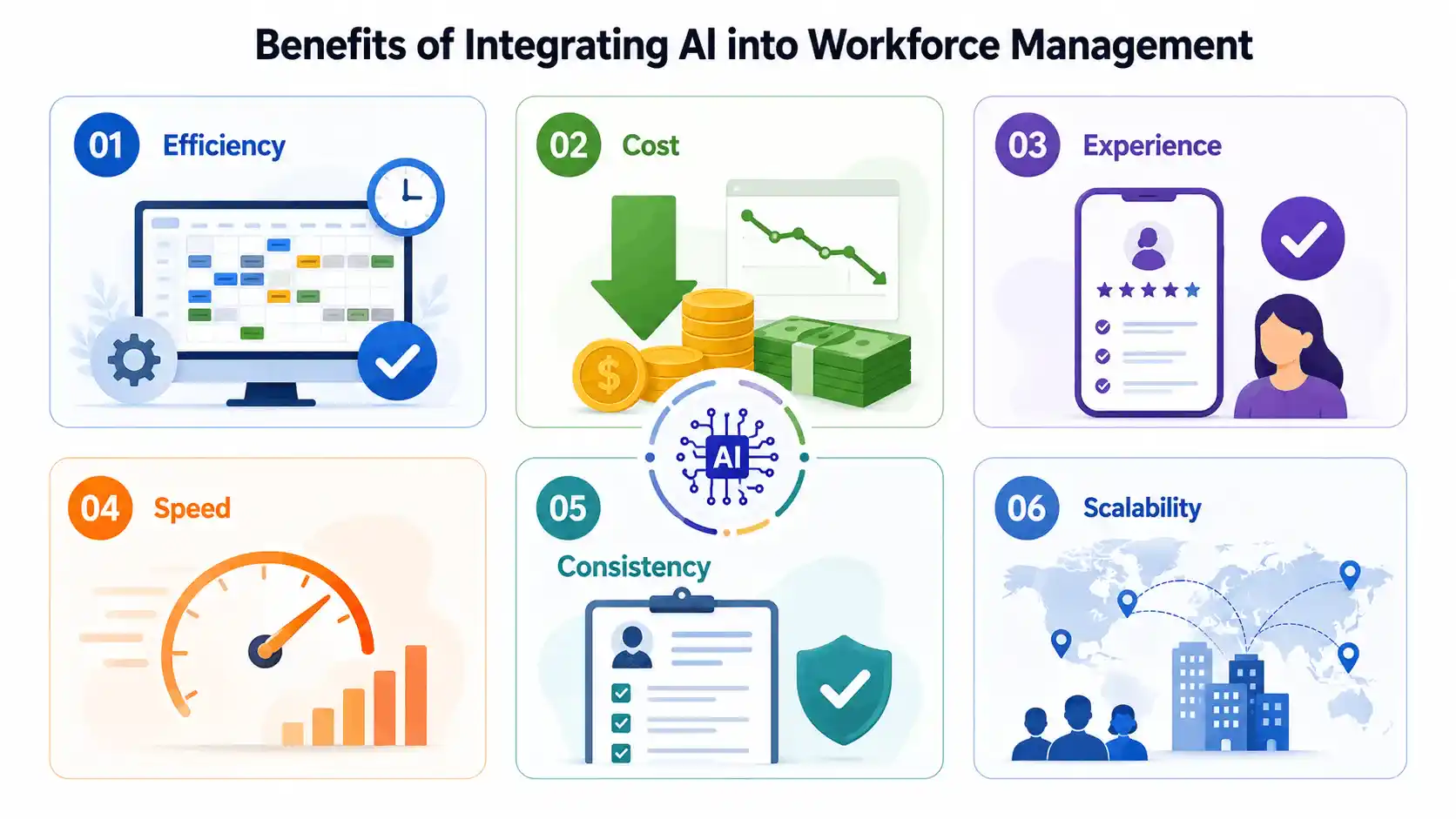
1. Higher Operational Efficiency
Automating repetitive administrative work, building rosters, tracking attendance through remote workforce management software like ActivTrak, and compiling reports frees up manager time for higher-value decisions instead of paperwork.
- Fewer manual scheduling hours spent per week
- Reduced administrative overhead for HR and team leads
- Faster turnaround on shift changes and approvals
2. Lower Labor Costs
Accurate forecasting and demand-matched staffing directly cut the cost of both overstaffing and last-minute overtime.
- Less overtime spend from reactive, last-minute staffing
- Reduced idle labor hours during low-demand periods
- Better budget predictability across pay cycles
3. Better Employee Experience
Employees get more predictable, fairer schedules and self-service tools instead of chasing managers for basic requests.
- Shift preferences and availability respected more consistently
- Faster resolution of time-off and swap requests
- Greater transparency in how schedules and assessments are decided
4. Faster, Real-Time Decision-Making
Because data is processed continuously rather than in weekly batches, leaders can react to staffing gaps or demand spikes as they happen.
- Live dashboards instead of end-of-week reports
- Faster reallocation of staff during unexpected demand shifts
- Fewer disruptions caused by delayed visibility into problems
5. More Consistent, Data-Backed Decisions
Standardized scoring and rules-based scheduling reduce the inconsistency that comes from relying purely on individual manager judgment.
- Reduced rater bias in performance reviews
- Consistent application of scheduling and compliance rules across teams
- Clearer audit trail for staffing and evaluation decisions
6. Improved Scalability
AI-driven systems handle growing headcount and multi-location complexity far more easily than manual processes ever could.
- Onboarding new locations or teams without rebuilding processes from scratch
- Consistent rules applied whether managing 50 or 5,000 employees
- Easier integration with other business systems as the organization grows
Key Technologies in AI-Driven Workforce Management
- Machine Learning and Predictive Analytics: Machine learning models analyze historical data to predict staffing needs, optimize scheduling, and improve decision-making by forecasting future trends more accurately.
- Natural Language Processing (NLP) for Communication and Support: NLP enables AI systems to read and respond in human language and therefore will allow employees to communicate through chatbots or virtual assistants for scheduling time off.
- AI-powered Chatbots for Employee Queries and Self-service: Most of the employees’ queries were handled by Chatbot completely, thereby bringing some free time to HR management without compromising the ease of getting answers.
The Future of Workforce Management in an AI-Driven World
- Future Role of AI in WFM: Increasingly, AI will be at the central position and will be highly autonomous while being integrated well with all other business processes, offering more personalized operations and operational efficiency.
- Impact on Job Roles and New Opportunities: The thing is, while AI technology may replace some tasks done by human beings, a new scope for workers regarding collaboration with AI in strategic decision-making, creativity, and data will emerge. Thereby raising the demand for AI data science skills.
- Ethical Considerations in Human-AI Collaboration: Human-AI When AI becomes part of a workplace, there are new ethical issues in bias, fairness, and privacy, among other concerns. Organisations, therefore, have to consider how they will design defences against responsible human-AI interaction.
Key Tools in AI-Powered Workforce Management
- AI in Scheduling and Resource Allocation: Smart scheduling tools, such as Forecast.io and Deputy, optimize shifts by incorporating employee preferences, availability, and trends in scheduling. Workforce optimization tools such as Kronos Workforce Ready and UKG forecast staffing needs so that employees are scheduled and scheduled right to boost efficiency and reduce labor costs.
- Performance Monitoring and Employee Engagement: AI-driven feedback tools, like 15Five and CultureAmp, which further break down sentiment and show areas of employee satisfaction and performance. Sentiment analysis tools evaluate feedback and communication regarding employee mood and morale for engagement in advance.
Challenges and Considerations
- AI bias and ethical concerns: Algorithms can unintentionally perpetuate bias in hiring or scheduling decisions, so safeguards and regular audits matter.
- Job security and workforce displacement: Automation may replace some routine tasks, making reskilling programs an essential part of responsible workforce management.
- Data privacy and compliance: AI systems rely on large volumes of employee data, so compliance with regulations like GDPR has to stay central to how workforce management software is deployed.
Conclusion: Embracing AI for a Smarter Workforce
AI won’t replace the judgment and leadership that good workforce management has always required, but it does remove much of the manual burden that used to slow it down. Organizations that pair AI-driven tools with thoughtful human oversight are better positioned to adapt to changing demand, keep employees satisfied, and run leaner, more responsive operations.
Ready to Modernize Your Workforce Management?
HyScaler helps organizations design and implement AI-driven workforce management systems tailored to their operations, from scheduling automation to performance analytics. Get in touch with HyScaler today to explore how AI can strengthen your workforce management strategy.
FAQs
Is AI actually going to replace my job, or just parts of it?
Mostly parts. In most AI-driven workforce management setups, AI takes over repetitive tasks like scheduling and reporting, while judgment-heavy work, handling conflicts, exceptions, and people issues, still needs a human.
How do I know if an AI scheduling system is treating employees fairly?
Check whether the system’s rules are documented and auditable. Fair systems apply the same logic to everyone and allow employees to flag and appeal decisions that seem off.
Can AI see everything employees do at work?
It depends on what’s deployed. Many tools track task completion, time, and location data rather than private conversations, but the specifics vary by employer, so it’s worth asking exactly what’s being monitored.
Does AI make scheduling more predictable or less?
For most teams, it improves predictability, since AI can lock in schedules further ahead using demand forecasts, though sudden demand shifts can still trigger last-minute changes.
Does AI scheduling account for employee preferences, or just business needs?
Better systems weigh both, but this varies by implementation; some tools prioritize cost and coverage first, treating preferences as secondary.
How much should leaders trust AI-generated performance scores?
Treat them as one data point, not the full picture. AI scoring is only as fair as the data and rules behind it, so it’s worth understanding what’s being measured before treating a score as definitive
What compliance risks come with AI-driven workforce data?
Since these systems process large volumes of employee data, regulations like GDPR make it essential to know what’s collected, how long it’s kept, and who can access it. This is usually a legal and IT question as much as an HR one.