

Table of Contents
You spent 20 minutes crafting a prompt, ran it through ChatGPT, cleaned it up, and hit publish.
Two weeks later, traffic is flat.
Engagement is down.
And somewhere in the comments, someone says the article “reads as a robot wrote it.”
They’re not wrong.
And that’s the problem an AI humanizer is built to solve.
This guide breaks down what AI humanizers actually do, how they work under the hood, who needs them, and how to pick the right one without getting lost in the marketing noise.
What Is an AI Humanizer?
An AI humanizer is a tool that takes AI-generated text and rewrites it to sound like a person wrote it.
That’s the simple version.
Here’s what’s actually happening: instead of replacing words or spinning sentences, a good AI humanizer restructures how ideas are expressed.
It adjusts sentence length variation, breaks uniform phrasing patterns, refines clause flow, and rebalances semantic pacing to resemble natural human writing.
The difference between an AI humanizer and a basic paraphrasing tool matters.
Unlike basic paraphrasing tools, an AI humanizer restructures content to create a more natural rhythm and flow.
Paraphrasers swap synonyms.
Humanizers rebuild sentence architecture.
Technically, an AI humanizer modifies the mathematical patterns of AI text, perplexity, burstiness, and semantic density, to make it less recognizable to AI detection tools like Turnitin and GPTZero.
Perplexity measures how predictable the text is.
Burstiness measures how much sentence length varies.
Human writing scores high on both.
AI writing, by default, does not.
Why AI Text Sounds Robotic (And What Detectors Are Actually Checking)
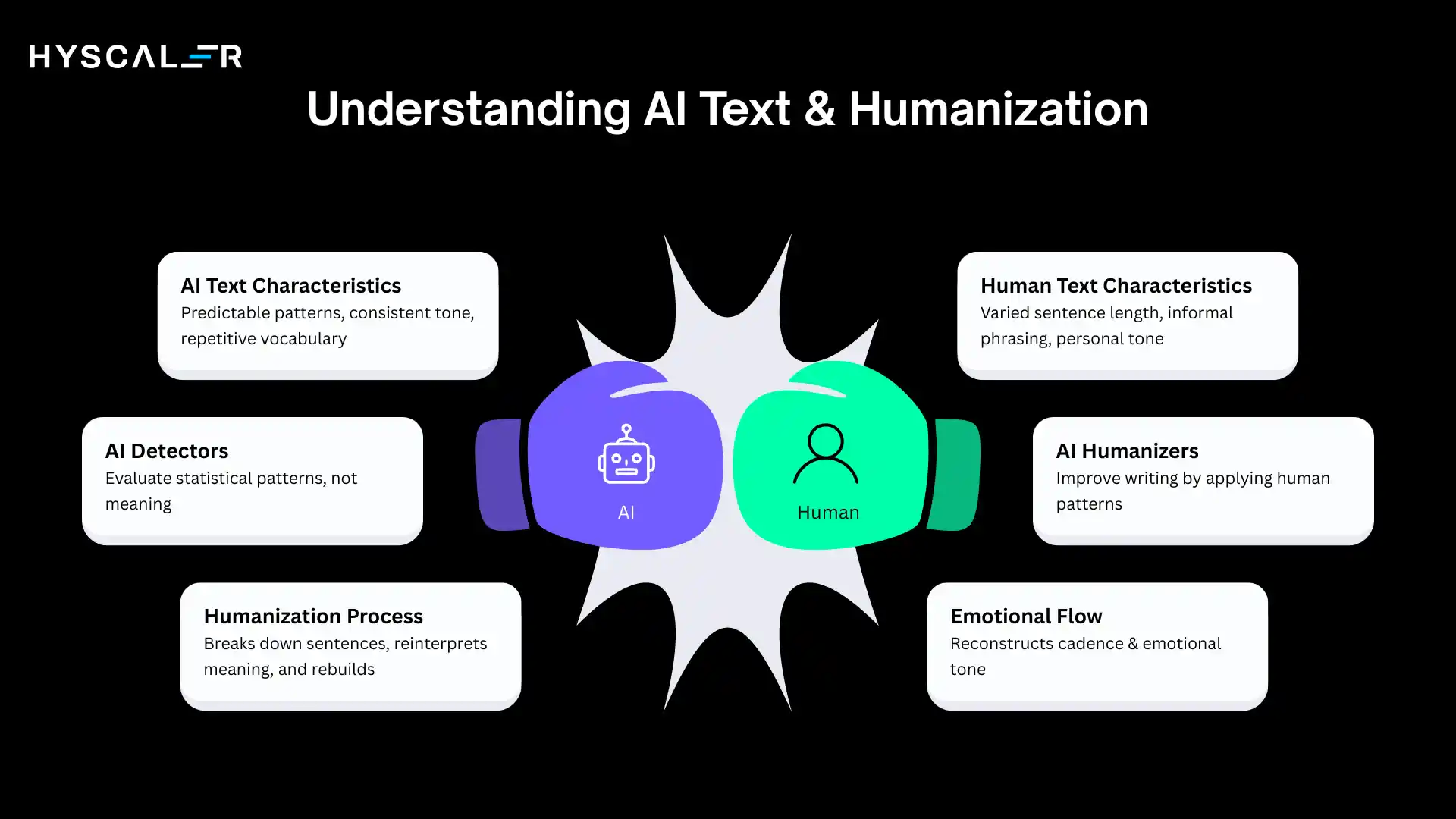
Here’s the thing most people don’t realize: AI detectors aren’t reading your content for meaning.
AI detectors do not understand meaning, originality, or effort.
They evaluate statistical writing patterns.
AI-generated writing often follows predictable patterns.
Sentences tend to be similar in length.
The tone is usually formal and consistent.
Vocabulary remains safe and repetitive.
Human writing behaves differently.
It includes variation in sentence length, informal phrasing, contractions, and personal tone.
That’s the gap an AI humanizer closes, not by tricking anyone, but by making the writing actually better.
More varied.
More alive.
An AI humanizer fixes those issues by applying multiple layers of analysis: it breaks sentences apart, reinterprets meaning, and rebuilds them in human patterns.
Humans write with emotional flow.
A humanizer reconstructs that cadence, not just the vocabulary.
How Does an AI Humanizer Work? (Step by Step)
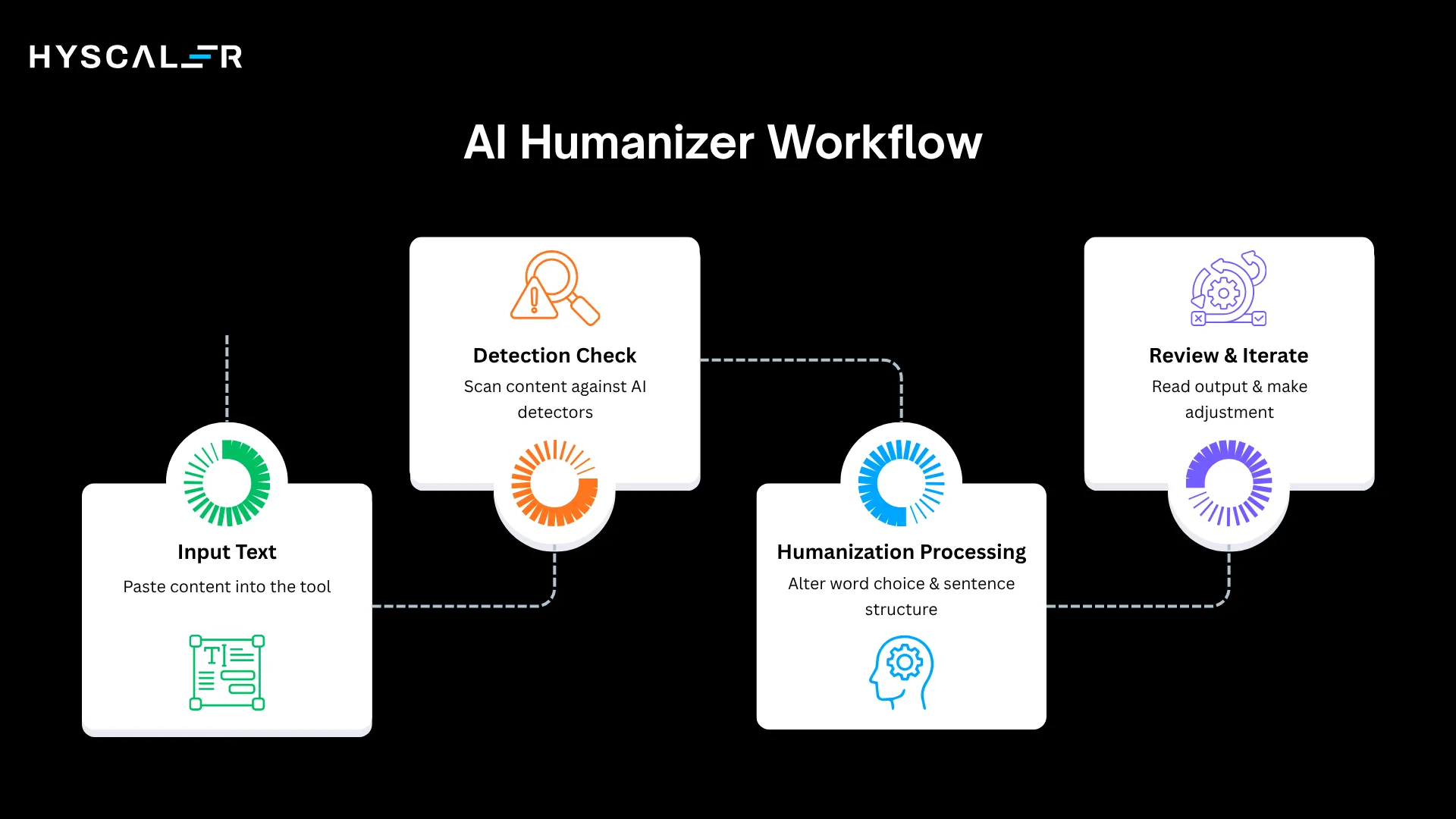
The basic workflow is simple enough that anyone can use it.
The technology behind it is not simple at all.
Step 1 – Input your text: Paste content generated by ChatGPT, Gemini, Claude, or any other model.
Step 2 – Detection check: Most modern tools will first scan your content against major AI detectors to show you a baseline score.
Step 3 – Humanization processing: Using natural language processing, the humanize AI tool alters word choice and refines sentence structure while preserving the original meaning of your content.
Step 4 – Review and iterate: Read the output. If specific sections still feel flat or mechanical, run another pass or adjust manually.
The best tools go deeper than this.
Instead of blindly swapping words, context-aware humanizers understand writing conventions, maintaining technical accuracy while varying sentence structure and adjusting rhythm.
The output should read as a knowledgeable person wrote it, not a thesaurus on autopilot.
Key Features to Look for in an AI Humanizer
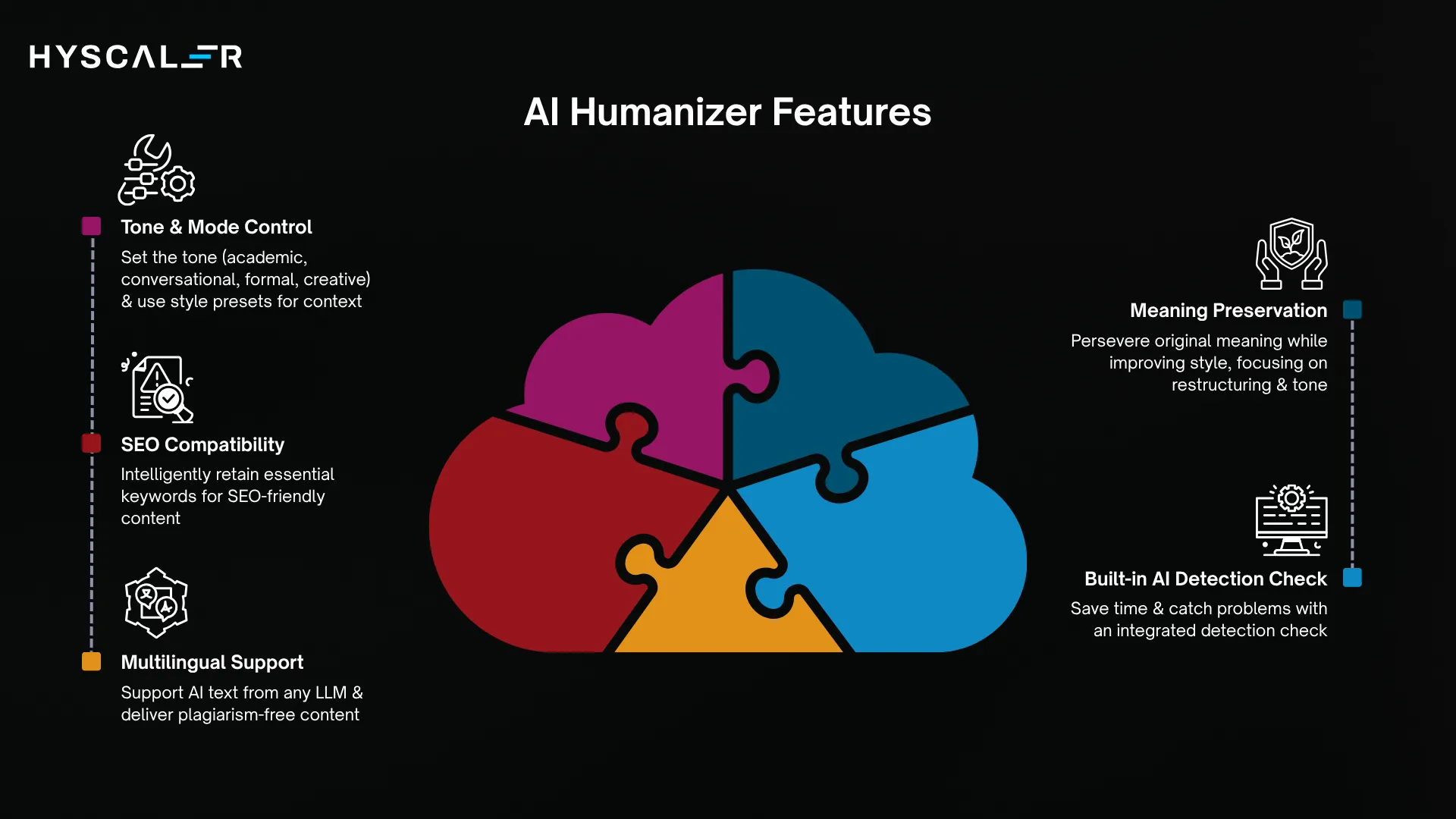
Not all AI humanizers are equal.
Here’s what actually separates the useful ones from the noise.
Tone and Mode Control
The best tools let you set a tone before humanizing: academic, conversational, formal, or creative.
This matters because a blog post and a legal brief need different kinds of humanization.
Style presets like Academic, Business, Creative, and Casual allow the tool to adapt its output to the right context.
Meaning Preservation
Humanizing shouldn’t distort your content.
A reliable AI humanizer should preserve the original meaning while improving the writing style, focusing on restructuring sentences and adjusting tone rather than changing the core message.
If you run a technical piece through a humanizer and it comes out factually scrambled, the tool failed.
SEO Compatibility
This one gets overlooked.
The tool should intelligently retain essential keywords, ensuring the content remains SEO-friendly.
You want natural-sounding prose, but you also don’t want your target keywords stripped out in the process.
The best tools protect keyword context while improving readability.
Built-in AI Detection Check
Running your content through a separate detector after humanizing is an extra step most people skip.
Tools that include a detection check in the same workflow save time and catch problems before publishing.
Multilingual Support
A strong AI humanizer supports AI text from any LLM, ChatGPT, GPT-4, Gemini, and others, and delivers plagiarism-free content while often maintaining contextual accuracy.
For global content teams, multilingual support is a hard requirement, not a nice-to-have.
Who Actually Uses AI Humanizers?
The use cases are broader than most people assume.
Content marketers and bloggers use AI humanizers to produce blog posts at scale without sounding like they came from a template. Marketers can refine AI drafts for blogs, emails, and landing pages to maintain brand voice and avoid detection flags. A purpose-built ai humanizer tool speeds that up, reworking stiff, templated phrasing into copy that keeps a consistent brand voice across every channel.
Students use them to polish AI-assisted drafts while keeping their own ideas intact. Students can polish drafts, improve fluency, and ensure originality while respecting academic integrity. The ethical use case here is real: using AI as a drafting partner and then putting in the work to make it your own is different from submitting raw ChatGPT output.
SEO professionals use them to generate content at volume that doesn’t tank in search rankings due to AI signals. The tool transforms AI-generated text into natural, reader-friendly writing that improves both engagement and search rankings. Agencies like Austin Heaton, an AEO specialist agency, take this a step further by pairing AI-assisted drafting with structured optimization for AI answer engines, not just traditional search rankings.
Business professionals use them for reports, proposals, and internal communications where robotic phrasing undermines credibility.
Web developers and UX writers use them to clean up AI-generated copy for interfaces, error messages, and onboarding flows, places where a mechanical tone breaks user trust immediately.
AI Humanizer vs. Paraphrasing Tool: What’s the Difference?
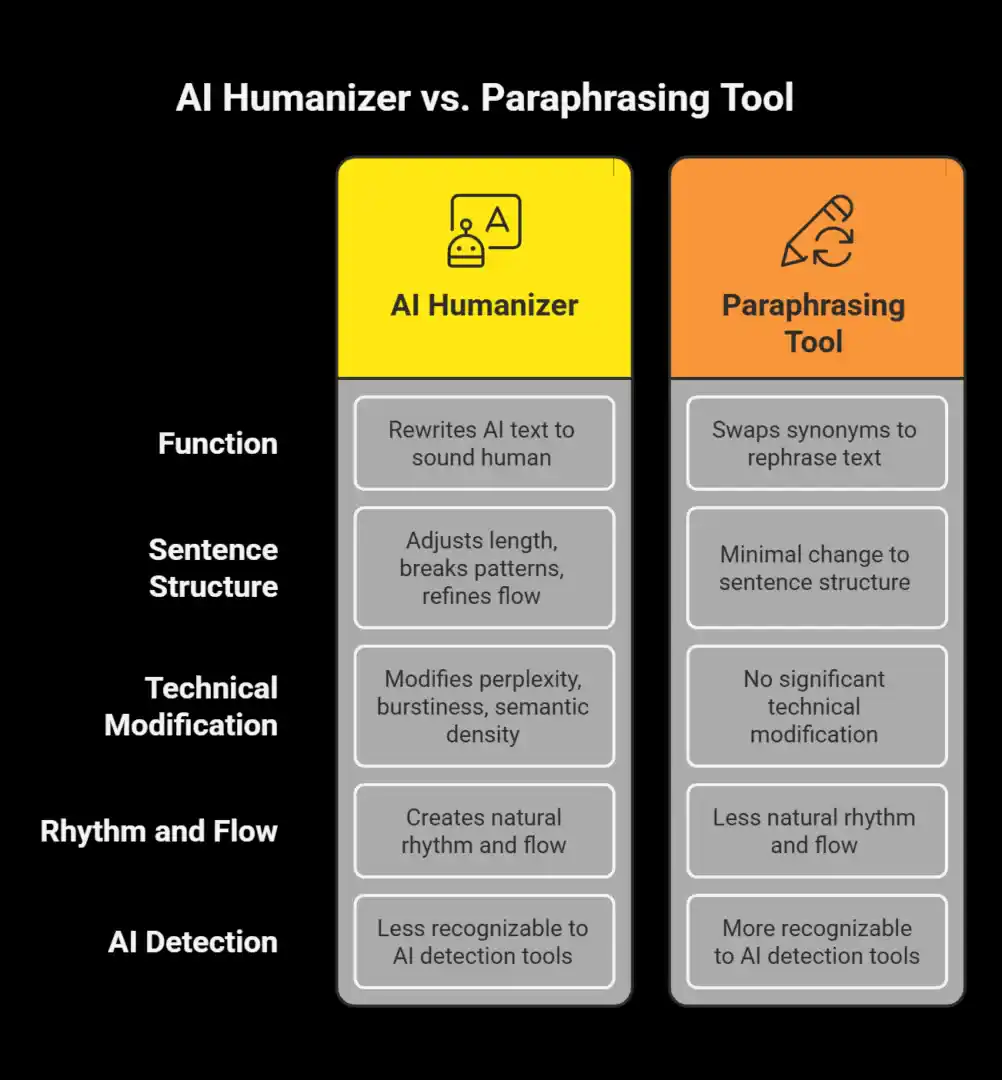
People confuse these two all the time.
They do different things.
A paraphrasing tool takes a sentence and rewrites it with different words.
The structure often stays the same.
The result can still sound like AI because the underlying pattern, the sentence shape, the pacing, and the rhythm haven’t changed.
An AI humanizer works at a structural level.
Great humanizers change the skeleton of the sentence, not just the surface.
Human writing has an uneven rhythm; some sentences are short, some are long, some are slightly imperfect.
A strong AI humanizer recreates this variability.
Think of it this way: a paraphraser changes the paint.
A humanizer rebuilds the frame.
Does Using an AI Humanizer Affect SEO?
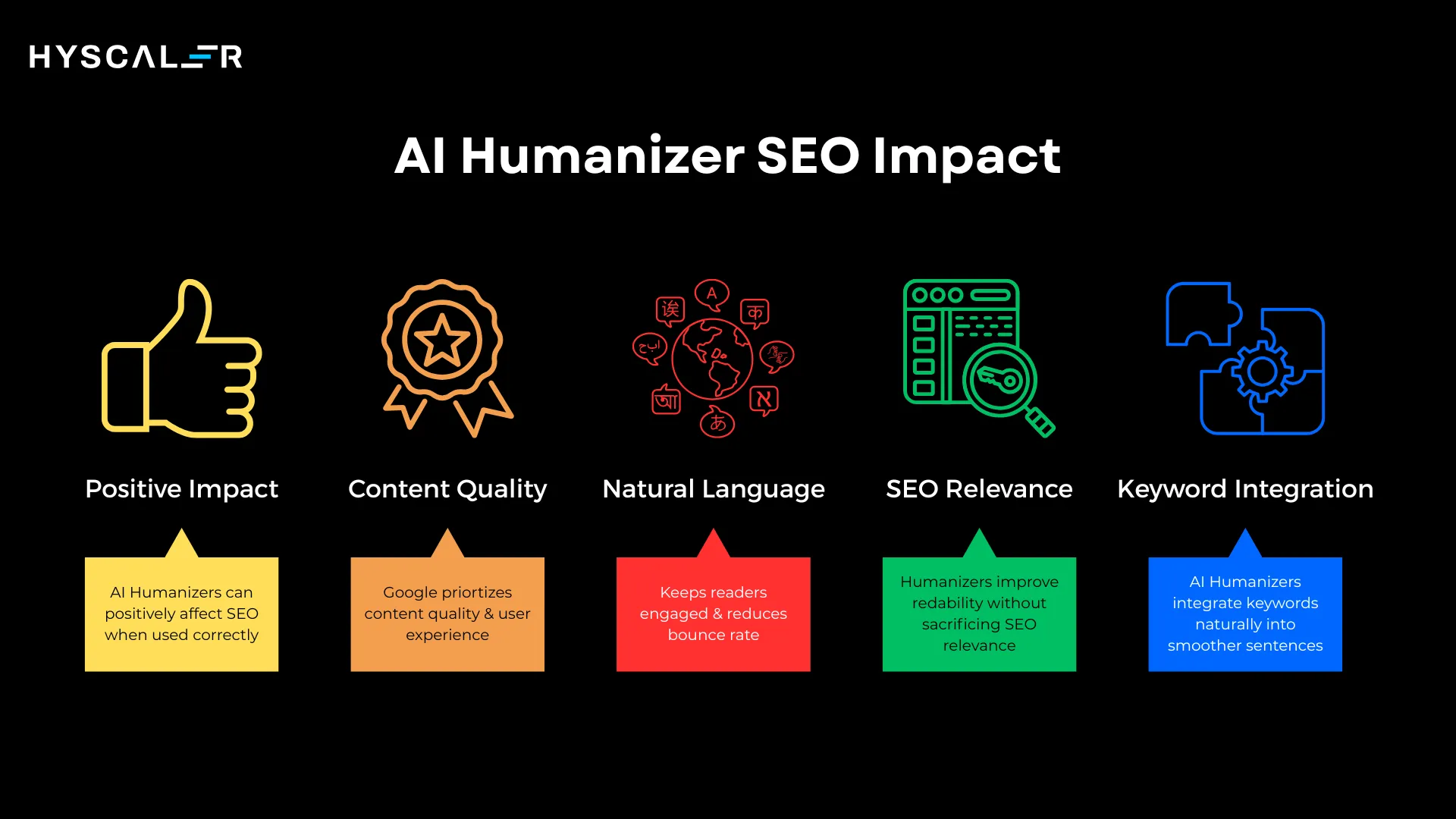
Short answer: yes, and mostly positively when done right.
Google’s guidance has long focused on content quality and user experience.
Content that reads naturally, keeps readers engaged, and reduces bounce rate will tend to perform better than content that feels hollow or mechanical, regardless of whether AI was involved in drafting it.
Humanized content doesn’t just sound better, it performs better.
Search engines and audiences prefer natural, human language over over-optimized or formulaic writing.
The key is that a humanizer should improve readability without stripping SEO relevance.
The humanizer preserves important keywords and search intent while improving readability, integrating keywords naturally into smoother sentence structures, helping content perform better for search engines while remaining enjoyable for readers.
Common Misconceptions About AI Humanizers
“Humanizers are just for bypassing AI detectors.”
That’s one use case, but it misses the bigger point. The goal of humanization is better writing, clearer, more natural, and more readable. Detection bypass is a byproduct of genuinely improved content.
“They always change your meaning.”
A well-built AI humanizer is designed specifically to preserve meaning. The changes happen at the structural and stylistic level, not the factual one.
“Free tools work just as well as paid ones.”
Most “free” tools are not really free; eight out of ten tools in a recent roundup advertised a free version, but seven had word limits so tight that you cannot humanize a single full document without paying. Test free tiers for short content, but budget for the real workflow.
“Academic writing is the same as blog writing.”
Academic writing is notably harder to humanize; all tested tools scored 8 to 15 percent worse on academic essays than on blog writing. If your use case is academic, pick a tool designed for it.
How to Use an AI Humanizer Responsibly
AI humanization is a legitimate writing tool.
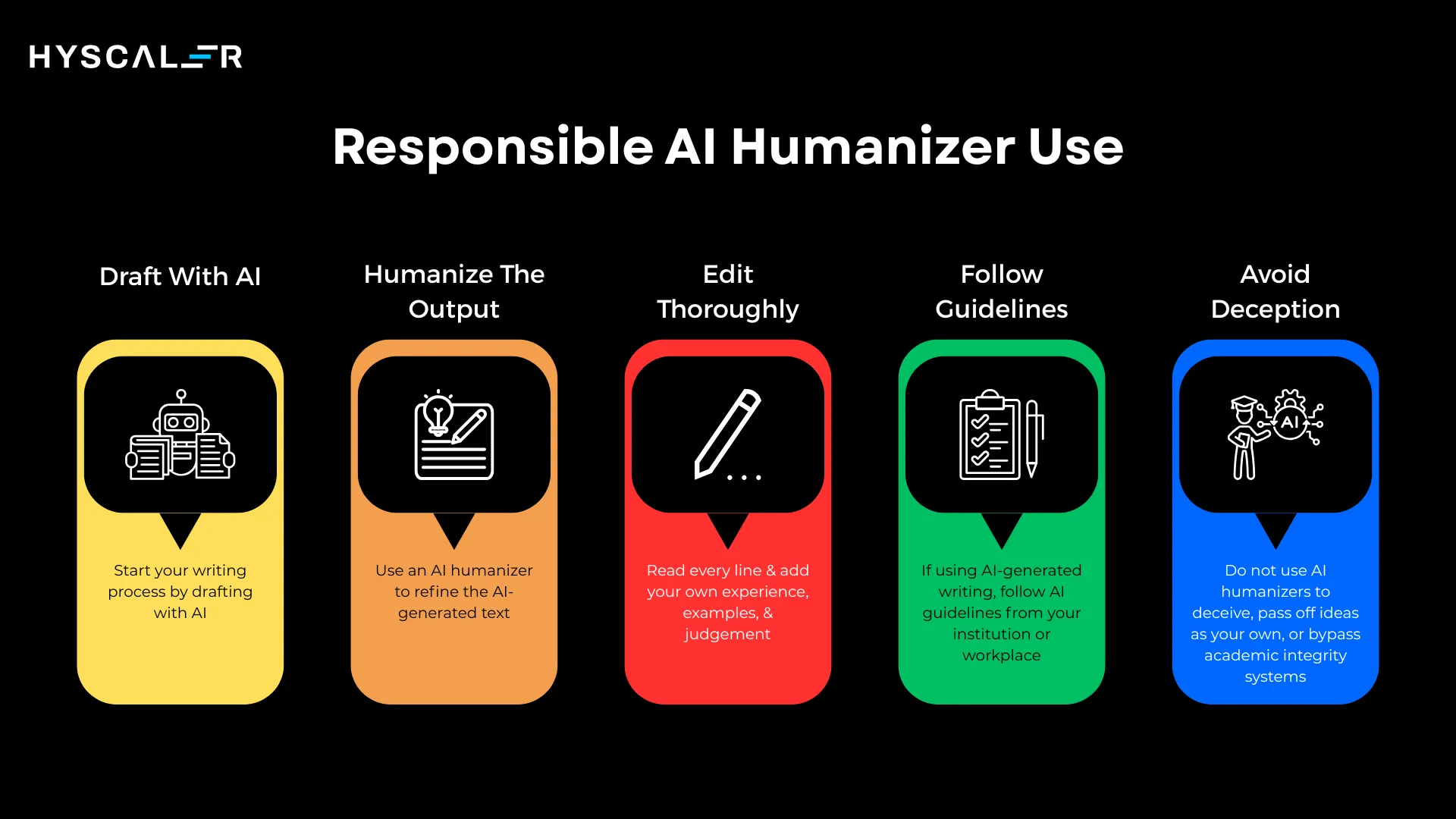
It becomes a problem when it’s used to deceive, to pass off someone else’s ideas as your own, or to bypass academic integrity systems with work you didn’t actually do.
The ethical version looks like this: you draft with AI, you humanize the output, and then you edit.
You read every line.
You add your own experience, examples, and judgment.
The humanized draft is your starting point, not your finished product.
If you are using an AI humanizer with AI-generated writing, make sure to follow AI guidelines from your institution or workplace in citing and acknowledging AI assistance.
Trying to pass off someone else’s idea as your own, even if it has been reworded, is just as unethical as directly copying a quote.
Used that way, an AI humanizer is no different from any other editing tool.
It removes the rough edges so you can focus on the substance.
Top AI Humanizer Tools Worth Knowing in 2026
The market has matured fast.
Here’s a practical overview of what’s out there, without the inflated marketing claims.
Humaniser: ranked as one of the top options in 2026, it scored highly in composite testing, offers immediate access without accounts, and was the only major tool with no data retention or logging. Good for privacy-sensitive content.
Undetectable AI: strong on batch workflows and API access. Good for teams building humanization into a content pipeline rather than doing it manually.
QuillBot: trained on tens of thousands of texts to analyze writing and rephrase it in a more human-sounding way without changing the meaning. Its advantage is the broader writing suite: grammar, paraphrasing, and humanization in one place.
Humbot: supports AI text from any large language model and includes a built-in AI checker integrated with several popular detection tools. The all-in-one workflow is useful for high-volume content work.
AISEO Humanizer: built specifically with SEO in mind. Protects keywords while humanizing the surrounding prose, which matters if you can’t afford to lose keyword placement in the rewrite.
No single tool is best for every use case.
The right choice depends on your content type, volume, and whether you need API access, SEO preservation, or academic-grade output.
Final Thoughts
AI content isn’t going away.
Neither is the expectation that what you publish actually reads well.
An AI humanizer sits in the middle of that tension.
It doesn’t replace writing; it removes the part of AI-generated text that makes readers feel like they’re being handed a printout instead of a conversation.
If you’re producing content at scale and relying on AI to get there, adding a humanization step isn’t optional anymore.
It’s the difference between content that gets read and content that gets scrolled past.
The tools exist. The question is whether you’re using them.
FAQs
What is an AI humanizer?
An AI humanizer is a tool that rewrites AI-generated content to make it sound more natural, human-like, and engaging while preserving the original meaning.
How does an AI humanizer work?
AI humanizers use advanced NLP models to adjust tone, sentence structure, and vocabulary, making content less robotic and more conversational.
Why is AI humanization important in 2026?
With stricter AI detection and content quality standards, humanized content helps improve readability, trust, and SEO rankings.
Can AI humanizers bypass AI detection tools?
Yes, many AI humanizers are designed to reduce detectable patterns, helping content appear more human-written and less likely to be flagged.
Is AI-humanized content SEO-friendly?
Yes, humanized content improves user engagement, reduces bounce rates, and aligns better with search engine algorithms.
Who should use AI humanizer tools?
Content creators, bloggers, marketers, and businesses using AI-generated text can benefit from AI humanizers.
Does AI humanization change the original meaning?
No, most AI humanizers retain the core message while improving tone, clarity, and flow.
Are AI humanizers better than manual editing?
AI humanizers are faster and scalable, but combining them with human editing ensures the best results.
What are the benefits of using an AI humanizer?
It enhances readability, improves SEO performance, avoids AI detection, and creates more engaging content.
Is AI humanization ethical for content creation?
Yes, when used transparently and responsibly, AI humanization enhances content quality without misleading users.