

Table of Contents
What Is AI Consulting for Startups?
AI consulting for startups is a hands-on technical partnership. It helps resource-strapped startups move from messy AI experiments to real, working systems. Unlike general IT consulting, it focuses on speed, tight budgets, and unit economics, not long roadmaps.
The Technical Debt of AI-Lag
Here is what kills most startups in 2026. It is not ignoring AI. It is shipping an AI prototype with no plan to make it work at scale.
AI-native companies earn a 3.2x higher valuation than traditional tech peers. But that number only holds if you move past the demo stage. Most startups never do. They run pilots, show a cool demo, and then stall. That stall has a name.
AI-Lag Technical Debt is the growing cost a startup pays when it delays real AI work or manages it poorly. It compounds over time. Every month you stay stuck in pilot mode, your competitors pull further ahead.
Four numbers show how deep this problem runs:
- The Pilot Gap. According to a report, about 88% of companies use AI in some form. But fewer than one in three have scaled it past a pilot. That means 71% of AI projects die before reaching users.
- The Unit Economics Crisis. As per an MIT report, roughly 95% of AI projects fail to move the bottom line. The issue is not technology. It is a poor strategy and weak governance.
- The Hidden Cost Reality. Data prep and infrastructure eat up 56% of surprise AI costs. This often costs more than the AI model itself. Most startups undercount first-year AI costs by 30–50%.
- The Productivity Paradox. Developers say AI tools make them 20% faster. But the total project output can drop by 20%. Why? Teams spend too much time checking, fixing, and re-prompting AI outputs.
These numbers point to one root cause. Startups treat AI like a product to buy. They should treat it like a skill to build.
Traditional SaaS Implementation vs. AI Agentic Workflows
| Dimension | Traditional SaaS | AI Agentic Workflows |
| Core Architecture | Fixed rules and static workflows | Goal-driven agents that reason and adapt |
| Scalability Model | Add more user seats or copy manual steps | Add more agents that manage each other |
| Human Oversight | Constant manual input at every step | Humans only step in for high-stakes decisions |
| Time-to-Value | Fast for standard, off-the-shelf tools | 2–6 weeks for pilots; 8–12 weeks for full production |
| Primary Cost Driver | Monthly subscription fees | Compute costs (often 80% of AI revenue), API fees, and retraining |
| Failure Mode | Unused tools sitting on a shelf | Add more user seats or copy the manual steps |
Startups that think “SaaS-first” are at a disadvantage. They treat AI like another tool to subscribe to. But AI agents need to be built into the core of the business. Skipping this step is why 71% of AI projects never reach production.
The 5-Pillar AI Consulting Framework: The Deployment Readiness Stack
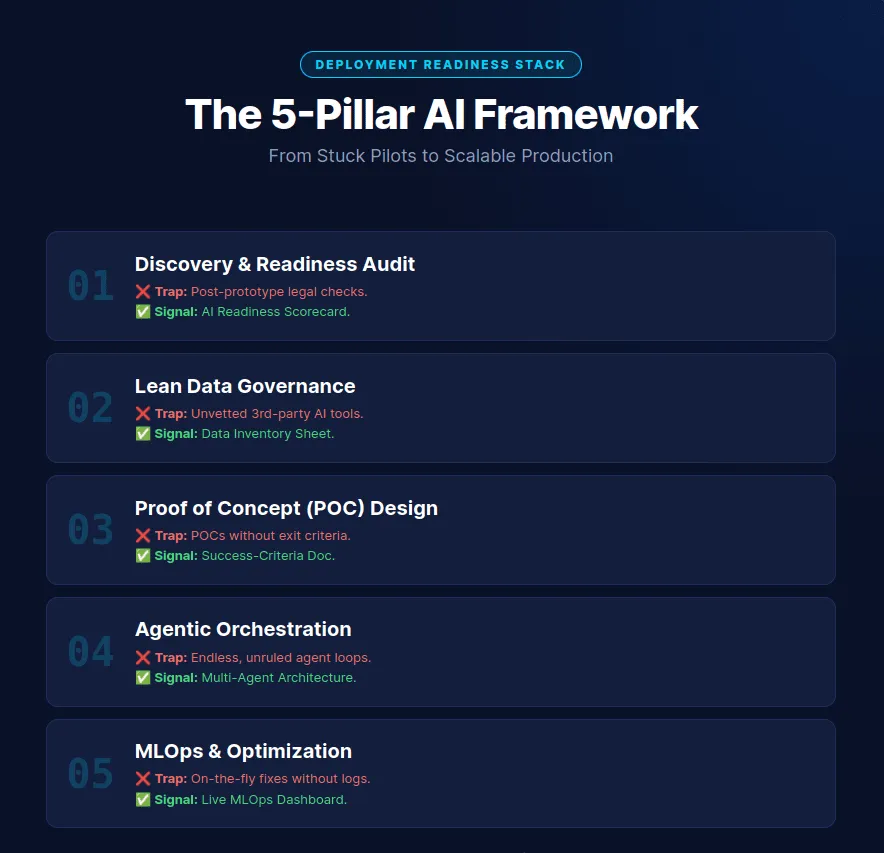
The Deployment Readiness Stack is a five-step framework. It moves startups from stuck pilots to working AI systems. Each step has a clear deliverable and a common trap to avoid.
Pillar 1: Discovery & AI Readiness Audit
Start by checking what you have. Assess your data quality, infrastructure, and which use cases make sense. Talk to both technical and business teams early.
Common mistake: Waiting until after the prototype to check with legal or data teams. This adds 4–8 weeks of delay.
Completion signal: A scored AI Readiness Scorecard.
Pillar 2: Lean Data Governance
This step builds a simple data protection setup for small teams (10–50 people). It covers data inventory, access rules, and basic compliance. You do not need an enterprise legal team to get this right.
Common mistake: Sending private company data through unvetted third-party AI tools. This kills enterprise deals later.
Completion signal: A signed Data Inventory Sheet.
Pillar 3: Proof of Concept (POC) Design
Test your idea on real data with clear success metrics. Set a pass/fail threshold before you start. This prevents “demo theater”, demos that look great but never ship.
Common mistake: Running a POC without a deadline or exit criteria. Without these, POCs become permanent experiments.
Completion signal: A signed POC Success-Criteria Document.
Pillar 4: Agentic Orchestration & Scaling
Move beyond basic chatbots. Build systems where AI agents break tasks apart, call external tools, and share memory. Think of it as a team of AI workers that hand tasks to each other.
Agentic Overhead is the hidden cost here. It covers the time and money you spend debugging agent loops and maintaining complex agent code.
Common mistake: Launching too many agents without rules. Agents can get stuck in expensive, endless loops.
Completion signal: A documented multi-agent architecture with roles, memory limits, and cost estimates.
Pillar 5: MLOps & Continuous Optimization
Set up systems that watch your AI after launch. Track drift, schedule retraining, and monitor costs. Without this, your model slowly breaks, and nobody notices until users complain.
Common mistake: Fixing AI issues on the fly without logging what went wrong. This prevents learning.
Named metric: The Inference Efficiency Ratio measures the cost to run AI per user, divided by the revenue that the AI feature creates. A falling ratio means your AI is losing money.
Completion signal: A live MLOps dashboard with drift reports and cost tracking.
The “AI-Native” Business Model
Most AI consultants help startups bolt AI onto old processes. This misses the bigger opportunity.
An AI-Native Business Model puts AI agents at the center of how the business works. AI does the core job. Humans direct and supervise. The business grows output without growing headcount at the same rate.
AI-Assisted vs. AI-Native: The Execution Gap
- AI-Assisted: A SaaS startup adds an “AI Copilot” that drafts emails for users. Humans still do most of the work. AI just speeds up one small step.
- AI-Native: A startup where AI agent teams handle full tasks end-to-end. Two engineers produce the output of ten. AI runs the pipeline. Humans guide the strategy.
The Human-in-the-Loop Cost
Every pilot budgets for AI model fees. Almost no budget for human review time.
Example: A 10-person engineering team uses AI coding tools. Each developer feels 20% faster. But the two senior engineers now spend 30% of their time reviewing AI-generated code. The speed gain disappears. Net output stays flat. This is the Human-in-the-Loop Cost. It is real, measurable, and often breaks the business model.
The AI Trust Score
Enterprise buyers now check your AI before they buy. The AI Trust Score rates your data sources, model transparency, and audit trail. It is a composite reliability rating.
Big companies in finance and healthcare demand this. They want to see bias tests, prompt logs, and compliance docs. A high score shortens sales cycles. A low score kills deals before they start.
Measuring Hard ROI in AI-Enabled Startups
| KPI | What It Measures | Why It Matters | Benchmark Target |
| Inference Cost Per Active User | Compute the cost to serve one user | AI compute can hit 80% of revenue | Below 5% of revenue per user |
| Inference Cost vs. LTV | Total compute per user vs. lifetime revenue | Shows if AI features are sustainable | Inference under 15–20% of LTV |
| AI-Attributable Revenue Ratio | Revenue directly driven by AI features | Justifies AI investment to investors | 15–25% revenue lift within 12 months |
| Human-in-the-Loop Hours Per 1,000 Outputs | Manual hours to check AI results | High oversight kills productivity gains | Under 4 hours per 1,000 outputs |
| Time-to-Deploy (POC to Production) | Weeks from validated POC to live users | Slow deployment burns runway | 8–12 weeks |
| Model Drift Rate (Monthly) | How fast does model accuracy degrade | Silent drift erodes user trust | Under 3% per month; retrain above 5% |
Key benchmark: 82% of successful AI projects report positive ROI. Teams save about 8 hours per week per employee. But these results only happen when you set KPIs before launch, not after.
The AI Consulting Failure Matrix
The following matrix maps the critical friction points where AI initiatives collapse, with the strategic consulting interventions required to cross each threshold.
| Phase | Common Mistake | Better Approach | Cost of Inaction |
| Strategy | Chasing tools before defining problems | Start with the bottleneck, then pick the tool | Wasted spend; 95% of AI projects show no ROI |
| Data | Ignoring messy data or skipping legal review | Start Lean Data Governance on day one | 56% budget overrun from surprise data costs |
| Productivity | Measuring individual speed, not team output | Track cost per transaction and cycle time | 20% net productivity drop from review overhead |
| Sustainability | Tracking vanity metrics like daily prompts | Track Inference Efficiency Ratio weekly | 90% of projects fold within year one |
| Compliance | Putting regulatory review after launch | Map compliance before the POC starts | Lost enterprise deals and legal risk |
| Execution | Running endless POCs with no exit criteria | Set pass/fail thresholds before starting | 71% failure to reach production |
| Orchestration | Launching agents without governance rules | Define roles, costs, and escalation logic upfront | Runaway compute costs from agent loop traps |
FAQs
How do we avoid “Comprehension Debt” when using AI to build our core product?
Comprehension Debt builds when your team cannot understand or fix the AI systems they depend on. Prevent it with a 2–4 week overlap period. Have consultants and your engineers build together. If you skip this, you own a codebase nobody on your team can change. That makes every future update an outside expense.
What are the specific hidden costs that sink AI pilots at the seed stage?
Three costs trip up seed-stage founders.
First, the Output Validation Tax. Senior engineers spend 25–35% of their time checking AI work.
Second, infrastructure surprises. Data prep eats 56% of unplanned AI spend. A $50K pilot often costs $75K–$85K in reality.
Third, Agentic Overhead. Debugging agent loops and maintaining orchestration code costs more than most founders expect. Plan for 10–15% annual maintenance on top of your initial build.
How do we fix negative unit economics in an AI-native startup?
Fix it at the source: your Inference Efficiency Ratio.
First, switch from general-purpose models to fine-tuned models. They cost less per query and perform better on your specific tasks.
Second, automate quality checks so humans do not review every output.
Third, track the inference cost per user weekly. Set automated alerts before compute costs hit dangerous levels. AI computing can reach 80% of revenue. Catch it early.
How do we measure Hard ROI for a project that is only 10% AI-enabled?
Use the 10-20-70 rule. Attribute 10% of success to the model, 20% to the tech stack, and 70% to process changes. Isolate the workflow your AI touches. Measure the cost or revenue change in that specific area. Even a 10% AI feature delivers strong returns if it automates a high-volume bottleneck. Define KPIs before you build, not after.
Which regulatory compliance requirements are mandatory before our first AI pilot?
Three things are non-negotiable.
First, sign a Data Processing Agreement (DPA) with every AI service provider. This sets data retention limits and breach rules.
Second, align with SOC 2 Type I or ISO 27001. Enterprise buyers check this in the security review. No cert means no deal in regulated sectors.
Third, document your AI Trust Score inputs: data sources, model versions, bias test results, and audit logs.
Startups that skip compliance get eliminated in enterprise procurement before the demo even starts.
Your Next Step: The AI Readiness Audit
The gap between winning startups and failed pilots is not technology. It is execution. Every founder has access to the same models. What matters is how you deploy them.
The Deployment Readiness Stack gives you a clear five-step path. It takes you from stuck pilots to working AI systems. Each step has a deliverable and a measurable endpoint. You always know where you stand and what to fix next.
Schedule your AI Readiness Audit to get a scored assessment of your data, infrastructure, compliance, and use cases. We return your AI Readiness Scorecard within five business days, with a roadmap built for your stage, team size, and budget.