
Table of Contents
Artificial intelligence has moved well beyond the chatbot era.
In 2026, businesses are deploying AI agents that autonomously complete tasks, make decisions, coordinate multi-step workflows, and operate around the clock with little to no human hand-holding.
The numbers tell the story plainly: the global AI agents market is projected to exceed $10.9 billion in 2026, growing at over 45% CAGR.
According to McKinsey, 88% of organizations now use AI in at least one business function, yet only 23% have genuinely scaled agentic AI.
That gap between experimentation and execution is exactly where competitive advantage lives right now.
Whether you run a lean startup or a global enterprise, understanding which AI agents are being adopted and why is the first step toward deploying them effectively in your own organization.
This guide covers 35 AI agents businesses are actively using in 2026, organized by function, with real use cases for each.
What Is an AI Agent?
An AI agent is software that perceives its environment, makes decisions, and takes action to achieve a defined goal, often without step-by-step human instruction.
That’s the key difference from a traditional chatbot.
A chatbot responds.
An AI agent acts.
It can browse the web, write and execute code, call APIs, manage files, trigger workflows, and loop back to check its own work all within a single task.
Assistive vs. autonomous agents: Some agents augment human work (think GitHub Copilot suggesting code). Others operate autonomously end-to-end (think Devin filing a bug, writing a fix, and opening a pull request without a human in the loop).
Single-agent vs. multi-agent systems: A single agent handles one workflow. Multi-agent systems coordinate several specialized agents working in parallel, increasingly common in enterprise deployments, where 22% of production setups now coordinate three or more agents.
Why Businesses Are Adopting AI Agents in 2026
The business case for agentic AI isn’t theoretical.
Here’s what’s actually driving adoption:
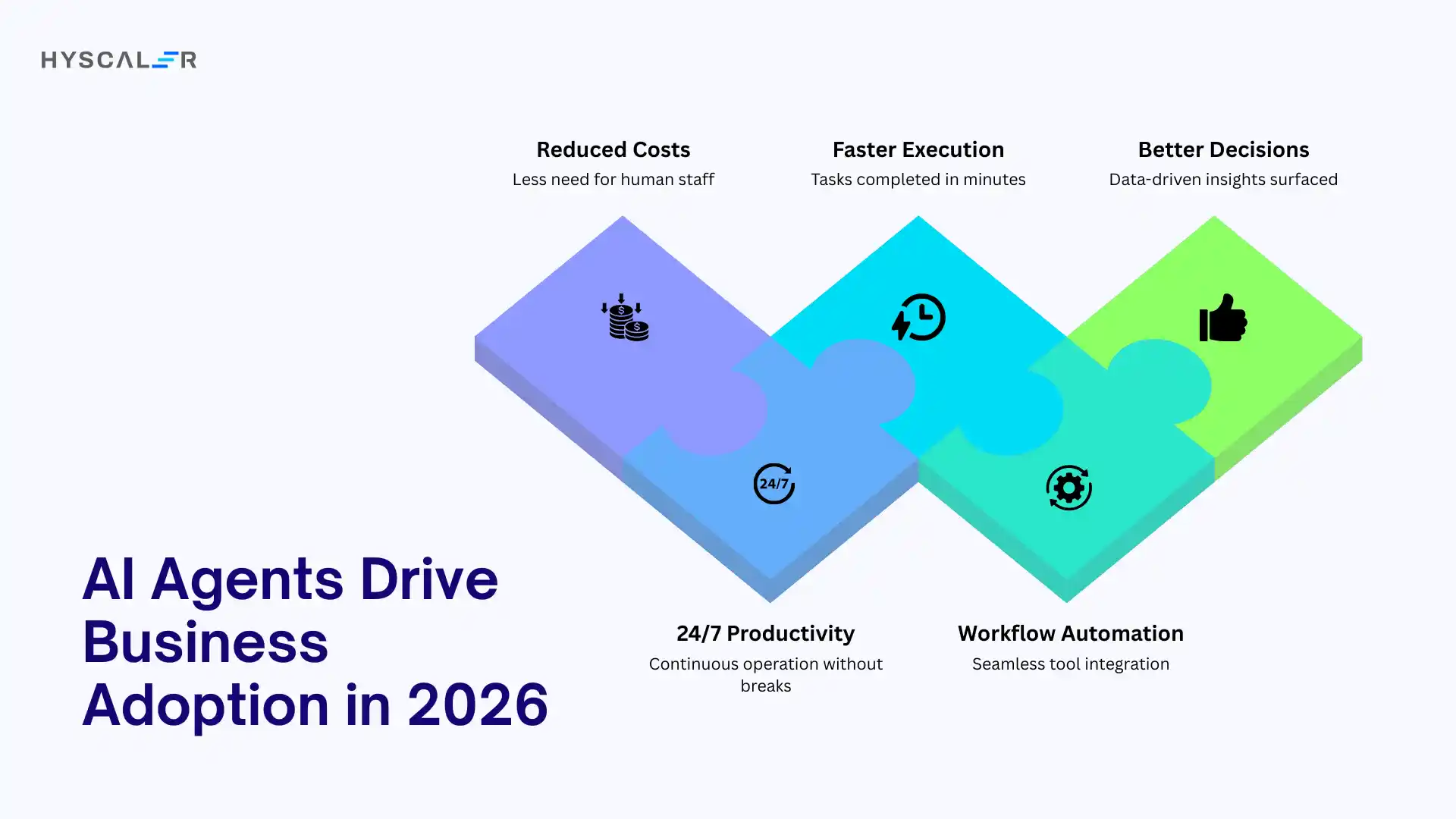
- Reduced costs: Agents handle high-volume, repetitive tasks that would otherwise require headcount, customer queries, data entry, lead qualification, and code review.
- 24/7 productivity: Agents don’t sleep. Customer support, monitoring, and pipeline management keep running after hours.
- Faster execution: Tasks that took days (market research, outreach drafting, QA testing) now take minutes.
- Workflow automation: Agents connect tools, CRMs, email, ticketing systems, and databases, and move work between them automatically.
- Better decisions: Data-driven agents can surface insights from large datasets faster than any analyst team working manually.
Gartner forecasts that 40% of enterprise applications will embed task-specific AI agents by the end of 2026, up from less than 5% in 2025.
The shift is happening now, and it’s accelerating.
How We Selected These 35 AI Agents Businesses Are Actually Using
Every agent on this list was evaluated against the same criteria:
- Real enterprise adoption (not just hype or beta products)
- Measurable business impact on cost, speed, or quality
- Workflow automation capabilities beyond simple Q&A
- Integration ecosystem with existing business tools
- Ease of deployment across different company sizes
- Market relevance in 2026 specifically
The result is a practical list, not a wishlist of AI demos, but tools businesses are actually paying for and running in production today.
Customer Support AI Agents
Customer service was the first major enterprise category to see serious AI agent adoption, with AI in customer support becoming increasingly relevant for businesses looking to automate customer interactions.
The ROI is clear and measurable: lower cost per ticket, faster resolution, higher satisfaction scores.
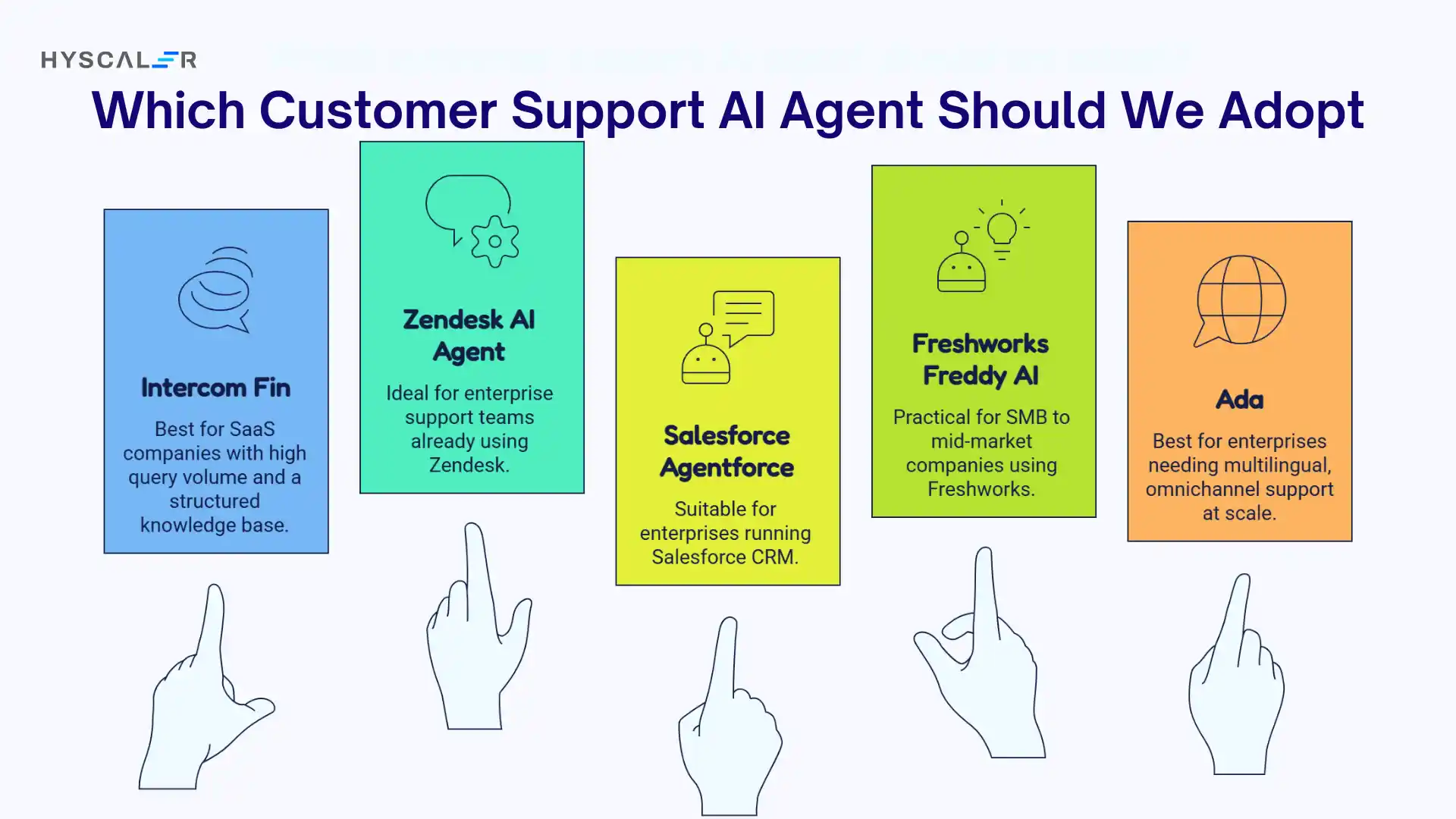
1. Intercom Fin
Best for: Mid-market and enterprise SaaS customer support
Fin is Intercom’s flagship AI agent, built on large language models and trained on your own help center content.
It resolves customer queries end-to-end, not just routing them, but actually answering them.
Fin hands off to human agents only when it can’t resolve the issue, passing the full conversation context.
Real-world deployments report resolution rates of 50%+ without human intervention, directly reducing support headcount requirements.
Ideal use case: SaaS companies handling high inbound query volume with a structured knowledge base.
2. Zendesk AI Agent
Best for: Enterprise support teams that want AI resolving tickets end to end, not just deflecting them
Zendesk’s AI agents are autonomous customer service agents that resolve routine and multi-step requests (order status, returns, account changes) end to end across email, chat, voice, and social channels.
Where script-based chatbots stop at fixed flows, Zendesk’s agents classify intent, take the action, and close the loop.
They run inside Zendesk’s workflow engine, so an agent can issue a refund, update an order, or escalate to a human with the full conversation attached, without leaving the platform.
Built-in QA scores every AI interaction, and 1,800+ integrations connect resolutions to the rest of the stack.
3. Salesforce Agentforce
Best for: Enterprises running Salesforce CRM
Agentforce is Salesforce’s answer to the agentic era, an autonomous AI layer built directly into the Salesforce platform.
It can handle customer service cases, qualify sales leads, and execute multi-step business workflows using your CRM data, without custom code.
Agentforce agents are designed to operate within guardrails defined by your team, making them a strong fit for regulated industries.
4. Freshworks Freddy AI
Best for: SMB to mid-market companies on Freshdesk or Freshsales
Freddy handles customer interactions across support and sales, auto-classifying tickets, suggesting resolutions, and proactively engaging website visitors.
Its strength is tight integration across the Freshworks suite, making it a practical choice for teams that don’t want to stitch together separate tools.
5. Ada
Best for: Enterprises needing multilingual, omnichannel support at scale
Ada is a purpose-built AI customer service platform that automates conversations across chat, email, phone, and SMS.
What distinguishes Ada is its focus on coaching the platform, which helps teams identify where the AI underperforms so they can improve it continuously.
Ada is used by brands handling millions of monthly interactions globally.
Sales & Revenue AI Agents
Sales teams were early adopters of AI automation.
In 2026, agents are doing more than writing cold emails; they’re researching prospects, managing outreach sequences, qualifying inbound leads, and updating CRMs automatically.
6. Front

Best for: B2B customer support teams managing complex, cross-team requests
Front combines AI-powered customer support with a shared workspace that keeps conversations, context, and team collaboration connected. Its AI can automate routine requests, assist agents with suggested replies, and help route conversations to the right team when human involvement is needed.
What makes Front useful for customer operations is its ability to handle more complex workflows that involve multiple teams and systems. It helps businesses automate repetitive support tasks while preserving conversation context during handoffs, allowing support teams to resolve issues faster without losing the human touch.
Ideal use case: B2B companies with complex customer support workflows that need AI automation alongside human collaboration.
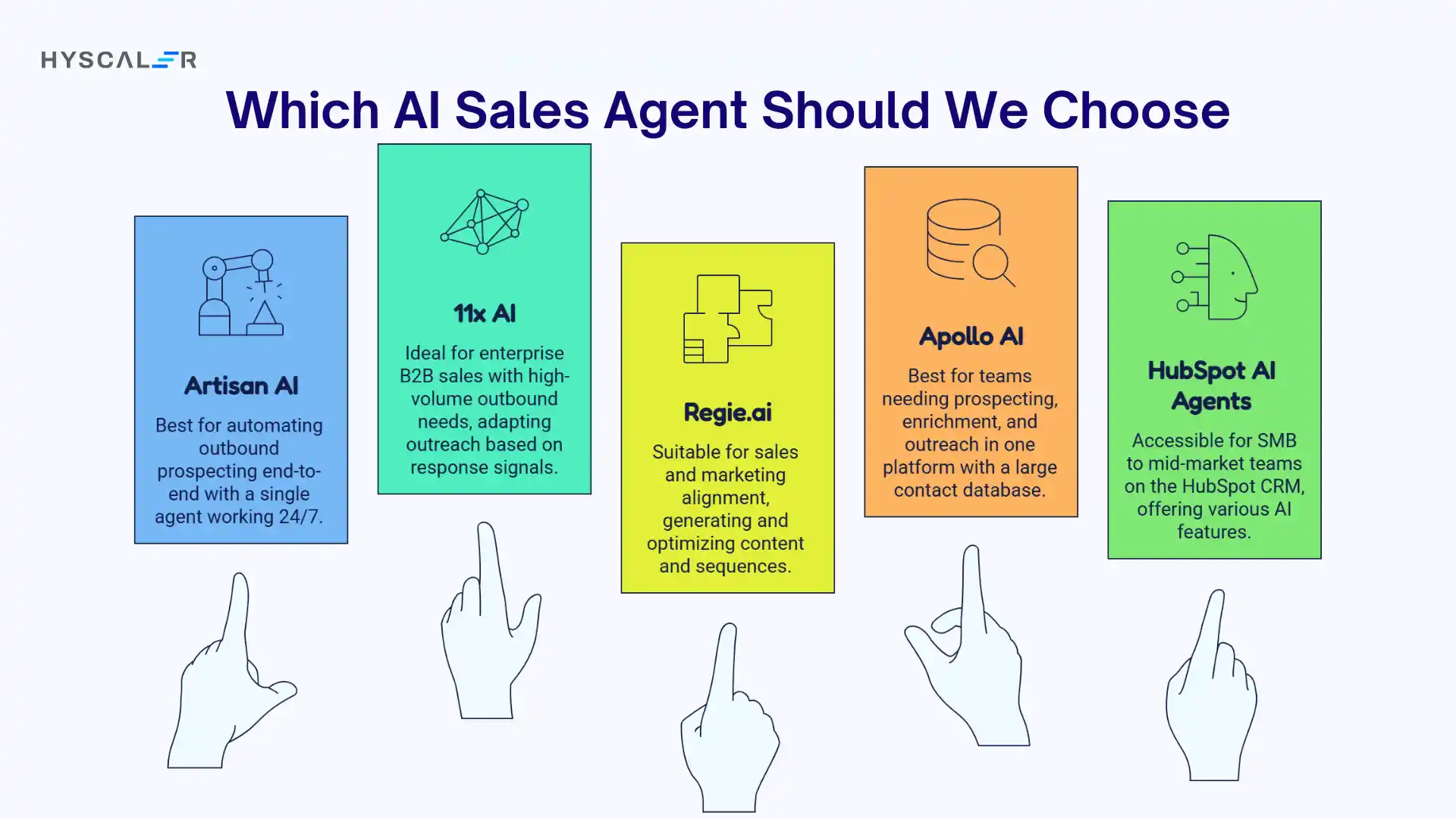
7. Artisan AI
Best for: Outbound sales teams looking to automate prospecting end-to-end
Artisan’s AI sales agent, called Ava, researches prospects, builds contact lists, crafts personalized outreach, and manages email sequences autonomously.
The pitch is replacing large SDR teams with a single AI agent that works 24/7.
Artisan has seen strong traction with growth-stage B2B companies looking to scale outbound without proportionally scaling headcount.
8. 11x AI
Best for: Enterprise B2B sales with high-volume outbound needs
11x builds AI digital workers focused on sales.
Its flagship agent handles prospecting, email personalization, and meeting booking at scale. Unlike basic sequencing tools, 11x agents adapt outreach based on response signals, behaving more like a skilled SDR than an email scheduler. Teams evaluating 11x alternatives will find this agent-first approach is now a baseline expectation across the category.
9. Regie.ai
Best for: Sales and marketing alignment on content and outreach
Regie.ai helps revenue teams generate, manage, and optimize sales content and sequences using AI.
Its agents automate prospecting content creation across the full funnel, from initial cold outreach to follow-up cadences while maintaining brand voice and compliance standards.
10. Apollo AI
Best for: Teams that want prospecting, enrichment, and outreach in one platform
Apollo is already one of the most widely used sales intelligence platforms.
Its AI layer adds automated email sequence generation, lead scoring, and intent signal processing.
For teams already using Apollo’s database of 275M+ contacts, the AI features significantly reduce the manual work of building and running outbound campaigns.
11. HubSpot AI Agents
Best for: SMB to mid-market teams on the HubSpot CRM
HubSpot has embedded AI agents across its CRM, marketing, and sales hubs, writing email drafts, summarizing call transcripts, scoring leads, and suggesting next actions.
The accessibility of HubSpot’s platform makes it one of the most widely adopted starting points for teams new to agentic AI.
Marketing AI Agents
Marketing teams have embraced AI faster than almost any other function.
In 2026, agents handle everything from content creation and SEO optimization to campaign testing and audience personalization.
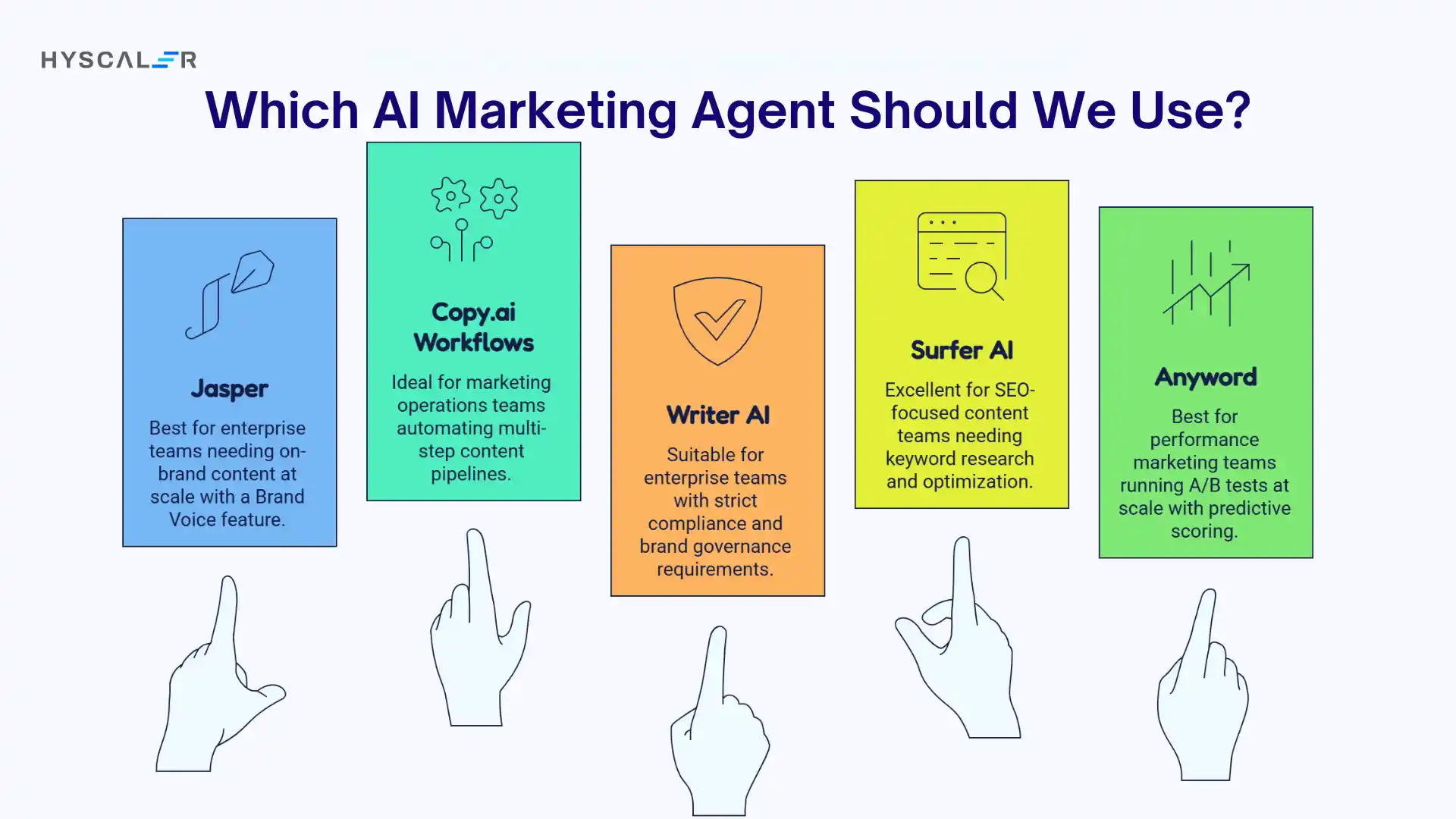
12. Jasper
Best for: Enterprise marketing teams needing on-brand content at scale
Jasper is an AI writing and content platform that operates within defined brand guidelines.
It can draft blog posts, ads, email campaigns, and social content, but its key differentiator is the Brand Voice feature, which keeps all output consistent with your company’s tone and messaging.
Enterprise teams use Jasper to dramatically accelerate content production without sacrificing quality standards.
13. Copy.ai Workflows
Best for: Marketing operations teams automating multi-step content pipelines
Copy.ai’s Workflows feature moves the product beyond single-prompt content generation into genuine agentic territory.
Teams can build automated pipelines to research a topic, draft content, optimize for SEO, and format for publishing that run without manual intervention.
It’s particularly popular for teams producing high volumes of product descriptions, ad variants, or localized content.
14. Writer AI
Best for: Enterprise teams with strict compliance and brand governance requirements
Writer is an enterprise-focused AI platform that emphasizes accuracy and control.
Its agents generate content while checking against your company’s style guide, terminology lists, and compliance rules. Industries like healthcare, finance, and legal have adopted Writer specifically because it reduces the risk of AI-generated content going off-policy.
15. Surfer AI
Best for: SEO-focused content teams
Surfer combines content creation with SEO analysis.
Its AI agent researches keyword opportunities, generates SEO-optimized drafts, and scores content against top-ranking competitors in real time.
For teams whose primary goal is organic traffic, Surfer’s closed-loop approach (write, optimize, publish, rank) makes it a go-to tool.
16. Anyword
Best for: Performance marketing teams running A/B tests at scale
Anyword uses predictive performance scoring to generate ad copy, landing page content, and email subject lines that are ranked by expected conversion rate before they go live.
Marketing teams use it to reduce the time spent testing variations manually, letting the AI pre-screen which copy is most likely to perform.
Software Development AI Agents
The developer tooling space has seen the most dramatic agentic AI transformation of any category.
Coding agents now go far beyond autocomplete; they can plan, implement, test, and deploy features autonomously.
17. GitHub Copilot Agent Mode
Best for: Software development teams already on GitHub
Copilot’s Agent Mode moves beyond line-by-line code suggestions to multi-file, multi-step task completion.
Developers can describe a feature in natural language, and Copilot will plan the implementation, write code across multiple files, run tests, and iterate on errors all within the IDE.
With GitHub’s enormous install base, this is likely the most widely used coding agent in the world right now.
18. Cursor
Best for: Developers who want the fastest AI-native coding experience
Cursor is an AI-first code editor that has rapidly become a favorite among developers building on modern stacks.
Its agent mode can read your entire codebase, understand architectural context, and implement changes across multiple files.
Developers report dramatic productivity gains on tasks like refactoring, debugging, and building new features from scratch.
19. Devin
Best for: Engineering teams looking to automate well-defined development tasks
Devin, built by Cognition AI, was one of the first AI agents to demonstrate the ability to complete full software engineering tasks end-to-end, writing code, running tests, debugging failures, and opening pull requests without human checkpoints.
It operates best on clearly scoped tasks with well-defined success criteria.
20. Cognition AI
Best for: Enterprise engineering teams needing autonomous development capabilities
Cognition’s platform goes beyond Devin’s individual agent to enterprise-grade deployment with better security controls, audit trails, and team management.
Organizations using it report measurable reductions in time-to-deploy for routine engineering tasks.
21. Replit Agent
Best for: Non-technical founders, small teams, and rapid prototyping
Replit’s AI agent builds fully functional web applications from natural language descriptions.
Users describe what they want, and the agent generates, runs, and iterates on working code in a cloud environment.
It has democratized software development for teams without dedicated engineering resources.
Operations & Productivity AI Agents
Enterprise productivity platforms have become AI-first products in 2026.
These agents help knowledge workers move faster, summarizing documents, drafting communications, managing projects, and coordinating workflows across teams.
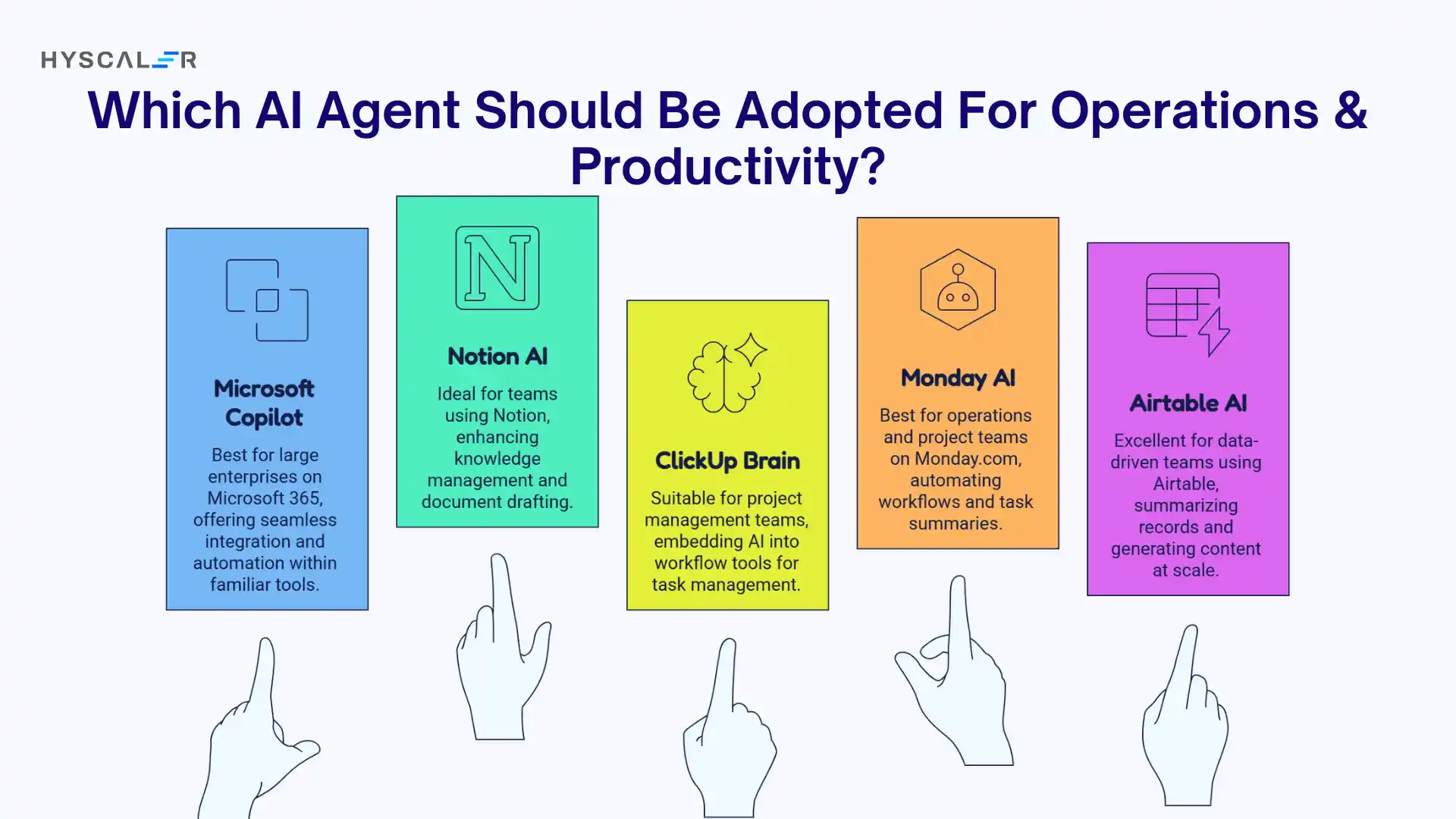
22. Microsoft Copilot
Best for: Large enterprises on Microsoft 365
Microsoft Copilot is now embedded across Word, Excel, PowerPoint, Outlook, Teams, and the entire M365 suite.
For enterprise organizations already standardized on Microsoft, it’s the most immediately accessible AI agent layer available.
Copilot drafts emails, summarizes meetings, generates presentations, analyzes data in spreadsheets, and automates repetitive tasks, all from within familiar tools.
23. Notion AI
Best for: Teams using Notion as their primary knowledge and project management tool
Notion AI can search, summarize, and synthesize information across your entire Notion workspace.
It drafts documents, answers questions from your company’s knowledge base, and auto-fills project templates.
For knowledge-intensive teams, it significantly reduces the time spent searching for and reformatting internal information.
24. ClickUp Brain
Best for: Project management teams wanting AI embedded in their workflow tool
ClickUp Brain is an AI layer built directly into ClickUp’s project management platform. It answers questions about tasks and projects, writes status updates, summarizes threads, and automates routine project management activities.
Teams use it to reduce the overhead of keeping projects documented and stakeholders informed.
25. Monday AI
Best for: Operations and project teams on Monday.com
Monday.com’s AI features help teams automate workflow creation, generate task summaries, update project statuses, and identify bottlenecks.
Its strength is making workflow automation accessible to non-technical operations managers who wouldn’t otherwise build automations from scratch.
26. Airtable AI
Best for: Data-driven teams using Airtable as a flexible operations database
Airtable AI embeds language models directly in tables and views, enabling teams to summarize records, categorize data, extract information from text fields, and generate content at scale.
It’s particularly useful for teams managing large content operations, product catalogs, or customer databases.
27. Larridin
Best for: Enterprises measuring AI adoption, usage, and business impact
Larridin helps organizations understand how AI is being adopted across teams, workflows, and business functions. It provides visibility into AI usage, spending, and workflow performance, helping leaders identify where AI is creating value and where adoption or investment needs attention.
Its workflow intelligence also helps businesses see how AI is changing the way work gets done, making it easier to identify automation opportunities and measure the impact of AI initiatives.
Ideal for: Businesses scaling AI adoption across multiple teams and workflows.
HR & Recruiting AI Agents
Recruiting and HR workflows have historically been time-intensive, making AI agents for HR increasingly valuable for sourcing candidates, screening applicants, scheduling interviews, and streamlining onboarding.
AI agents are now handling sourcing, screening, scheduling, and onboarding, compressing hiring timelines and improving candidate experience.
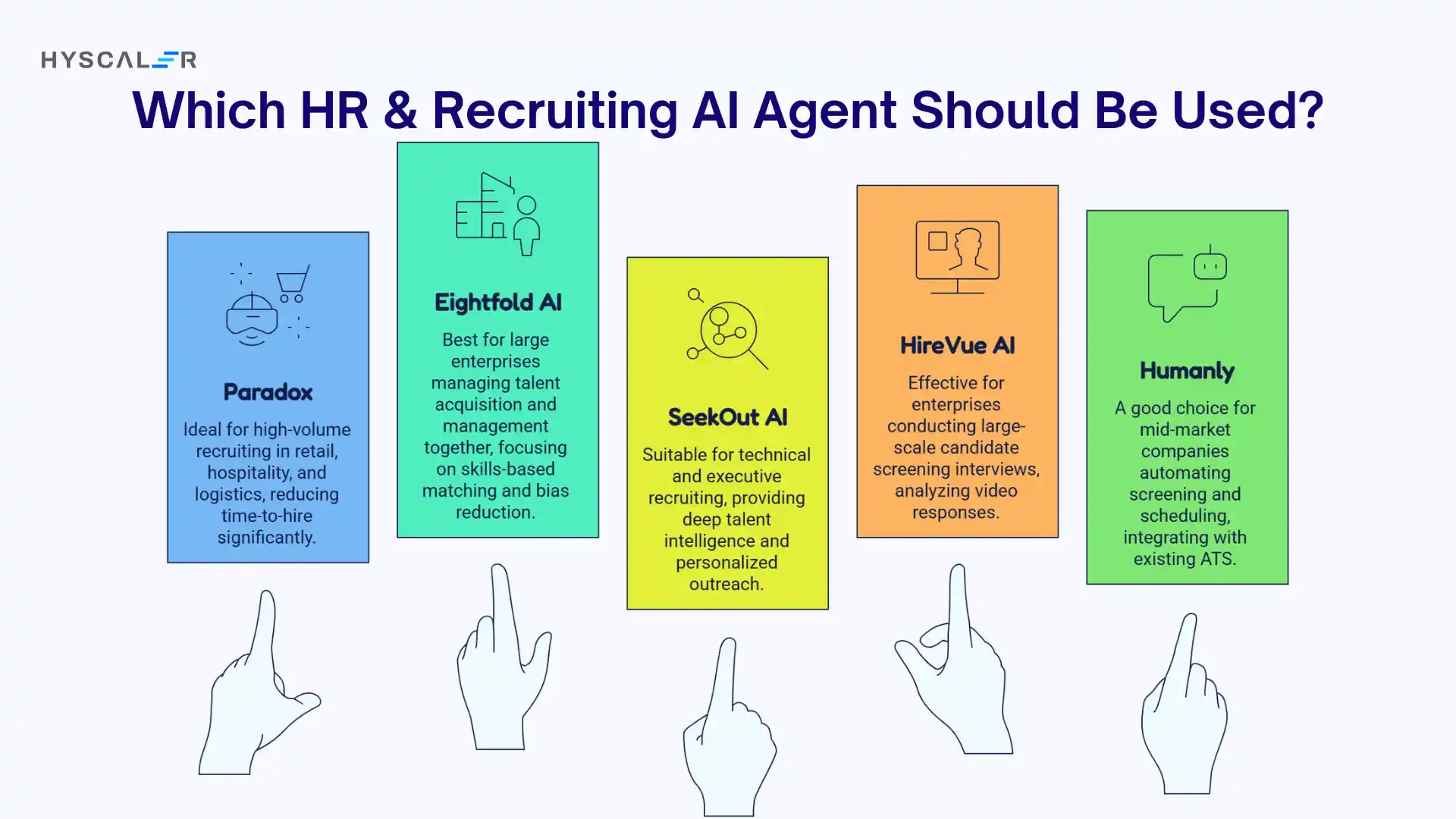
28. Paradox
Best for: High-volume recruiting in retail, hospitality, and logistics
Paradox’s AI recruiting assistant, Olivia, handles candidate conversations via text, screens applicants against job requirements, schedules interviews, sends reminders, and completes onboarding paperwork.
For companies hiring hundreds of frontline workers at a time, Paradox reduces time-to-hire from weeks to days.
29. Eightfold AI
Best for: Large enterprises managing talent acquisition and talent management together
Eightfold’s AI platform matches candidates to roles using skills-based matching rather than keyword-matching alone.
It identifies internal mobility opportunities, predicts candidate success, and helps organizations reduce bias in hiring.
Enterprise HR teams use it to connect recruiting, retention, and workforce planning in a single AI-powered layer.
30. SeekOut AI
Best for: Technical and executive recruiting requiring deep talent intelligence
SeekOut helps recruiters find and engage hard-to-find talent, including engineers, executives, and diverse candidates, using AI-powered search and outreach.
Its agents surface contact information, generate personalized outreach messages, and track engagement across recruiting pipelines.
31. HireVue AI
Best for: Enterprises conducting large-scale candidate screening interviews
HireVue uses AI to analyze candidate video interviews, evaluating responses and communication patterns against role-specific criteria.
Organizations use it to screen hundreds of candidates efficiently before routing top performers to live interviews with hiring managers.
32. Humanly
Best for: Mid-market companies looking to automate screening and scheduling
Humanly’s conversational AI handles initial candidate screening via chat, qualifying applicants based on job requirements and scheduling interviews automatically.
It integrates with major ATS platforms, making it easy to add AI-powered screening to existing workflows without replacing them.
Data & Analytics AI Agents
Every organization is sitting on data it can’t fully use.
These agents translate that data into answers, surfacing insights on demand without requiring SQL skills or analyst availability.
33. Glean
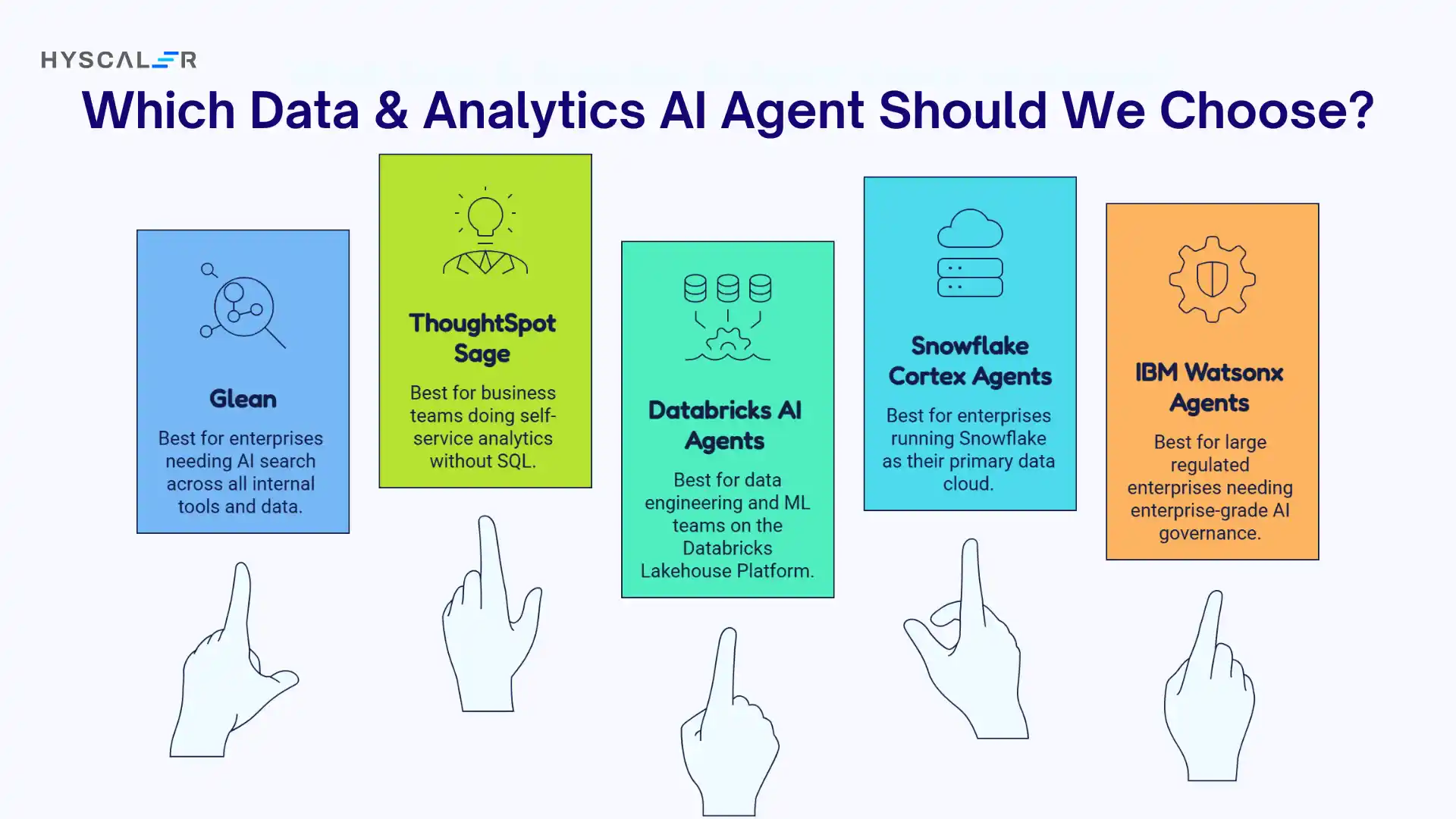
Best for: Enterprises needing AI search across all internal tools and data
Glean indexes your organization’s information across every connected app, Slack, Google Drive, Confluence, Jira, Salesforce, email, and more, and enables employees to find answers through natural language search.
It’s one of the most widely adopted enterprise AI tools for knowledge workers who spend significant time searching for internal information.
34. ThoughtSpot Sage
Best for: Business teams doing self-service analytics without SQL
ThoughtSpot Sage allows business users to ask data questions in plain English and receive chart and table answers in seconds, without writing SQL or waiting for a data analyst.
It connects to cloud data warehouses and makes analytics genuinely accessible to non-technical decision-makers.
35. Databricks AI Agents
Best for: Data engineering and ML teams on the Databricks Lakehouse Platform
Databricks’ agent framework lets data teams build AI agents that query, process, and analyze data at scale directly within their lakehouse environment.
For organizations with complex data pipelines, Databricks enables building custom agents that automate data validation, anomaly detection, and reporting workflows.
36. Snowflake Cortex Agents
Best for: Enterprises running Snowflake as their primary data cloud
Snowflake Cortex embeds LLM capabilities directly in the Snowflake data cloud, allowing teams to query structured and unstructured data through natural language.
Cortex Agents can search documents, databases, and external sources to answer complex enterprise data questions without moving data out of Snowflake’s secure environment.
37. IBM Watsonx Agents
Best for: Large regulated enterprises needing enterprise-grade AI governance
IBM WatsonX offers AI agent capabilities built with enterprise governance, explainability, and compliance controls at the core.
Organizations in banking, healthcare, and government deploy WatsonX agents for use cases like document processing, regulatory reporting, and operational workflow automation where auditability is non-negotiable.
Comparison: AI Agents at a Glance
| AI Agent | Category | Best For | Enterprise Ready |
|---|---|---|---|
| Intercom Fin | Customer Support | SaaS support automation | Yes |
| Zendesk AI Agent | Customer Support | Enterprise ticketing | Yes |
| Salesforce Agentforce | Customer Support / Sales | Salesforce-native orgs | Yes |
| Freshworks Freddy AI | Customer Support | SMB / mid-market | Yes |
| Ada | Customer Support | Multilingual enterprise support | Yes |
| Artisan AI | Sales | Outbound prospecting | Growing |
| 11x AI | Sales | High-volume B2B outbound | Yes |
| Regie.ai | Sales | Sales content workflows | Yes |
| Apollo AI | Sales | Prospecting + outreach | Yes |
| HubSpot AI | Sales / Marketing | SMB / mid-market CRM | Yes |
| Jasper | Marketing | Brand content at scale | Yes |
| Copy.ai Workflows | Marketing | Content pipelines | Yes |
| Writer AI | Marketing | Compliance-heavy content | Yes |
| Surfer AI | Marketing | SEO content | SMB–Enterprise |
| Anyword | Marketing | Performance ad copy | Yes |
| GitHub Copilot | Development | Code generation at scale | Yes |
| Cursor | Development | AI-native development | SMB–Enterprise |
| Devin | Development | Autonomous coding tasks | Growing |
| Cognition AI | Development | Enterprise dev automation | Yes |
| Replit Agent | Development | Rapid prototyping / no-code | SMB |
| Microsoft Copilot | Productivity | M365 enterprise orgs | Yes |
| Notion AI | Productivity | Knowledge management | SMB–Enterprise |
| ClickUp Brain | Productivity | Project management | Yes |
| Monday AI | Productivity | Operations teams | Yes |
| Airtable AI | Productivity | Data-driven ops teams | Yes |
| Paradox | HR | High-volume recruiting | Yes |
| Eightfold AI | HR | Enterprise talent management | Yes |
| SeekOut AI | HR | Technical / exec recruiting | Yes |
| HireVue AI | HR | Large-scale screening | Yes |
| Humanly | HR | Mid-market screening | Growing |
| Glean | Data / Analytics | Enterprise knowledge search | Yes |
| ThoughtSpot Sage | Data / Analytics | Self-service BI | Yes |
| Databricks AI Agents | Data / Analytics | ML/data engineering teams | Yes |
| Snowflake Cortex | Data / Analytics | Cloud data platforms | Yes |
| IBM watsonx | Data / Analytics | Regulated industries | Yes |
How to Choose the Right AI Agent for Your Business
With 35 options across six categories, the choice can feel overwhelming.
A few practical filters:
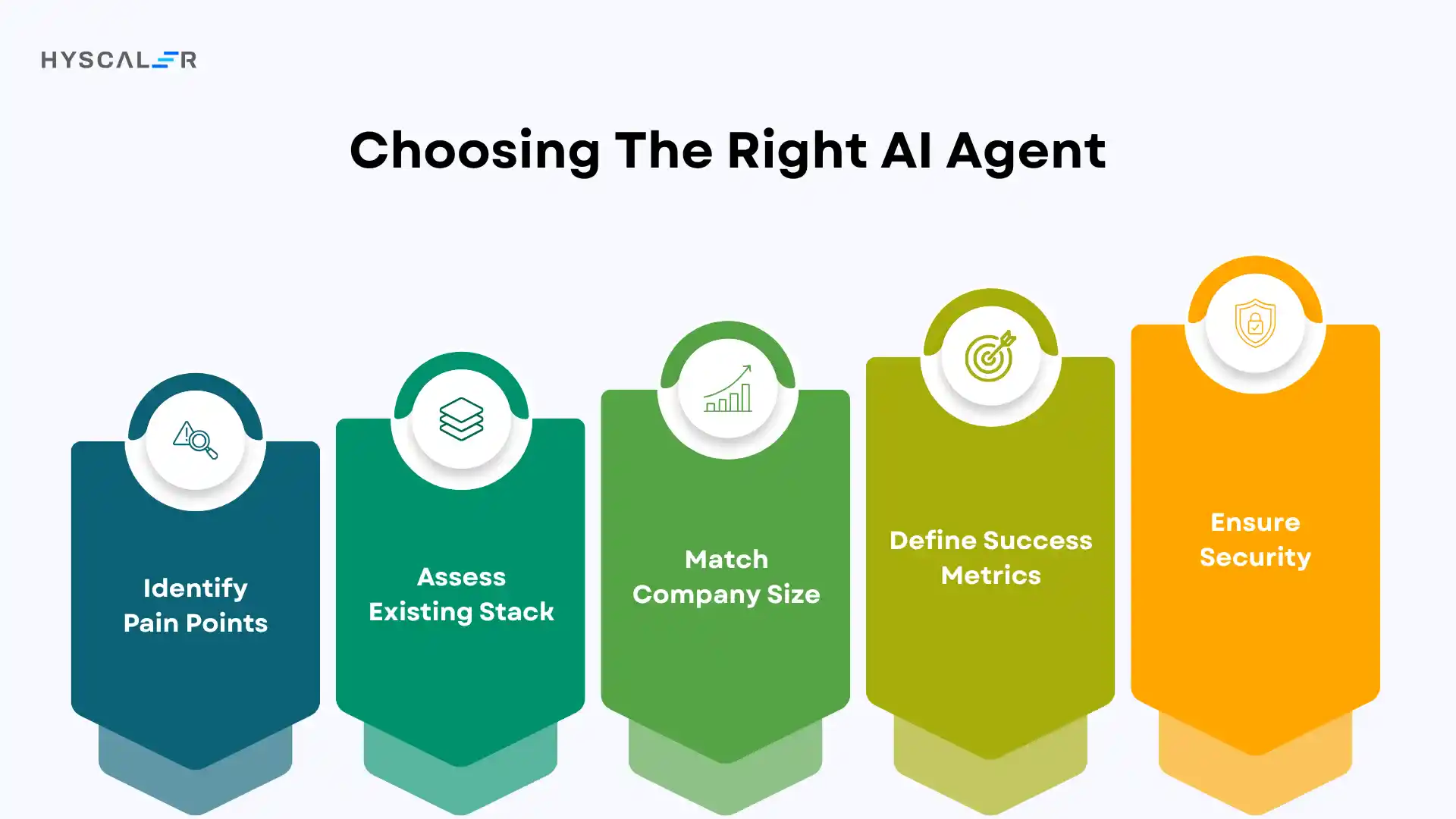
Start with your most painful workflow: The best AI agent is the one that solves a real, daily problem. Don’t adopt AI agents in categories where your current process already works well.
Consider your existing stack: If you’re on Salesforce, Agentforce is the fastest path. If you’re on Microsoft 365, Copilot is already available. Agents that integrate natively with your current tools will deliver value faster and create less disruption.
Match company size to product maturity: Enterprise-grade platforms like IBM WatsonX, Salesforce Agentforce, and Eightfold AI require implementation resources. SMB-friendly tools like Replit Agent, HubSpot AI, and Notion AI are designed for fast, self-serve deployment.
Define what “success” looks like before you start: Organizations that fail with AI agents usually fail because they are deployed without clear success metrics. Pick one use case, define the KPI it should move (resolution rate, time-to-hire, pipeline generated), and measure it from day one.
Think about security and governance: For regulated industries, agents that handle sensitive data need enterprise-grade access controls, audit trails, and compliance certifications. Tools like IBM WatsonX, Writer AI, and Snowflake Cortex are built with this in mind.
The Future of Agentic AI
Multi-agent orchestration is the next frontier. Rather than one agent handling a workflow, multiple specialized agents will collaborate, with a research agent passing insights to a writing agent, which hands output to a publishing agent. 22% of production enterprise deployments already coordinate three or more agents.
Vertical AI agents are gaining ground over horizontal ones. General-purpose agents are being supplemented by purpose-built agents for specific industries, such as legal document agents, clinical trial agents, and financial compliance agents trained on domain-specific data and designed to meet industry regulations.
The AI coworker model is emerging. Rather than deploying AI to replace roles, leading organizations are deploying AI agents as persistent digital coworkers with defined responsibilities, measurable KPIs, and human escalation protocols.
Agent orchestration platforms, tools that manage, monitor, and coordinate multiple agents across an organization, are becoming a distinct product category. Expect this to be one of the fastest-growing enterprise software segments through 2028.
Conclusion
The question is no longer whether AI agents work.
The question is where they deliver the fastest, clearest return for your organization and how to build the internal capability to deploy them responsibly.
The 35 agents covered in this guide represent the current state of practical enterprise adoption.
From customer support and outbound sales to software development and HR, the tools are mature, the use cases are proven, and the competitive pressure to adopt is real.
The gap between organizations that are experimenting and those that are scaling is still wide.
That gap is where the opportunity lives.
Start with one high-impact workflow.
Define success clearly.
Measure rigorously.
Then expand.
If you’re evaluating where to start or looking to build custom AI agents tailored to your specific business workflows, speak with a team that specializes in enterprise AI development.
The right architecture decisions made early will save significant time and cost later.
Looking to build a custom AI agent for your business? Explore Hyscaler’s AI Agent Development Services, Generative AI Development, and AI Workflow Automation capabilities.
FAQ
What are AI agents?
AI agents are autonomous software systems that perceive their environment, make decisions, and take actions to achieve a defined goal without step-by-step human instruction. Unlike chatbots, they can execute multi-step tasks across tools and systems.
How are AI agents different from chatbots?
Chatbots respond to prompts. AI agents act on goals. An agent can plan a sequence of steps, use tools like web browsers or APIs, check its own results, and loop back to improve all within a single task.
Which AI agents are best for small businesses?
HubSpot AI, Notion AI, Replit Agent, and Humanly are all strong SMB options. They’re designed for self-serve deployment, integrate with common tools, and don’t require a dedicated AI engineering team.
Are AI agents safe for enterprise use?
The leading enterprise platforms, Salesforce Agentforce, IBM WatsonX, Microsoft Copilot, Snowflake Cortex, are built with enterprise security, compliance, and governance controls. Human-in-the-loop oversight, access controls, and audit logging are standard in mature enterprise deployments.
How much do AI agents cost?
Pricing varies widely. Sales-focused agents like Artisan AI and 11x start at a few hundred dollars per month. Enterprise platforms like IBM WatsonX and Salesforce Agentforce are priced on enterprise contracts ranging from tens of thousands to millions annually, depending on scale.
What industries use AI agents the most?
Customer service, eCommerce, and software development lead adoption due to clear ROI and repeatable workflows. Financial services, healthcare, and HR are growing rapidly. Regulated sectors (government, pharma) are adopting more carefully, with a focus on governance.