
Table of Contents
The web security landscape going into 2027 has changed in seven ways that matter to anyone who builds software. Attackers now get in through unpatched software more often than stolen passwords. The software supply chain is a named top-three risk. AI writes insecure code nearly half the time. AI features are a new attack surface.
AI is also raising both the cost of a breach and the savings from good defense. European law now puts duties on the software maker. And today’s encryption has an end date.
This guide takes each shift from the report that measured it and ends on the one thing to change in how software gets built.
1. Why are attackers exploiting software instead of stealing passwords?
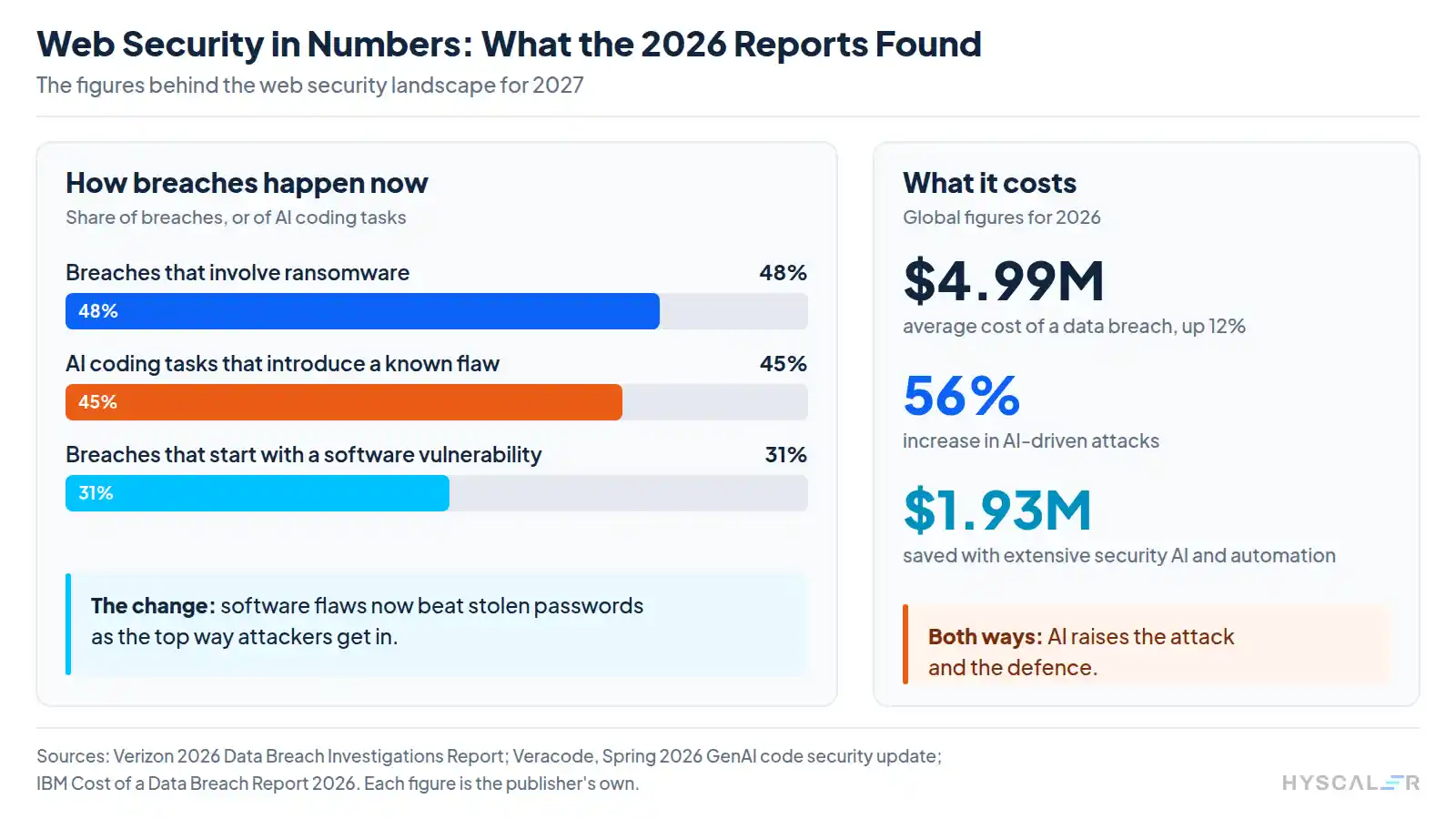
Because it now works more often. In Verizon’s 2026 Data Breach Investigations Report, 31% of breaches start with a software vulnerability, which Verizon says beats stolen passwords as the top way attackers get in. The same report finds that 48% of all breaches involve ransomware.
Europe’s data agrees. For its Threat Landscape 2026 report, ENISA analyzed 8,257 incidents and found vulnerability exploitation a prevalent route to unauthorized access, at 60.4%, with misconfiguration and accidental exposure at 20.7%.
What to change: treat patching as a delivery deadline, not a maintenance chore. Keep an inventory of every internet-facing system and its dependencies, and set a fixed number of days to apply a critical patch. Our guide to cloud security misconfigurations covers the second cause.
2. What does the OWASP Top 10:2025 change?
It moves the software supply chain into the top three. The OWASP Top 10:2025 lists these risks in order:
| Rank | Risk |
|---|---|
| A01 | Broken Access Control |
| A02 | Security Misconfiguration |
| A03 | Software Supply Chain Failures |
| A04 | Cryptographic Failures |
| A05 | Injection |
| A06 | Insecure Design |
| A07 | Authentication Failures |
| A08 | Software or Data Integrity Failures |
| A09 | Security Logging and Alerting Failures |
| A10 | Mishandling of Exceptional Conditions |
Two entries deserve attention. Software Supply Chain Failures, third, covers the libraries, build tools, and services your code depends on. Mishandling of Exceptional Conditions, tenth, covers what your software does when something goes wrong: errors that leak detail or failures that leave a system open.
What to change: know what is in your build. Generate a software bill of materials for every release, pin dependency versions, and review how each service fails, not only how it works.
3. How secure is AI-generated code?
About half of it is not. Veracode’s Spring 2026 GenAI code security update found that only 55% of AI code generation tasks result in secure code, which means that in 45% of cases the model introduces a known security flaw. Veracode notes that syntax correctness now exceeds 95% and that the security pass rate is virtually where it stood two years ago.
The risk is that the code looks right. It compiles, it passes a demonstration, and the flaw sits in the part nobody read. We cover the build-up of this risk in vibe coding security debt.
What to change: review AI-written code to the same standard as human-written code, and run security scanning on every change before it merges. Speed gained in writing must not be spent skipping review.
4. What new risks do AI features add to a web application?
They add a second list of risks beside the first. OWASP’s Top 10 for LLM Applications puts prompt injection first:
| Rank | Risk |
|---|---|
| LLM01 | Prompt Injection |
| LLM02 | Sensitive Information Disclosure |
| LLM03 | Supply Chain |
| LLM04 | Data and Model Poisoning |
| LLM05 | Improper Output Handling |
| LLM06 | Excessive Agency |
| LLM07 | System Prompt Leakage |
| LLM08 | Vector and Embedding Weaknesses |
| LLM09 | Misinformation |
| LLM10 | Unbounded Consumption |
Three of these change how a feature is designed. Prompt injection means any text the model reads, including a web page or an uploaded file, can try to redirect it. Excessive agency means an agent that can act, such as issuing a refund, will sometimes act wrongly. Unbounded consumption means a feature with no usage limit can be run up into a large bill.
What to change: give an AI feature the least access that does the job, require human approval for actions that move money or data, treat model output as untrusted input to the next system, and set usage limits. Our zero trust AI framework goes deeper.
5. How is AI changing the cost of a breach?
It is raising both the attack and the defense. IBM’s Cost of a Data Breach Report 2026 puts the global average cost of a breach at $4.99 million, a 12% increase over last year and a record high. The report records a 56% increase in AI-driven attacks, led by deepfake impersonation and AI-enabled malware.
The same IBM report shows the other side: organizations with extensive use of AI and automation in security saved $1.93 million per breach compared with those using none. Verizon’s report adds that 15 different attack techniques are now being strengthened by generative AI.
What to change: automate detection and response where you can, and train staff to verify requests for money or access through a second channel, because a voice or a video is no longer proof of who is asking.
6. What does the EU Cyber Resilience Act require of software makers?
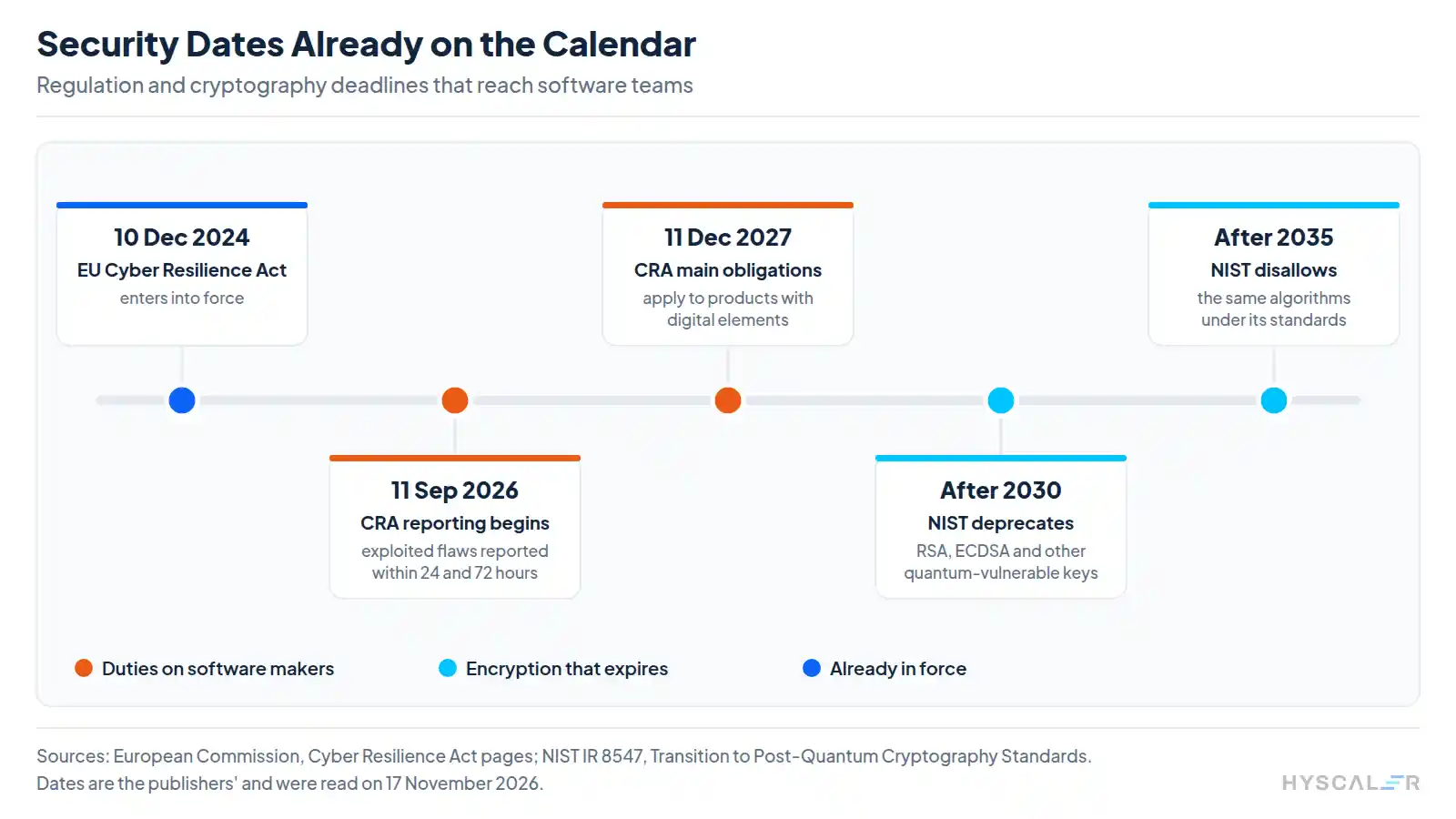
It makes the maker of a product with digital elements responsible for its security, and it has started. According to the European Commission, the Act entered into force on 10 December 2024, reporting obligations apply from 11 September 2026, and the main obligations apply from 11 December 2027.
The reporting rules are specific. A manufacturer must report an actively exploited vulnerability or a severe incident with:
- an early warning within 24 hours of becoming aware,
- a full notification within 72 hours,
- a final report no later than 14 days after a corrective measure is available for an actively exploited vulnerability.
If you sell software or connected products into the EU, this applies to you wherever you are based.
What to change: decide now who would send that 24-hour warning and how you would know a vulnerability in your product is being exploited. Both need a process before the day they are needed.
7. When does today’s encryption stop being acceptable?
After 2030, it is deprecated, and after 2035, it is disallowed, under United States federal standards. NIST’s IR 8547, Transition to Post-Quantum Cryptography Standards, published in October 2026, says NIST will deprecate quantum-vulnerable public-key cryptography after 2030 and disallow its use under NIST standards and guidelines after 2035. The algorithms named include RSA, ECDSA, and EdDSA, which protect most web traffic and software signing today.
The reason to act early is data with a long life. Information encrypted today can be stored and decrypted later, once quantum computers are capable. Health, financial, and legal records all outlive 2035.
What to change: make a list of where your systems use public-key cryptography, and design new systems so the algorithm can be changed without a rewrite. That property is called crypto-agility.
What does the web security landscape mean for a software team in 2027?
One practice answers each shift.
| Shift | Build practice | Who owns it |
|---|---|---|
| Software flaws are the top way in | Patch deadlines and an inventory of internet-facing systems | Engineering lead |
| Supply chain in the OWASP top three | Software bill of materials and pinned dependencies | Build and release |
| AI code is insecure 45% of the time. | Same review and scanning for AI-written code | Every developer |
| AI features are an attack surface. | Least access, human approval, usage limits | Product and architecture |
| AI raises breach cost and defense. | Automated detection, second-channel verification | Security and operations |
| EU duties on software makers | A named owner for 24-hour reporting | Leadership |
| Encryption with an end date | A cryptography inventory and crypto-agile design | Architecture |
What should you ask whoever builds your software?
Ask ten questions. A team that builds securely answers them without preparation.
- How quickly do you apply a critical security patch, and how do you track it?
- Can you give me a software bill of materials for what you deliver?
- How do you review code written with AI assistants?
- Which security scans run on every change, and what blocks a release?
- How do you test access control, the first risk on the OWASP list?
- What can the AI features in my product do without a person approving it?
- Where do secrets and keys live, and who can read them?
- How would you know if my product were being attacked, and how fast would you tell me?
- Which cryptographic algorithms does my system use, and how hard are they to change?
- Who is responsible for security after launch?
FAQ
What is the biggest web security threat going into 2027?
Exploitation of unpatched software. Verizon’s 2026 report finds that 31% of breaches start with a software vulnerability, ahead of stolen passwords.
Is the OWASP Top 10 updated for 2025?
Yes. The OWASP Top 10:2025 places Broken Access Control first, Security Misconfiguration second, and Software Supply Chain Failures third, and adds Mishandling of Exceptional Conditions in tenth place.
Is AI-generated code safe to ship?
Only after review and scanning. Veracode’s 2026 testing found that 45% of AI code generation tasks introduce a known security flaw.
Does the EU Cyber Resilience Act apply to companies outside the EU?
It applies to products with digital elements placed on the EU market, so a company based elsewhere that sells into the EU is covered. Reporting duties began on 11 September 2026, and the main obligations apply from 11 December 2027, according to the European Commission.
When will RSA encryption be phased out?
Under NIST’s transition plan, quantum-vulnerable algorithms, including RSA, are deprecated after 2030 and disallowed under NIST standards after 2035.
Sources
- Verizon, 2026 Data Breach Investigations Report
- OWASP, Top 10:2025 and Top 10 for LLM Applications
- Veracode, Spring 2026 GenAI code security update
- IBM, Cost of a Data Breach Report 2026
- European Commission, Cyber Resilience Act and reporting obligations
- ENISA, Threat Landscape 2026
- NIST, IR 8547, Transition to Post-Quantum Cryptography Standards, October 2026
How HyScaler builds with these practices
HyScaler builds software, and we build it with these practices. We are not a security vendor.
- Security in delivery: our DevOps security measures put scanning and patching into the release pipeline.
- Testing before release: rigorous testing and QA cover access control and failure handling.
- Data rules built in: governance and compliance for the data your systems hold.
- AI features built carefully: our AI services team designs agents with least access and human approval.
Bring the ten questions to a call with us. Talk to our team.