
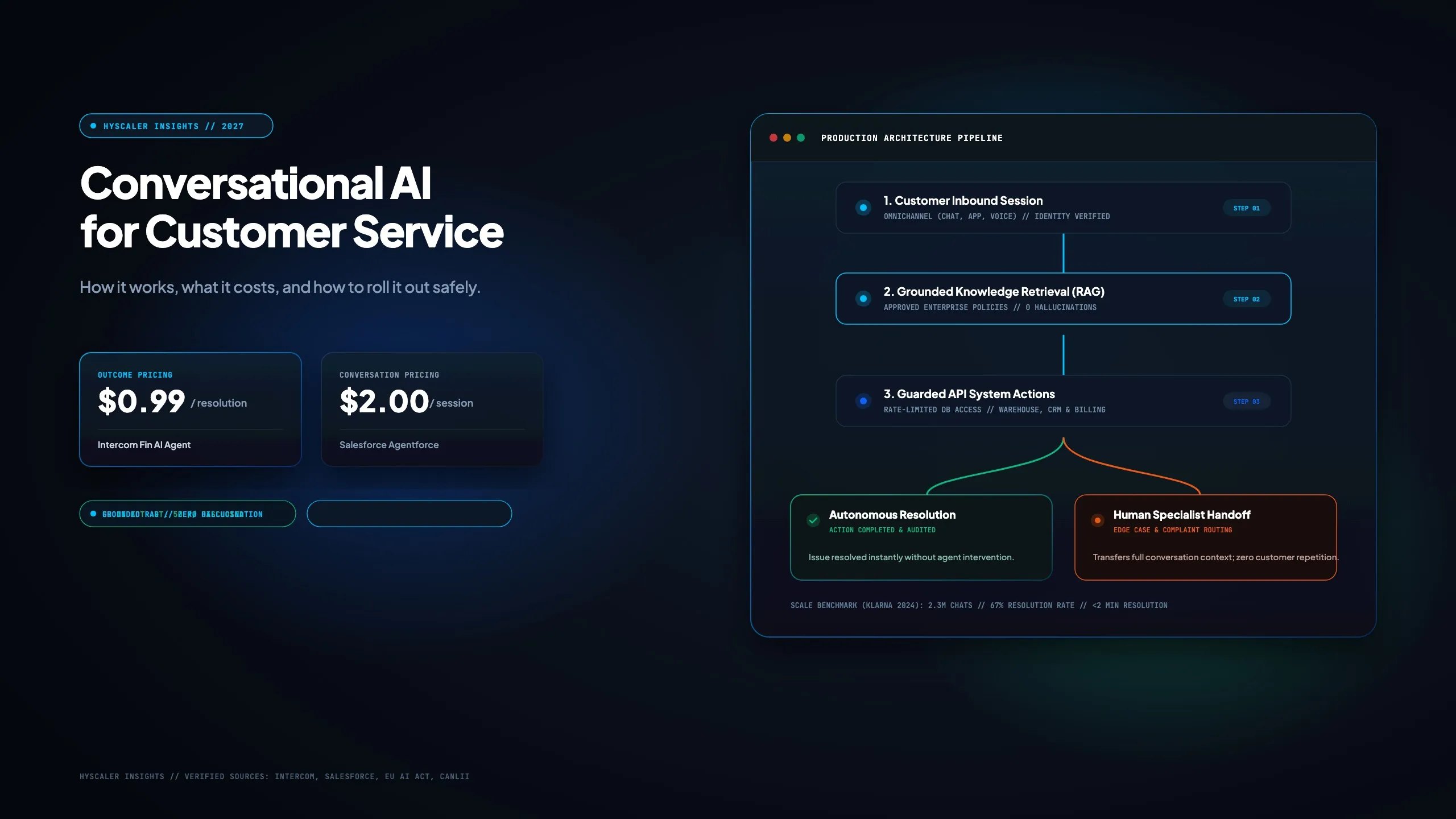
If your customer support inbox receives ten thousand repetitive messages a month, paying agents to type out the same return policy or copy-paste tracking links burns cash. Conversational AI for customer service changes that dynamic by letting natural language models parse customer questions, query your backend APIs, and complete account updates or refunds directly without a human touching the ticket.
Unlike scripted chatbots that crumble the second a customer uses a phrasing outside their decision tree, modern conversational AI for customer service interprets intent in messy, unedited human language. It checks what is actually possible in your systems, composes a context-aware answer grounded strictly in your documentation, and loops in a human agent only when the problem requires real human discretion.
Table of Contents
What is conversational AI for customer service?
Conversational AI for customer service is software that conducts autonomous, two-way interactions across web chat, mobile apps, email, or voice channels to resolve inquiries using your verified company records. It handles the entire pre-sales and post-sales spectrum, from explaining pricing tiers and booking onboarding calls to issuing warranty refunds.
| Capability | Scripted Chatbot | Conversational AI |
|---|---|---|
| Understanding | Rigid pattern matching against hardcoded keywords | Semantic intent recognition across unedited speech and text |
| Answer generation | Static, pre-written canned responses | Contextual answers dynamically assembled from verified documents |
| System actions | Sends links to external forms or triggers basic triage tags | Executes live database calls to check stock, modify orders, or process payments |
| Edge cases | Loops unhelpfully or drops the customer cold | Transmits complete session history and user intent to a live agent |
Traditional bots were fundamentally interactive phone trees pasted into a chat window. If an angry shopper misspelled their account number or asked two related questions in one message, the bot broke. Modern conversational AI for customer service treats conversation as a fluid dialogue, maintaining memory across turns and validating identity before changing records in your warehouse or billing stack.
How does conversational AI for customer service work?
Behind the scenes, the system connects a frontier large language model to your internal databases using retrieval-augmented generation.
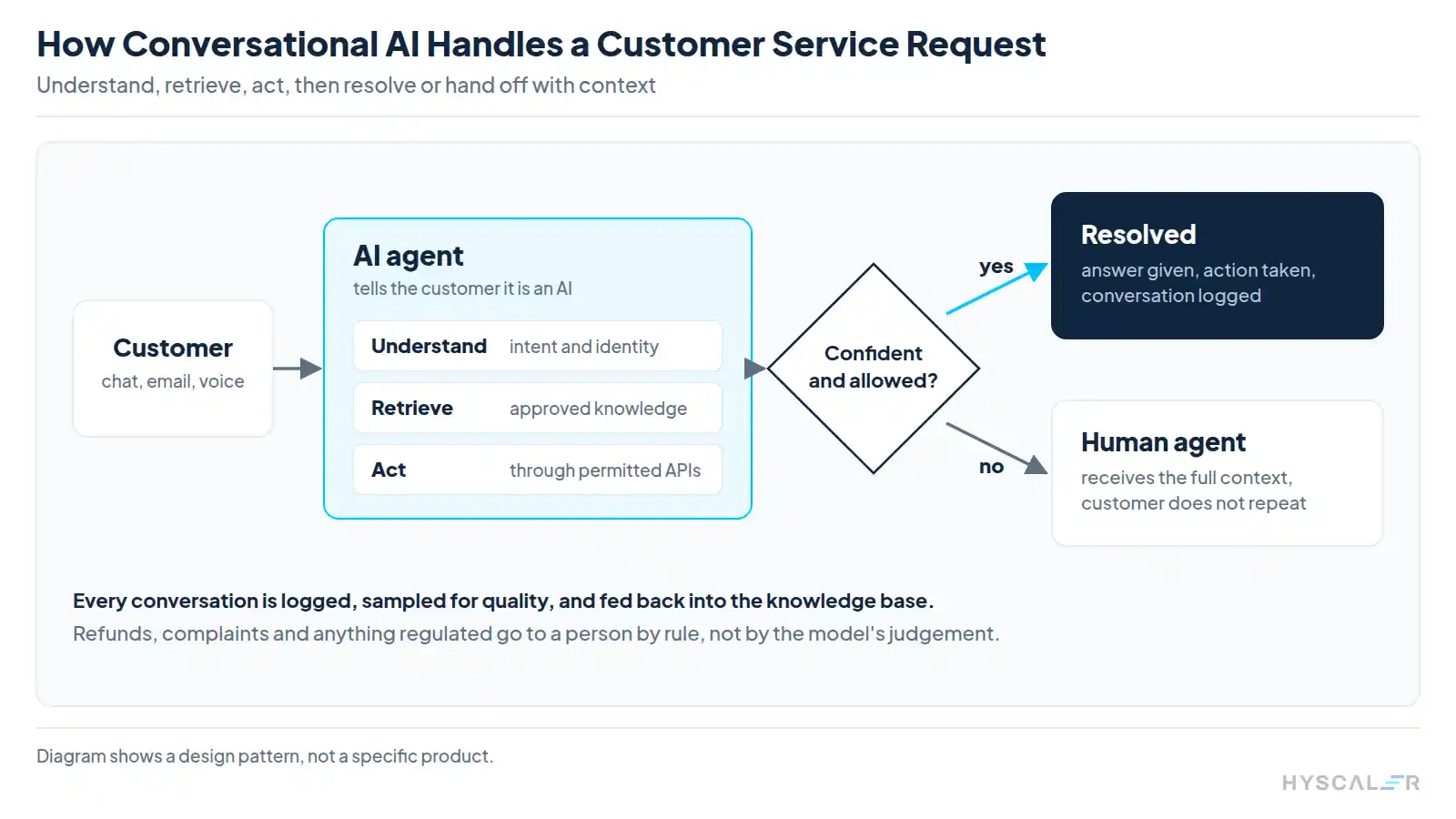
First, the system interprets what the customer actually wants. The language model analyzes the incoming message to identify intent, extracts key variables like an order number or flight date, and validates whether the user has completed authentication.
Next comes grounded retrieval. Instead of letting the AI guess based on general internet training data, the application queries your internal knowledge repositories. It scans your product catalogs, return policies, and help articles, assembling only the exact, verified snippets relevant to that specific request into its prompt context.
Third, the agent performs authorized actions. Equipped with guarded API connectors, the model triggers permitted functions inside your CRM, billing gateway, or inventory management software. It can look up a delayed parcel in your warehouse database, update a delivery address, or issue a credit up to an approved dollar threshold.
Finally, the system finishes the transaction or escalates. When the system executes the requested action within predefined confidence limits, it confirms resolution with the customer. The second an anomaly appears, such as an ambiguous fraud alert or a customer expressing extreme frustration, it hands the entire chat transcript over to a person so the customer never has to repeat themselves.
Operational reliability requires hard programmatic boundaries. Never let an AI model decide whether an issue is severe enough to warrant human intervention. Hardcode programmatic triggers for chargebacks, formal legal complaints, and sensitive account security resets.
What results can you expect?
Actual efficiency gains depend entirely on your ticket distribution and the accuracy of your source documentation. If eighty percent of your inquiries involve deeply subjective technical debugging or complex contract negotiation, automation rates will stay modest. For high-volume transactional queries, the impact can be dramatic.
In February 2024, Swedish fintech firm Klarna released performance metrics for the first month of operating its consumer AI assistant, based on Klarna’s own announcement:
- Handled 2.3 million conversations in four weeks, representing two-thirds of the company’s global customer service chat volume.
- Performed the equivalent workload of roughly 700 full-time customer service agents.
- Reduced average resolution time from 11 minutes down to under 2 minutes.
- Cut repeat inquiries by 25 percent while maintaining customer satisfaction scores matching human agents.
- Deployed across 23 global markets in more than 35 languages.
These figures reflect a highly specific, digital-first retail banking environment handling repetitive inquiries like card balances and payment deferrals. Treat these as self-reported early results from an optimized rollout, not a universal guarantee. Establish your own team’s baseline first: calculate your existing cost per contact, average resolution time, and root causes for repeat tickets before projecting returns.
How much does conversational AI for customer service cost?
Software vendors sell conversational AI for customer service using three distinct pricing units: per resolved outcome, per conversation, or per seat. The pricing metric you choose will influence your operating budget far more than the headline software license.
| Platform and Agent | Pricing Model | Published List Price | Source Reference |
|---|---|---|---|
| Intercom, Fin AI Agent | Per resolved outcome | $0.99 per resolution | Intercom pricing |
| Salesforce, Agentforce | Per conversation | $2.00 per conversation | Agentforce pricing |
| Salesforce, Agentforce | Per consumption credit | $500 per 100,000 Flex Credits | Agentforce pricing |
Intercom bills for an outcome only when a user explicitly marks a query as resolved, abandons the chat after receiving the answer without requesting further assistance, or when the agent completes a specific automated workflow. Salesforce bills its two-dollar conversation fee whenever an Agentforce agent participates in a customer interaction.
A worked monthly cost comparison
Consider a support department managing 10,000 customer sessions every month, assuming the automated system resolves 50 percent of the traffic and escalates the remainder to human staff.
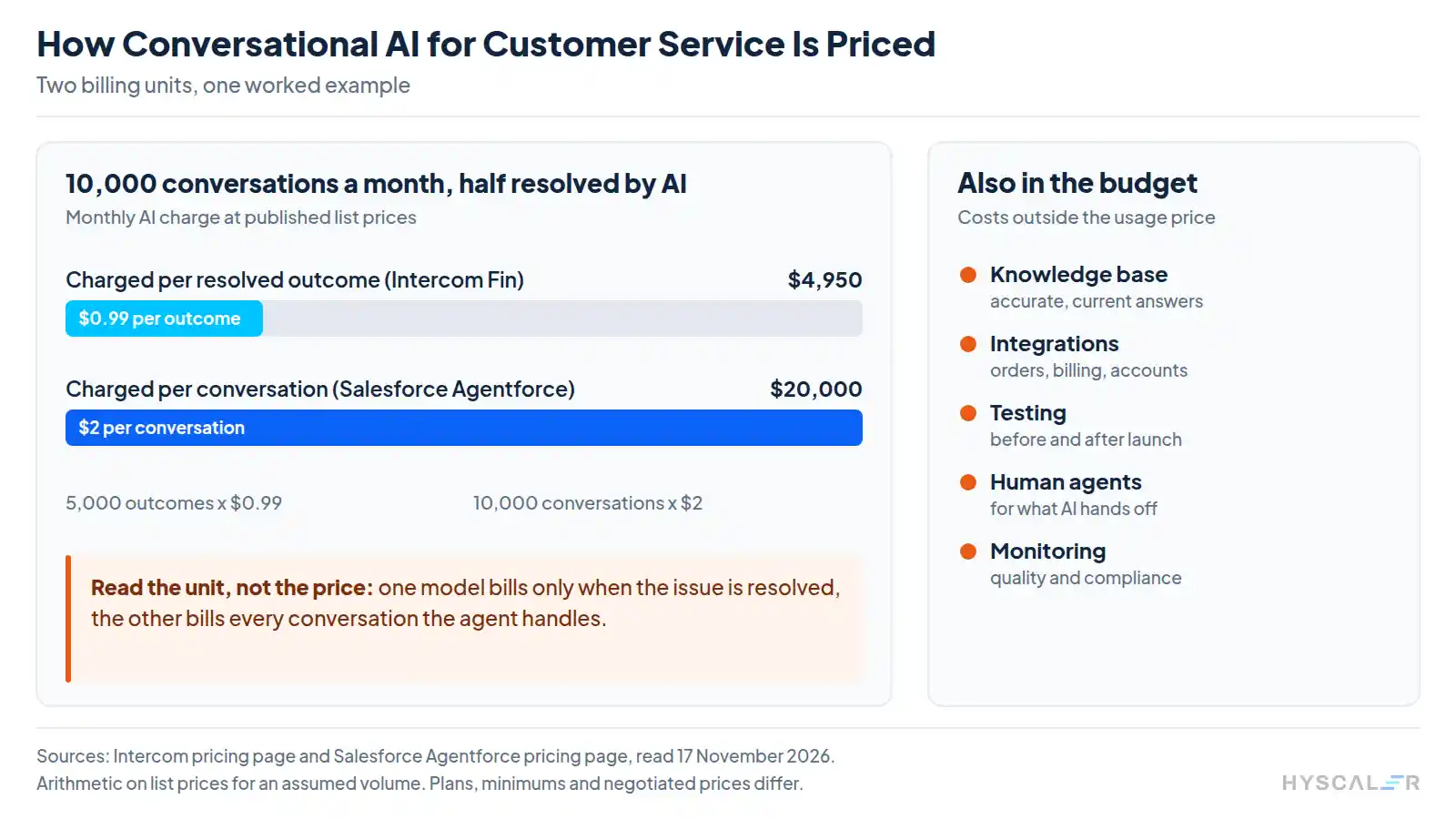
- At Intercom’s list price of $0.99 per outcome, the 5,000 resolved tickets incur usage charges of $4,950. The 5,000 escalated sessions trigger no automation fee.
- Under the flat $2 per conversation model quoted by Salesforce, all 10,000 sessions cost money, bringing the monthly platform bill to $20,000 regardless of how many cases were successfully resolved without human staff.
This math demonstrates why evaluating usage models against your historical deflection rate is crucial. Enterprise volume discounts, bundled tiers, and baseline seat licenses change real-world totals, but the underlying rule holds true: always evaluate software proposals against your exact ratio of simple lookups to escalated complaints.
What expenses exist outside the software license?
Your platform invoice is often the smallest part of the total investment. Deploying production-ready conversational AI for customer service requires substantial engineering and governance work that sits completely outside your vendor subscription.
First, your internal knowledge base must undergo ruthless auditing. If your documentation contains contradictory cancellation windows or outdated holiday shipping deadlines, the AI will confidently recite those errors to angry customers. Someone has to review, rewrite, and take ongoing editorial ownership of your source documents.
Second, building reliable integrations into your core inventory, CRM, and payment processing backends requires custom engineering. The agent cannot check shipping details or apply credits unless your developers establish authenticated, rate-limited APIs with strict write permissions.
Finally, factor in operational monitoring. You will need supervisors sampling transcripts weekly to catch hallucinations, alongside human support staff ready to step in when complex escalations occur.
What are the legal and compliance risks?
Deploying customer-facing automation introduces distinct legal liabilities that marketing teams routinely overlook.
Transparency is now a statutory requirement in major jurisdictions. Under Article 50 of the EU AI Act, businesses deploying AI systems that interact directly with individuals must design their applications so users are clearly informed they are communicating with an automated system. This rule takes effect on 2 August 2026. If your web portal or customer application interacts with users located within the European Union, disguising an AI agent as a human representative creates direct regulatory liability.
You are also legally responsible for promises made by your automated systems. In 2024, the Civil Resolution Tribunal of British Columbia addressed this directly in Moffatt v. Air Canada. A customer purchased tickets relying on false bereavement travel discount terms provided by Air Canada’s website chatbot. The airline argued the chatbot was a separate legal entity responsible for its own actions, but the tribunal rejected that claim, ruling that companies owe a duty of care to ensure all information hosted on their digital platforms is accurate. The tribunal ordered the airline to pay damages. If your customer service AI quotes an unapproved price or misrepresents an exchange policy, you will have to honor it.
Data governance requires clear storage and processing guardrails. Customer messages frequently contain credit card fragments, health information, and home addresses. You must confirm where conversation transcripts are stored, set automated retention and deletion schedules, and ensure your third-party AI vendors do not use your proprietary customer transcripts to train their foundational models.
How do you roll out conversational AI for customer service?
Successful engineering teams implement conversational AI for customer service incrementally, avoiding the temptation to automate the entire support queue at once.
- Calculate the baseline. Quantify total ticket volume grouped by topic, current mean time to resolution, direct cost per contact, and customer satisfaction scores.
- Select high-volume, low-risk test workflows. Start with deterministic requests that have objective answers, such as checking parcel transit status, initiating password resets, verifying store hours, or generating invoices.
- Audit and consolidate knowledge sources. Remove deprecated help docs, resolve contradictions, and assign a single internal owner to approve every answer in the knowledge repository.
- Connect APIs with restricted permissions. Grant the agent read-only access to order records initially, verifying stability before unlocking low-risk write operations like address changes.
- Launch quietly to a small percentage of incoming volume. Deploy the agent to ten percent of inbound web chat traffic, ensuring a one-click button to speak with a human is visible at all times, and conduct daily manual transcript audits.
- Expand systematically across new departments. Add additional inquiry categories only when existing automated topics maintain your target satisfaction and deflection benchmarks.
If you are evaluating automated support for internal corporate staff rather than external consumers, review our deep dive on AI chatbots for IT support automation.
Should you buy an off-the-shelf platform or build custom?
Purchasing a turnkey SaaS platform makes sense when your company uses standard applications like Zendesk or Shopify that come with pre-built vendor connectors, and when your customer workflows follow predictable paths.
Building a custom agent infrastructure becomes necessary when your support operations rely on legacy on-premise databases, when strict data privacy rules prevent transmitting customer records to multitenant cloud software, or when high query volume makes per-conversation vendor fees prohibitively expensive.
Most large enterprises adopt a hybrid approach: they use standard commercial software for front-end web chat distribution while contracting specialized engineers to build custom retrieval pipelines and middleware connectors behind it. Our practical overview of AI chatbots and virtual assistants covers the architectural tradeoffs between these implementation models.
How HyScaler can help with conversational AI for customer service
We build conversational agents that connect securely to your proprietary enterprise data and internal software systems.
Our engineering teams build tailored implementations across your entire communication stack:
- Autonomous agents and virtual assistants: our conversational AI and virtual assistants practice develops chat and voice automation with transparent human escalation pathways.
- Grounded enterprise retrieval: custom retrieval-augmented generation solutions ensure responses reflect only your approved documentation and business rules.
- System integrations and workflows: robust AI-powered automation connects front-end conversational interfaces directly to your billing, ERP, and customer databases.
- Omnichannel user journeys: comprehensive customer experience engineering unifies conversational interfaces across your mobile, web, and internal help desk touchpoints.
Share your monthly support volume and your top five ticket categories with us, and we will model where automation yields real ROI. Talk to our AI team.
Frequently asked questions
What is the difference between a chatbot and conversational AI?
A traditional chatbot follows rigid, pre-programmed decision trees and matches specific keywords to canned scripts. Conversational AI uses natural language understanding and dynamic retrieval to comprehend unstructured user inputs, query private company data sources in real time, execute backend system actions, and route conversations to human specialists when exceptions occur.
Does conversational AI replace human customer service agents?
No. Automated agents handle repetitive, mechanical inquiries such as order lookups, billing receipts, and basic policy explanations. This offloads transactional volume so human support specialists can concentrate on emotionally sensitive escalations, complex dispute resolutions, and high-value customer retention issues.
Is conversational AI or live chat better for customer service?
A modern support operation requires both channels working together. Conversational AI delivers instant, round-the-clock responses to routine inquiries across all time zones. Live human chat provides the empathy, creative problem-solving, and authority needed for edge cases. High-performing systems let automated agents hand off unresolved sessions to live staff with complete conversation transcripts attached.
How is conversational AI for customer service priced?
Vendors bill using per-resolution fees, per-conversation charges, consumption-based API credits, or recurring software seat licenses. On 17 November 2026, Intercom listed its Fin AI agent at $0.99 per successful resolution, while Salesforce published Agentforce list pricing at $2.00 per active conversation.
Are businesses legally required to disclose AI customer service agents?
In the European Union, disclosure is mandatory. Article 50 of the EU AI Act specifies that providers and deployers must design systems so individuals are informed when they are interacting directly with an artificial intelligence system, with the requirement taking effect from 2 August 2026. Explicit disclosure is also considered standard commercial practice globally to build consumer trust.
How long does it take to implement conversational AI?
A targeted implementation covering three to five standard inquiry types can launch in four to six weeks if your underlying documentation is accurate and current. Broad enterprise deployments involving complex ERP integrations, multilingual support, and strict compliance signoffs typically require three to five months.
Sources
- Klarna, Klarna AI assistant handles two-thirds of customer service chats in its first month, 27 February 2024
- Intercom, pricing, verified 17 November 2026
- Salesforce, Agentforce pricing, verified 17 November 2026
- European Parliament and Council of the European Union, EU Artificial Intelligence Act, Article 50: transparency obligations
- Civil Resolution Tribunal of British Columbia, Moffatt v. Air Canada, 2024 BCCRT 149