

Table of Contents
An AI trading app uses artificial intelligence, machine learning, NLP, and reinforcement learning to analyze market data, identify trading opportunities, and execute buy/sell orders automatically. These tools replace manual chart-reading and gut-feel decisions with adaptive algorithms that learn from every trade, and they now power between 60–89% of global equity trading volume.
Is it legit? Yes. AI trading is fully legal and regulated in the US (SEC/CFTC), UK (FCA), EU (MiFID II), and India (SEBI). The technology is the same engine institutional desks have used for decades; the 2026 difference is that retail investors now have access through platforms starting at $0/month.
Here is a quick comparison of the top-rated platforms. A detailed review of each follows below.
| Platform | Best For | Starting Price | Assets | Risk Control |
|---|---|---|---|---|
| Trade Ideas | Day Trading | $89/mo (Annually) | Stocks, ETFs, Crypto | SmartStop auto stop-loss |
| TrendSpider | Swing Trading | $107/mo | Stocks, Forex, Crypto | Auto trendline alerts |
| SaintQuant | No-Code Algo | $49/mo | Stocks, Forex, Crypto | Backtest validation |
| TradeStation | Developer/Quant | Free (w/ $10k) | Stocks, Options, Futures | Custom risk via API |
| 3Commas | Crypto Bots | $22/mo | Crypto | DCA + trailing stop-loss |
| Pionex | Free Crypto Bots | Free (0.05% fee) | Crypto | Grid bot risk limits |
| Tickeron | Options + Patterns | $30/mo | Stocks, Forex, Crypto | Virtual agents + hedging |
| Public.com | Hands-Off Intent | Free (brokerage) | Stocks, Options, Crypto | Non-custodial native |
| AlgosOne | Fully Managed | Commission-based | Crypto, Forex, Stocks | Reserve fund hedge |
| Danelfin | Stock Research | Free–$107/mo | Stocks, ETFs | N/A (research only) |
This guide provides a complete framework for evaluating and selecting the right AI trading platform for your needs in 2026. We cover how the technology works, whether it’s safe, the top platforms ranked, and specialized picks by trading style, budget, and experience level.
Our Methodology: We evaluated 25+ AI trading platforms across 8 criteria: AI model sophistication, cost structure, regulatory compliance, user experience, asset coverage, backtesting capabilities, exchange integrations, and support quality. Testing was conducted between January and May 2026 using live paper trading accounts and documented backtests.
What Is AI Trading and How Does It Work?
AI trading is the use of artificial intelligence and machine learning to analyze market data, identify trading opportunities, and automatically execute buy/sell orders, replacing manual analysis with adaptive, self-learning algorithms. Unlike older rule-based systems, modern AI trading agents refine their strategies based on real-time market feedback, learning from every trade.
By 2026, AI-driven algorithms will facilitate the vast majority of global equity trading volume, transforming what was once a niche institutional tool into a market cornerstone.
Synonyms: AI trading is frequently referred to as algorithmic trading (algo-trading), automated trading, or quant trading (quantitative trading). While these terms overlap, 2026-era AI trading is distinguished by being adaptive, learning from mistakes and adjusting to new market conditions rather than relying on static, rule-based instructions.
How AI Trading Works
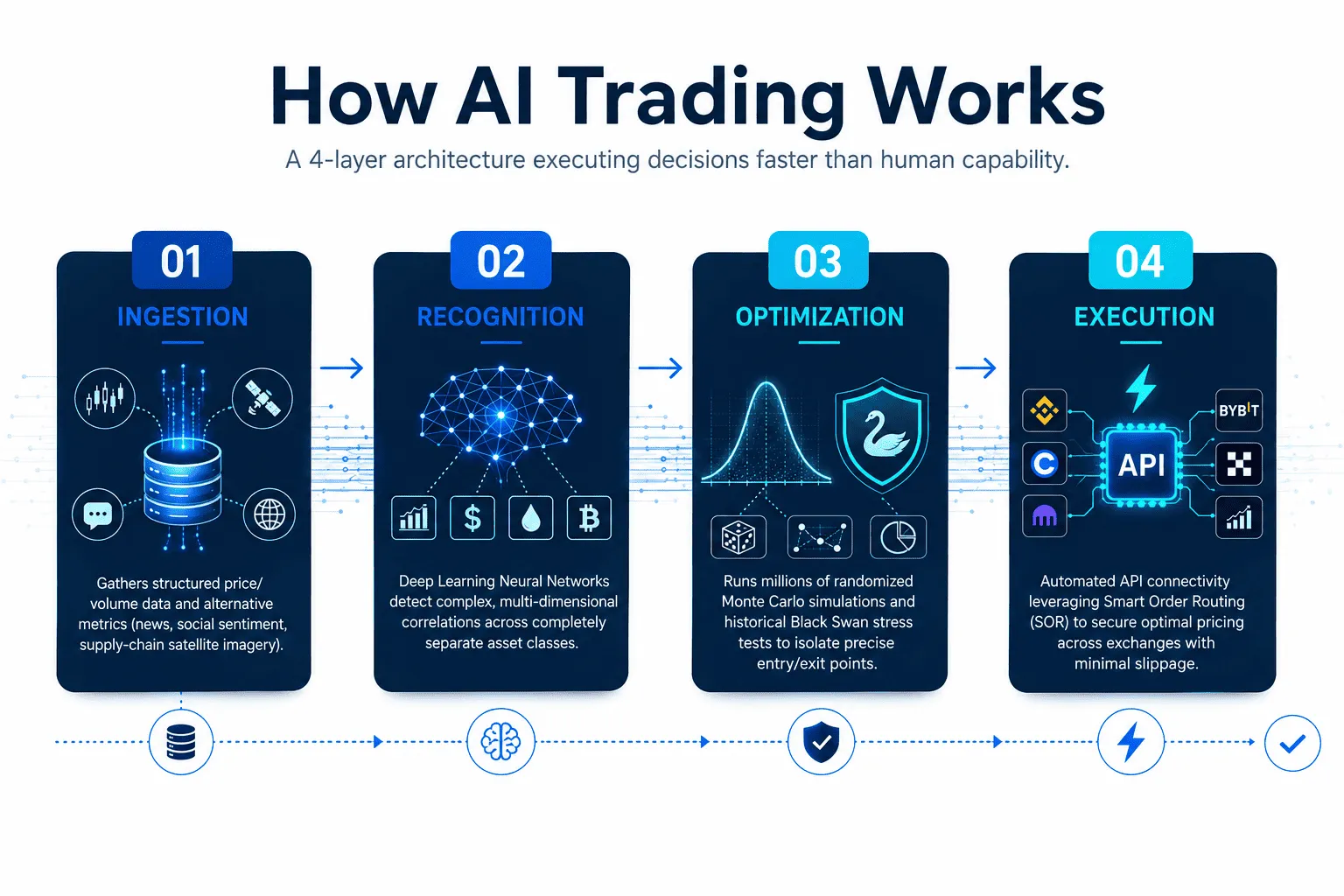
AI trading uses a layered architecture to process datasets and execute decisions faster than human capability. This process follows four distinct layers:
- Data Ingestion: The system gathers structured data (prices, volume, order books) and unstructured alternative data (financial news, social media sentiment, and on-chain blockchain metrics). Institutional-grade systems may also incorporate satellite imagery and supply-chain data.
- Pattern Recognition: Using deep learning models like Neural Networks, the AI identifies complex, non-linear relationships in data that are invisible to traditional technical indicators. It detects multi-dimensional correlations across different asset classes simultaneously.
- Strategy Optimization: Before risking capital, the AI conducts millions of backtests and “Monte Carlo” simulations (randomized stress tests that model thousands of possible market scenarios). It evaluates how a strategy would have performed during historical “Black Swan” events to determine the highest statistical probability for entry and exit points.
- Execution: The system connects to exchanges via APIs to execute trades automatically. Using Smart Order Routing (SOR), which selects the best exchange for optimal pricing, the AI ensures orders are filled at the best possible price with minimal slippage.
Core Technologies Involved
The effectiveness of AI trading is driven by several key technological disciplines:
- Machine Learning (ML): Unlike fixed rules, ML models adapt and improve as they process more data, allowing them to respond to changing market conditions.
- Natural Language Processing (NLP): This allows the AI to “read” and interpret human language from earnings calls, news headlines, and social media to gauge market sentiment.
- Sentiment Analysis: Building on NLP, this technique categorizes the market tone as positive, negative, or neutral to help anticipate direction based on public and institutional mood.
- Reinforcement Learning (RL): Considered the most advanced tier, a trading agent learns an optimal strategy through trial and error within a market environment, receiving “rewards” for profitable outcomes and refining its policy over time.
- Computer Vision: Increasingly, Convolutional Neural Networks (CNNs) are used to identify visual trend patterns in stock charts, similar to how they process images.
The Rise of “Agentic Brokerage” in 2026
A major innovation in 2026 is the rise of agentic brokerage, where users interact with AI via natural language prompts. Instead of manually setting technical parameters, a trader can express intent, for example, prompting an agent to “Hedge my tech stocks if the VIX spikes above 25”, and the AI autonomously builds and executes the necessary strategy.
AI Agent Applications in Quantitative Trading (2026)
By 2026, quantitative trading houses will use multi-agent systems rather than single-model architectures. Instead of relying on one algorithm to make all decisions, quant teams deploy specialized AI agents that collaborate and cross-verify strategies:
- Alternative Data Agents: Parse unstructured text from retail message boards, global news outlets, and patent filings to build live sentiment feeds.
- Risk and Exposure Agents: Monitor real-time correlations across different asset classes, dynamically adjusting stop-loss levels during sudden market shocks.
- Execution Routing Agents: Interact directly with order books, splitting larger trades across dark pools and lit exchanges to minimize market impact and slippage.
- Adversarial Backtesters: Actively stress-test primary trading models by simulating historical macroeconomic crises, locating potential points of system failure before live capital is committed.
Benefits and Precautions
- Eradication of Emotion: AI eliminates human biases such as fear, greed, and “revenge trading,” sticking strictly to data-driven logic.
- 24/7 Monitoring: AI can track thousands of assets across global time zones and decentralized exchanges without fatigue.
- Risks: Users must be wary of “model drift” (where a model calibrated for a bull market fails during sudden regime shifts) and the transparency challenge (where the reasoning behind a deep-learning model’s trade is not easily interpretable).
Experts generally recommend a hybrid approach, treating AI as a “co-pilot” or research assistant while maintaining human oversight for high-stakes strategic decisions and unpredictable global events.
Is AI Trading Legit, Safe, and Legal in 2026?
Yes, AI trading is legitimate; it powers a dominant share of institutional equity volume globally and is fully legal in the U.S., U.K., EU, and most major markets. However, while the technology itself is safe when used through reputable, regulated brokers that offer investor protections (such as SIPC insurance), it is not “risk-free.” Safety depends on the user’s ability to manage technical risks, such as software errors or connectivity failures, and their vigilance in avoiding fraudulent “scam bots” that operate without oversight.
Regulatory Oversight
Legitimate AI trading activity is monitored by several key regulatory bodies to prevent fraud and ensure market fairness:
- SEC (U.S. Securities and Exchange Commission): Oversees equity and options markets. The SEC issued an Investor Alert on Artificial Intelligence and Investment Fraud (2024), warning investors against “AI-washing”, where platforms falsely claim to use advanced algorithms to generate high returns.
- CFTC (Commodity Futures Trading Commission): The primary U.S. regulator for derivatives and commodities. The CFTC has explicitly warned investors that “AI won’t turn trading bots into money machines” and mandates human-in-the-loop oversight for automated trading systems.
- FINRA (Financial Industry Regulatory Authority): A self-regulatory organization overseeing broker-dealers. FINRA recommends using the FINRA BrokerCheck tool to verify the licensing status and registration credentials of any firm promoting automated trading tools.
- SEBI (Securities and Exchange Board of India): India’s primary securities regulator. SEBI’s Framework for Algo Trading by Retail Investors requires that retail algorithmic trading strategies be routed through broker-approved algorithms registered with the exchange. Platforms like uTrade Algos and Capitalise.ai (via Interactive Brokers) comply with these requirements for Indian retail investors.
- FCA (Financial Conduct Authority, UK): Under the FCA’s PS22/9 Consumer Duty, platforms that market AI trading tools to UK retail investors must demonstrate that their products deliver “fair value” and that their promotional materials are “clear, fair, and not misleading.” The FCA has flagged AI-driven financial promotions as a priority enforcement area in 2025–2026.
- CSA/IIROC (Canadian Securities Administrators): In Canada, AI trading tools that provide personalized investment recommendations may be classified as “portfolio managers” under Canadian securities law, requiring additional registration. Verify platform registration through the CSA National Registration Search.
- ESMA / MiFID II (European Union): The Markets in Financial Instruments Directive II (MiFID II) requires firms that use algorithmic trading to implement pre-trade risk controls, maintain audit trails for all algorithmic decisions, and have kill switches to halt automated trading during market stress.
At the international level, the International Organization of Securities Commissions (IOSCO) published guidance in 2024 on the use of AI and machine learning in capital markets, recommending that regulators focus on algorithmic accountability, data governance, and the explainability of AI-driven trading decisions.
“Red Flags” Checklist for AI Trading Scams
Before committing capital, investors should look for these warning signs of a potential scam:
- Guaranteed Returns: Legitimate trading always involves risk; any platform claiming “guaranteed” or “100% certain” profits is likely a scam.
- Anonymous Founders: A lack of transparent information about the team or company history is a major warning sign.
- Direct Money Deposits: If a bot asks you to deposit funds directly into its website rather than connecting to a regulated broker via API, it is almost certainly a scam.
- Pressure to Invest Quickly: Scammers often use high-pressure tactics or limited-time offers to bypass your due diligence.
- No Free Trial or Demo Account: Reputable platforms typically allow users to test features via “paper trading” or trials before charging fees.
- No Regulatory Disclosures: Lack of information regarding licensing or partnerships with regulated entities.
Institutional Algo Trading vs. Scam Bots
| Feature | Institutional / Regulated AI | Fraudulent Scam Bots |
|---|---|---|
| Control | Connects to your own broker via API; you retain withdrawal permissions. | Asks for direct custody of your funds on their internal platform. |
| Logic | Focuses on execution efficiency, reducing slippage, and statistical probability. | Operates with no clear logic, often faking historical results. |
| Goal | Acts as a “co-pilot” for research or a system for disciplined, emotion-free execution. | Markets itself as a “magic money machine” requiring zero oversight. |
| Transparency | Provides detailed logs, backtesting data, and risk management settings. | Offers no verified performance history or audit trails. |
AI Trading Security Checklist: Before You Connect Any Bot
Choosing a legitimate platform is only half the equation. Once you connect an AI trading bot to your exchange or brokerage, your capital is only as safe as your security configuration. The following checklist is based on best practices recommended by CFTC, along with platform-specific security documentation.
1. API Key Permissions: Least Privilege
When connecting a bot to your exchange, generate a trade-only API key; never enable withdrawal permissions. Most major exchanges (Binance, Coinbase, Kraken) allow granular permission control:
| Permission | Should You Enable? | Why |
|---|---|---|
| Read (view balances) | ✅ Yes | Required for the bot to monitor positions |
| Trade (place orders) | ✅ Yes | Required for automated execution |
| Withdraw (move funds out) | ❌ Never | If the bot or platform is compromised, attackers cannot drain your account |
| Transfer (move between sub-accounts) | ⚠️ Only if needed | Some DCA strategies require this , evaluate case-by-case |
2. Exchange Account Hardening
Before connecting any third-party tool to your brokerage or exchange:
- Enable 2FA (two-factor authentication) using an authenticator app, not SMS, which is vulnerable to SIM-swap attacks.
- Enable IP whitelisting for your API key, and restrict API access to the bot’s server IP only.
- Set withdrawal address whitelisting, even if withdrawal permissions are disabled; this adds a second layer of protection.
- Use a unique, strong password that is not shared with any other service.
3. Capital Allocation Rule
Never allocate more than 5–10% of your total investment portfolio to any single AI bot or strategy. This limits your maximum exposure if the algorithm experiences model drift, overfitting failure, or a black swan event. Professional quant desks typically allocate capital across 5–10 uncorrelated strategies to diversify algorithmic risk.
4. Paper Trading Protocol
Test every new AI strategy in a demo/paper trading environment for a minimum of 14 days before deploying live capital. Most platforms (Trade Ideas, TrendSpider, 3Commas, Pionex) offer paper trading modes. During this period, evaluate:
- Does the bot’s live performance match its backtested results?
- How does the strategy behave during periods of high volatility?
- What is the maximum drawdown during the test period?
5. Monitoring Cadence
AI trading is not “set and forget”; even fully automated platforms require human oversight:
| Frequency | Action |
|---|---|
| Daily | Check for failed trades, connectivity issues, or unusual position sizes |
| Weekly | Review P&L performance against your risk threshold |
| Monthly | Audit strategy parameters , is the market regime still aligned with the bot’s assumptions? |
| Quarterly | Re-evaluate whether the platform still meets your needs; check for regulatory changes |
6. Regulatory Verification
Before depositing funds or connecting your brokerage account, verify the platform’s regulatory status:
- US platforms: Check registration via FINRA BrokerCheck or the SEC EDGAR database.
- Indian platforms: Verify SEBI registration and algo trading approval status.
- UK platforms: Check the FCA Register.
- EU platforms: Verify MiFID II compliance through national regulators.
Top AI Trading Platforms (2026 Rankings)
To select the optimal tool, investors must cut through marketing jargon and focus on functional utility. The following comparison matrix evaluates the top platforms across their primary capabilities, assets, pricing, and our Weighted Dimension Score (based on AI sophistication, cost, compliance, and usability).
| App Name | Primary AI Capability | Pricing Tier | Supported Assets | Best For | Risk Control | Non-Custodial? | Regulation | Weighted Score (2026) |
|---|---|---|---|---|---|---|---|---|
| Trade Ideas | “Holly” Signal Scanner | $89–$254+/mo | Stocks, ETFs, Crypto | Day Traders | SmartStop auto stop-loss | ✅ Yes (via Alpaca) | SEC-registered broker | 9.2 / 10 |
| TrendSpider | Technical Automation | $107–$349/mo | Stocks, Forex, Crypto | Swing Traders | Auto alerts, no execution | ✅ Yes (connects to broker) | N/A (analysis tool) | 9.0 / 10 |
| Prospero.ai | AI Trading & Market Intelligence | Free / Paid Plans | Stocks, ETFs, Crypto | AI-Assisted Investors | AI risk insights, portfolio monitoring | ✅ Yes (analysis/research) | N/A (analysis tool) | 8.9 / 10 |
| SaintQuant | No-Code NL Builder | $49–$199/mo | Stocks, Forex, Crypto | No-Code Algo | Backtest validation | ✅ Yes (API-based) | N/A (analysis tool) | 8.8 / 10 |
| TradeStation | API & EasyLanguage | Free w/ $10k | Stocks, Options, Futures | Quant Developers | Custom risk via API | ❌ No (integrated broker) | SEC/FINRA registered | 8.7 / 10 |
| 3Commas | Multi-Exchange Bots | $22–$75+/mo | Crypto Only | Crypto Bots | Trailing stop-loss, DCA | ✅ Yes (API to exchanges) | Unregulated | 8.6 / 10 |
| Public Agents | Native Intent-Based | Free (Brokerage) | Stocks, Options, Crypto | Hands-Off Intent | Non-custodial native agent | ❌ No (integrated broker) | SEC/FINRA registered | 8.5 / 10 |
| Tickeron | Pattern Search & Robots | $30–$145/mo | Stocks, ETFs, Crypto, Forex | Multi-Asset | Virtual agents, hedging | ✅ Yes (API-based) | SEC-registered | 8.5 / 10 |
| Composer | Visual Strategy Builder | Free–$99/mo | Stocks, ETFs, Crypto | No-Code Algo | Slippage modeling | ❌ No (integrated broker) | SEC-registered | 8.4 / 10 |
| Edgeful | Futures Assistant | $79–$249/mo | Futures Only (CME) | Futures Day Traders | Max daily loss safeguards | ✅ Yes (connects to broker) | N/A (analysis tool) | 8.4 / 10 |
| AlgosOne | NLP & Deep Learning | Commission-based | Crypto, Forex, Stocks | Black Box Quant | Reserve fund hedge | ❌ No (custodial) | EU-regulated | 8.3 / 10 |
| StockHero | Strategy Marketplace | $29.99–$99.99/mo | Stocks, ETFs, Crypto | Beginner Bots | Configurable stop-loss | ✅ Yes (API to exchanges) | Unregulated | 8.3 / 10 |
| ChainGPT | On-Chain Sentiment | Free / Credits | Crypto/Blockchain | Blockchain Specialists | N/A (research tool) | ✅ Yes (analysis only) | Unregulated | 8.2 / 10 |
| AInvest | Aime Natural Language | Free–$25+/mo | Stocks, ETFs, Crypto | Passive Investors | AI Radar risk alerts | ✅ Yes (connects to broker) | N/A (analysis tool) | 8.1 / 10 |
| Kavout | Kai Score Ranking | Free–$20+/mo | Stocks, Crypto, ETFs | Systematic Scoring | N/A (research tool) | ✅ Yes (analysis only) | N/A (research tool) | 8.0 / 10 |
Disclaimer: Pricing and scores may vary over time. Visit the official providers for real-time rates.
The “best” application is inherently subjective; a non-coding investor seeking guided insights requires a fundamentally different architecture than a technical quant deploying custom Pine Script frameworks. Below, we distill the unique value propositions of the current market leaders based on their functional utility and technological edge.
1. Tickeron
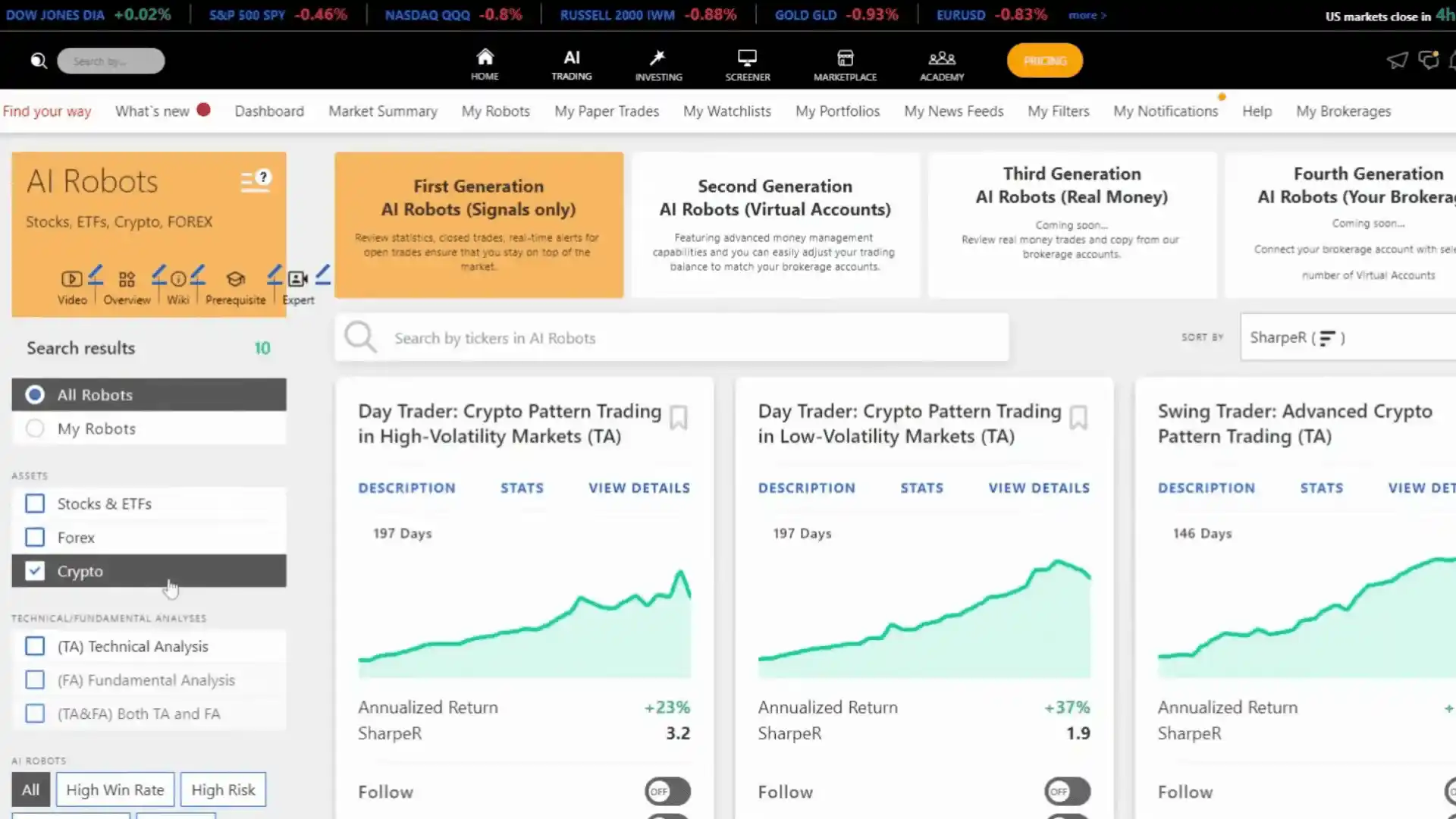
Tickeron maintains its position as a comprehensive suite for pattern recognition and trend prediction. It is particularly noted for its “micro-algorithmic explainers,” which attempt to solve the “black box” problem of AI by providing the logic behind every signal.
- Key Features:
- AI Trading Robots: Three distinct tiers (Signal, Virtual, and Brokerage Agents) offering varying levels of risk management and tick-level execution.
- Financial Learning Models (FLMs): Advanced engines used to identify chart and candlestick patterns with specified confidence levels.
- Earnings-Calendar Screening: AI-driven analysis of volatility surrounding corporate reporting cycles.
Analytical Evaluation: Tickeron serves as a critical bridge for investors migrating from manual to systematic trading. Its competitive edge lies in the democratization of hedging strategies; users can deploy “Short Bias” robots or utilize Inverse ETFs automatically during periods of high volatility, a feature typically reserved for professional desks.
| Feature Category | Detail |
| Pros | Multi-asset support (Stocks, ETFs, Forex, Crypto); $35/mo entry-tier all-in package. |
| Cons | The massive depth of tools can create a steep learning curve for novices. |
Ideal Use Case: Best for traders who want to scale complexity from simple signals to advanced, automated hedging agents.
2. TradeStation
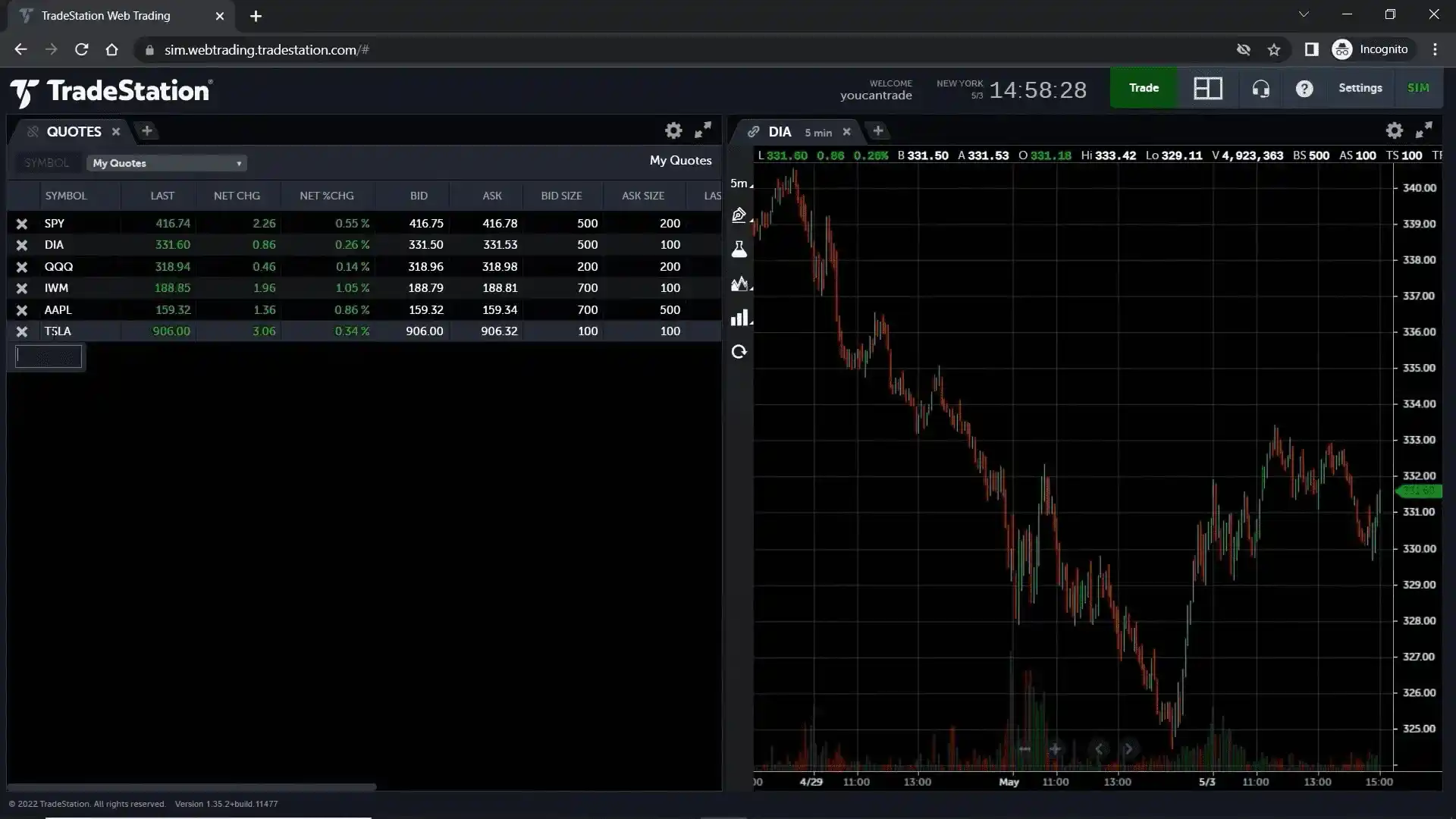
A brokerage-centric powerhouse, TradeStation is the premier choice for active traders who require a high-performance tech stack and full strategy automation capabilities.
- Key Features:
- EasyLanguage: A proprietary, trader-centric programming language that is more intuitive than Python for financial logic.
- Comprehensive API Access: Support for C#, C++, and Python for deep institutional-grade integration.
- Cloud Hosting: Ensures algorithms run 24/7 without the latency or hardware risks of local machines.
Analytical Evaluation: When we contrast TradeStation with its peers, its primary advantage is the “native” feel of its developer environment. However, a significant scalability limitation persists: the platform’s algorithms are primarily applied to stocks with “open charts,” which may hinder quants looking to run massive multi-ticker scans simultaneously across the entire market.
| Feature Category | Detail |
| Pros | Zero-commission stock trades; institutional-grade historical data for backtesting. |
| Cons | Scalability is capped by the “open chart” requirement for certain automated scans. |
Ideal Use Case: Best for technical traders and developers building custom, high-performance algorithmic strategies.
3. Prospero
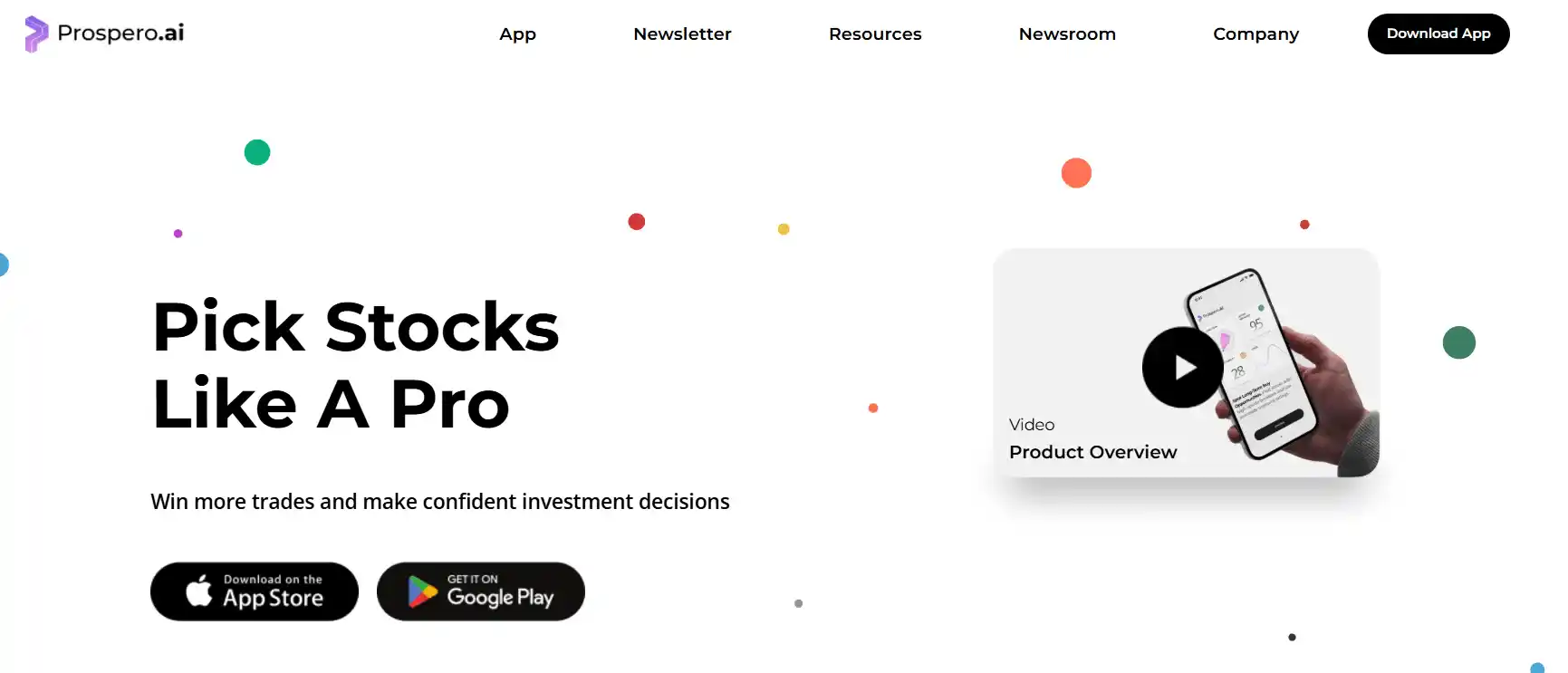
Prospero.ai is an AI stock analysis app that runs 10,000+ machine learning models to analyze more than 100 million data points and turn complex trading insights into short-term and long-term signals. It also offers investing and trading newsletters with expert insights and claims a 60% win rate compared with the S&P 500 and 81% annualized outperformance as of July 2025. The Prospero.ai app is free to use, making it easier for investors to access institutional-grade trading insights.
Key Features:
- Daily picks: Sorts stocks into Short-Term Bulls, Long-Term Bulls, Short-Term Bears, and Long-Term Bears, plus a curated “Our Picks” list.
- Daily screener: Surfaces stocks with the strongest cumulative signal scores, so you don’t have to combine the 10 signals manually.
- Watchlist: Tracks positions and monitors signal changes.
- In-app learning guide: Explains each signal and the financial terms behind it, which reviewers consistently highlight as the app’s best feature.
Analytical Evaluation: Prospero.ai’s edge is packaging order flow and positioning data into ten simple 0-100 scores for a retail audience. The signals are split into two groups: five short-term signals that update within minutes and five long-term models designed for a 6-month to 2-year investment horizon.
| Feature Category | Detail |
| Pros | Institutional-grade data, a free mobile app; near-real-time options and dark pool signals, and in-app education for beginners |
| Cons | Not a direct execution platform |
Ideal Use Case: Best for retail investors who want institutional-grade insights without paying for an expensive trading platform.
4. Trade Ideas
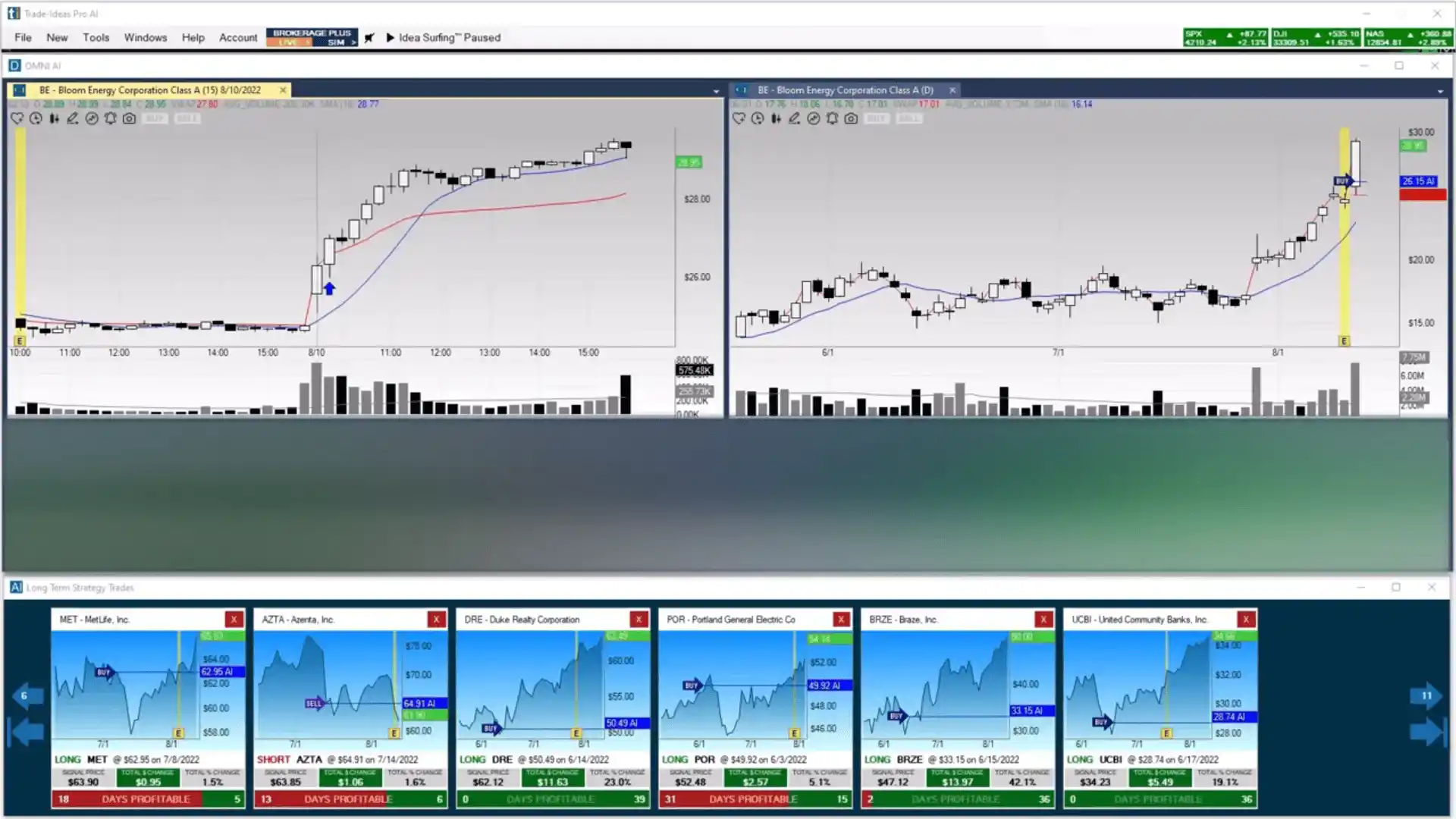
Trade Ideas focuses on real-time AI scanning and success-filtered alerting, powered by its proprietary “Holly” engine.
- Key Features:
- Holly AI Engine: Conducts millions of simulated trades overnight so the trader begins the day with pre-validated, high-probability setups.
- OddsMaker Backtesting: Simulates share size and commission to provide a “net profit” reality check on any strategy.
- Stock Race Visualizations: Provides a 3D-style visual of real-time momentum, allowing traders to spot “breakout” capital flows instantly.
Analytical Evaluation: The competitive edge of Trade Ideas is not just scanning, but pre-validation. While other tools alert you to a pattern as it happens, “Holly” has already run the simulations to tell you the statistical likelihood of that pattern’s success based on current market conditions.
| Feature Category | Detail |
| Pros | High-accuracy, success-filtered alerts; eliminates intra-day “market noise.” |
| Cons | Resource-intensive software; strictly optimized for high-frequency/day trading. |
Ideal Use Case: Best for active day traders requiring high-velocity signals and pre-market validation.
5. TrendSpider
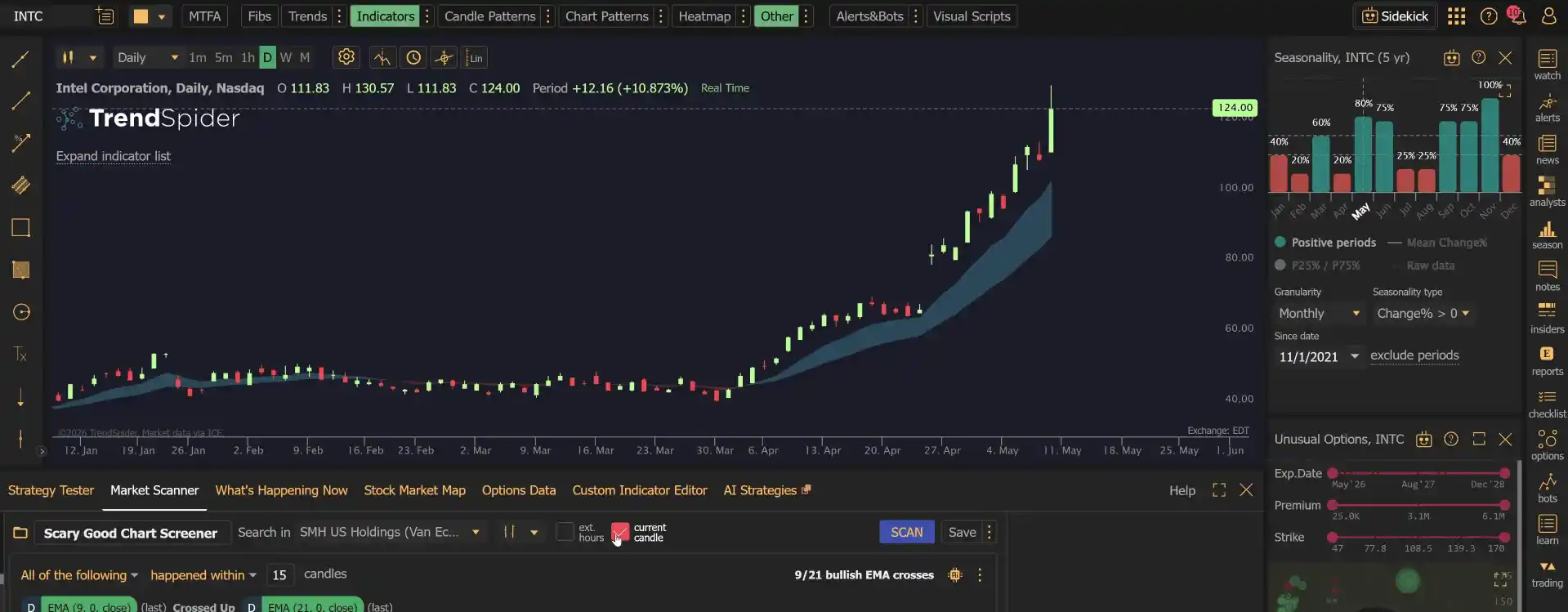
TrendSpider specializes in the automation of technical analysis, effectively removing the manual labor and subjective bias from charting.
- Key Features:
- Automated Trendline & Fibonacci Detection: Uses AI to identify support, resistance, and retracement levels across 150+ patterns.
- Multi-timeframe Chart Overlays: Allows for the visualization of secondary timeframes without switching screens.
- Dynamic Alerts: SMS and email triggers based on complex technical conditions (e.g., RSI divergence on a specific EMA cross).
Analytical Evaluation: TrendSpider’s value is rooted in “visual consistency.” Automating the drawing of Fibonacci levels and trendlines, it ensures that a trader’s technical framework remains objective, preventing the “vision bias” that often leads traders to see patterns that don’t exist.
| Feature Category | Detail |
| Pros | Powerful point-and-click backtesting eliminates manual charting errors. |
| Cons | Lacks a built-in social or copy-trading community. |
Ideal Use Case: Best for technical chart analysts and swing traders who want to refine strategies without writing code.
6. AlgosOne
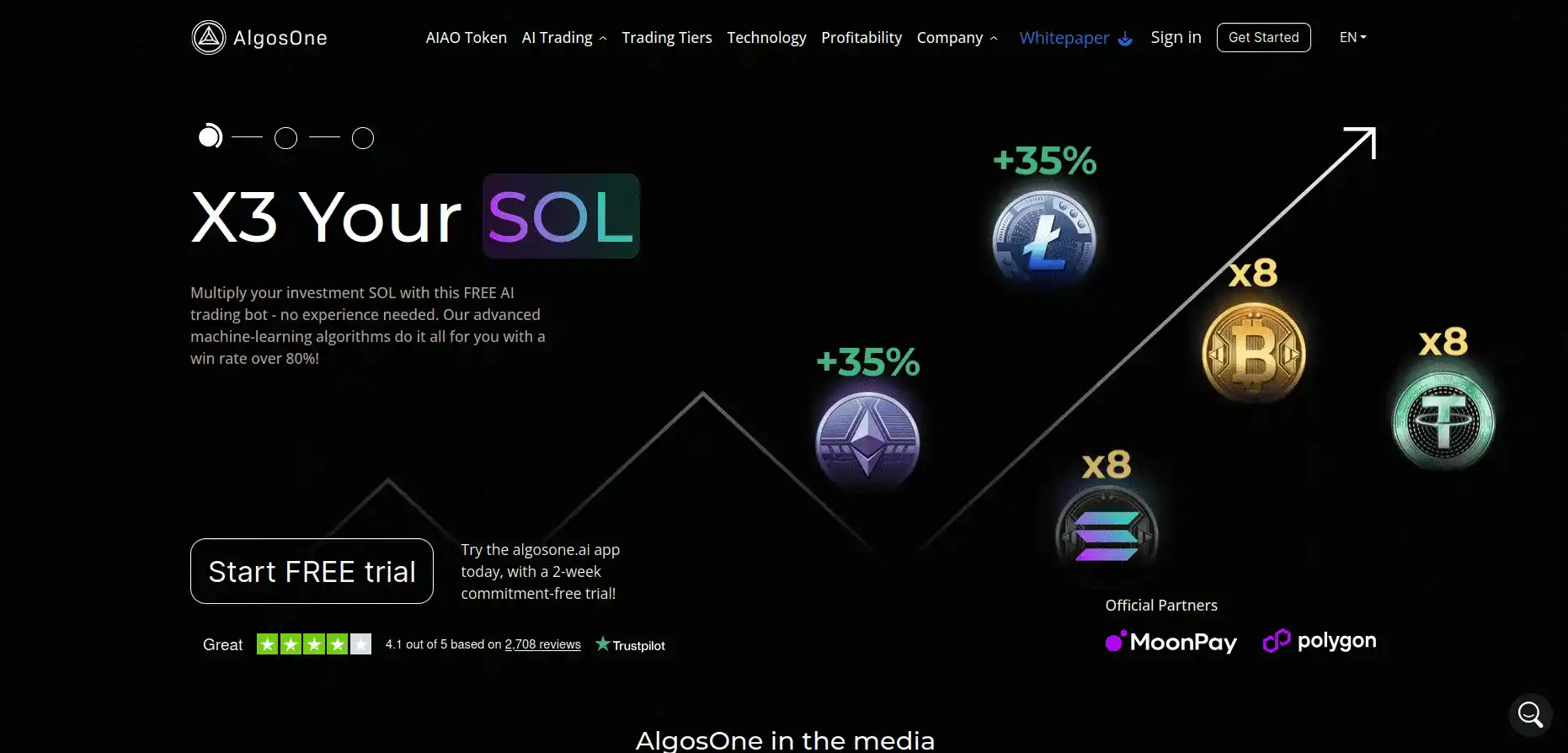
AlgosOne leverages a high-level AI stack, including Deep Learning and NLP, to provide a “hands-off” automated experience across crypto, forex, and commodities.
- Key Features:
- NLP News Analysis: Triggers trades based on global sentiment and macroeconomic shifts faster than human reaction times.
- Reserve Fund: A proprietary capital protection mechanism and profit-sharing model.
- Institutional Logic: Uses the same deep learning architecture employed by top-tier quant funds.
Analytical Evaluation: AlgosOne operates on a distinct “Tiered Commission” and profit-sharing model rather than a flat subscription. This aligns the platform’s success with the user’s, making it an attractive, fully managed solution for those who prefer the AI to handle both the analysis and the execution.
| Feature Category | Detail |
| Pros | EU-regulated; high-level NLP integration for news-driven trades. |
| Cons | Long capital lock-in periods (12–24 months) and high early-termination fees. |
Ideal Use Case: Best for investors seeking an institutional-style, fully automated “quant” experience.
7. Kavout
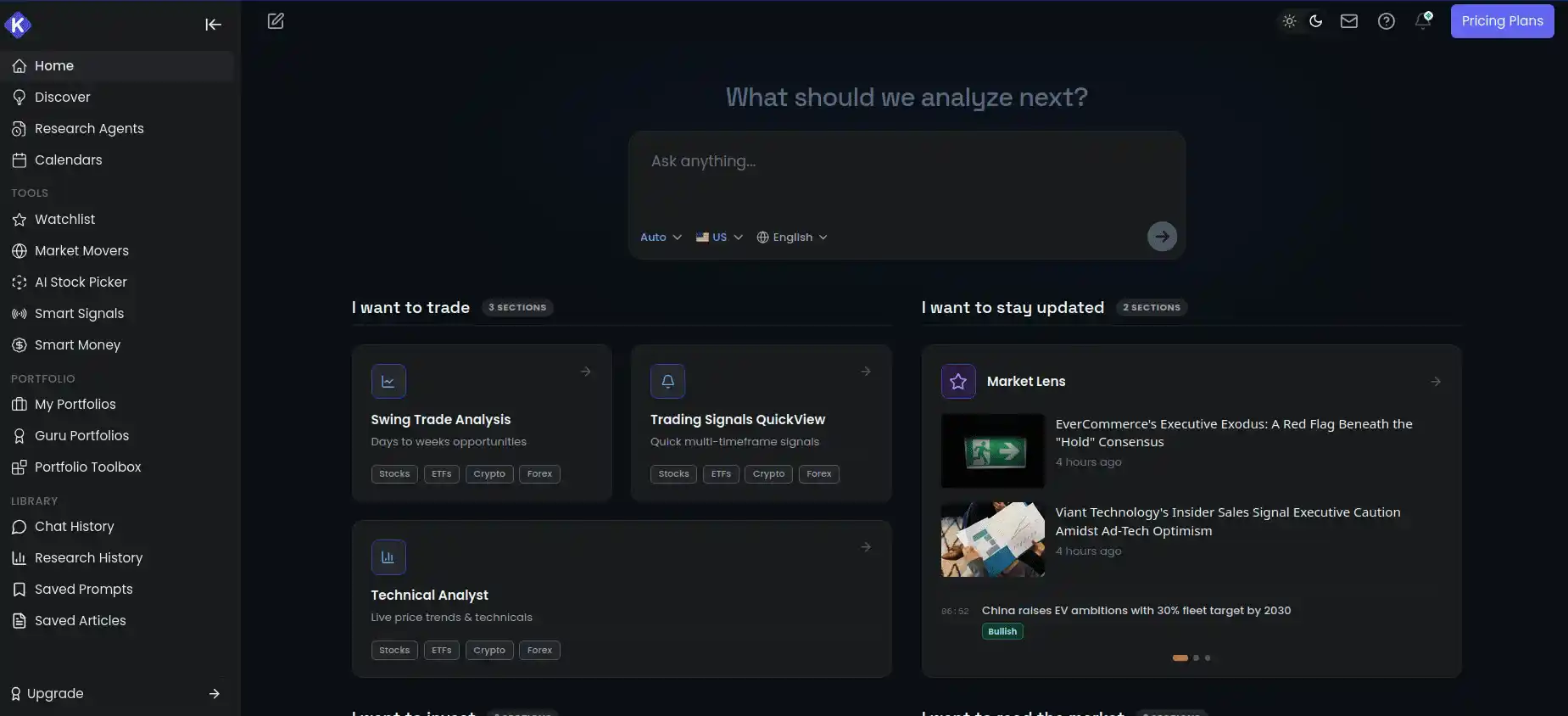
Kavout simplifies the complex world of quantitative data into an actionable ranking system known as the “Kai Score.”
- Key Features:
- Kai Score: A 1–9 rating that distills fundamental, technical, and sentiment data into a single score.
- Factor-Tilted Portfolios: AI-driven allocations focused on specific growth or value factors.
- API for Quant Funds: Allows for the integration of Kai Score signals into existing proprietary trading setups.
Analytical Evaluation: Kavout represents a hybrid model of AI efficiency and human-expert oversight. Its “Kai Score” is an essential tool for systematic investors who need a quick, data-backed screening process to support their manual execution.
| Feature Category | Detail |
| Pros | Simplified, actionable scoring; strong predictive analytics for long-term screening. |
| Cons | Limited transparency on the proprietary logic behind the Kai Score. |
Ideal Use Case: Best for systematic investors who want AI-driven rankings to supplement their manual decision-making.
8. AInvest
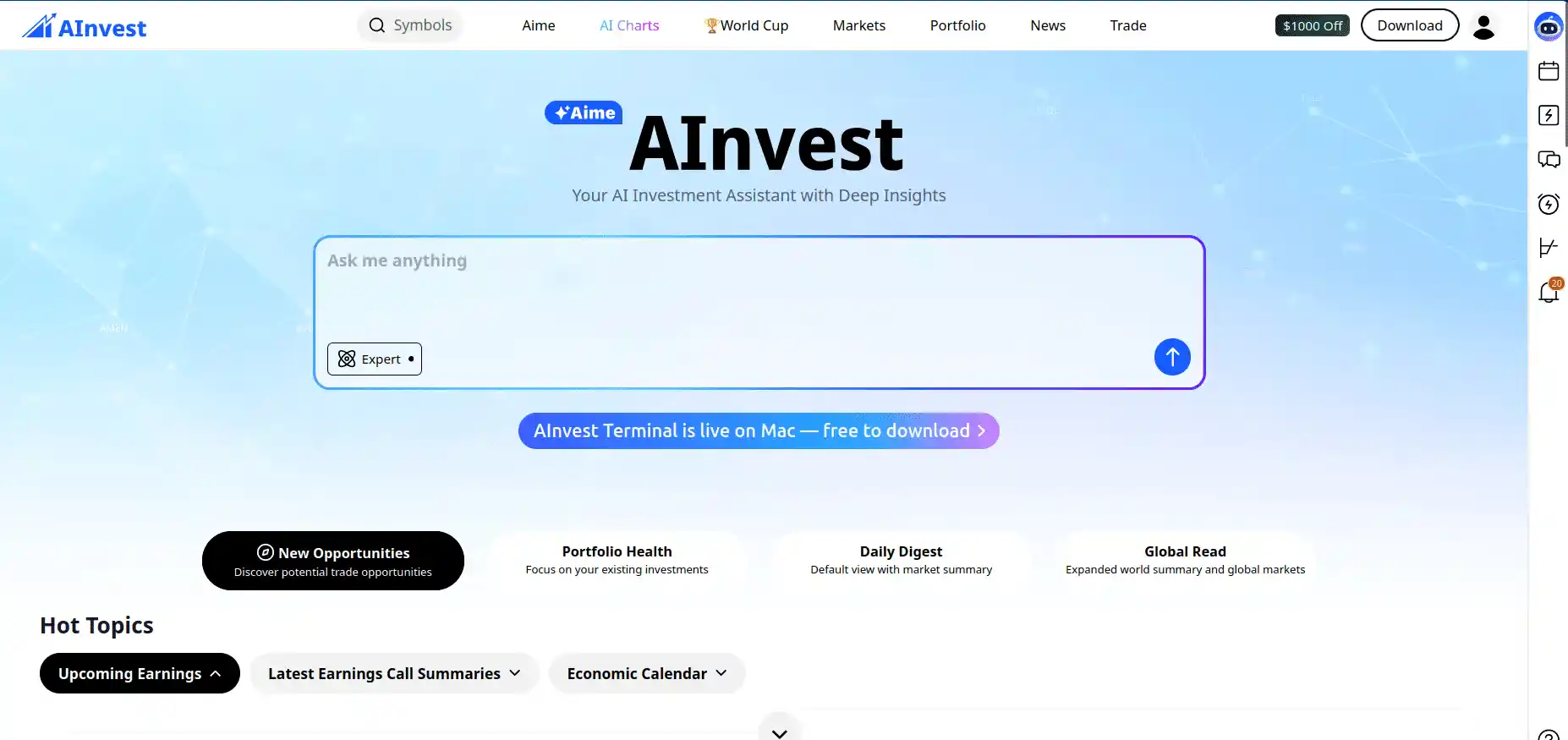
AInvest bridges the gap between brokerage execution and AI research through its natural-language virtual analyst, “Aime.”
- Key Features:
- Aime Analyst: A virtual assistant that answers complex investment queries (e.g., “Which ETFs have the highest exposure to AI hardware with low volatility?”).
- SnapTrade Integration: Connects seamlessly with multiple existing brokerages for direct execution.
- AI Radar: Predictive tools designed to help users anticipate momentum shifts before they materialize.
Analytical Evaluation: AInvest democratizes professional-level research. By allowing users to interact with market data in plain English, it reduces the barrier to entry for “passive-plus” investors who want sophisticated insights without the complexity of traditional terminal screens.
| Feature Category | Detail |
| Pros | Intuitive NLP interface; excellent multi-broker connectivity via SnapTrade. |
| Cons | Mobile-first design may feel restrictive for power users accustomed to desktop setups. |
Ideal Use Case: Best for passive investors and the “crypto-curious” who value conversational AI insights.
9. 3Commas
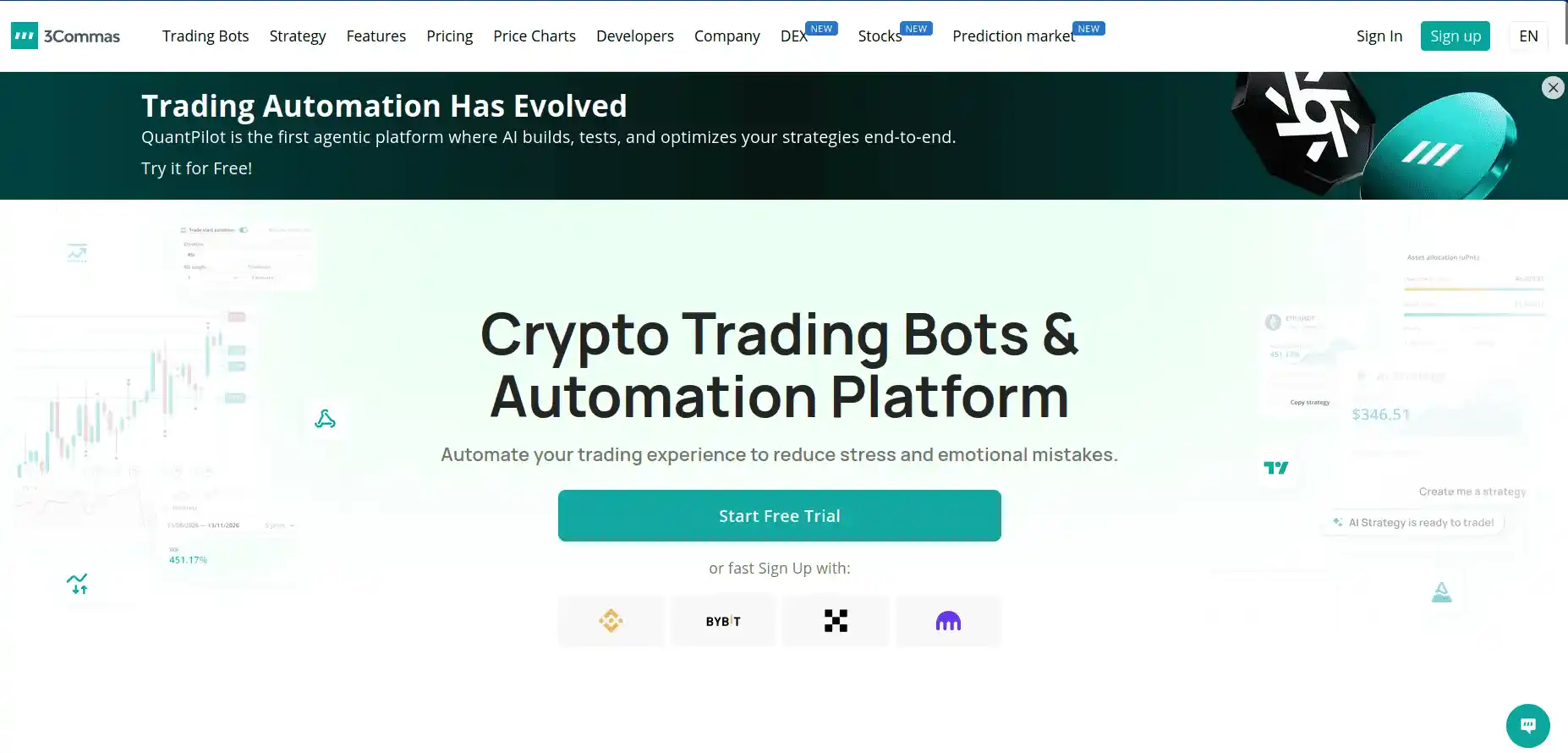
3Commas is the gold standard for crypto-focused automation, providing a unified command center for managing trades across 30+ exchanges.
- Key Features:
- Signal Bots: Deep integration with TradingView and Pine Script for executing custom technical strategies.
- DCA and Grid Bots: Automated tools for accumulating assets in bear markets or profiting from sideways volatility.
- Unified Terminal: Manage stop-loss and take-profit orders across multiple exchanges from a single interface.
Analytical Evaluation: For the “Technical Quant,” 3Commas’ support for Pine Script and webhooks is a massive force multiplier. It allows for the automation of highly specific technical strategies across the fragmented crypto exchange landscape.
| Feature Category | Detail |
| Pros | Extensive support for 30+ crypto exchanges; robust copy-trading features. |
| Cons | Strictly limited to cryptocurrency; requires constant monitoring during extreme volatility. |
Ideal Use Case: Best for high-volume crypto traders looking to manage multiple bots across various platforms.
10. Composer
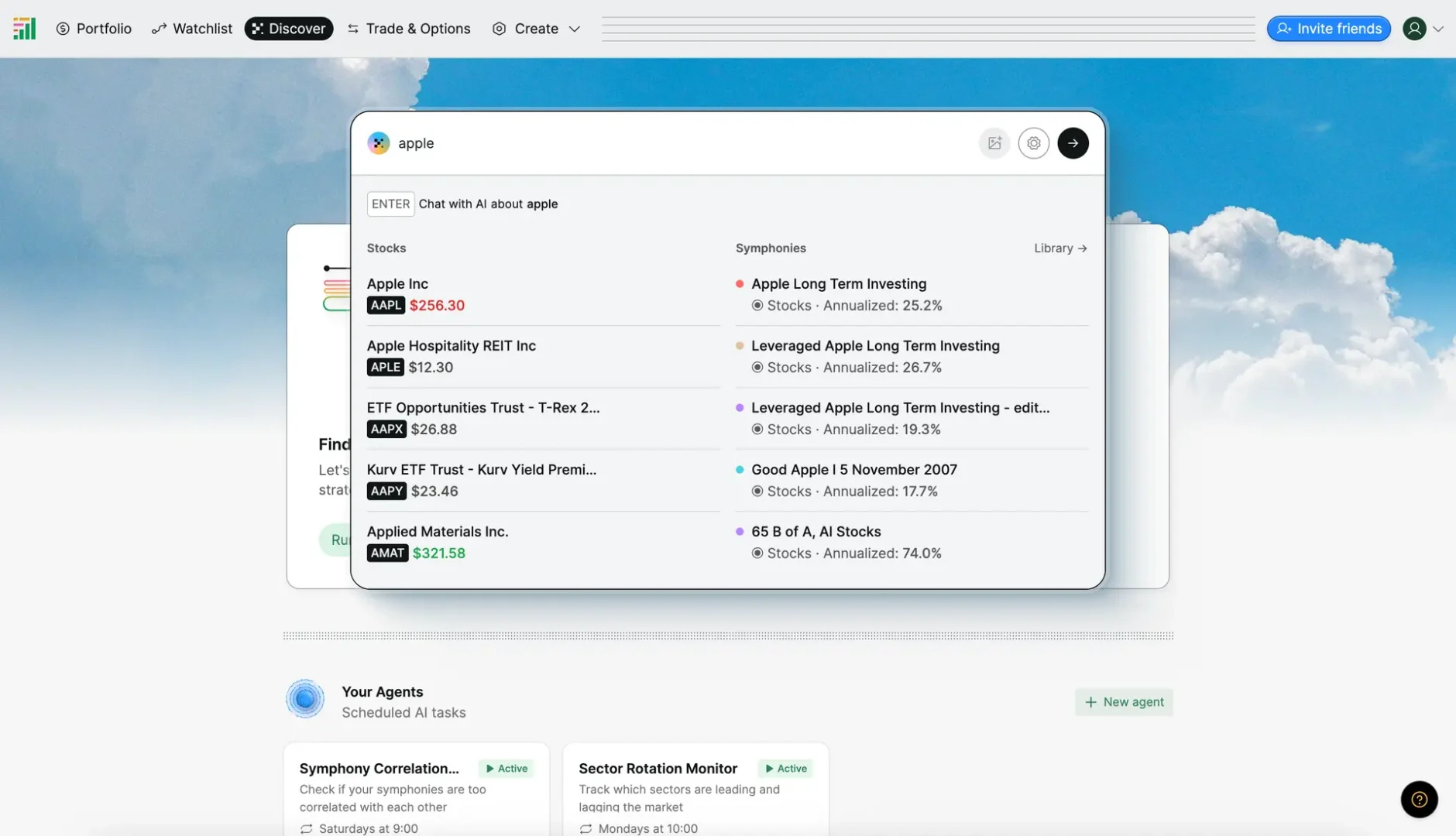
Composer allows users to build and fund automated trading strategies using a visual, no-code “Symphony” editor.
- Key Features:
- Logic Blocks: Use IF/ELSE conditions and weighting methods to build complex strategies visually.
- Zero Commissions: Direct trading in stocks and ETFs with no per-trade fees.
- Realistic Backtesting: Includes slippage and fee modeling to ensure backtest results mirror real-world performance.
Analytical Evaluation: Composer effectively democratizes quant trading by removing the syntax barrier. It allows an investor to focus entirely on the logic of a strategy (e.g., “If the NASDAQ drops 5% and Volatility is under 20, rebalance into bonds”) rather than the code required to execute it.
| Feature Category | Detail |
| Pros | Intuitive no-code builder; supports retirement accounts (IRA/401k). |
| Cons | Limited to a select number of supported brokerages. |
Ideal Use Case: Best for intermediate traders who want to build logic-based algorithmic strategies without learning to code.
11. ChainGPT
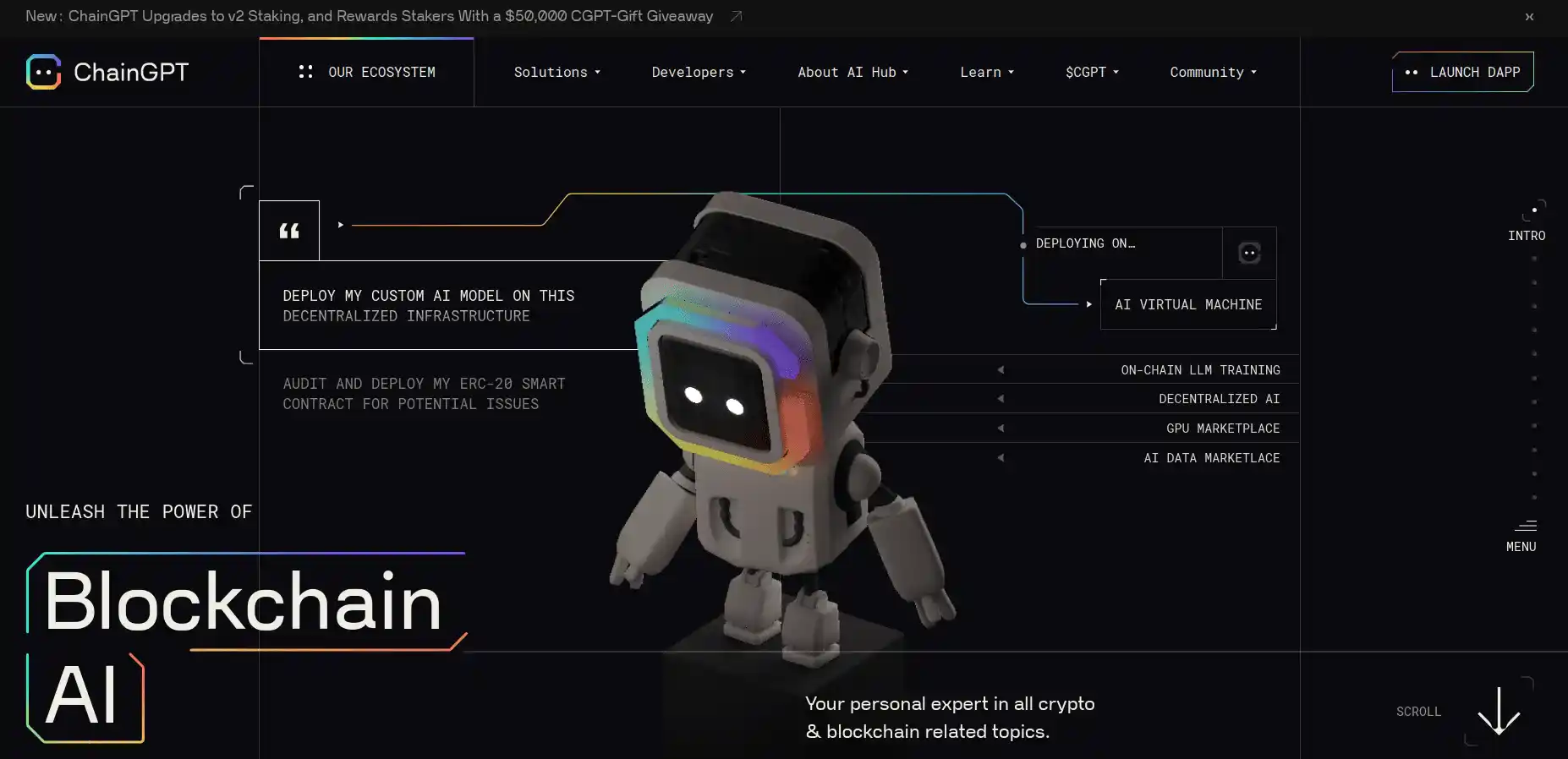
ChainGPT is a specialized AI platform engineered specifically for the unique, data-dense demands of the blockchain and crypto markets.
- Key Features:
- On-Chain Metric Analysis: Goes beyond price to analyze blockchain-specific data like wallet movements and hash rates.
- AI-Powered Strategy Builder: A dedicated assistant for building and backtesting crypto-centric models.
- Real-time Sentiment Scanning: Monitors social and news sentiment specifically within the decentralized finance (DeFi) space.
Analytical Evaluation: ChainGPT’s competitive advantage over general-purpose AI is its focus on on-chain data. In crypto, price is often a lagging indicator; by analyzing real-time blockchain movements, ChainGPT provides insights that general sentiment tools often miss.
| Feature Category | Detail |
| Pros | Highly specialized for blockchain data, real-time on-chain forecasting. |
| Cons | A credits-based pricing system can become expensive for high-frequency users. |
Ideal Use Case: Best for blockchain specialists who require deep, on-chain predictive data.
12. SaintQuant
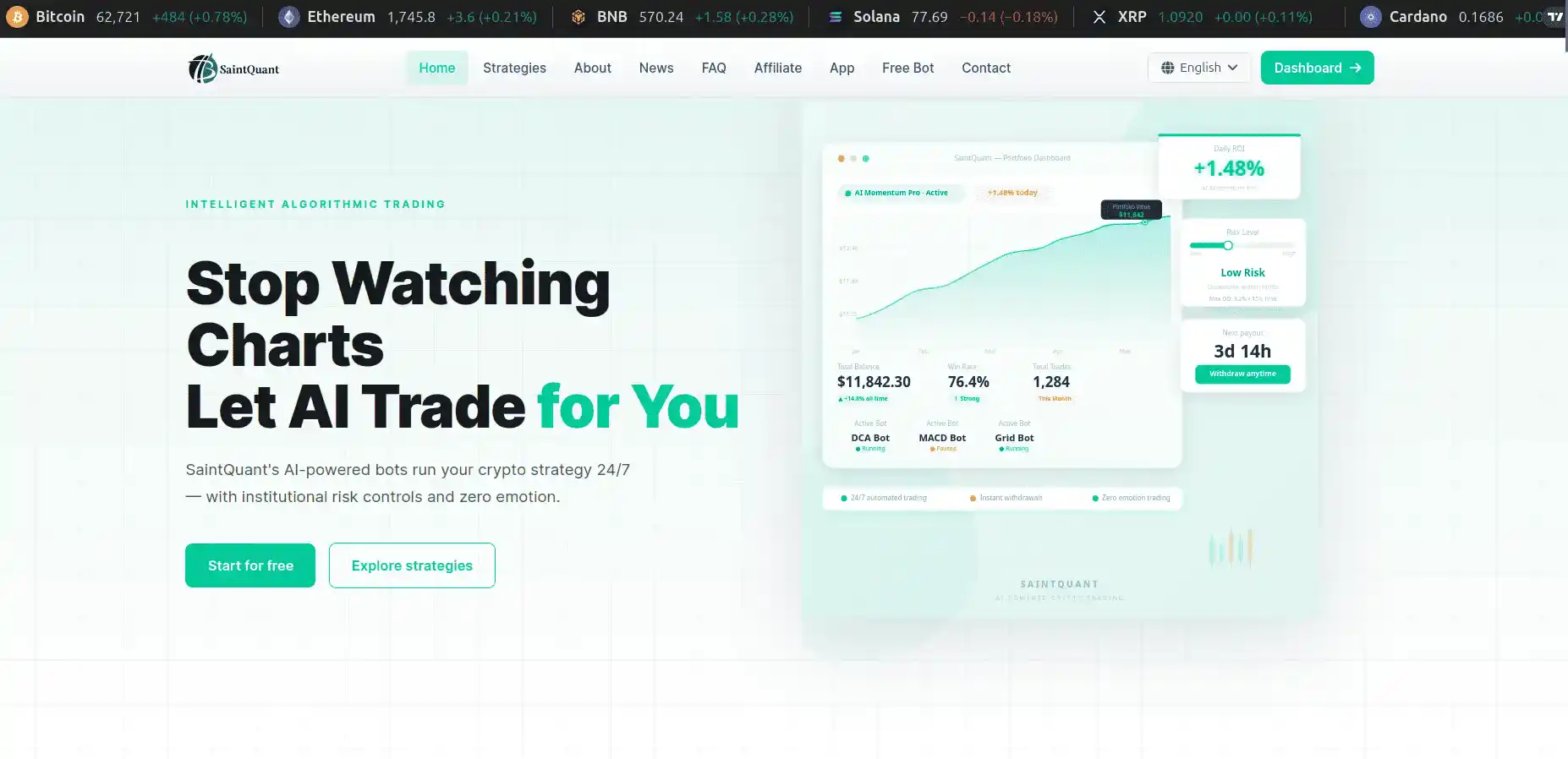
SaintQuant is a no-code, multi-asset automated platform built to let traders create complex automated strategies without coding.
- Key Features:
- No-Code Strategy Builder: Uses visual drag-and-drop logical blocks to construct backtestable trading rules.
- Multi-Asset Integration: Seamless API links across equities, forex, and cryptocurrency.
- Natural Language Backtesting: Allows users to input plain-English strategy ideas (e.g., “Buy BTC when RSI under 30 and SPY is green”) and instantly simulates historical performance.
Analytical Evaluation: SaintQuant has emerged as a major competitor in the no-code automated space. By removing the programming barrier entirely, it competes directly with Composer, but extends its capabilities to cryptocurrency and forex. However, its optimization models can be prone to overfitting if not validated with out-of-sample data.
| Feature Category | Detail |
|---|---|
| Pros | Cross-asset automated execution; intuitive natural language strategy builder. |
| Cons | Advanced backtesting modules require premium plans; limited custom indicator coding. |
Ideal Use Case: Best for retail traders seeking to build and automate cross-asset strategies without coding.
13. StockHero
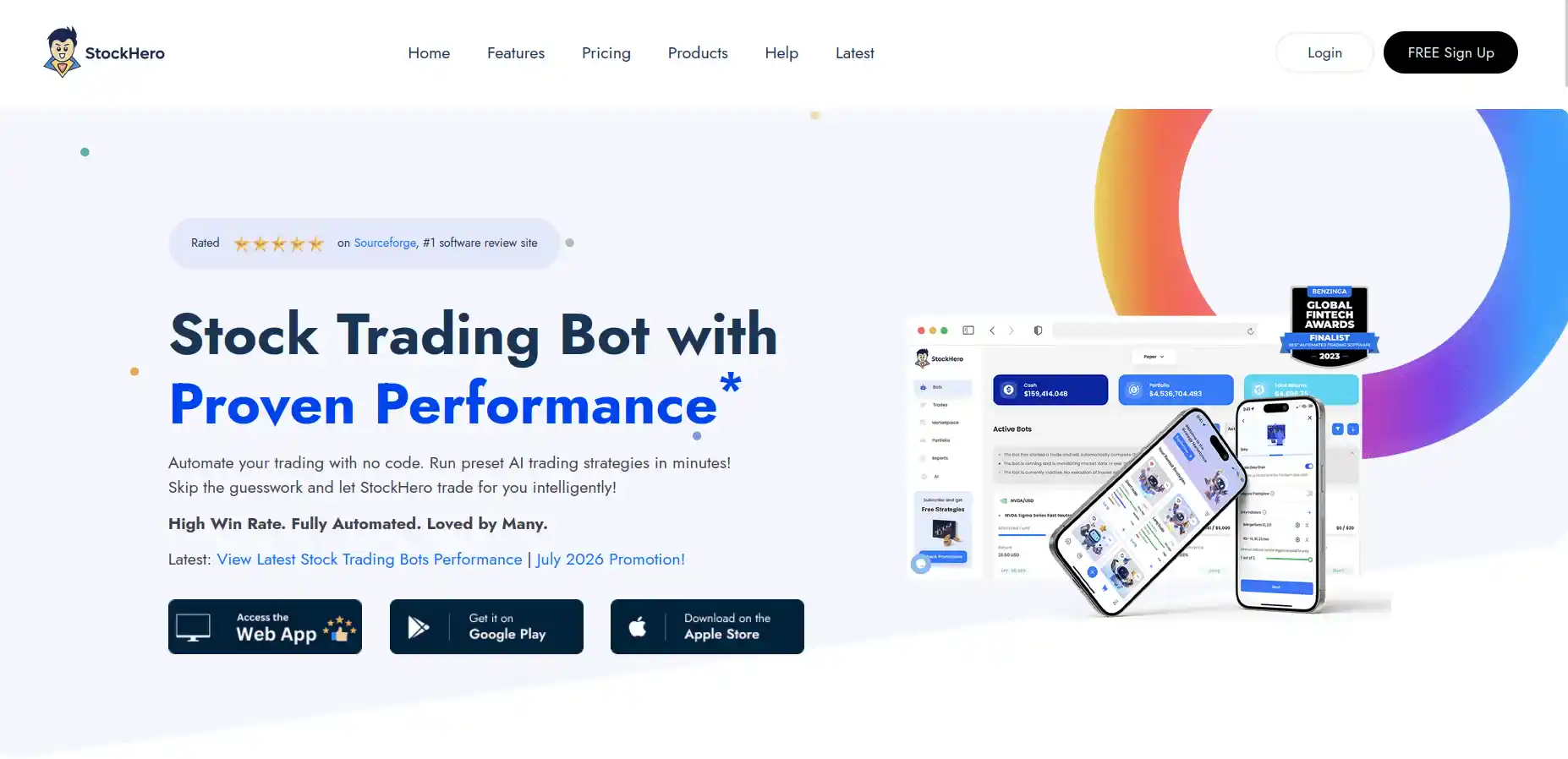
StockHero focuses on lowering the cognitive barrier of entry for automated trading through pre-configured bot architectures and white-glove setup options.
- Key Features:
- Strategy Marketplace: Beginners can lease proven bot strategies created by experienced quants.
- White-Glove Onboarding: Premium users receive one-on-one setup guidance from a platform engineer.
- Multi-Exchange Broker Support: Links to TradeStation, Alpaca, Binance, and other brokers.
Analytical Evaluation: StockHero specializes in lowering the cognitive load of bot creation. While platforms like TradeStation require mastery of EasyLanguage, StockHero uses a simple visual wizard. Its marketplace is highly rated by beginners, though advanced traders may find the lack of custom mathematical modeling capabilities restrictive.
| Feature Category | Detail |
|---|---|
| Pros | Simple visual wizard; active strategy marketplace; excellent onboarding support. |
| Cons | Locked timeframes on cheaper plans; basic technical analysis tools. |
Ideal Use Case: Best for beginners seeking a guided entry into automated stock and crypto bot trading.
14. Edgeful
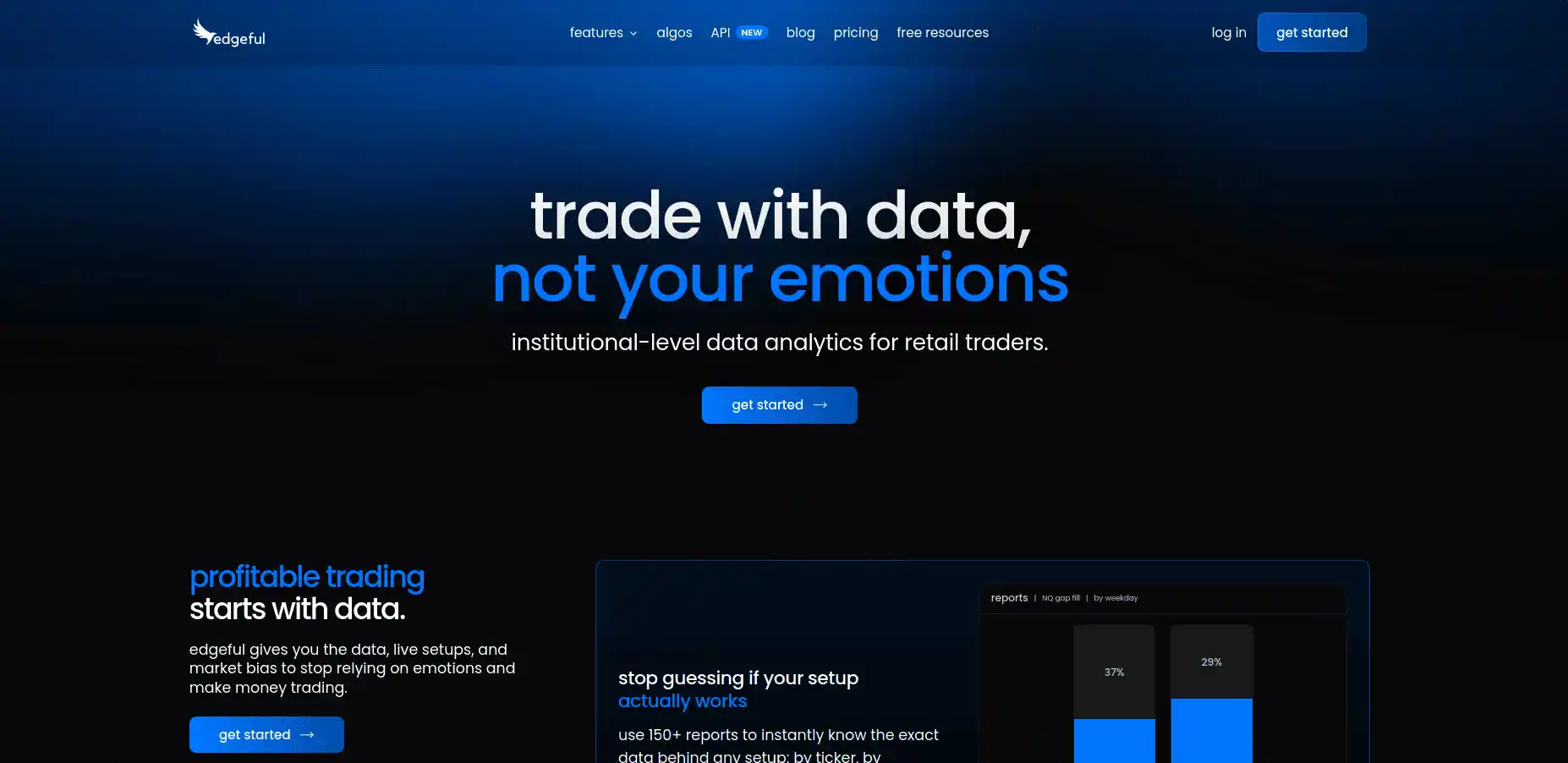
Edgeful is a quantitative trading assistant tailored specifically for index futures markets.
- Key Features:
- Futures Assistant: Custom-tailored algorithms optimized for E-mini S&P 500 (ES) and Nasdaq 100 (NQ) futures contracts.
- Order Flow Analytics: Uses volume profile and order book imbalance detection to predict short-term futures trends.
- Automated Risk Limits: Built-in maximum daily loss safeguards to prevent catastrophic capital drawdowns.
Analytical Evaluation: Edgeful targets a highly specific market: active index futures traders. Unlike general-purpose scanners, Edgeful’s deep reinforcement learning models are trained purely on CME Group futures data. This specialization delivers high-velocity execution, but makes it unsuitable for stock-picking or long-term portfolio builders.
| Feature Category | Detail |
|---|---|
| Pros | Optimized specifically for index futures; advanced order flow pattern recognition. |
| Cons | No support for equities, ETFs, or spot cryptocurrency; high subscription cost. |
Ideal Use Case: Best for dedicated index futures day traders seeking a quantitative executing assistant.
15. Public
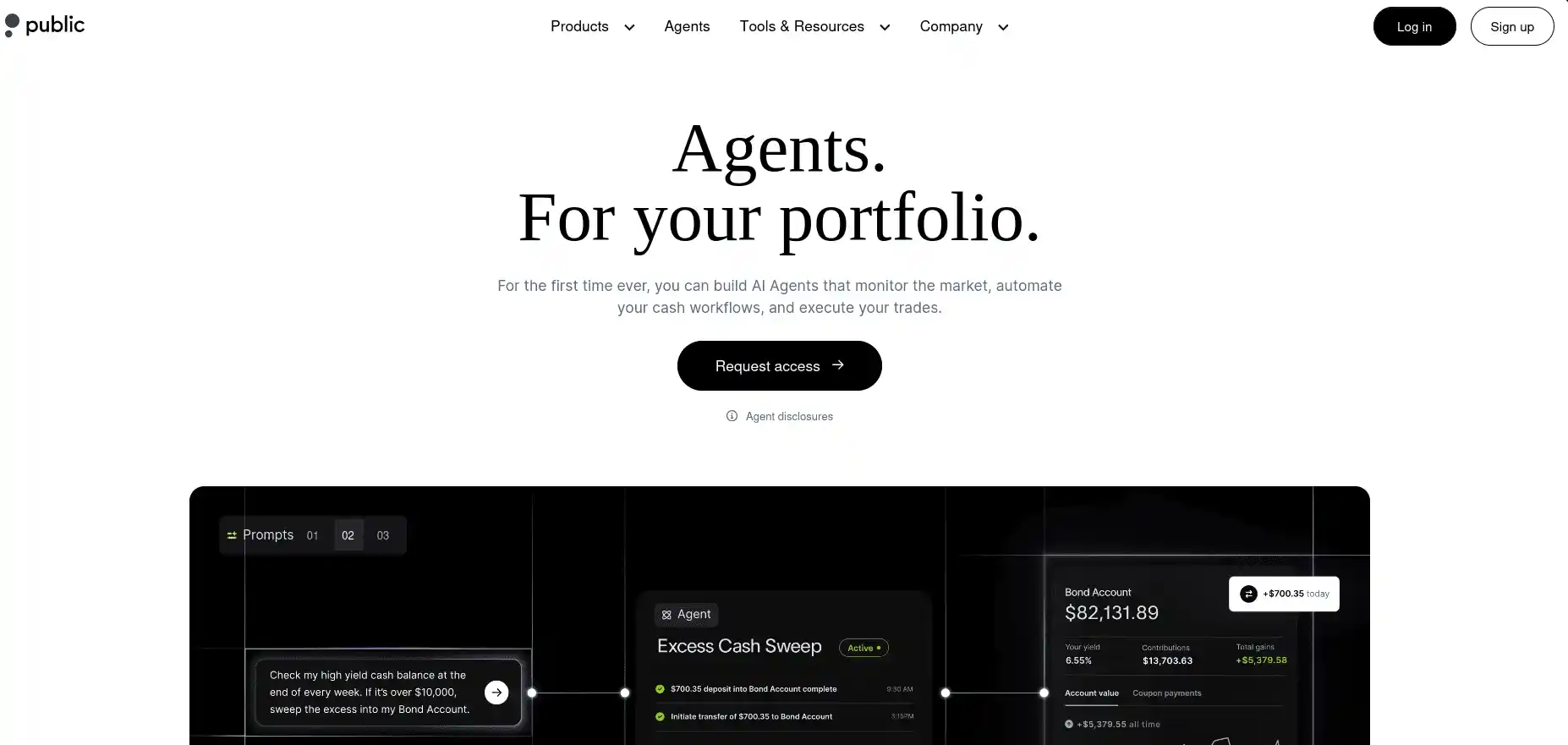
Public Agents are native AI agents built directly into the Public.com brokerage platform, allowing secure, intent-based trading without third-party API keys.
- Key Features:
- Native Brokerage Integration: AI agents live directly within the Public.com brokerage account, executing orders without third-party APIs.
- Intent-Based Automation: Users execute strategies using natural language commands (e.g., “Roll my option profits into high-yield cash every Friday”).
- AI Portfolio Co-Pilot: A virtual analyst that actively monitors the portfolio for asset concentration risk and suggests rebalancing strategies.
Analytical Evaluation: Public Agents represent the vanguard of “agentic brokerage” in 2026. By removing the need for external API key configuration (which often poses security risks), it offers a highly secure and unified environment. However, since the agents only operate within the Public.com ecosystem, users cannot link external futures or specialized crypto wallets.
| Feature Category | Detail |
|---|---|
| Pros | High security with native execution; simple, plain-English commands. |
| Cons | Bound strictly to the Public.com platform; lacks advanced charting and programming. |
Ideal Use Case: Best for hands-off investors who want native, secure, natural-language automation for long-term growth.
Direct Comparison: Trade Ideas vs. TrendSpider vs. TradeStation (2026 Features)
To help traders make informed decisions, the following analysis details the differences between the three leading platforms: Trade Ideas, TrendSpider, and TradeStation. While all three use AI, they serve fundamentally different types of traders.
| Platform | Primary AI Feature | Execution Type | Target Market | Key Subscription Tier | Pricing |
| Trade Ideas | “Holly AI” (Predictive intraday signals, OddsMaker backtesting) | Auto-execution via Brokerage Plus | High-frequency day traders, momentum traders | Eagle Elite Bundle (Premium plan containing Holly) | $228/mo (billed annually) |
| TrendSpider | Strategy Lab (Visual strategy modeling, automatic pattern detection) | Alerts & webhooks (no direct broker execution without custom webhooks) | Technical swing traders, visual chart analysts | Elite Plan (With Strategy Lab and backtesting) | $124/mo (billed annually) |
| TradeStation | EasyLanguage & Cloud Quant Engine (API-based C#/Python modeling) | Native brokerage execution (stocks, options, futures) | Quantitative developers, systematic traders | TS Select / Go | Free w/ minimum funding ($10k / $2k) |
- Trade Ideas (Holly AI): Trade Ideas stands out for its three AI engines (Holly, Holly 2.0, Holly Neo) that run overnight simulations on over 8,000 stocks to identify high-probability setups before the opening bell. Users receive clear buy/sell alerts with predefined stop-losses and profit targets.
- TrendSpider (Strategy Lab): TrendSpider excels in automating visual analysis. Its AI detects chart patterns, support/resistance zones, and candlestick formations instantly. With Strategy Lab, users can build trading logic visually and backtest it without writing code.
- TradeStation (EasyLanguage): TradeStation is a developer-centric powerhouse. Rather than providing pre-packaged AI signals, it gives traders the coding frameworks (EasyLanguage) and REST APIs to deploy their own machine-learning models directly onto TradeStation’s high-speed brokerage execution network.
The Multi-Bot Strategy: 3Commas vs. Pionex vs. Capitalise.ai vs. Trade Ideas vs. TrendSpider
For investors comparing bot-centric execution, the following guide distinguishes how they differ in automation logic:
- 3Commas: Best for managing cryptocurrency-only bots across multiple external exchanges (Binance, OKX, Bybit). It specializes in DCA and Grid bots.
- Pionex: Best for free, built-in exchange bots. Since Pionex is a cryptocurrency exchange itself, users can run 16 free trading bots (such as Grid and Arbitrage) without configuring third-party API keys, minimizing security risks.
- Capitalise.ai: Best for code-free natural language automation. Users write strategies in plain English (e.g., “Buy 10 shares of AAPL if the 10-period EMA crosses above the 50-period EMA”), and the system translates and executes the strategy.
- Trade Ideas & TrendSpider: Focus on technical scanning and analysis rather than exchange bot management. Trade Ideas provides day-trading entry/exit alerts, while TrendSpider provides visual charting automation.
Best Free AI Trading Apps in 2026
The best free AI trading app for most users is Pionex, which provides 16 built-in bots at no subscription cost. For research-focused investors, Trade Ideas offers a free “Par Plan” with delayed market data. Here is a full breakdown of every free and budget-friendly option available in 2026.
Completely Free and Open-Source Tools
For those with technical skills or budget constraints, these platforms offer full functionality without subscription fees:
- Superalgos: A community-driven, 100% free, and open-source platform that allows users to build, backtest, and deploy complex AI systems on their own hardware.
- Pionex: Provides 16 free built-in trading bots (such as Grid and DCA bots) with no monthly subscription costs; users only pay a standard trading commission of 0.05% per transaction.
- MetaTrader 5 (MT5): The platform itself is typically free through most brokers and now includes generative AI “CoPilot” features to help users build strategies using natural language.
Apps with Permanent Free Tiers (Freemium)
Many leading platforms offer a “freemium” model where core research or basic automation features are available for $0:
- Trade Ideas: Offers a “Par Plan” that is free forever and includes delayed market data, basic charting, and the “Stock Race” visualization widget.
- Danelfin: Their free plan includes 10 stock/ETF reports per month, access to the top 10 stocks in all rankings, and two long-term trade ideas daily.
- WallStreetZen: Provides its “Zen Ratings” (A-F grades) for free, allowing users to research any U.S. stock based on 115 fundamental and AI factors.
- Public.com: Offers free access to AI-powered “Agents” built natively into the brokerage, allowing users to automate portfolio strategies using plain-English prompts without requiring third-party API keys. (Note: Commission-free stock and ETF trading; options contracts may incur per-contract fees.)
- QuantConnect: Features a free tier for algorithm development and backtesting, including access to a massive library of historical and alternative data.
- Cryptohopper: Includes a “Pioneer” plan that is free forever for basic platform testing and manual trading.
- Shrimpy: The “Starter” plan is free for one portfolio and includes weekly automated rebalancing. (Note: Limited to basic features; premium tiers unlock additional portfolios and more frequent rebalancing.)
Tools with Free Trial Periods
If you want to test premium features before committing, these apps offer limited-time trials:
- 3Commas: Provides a 3-day free trial of its “Pro” features with no credit card required.
- WunderTrading: Offers a 14-day free trial that includes access to copy trading and automated bot features.
- Bitsgap: Features a 7-day free trial with full access to its multi-exchange trading tools.
- StockHero: Offers a 14-day free trial on its “Lite” plan.
- Seeking Alpha Premium: Provides a 7-day free trial to explore AI-powered virtual analyst reports.
- TrendSpider: Offers a 7-day free trial to test its automated technical analysis and “Sidekick” AI assistant.
Budget Alternatives (Under $30/month)
For investors seeking low-cost paid options, several platforms offer entry tiers under $30 per month:
- Tickeron: Provides basic signal-based plans for as low as $5/month (billed at $60 annually).
- Streetbeat: Offers curated AI strategies starting at $9.99/month.
- WunderTrading: Their “Starter” plan for basic bots is priced at $14.99/month.
- AInvest: Features premium analytics starting at $25/month.
- StockHero: The entry-level “Lite” plan, which supports one active bot, is priced at $29.99/month.
Best Fully Automated AI Trading Apps (“Set It and Forget It”)
For users seeking a fully hands-off trading experience, AlgosOne is the top choice in 2026. It handles signal generation, execution, and risk management autonomously across stocks, forex, and crypto. Unlike tools that require active monitoring, the following platforms are designed to handle the entire lifecycle of a trade—from analysis to execution, with minimal human intervention.
1. AlgosOne – Best for Total Hands-Off Investing
AlgosOne is the leading fully managed solution for investors who want the AI to handle everything. It leverages deep learning and NLP to analyze macroeconomic shifts and news sentiment in real-time, autonomously managing signal generation, execution, and risk across crypto, forex, and stocks.
- How it works: Users deposit funds, and the system handles the complete trading lifecycle without manual intervention.
- Key Advantage: Uses generative AI to constantly hedge positions, automatically pivoting the portfolio toward defensive assets when it detects systemic risks.
- Pricing: Operates on a tiered commission and profit-sharing model rather than a monthly subscription.
2. Streetbeat – Best for Curated Hands-Off Portfolios
Streetbeat is optimized for beginners who prefer a portfolio-based, passive investing style powered by institutional-grade data.
- How it works: The app provides curated investment strategies based on real-time data from hedge funds and analysts, allowing users to follow professional-level models with minimal manual input.
- Ideal for: Long-term portfolio building rather than high-velocity day trading.
3. Public.com (AI Agents) – Best for Intent-Based Automation
In 2026, Public introduced “Agentic Brokerage,” allowing users to build autonomous agents using plain-English prompts.
- How it works: Instead of manually entering trades, you define your intent (e.g., “On the first of every month, roll any brokerage cash into the highest yield account” or “Sell covered calls to generate $5,000/mo”).
- Key Advantage: The agents live inside your portfolio and execute orders instantly when your specific criteria are met, without requiring third-party API keys.
4. Shrimpy – Best for Passive Long-Term Portfolio Rebalancing
Shrimpy is a top choice for “set and forget” users who want to maintain a diversified long-term portfolio without active trading.
- How it works: You set target percentages for your assets (e.g., 40% Bitcoin, 30% Ethereum), and the AI automatically buys and sells to maintain these allocations as prices fluctuate.
- Key Advantage: Removes the emotional stress of “timing the market” by enforcing a disciplined “buy low, sell high” rebalancing strategy.
5. AInvest – Best for Automated Growth with Low Effort
AInvest targets passive investors seeking to automate portfolio growth with very low effort.
- How it works: Utilizes an “AI Radar” tool to anticipate market shifts and leverages robo-advisory tools for automated trade execution and portfolio rebalancing.
- Ideal for: Those looking for an easy onboarding experience and a modern mobile interface.
Summary Table for Passive Investors
| App | Ideal Asset Focus | Primary “Set & Forget” Mechanism |
|---|---|---|
| AlgosOne | Stocks, Forex, Crypto | Full autonomous quant execution |
| Streetbeat | Stocks, ETFs, Crypto | Curated institutional-grade portfolios |
| Public.com | Stocks, Options, Crypto | Intent-based AI Agents (natural language) |
| Shrimpy | Cryptocurrency | Automated portfolio rebalancing |
| AInvest | Stocks, ETFs, Crypto | AI Radar and robo-advisory automation |
Important Note: While these apps are fully automated, experts recommend a “human-in-the-loop” approach. You should still check in regularly to review performance, as AI can suffer from model drift during unpredictable events that fall outside historical patterns.
AI Trading App Pricing Comparison
In 2026, the cost of AI trading software generally ranges from $30 to $100 per month for standard tiers, though professional-grade tools with real-time data can exceed $250 per month. Below is a comparison of leading platforms and their capital requirements:
| App | Monthly Cost (Standard) | Annual Discount | Free Trial? | Min. Deposit |
|---|---|---|---|---|
| Trade Ideas | $127 – $254 | ~30% ($89/mo) | No (Free Plan available) | $0 (via Alpaca) |
| TrendSpider | $107 – $349 | 20% – 55% | 14 Days ($5 fee) | N/A (connects to your broker) |
| Tickeron | $60 – $250 | Available | Yes | N/A (connects via API) |
| Danelfin | $25 – $107 | 25% – 40% | 14 Days | N/A (research tool only) |
| StockHero | $29.99 – $99.99 | ~20% ($25/mo) | 14 Days | $0 |
| 3Commas | $22 – $75 | 30% | 3 Days | N/A (connects via API) |
| AlgosOne | Commission-based | N/A | No | Varies by tier |
| Streetbeat | From $9.99 | Available | Yes | Small amounts |
| Pionex | Free (0.05% fee) | N/A | N/A (always free) | ~$100 |
| Public.com | Free (brokerage) | N/A | N/A (always free) | $0 |
| WallStreetZen | Free tier available | N/A | N/A (freemium) | N/A (research tool) |
AI Trading Performance and Market Accuracy
While AI offers sophisticated data ingestion and execution layers, it is important to balance technological potential with historical reality.
- Automation Scale: AI has moved from a niche institutional tool to a market cornerstone; currently, 60–89% of global equity trading volume is facilitated by AI-driven algorithms. (Source: VT Markets, 2025)
- Predictive Accuracy: Modern AI models can process millions of data points to identify non-linear patterns, with top-tier systems achieving approximately 60% accuracy in predicting financial performance. For example, Danelfin reports a win rate of 60% for its signals. At the same time, a study published found that AI models outperformed human analysts in 54.5% of return predictions.
- Multi-Signal Market Analysis: AI-driven platforms can combine different market signals, including price movements, institutional activity, options data, and investor sentiment, to provide a broader view of market conditions. Prospero.ai is an example of this approach, using multiple data sources to help investors identify market patterns and evaluate potential opportunities. This can complement traditional research by giving investors additional context when assessing potential trades.
- Long-Term Failure Rates: Despite high-speed processing, automation is not a guarantee of profit. Industry analysis suggests that over 90% of automated bots fail in the long term, often due to “model drift” (where the AI fails to adapt when market regimes change) or “overfitting” (where a strategy is too perfectly tuned to past data to work in live markets).
To achieve durable results, traders should adopt a hybrid intelligence model, using AI for its speed and pattern recognition while maintaining human oversight for macroeconomic context and strategic decision-making.
Key Takeaways for the Intelligent Investor
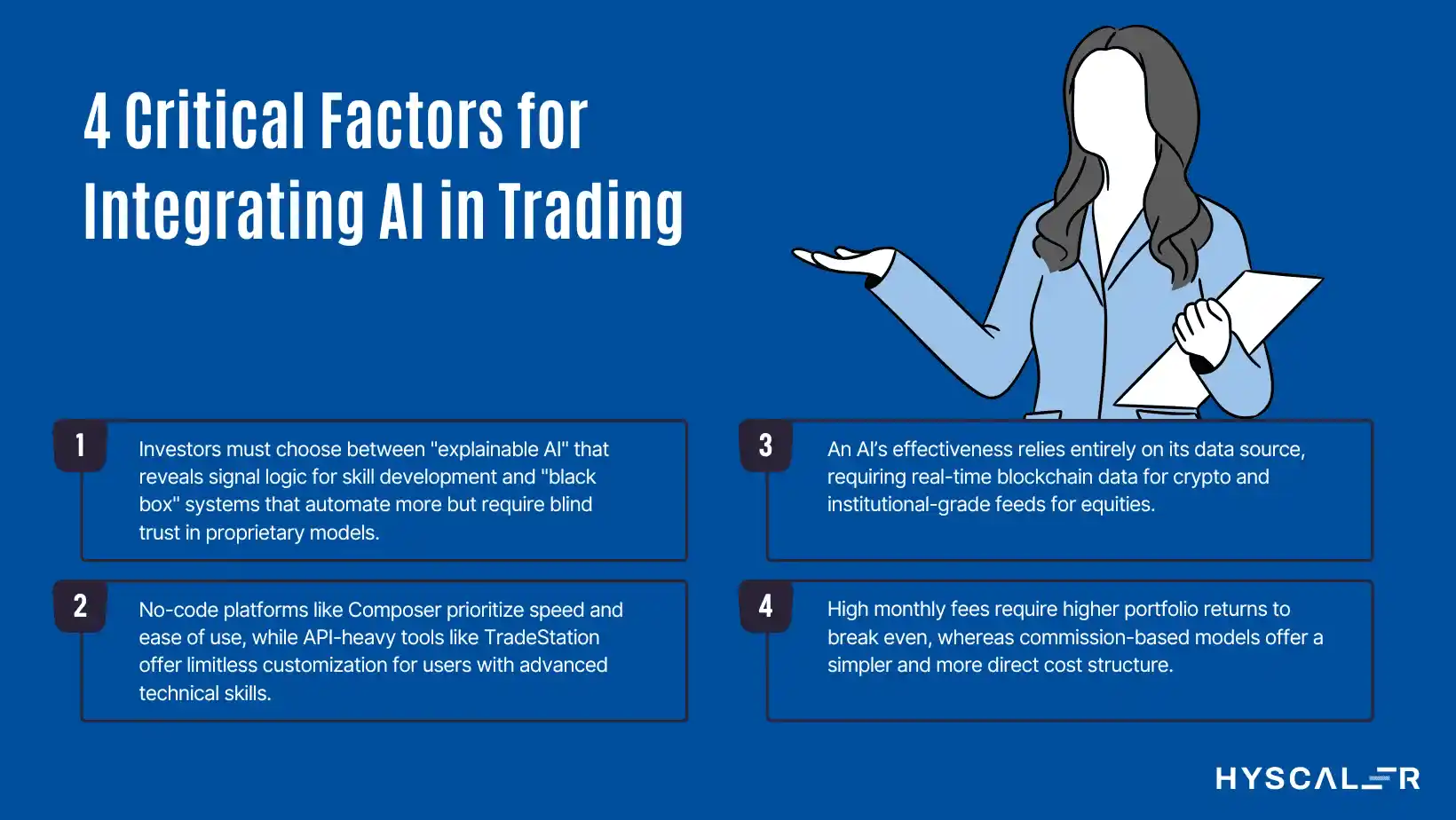
Clearly define your trading goals for successful AI integration. Before committing capital, evaluate these four critical factors.
- Accuracy vs. Transparency: “Explainable AI” (like Tickeron) reveals signal logic. This is vital for long-term skill development. Conversely, fully managed systems (like AlgosOne) automate more. Yet, they require trust in proprietary models, which is why regulatory compliance and transparent performance reporting are essential.
- Ease of Use vs. Customization: No-code platforms like Composer offer speed. However, API-heavy tools such as TradeStation provide limitless customization. Therefore, select the tool matching your technical skill.
- Data Integrity: An AI’s effectiveness relies solely on its data source. Prioritize platforms that leverage real-time blockchain data for crypto. Moreover, seek institutional-grade feeds for equities.
- Broader Market Context: Beyond the trading strategy itself, the quality and range of information used for analysis can influence investment decisions. AI-powered research platforms such as Prospero.ai bring together signals from areas such as institutional activity, options sentiment, and market behavior, giving investors additional context when evaluating potential opportunities. Using these insights alongside other research can help create a more balanced view of changing market conditions.
- Operational Cost: High monthly fees (e.g., Trade Ideas) demand much higher portfolio returns to break even. Conversely, commission-based models like AlgosOne present a simpler cost structure.
Strategic Tips for App Selection & Implementation
An AI tool is only as effective as the strategy it serves. Use these steps to ensure a successful deployment:
- Match the Tool to the Asset: Use 3Commas or ChainGPT for Crypto; use Trade Ideas or TradeStation for Stocks and Futures.
- Audit the Risk Controls: Ensure the platform has capital safeguards, such as Tickeron’s “Virtual Agents” for position sizing or AlgosOne’s “Reserve Fund” for catastrophic protection.
- Implement Hedging Strategies: Use AI to identify market regimes where you should switch to “Inverse ETFs” or “Short Bias” robots to protect your portfolio during downturns.
- Leverage Paper Trading: Never deploy a new AI strategy with live capital until it has been “forward tested” in a demo environment for at least 14 days.
Safety, Compliance, and the “Human Oversight” Mandate
Automation does not equal an absence of risk. AI trading is legal in most jurisdictions and is monitored by bodies like the SEC (U.S.) and FCA (U.K.) to ensure market fairness. However, the user remains the primary responsible party for all executed trades.
- Tax Considerations & Tax-Loss Harvesting: AI bots execute trades, but they do not manage your tax liability. However, 2026-era fintech tools can assist in Tax-Loss Harvesting, automatically selling losing positions to offset gains. Users must integrate their trading apps with platforms like Koinly to track these gains and losses for local tax authorities.
- The Human Element: AI should be viewed as a decision-support tool, not a “set and forget” income stream. Market conditions change, and human judgment is required to ensure the AI remains within the user’s intended risk parameters.
FAQs
What is AI trading?
AI trading is the use of artificial intelligence and machine learning to analyze market data, identify investment opportunities, and automatically execute trades. Unlike traditional rule-based systems, modern AI adapts to changing market conditions in real-time, learning from every trade. By 2026, AI-driven algorithms will facilitate 60–89% of global equity trading volume.
Is AI trading legit and safe?
Yes, AI trading is legal and legitimate in the U.S., U.K., and most major markets. Platforms must comply with SEC, FCA, and FINRA regulations. Regulated brokers like Alpaca offer SIPC protection up to $500,000 for cash and securities.
However, “safe” does not mean “risk-free.” Users face risks such as software errors, connectivity failures, and cybersecurity concerns. The key is using platforms that connect to regulated brokerages rather than custodying your funds directly.
Do I need coding skills?
No. Platforms like Composer and AInvest are built for no-code users. However, if you want full customization, tools like TradeStation (EasyLanguage) or 3Commas (Pine Script) provide that depth.
Can I trust the predictions?
AI is a tool, not a guarantee. Top-tier models achieve approximately 60% accuracy in predicting financial performance (University of Chicago, 2024), but their success depends on the quality of the underlying model, the data it’s trained on, and current market volatility. For maximum reliability, use platforms with transparent, explainable AI like Tickeron or Danelfin that show the logic behind their signals.
Can AI really make money trading stocks?
Yes, it is possible to make money using AI trading, provided you use a well-tested strategy and manage risk appropriately. Some AI systems have documented strong historical performance; for instance, Zen Ratings’ A-rated stocks have historically delivered average annual returns of 32.52% since 2003, and Danelfin reports a 263% return since 2017.
However, there are no guaranteed profits, and results depend heavily on the quality of the AI model and current market conditions.
What is the best free AI trading app?
Pionex is the best free AI trading app for most users, offering 16 built-in trading bots at zero subscription cost; users only pay a 0.05% trading commission. Several other platforms offer high-quality free options:
1. Trade Ideas: Offers a “Par Plan” that is free forever with delayed market data.
2. WallStreetZen: Provides its Zen Ratings (A–F stock grades) for free to research individual stocks.
3. Superalgos: A completely free and open-source platform for technically skilled users who want to build their own systems.
How much money do you need to start AI trading?
You can start AI trading with $0 in some cases. Capital requirements vary significantly by platform:
– $0 Minimum: Brokerages like Alpaca or Public allow you to start with no minimum deposit.
– Small Amounts: Platforms like Pionex allow users to begin automated trading with as little as $100.
– Institutional Tiers: More advanced platforms or specific account types (like TradeStation’s TS Plus) may require a minimum balance of $2,000 or more for full automation.
Generally, capital requirements range from a few hundred dollars to over $10,000, depending on your chosen strategy and platform.
Which AI trading app is best for beginners?
3Commas is the best overall AI trading app for beginners due to its user-friendly interface and educational resources, though RockFlow is ideal for complete novices thanks to its AI assistant “Bobby” that explains trading concepts in plain language.
Other strong options for beginners include:
– Pionex: Recommended for those who want a simple setup with pre-configured bots.
– AInvest: Focused on ease of use with a virtual analyst named “Aime” that answers investment queries.
How accurate are AI trading predictions?
AI trading models typically achieve about 60% accuracy in predicting financial performance, according to research from the University of Chicago. They process millions of data points and identify patterns humans might miss.
Some platforms report higher “win rates”; for example, Danelfin reports a win rate of 60%+, and Tickeron reports win rates of up to 86.6% over certain periods. A study in the Journal of Financial Economics found that AI models outperformed human analysts in 54.5% of stock return predictions.
However, accuracy is limited by data quality and can deteriorate during unpredictable “black swan” events or sudden regime changes that fall outside historical training data.
Are AI trading bots legal in the US?
Yes, AI trading bots are fully legal in the United States. They are monitored by regulatory bodies like the SEC and CFTC to ensure market fairness. While individuals can freely use these tools, financial institutions must remain compliant with specific regulations regarding automated decision-making.
What is the best AI for day trading?
Trade Ideas is the best AI platform for day trading in 2026. Its proprietary AI engine, “Holly,” runs millions of simulated trades nightly to provide curated, high-probability signals for the following day. Tickeron is also highly rated for day trading due to its AI Robots that scan for breakout patterns in real-time.
Can AI trade crypto automatically?
Yes, AI can trade crypto automatically around the clock. Specialized platforms like 3Commas, WunderTrading, and ChainGPT offer bots that execute strategies 24/7 across multiple exchanges. Platforms like Tickeron can also automate the buying and selling of crypto assets based on their predictive models.
Do AI trading apps actually work?
AI trading apps work effectively for data analysis and removing emotional bias, allowing traders to execute strategies faster and more consistently than humans. However, their success depends entirely on the bot’s design, the quality of the data, and the user’s ability to manage risk.
Most experts recommend using AI as a “co-pilot” rather than a fully independent decision-maker. Industry data shows that while AI powers 60–89% of institutional trading volume, over 90% of consumer-grade automated bots fail in the long term, making human oversight essential.
Conclusion
The AI trading landscape in 2026 offers unprecedented opportunities for retail investors to access institutional-grade intelligence. From Trade Ideas’ adaptive Holly engine to Public.com’s natural-language Agentic Brokerage, the tools available today can genuinely transform how you research, execute, and manage your portfolio.
However, the critical lesson from our analysis is clear: AI is a powerful co-pilot, not an autopilot. The most successful traders in 2026 will be those who pair AI’s speed and pattern recognition with human judgment on macroeconomic context, risk tolerance, and ethical investing.
Choose a platform that matches your trading style, start with a free tier or trial period, and always maintain human oversight over your capital.
Disclaimer: Trading involves significant risk. Past performance never guarantees future results. Remember, AI tools should support human judgment, not replace it.