

Table of Contents
Considering E-Commerce re-platforming for your website? This strategic move can elevate your site’s performance, unlock new technologies and features, increase sales, and more effectively meet your customers’ needs. However, navigating a successful e-commerce platform migration demands careful planning.
This guide will cover the six essential steps your business must undertake for a smooth e-commerce re-platforming journey. We’ll dive into recognizing the right time for re-platforming.
What is E-commerce Re-platforming?
E-commerce re-platforming involves transitioning your online store to a different e-commerce platform. This extensive process encompasses not just a website’s redesign and redevelopment but also the migration of data, incorporation of new systems, and thorough testing of the updated site.
Why Do Businesses Re-platform?
The primary goals of e-commerce re-platforming are to:
- Boost site performance: Faster load times, improved scalability, and better reliability during peak traffic.
- Access cutting-edge features: Leverage modern capabilities such as AI-driven personalization, headless commerce, and omnichannel selling.
- Meet evolving business & customer needs: Align the platform with your current growth strategy and the rising expectations of today’s digital shoppers.
While re-platforming demands a considerable investment of time and resources, the long-term advantages of improved
conversions, reduced technical debt, and greater operational efficiency make it a worthwhile and strategic move for any e-commerce
business ready to scale, and once on a modern platform, adding a referral tool like ReferralCandy helps turn that improved performance into a repeatable source of new customers.
E-commerce Re-platforming: The 6 Essential Steps to Transforming Your Online Store
1. Crafting the User Experience (UX)
The journey of e-commerce re-platforming begins with sculpting an impeccable user experience (UX). The challenge of designing an e-commerce website lies in visualizing the shopping journey your customers prefer.
- Start by defining the optimal online shopping experiences you aim to offer. This clarity guides the creation of a web design conducive to these experiences. Businesses building an online marketplace need to consider features that facilitate interactions between multiple buyers and sellers while maintaining a seamless user journey. Depending on your unique business needs and customer journey, the complexity of this step can vary.
- For a more personalized touch, engaging with a UX or Graphic Designer might be necessary to develop mockups or prototypes that encapsulate the desired online experience.
- This design process usually involves iterations based on team feedback until a final design is approved.

2. Developing the Website
With your store’s design blueprint in hand, the next critical phase of e-commerce re-platforming is the development or construction of your site. The duration and complexity of this process are largely influenced by the degree of customization your business requires.
- While some may find solace in using a standard website template supplemented by apps for additional functionality, this approach often presents limitations in flexibility.
- Thus, a web developer‘s expertise in front-end languages (HTML, CSS, JavaScript) becomes invaluable in bringing unique design elements to life on your e-commerce platform.
- Developers leverage mockups or prototypes from the UX design phase to ensure accuracy and efficiency. This development typically unfolds within a local development environment, supported by a cloud-based versioning repository and a command-line interface to seamlessly integrate changes into the live environment.

3. Navigating Data Migration
The journey to your new e-commerce site involves a critical phase: data migration. This stage is pivotal in e-commerce re-platforming, where the focus is on transferring your existing data to the new site. The complexity and time investment required for a successful migration varies significantly, often representing the most challenging aspect of re-platforming.
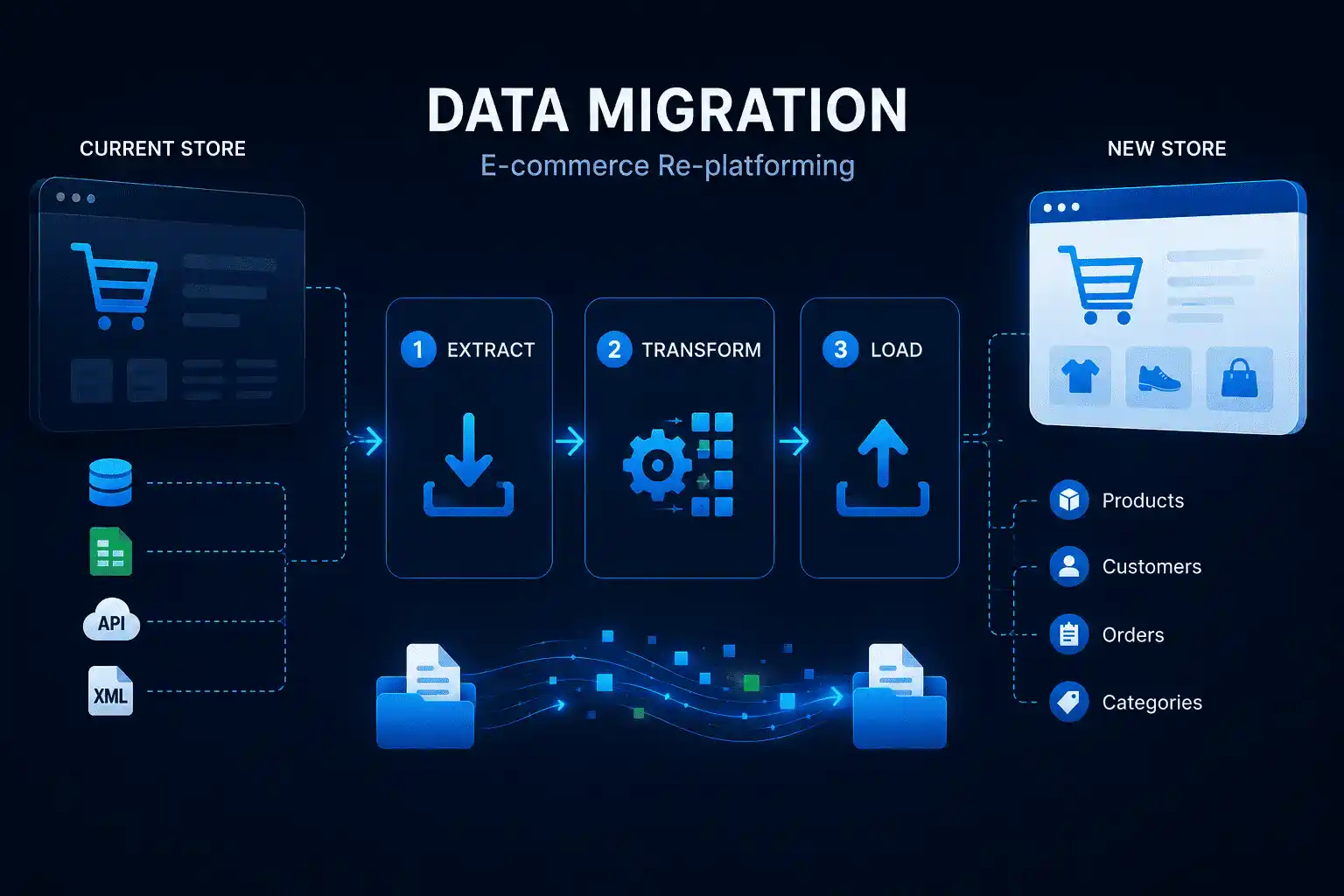
Data migration in e-commerce re-platforming is typically achieved through a three-stage ETL (Extract, Transform, Load) process:
- Extract: The first step is identifying and accessing the data to be migrated. Whether it’s stored in a local database, available for export to spreadsheets, or accessible through an API, understanding how to retrieve this data is crucial.
- Transform: Adapt your data to fit the new platform’s requirements. This process might involve renaming column headers or converting the data format (e.g., from XML to CSV) to align with the new system’s specifications.
- Load: This final step is executed in two stages: an initial partial load to test data structure and compatibility, followed by the final load to complete the migration. This ensures your new website is updated with the latest data, including customer accounts and orders, right before launch.
4. Ensuring SEO Success Post-Migration
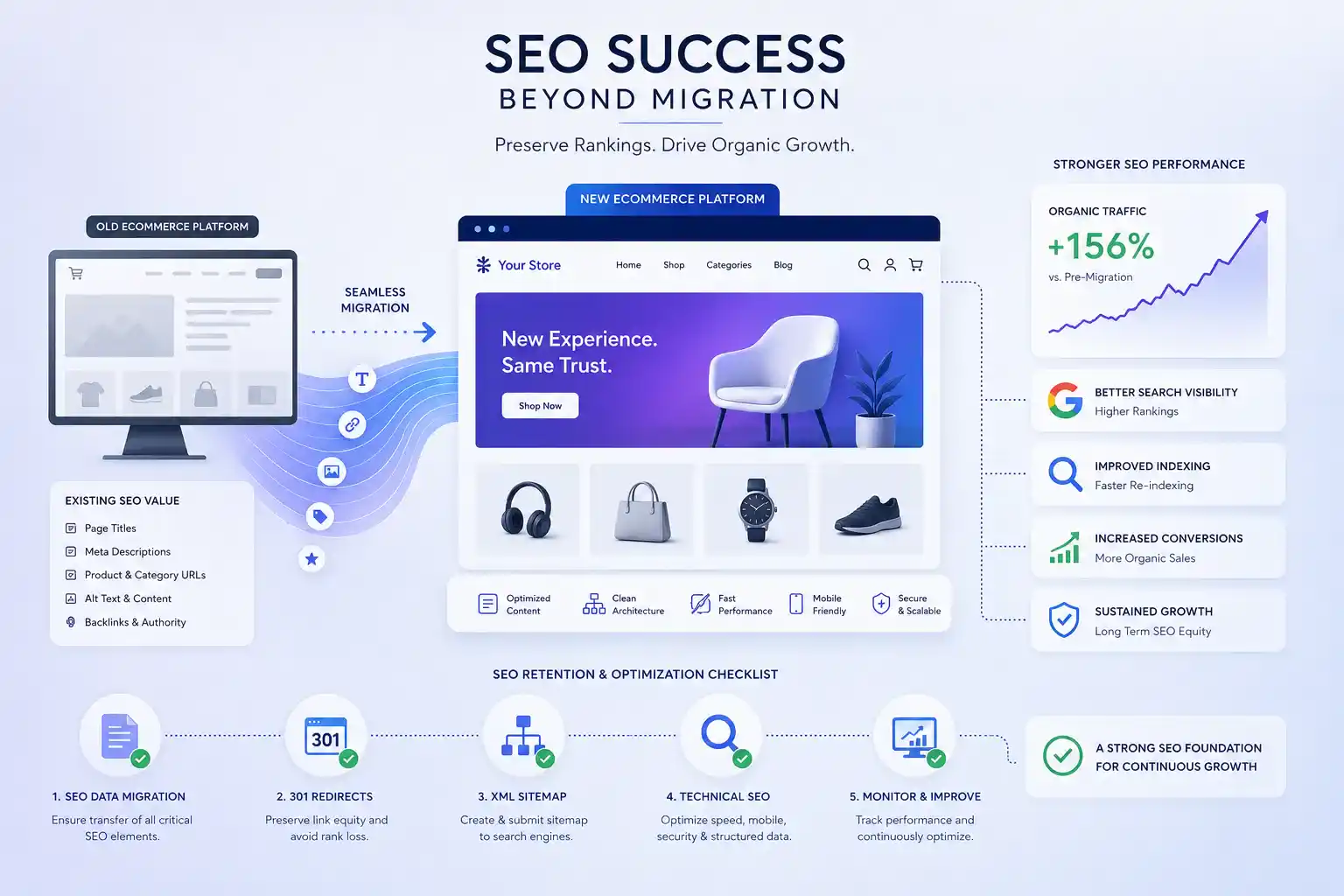
Optimizing your new e-commerce platform for search engine optimization (SEO) is a critical step in the re-platforming process. Effective eCommerce marketing plays a vital role during and after re-platforming, ensuring that your new store not only functions well but also attracts and converts customers consistently.
- Since search engines continuously refine their algorithms to deliver optimal search results, incorporating SEO best practices into your new site is non-negotiable for its success.
- It’s also crucial for your data migration team to ensure the seamless transfer of all SEO-related data, including titles, meta descriptions, and fields. With potential changes in URL structure, setting up 301 redirects is essential to maintain link integrity and search ranking.
- Lastly, creating and submitting an XML sitemap as part of your site launch can prompt search engines to re-index your site, minimizing any disruptions in search visibility.
5. Systems Integration
E-commerce re-platforming enters a crucial phase with systems integration once the initial data set is loaded into your development site. This stage often includes connecting your site to external systems, many of which offer plug-and-play connectors compatible with a variety of shopping cart platforms. Collaborating with specialists in paid social for ecommerce can also enhance this phase by aligning marketing data and advertising platforms with your new e-commerce system, ensuring seamless performance tracking and campaign optimization.
The integration process begins with mapping out the data flow: identifying what information is transferred, its destinations, and the timing. With this blueprint, you can explore various integration methods, including:
- Developing tailored API connections.
- Utilizing available connectors, apps, plugins, or cartridges.
- Implementing middleware or an iPaaS (Integration Platform as a Service) solution.
- Setting up automated tasks via cron jobs or managing flat file imports.
- Manually formatting files for import and export.

6. User Acceptance Testing
User Acceptance Testing (UAT) or Quality Assurance (QA) marks the culmination of an e-commerce re-platforming initiative. This critical phase involves rigorous testing of your revamped website across various devices, browsers, and usage scenarios to guarantee a smooth transition at launch.
- Leveraging Google Analytics and modern behavioural analytics tools to gain insights into user behaviour can enhance this process. Moreover, inviting a select group of customers to beta test the new platform can provide invaluable real-world feedback before a full public launch.
- Despite thorough testing, it’s almost impossible to anticipate every unique use case. Occasionally, a user might interact with your site unexpectedly, offering immediate and useful feedback post-launch.
- This unpredictability underscores the importance of having a robust support system, including your agency partner, systems integrator, e-commerce platform’s customer success team, and technical support, ready to address and rectify any issues swiftly after go-live.

Conclusion
E-commerce re-platforming is a multifaceted process that requires meticulous planning, execution, and post-launch support. User Acceptance Testing (UAT) stands as a pivotal final step, ensuring that the platform is robust, user-friendly, and ready for the diverse ways customers will interact with it.
As you embark on this journey, remember that e-commerce re-platforming is not just about technology but also about enhancing the user experience, streamlining operations, and setting the stage for future growth. With the right approach and support, your e-commerce platform will not only meet but exceed expectations, paving the way for continued success in the digital marketplace.
FAQ’s
When is the right time to consider e-commerce re-platforming?
Consider re-platforming when your current platform hinders growth, struggles with performance, or lacks modern integrations. A major business shift, like entering new markets or scaling operations, is also a strong signal that it’s time to switch.
How long does an e-commerce re-platforming project typically take?
A simple migration can take 2–3 months, while complex projects with custom development and large data volumes can extend to 6–12 months. The timeline depends largely on your store’s size, customization needs, and integration complexity.
How much does e-commerce re-platforming cost?
Costs can range from a few thousand dollars for a basic migration to hundreds of thousands for enterprise-level projects. Key cost drivers include custom development, data migration, UX design, and ongoing platform licensing fees.
How do I choose the right e-commerce platform for my business?
Audit your current pain points and future needs, such as scalability, integrations, and budget, before evaluating platforms like Shopify, Magento, or BigCommerce. If Shopify makes your shortlist, it helps to see how the costs and build process for an India store actually break down. Choose based on total cost of ownership, ease of use, and the platform’s ability to grow with your business.
Will re-platforming negatively impact my SEO rankings?
It can, if SEO isn’t carefully managed during the transition. Protect your rankings by migrating all metadata, setting up 301 redirects for changed URLs, and submitting a fresh XML sitemap immediately after launch.
What are the most common mistakes to avoid during e-commerce re-platforming?
The biggest pitfalls are underestimating data migration complexity, neglecting SEO, and rushing into launch without sufficient testing. Always have a rollback plan and ensure thorough QA before going live.
What data needs to be migrated during re-platforming?
You’ll need to migrate product catalogs, customer accounts, order history, promotional codes, and SEO data such as URLs and meta descriptions. Depending on your store, subscription data, loyalty program details, and custom attributes may also need to be transferred.
How do I ensure systems integrations work correctly on the new platform?
Document all existing integrations: ERP, CRM, payment gateways, and shipping tools, and verify compatibility with your new platform early in the process. Test every integration thoroughly in a staging environment before going live.