

Table of Contents
An autonomous AI software engineer is an AI system that takes a stated goal, “add multi-currency support to the checkout flow”, and independently plans the work, writes the code, tests it, debugs failures, and prepares it for deployment, checking back with a human at defined approval points rather than after every keystroke.
It differs from a coding assistant like GitHub Copilot in one key respect: a coding assistant completes what you’re typing, while an autonomous agent decides what to type next on its own, across many files and many hours, without a person driving each step.
Enterprises care because the promise isn’t faster autocomplete; it’s compressing the distance between “we need this feature” and “this feature is tested and ready for review.”
Organizations are increasingly experimenting with agents to automate discrete tasks, particularly in areas such as software engineering, customer support, and operations, and 2026 is the year this moves from lab demo to a standard line item in enterprise AI roadmaps.
TL;DR
- Definition: An AI system that plans, codes, tests, debugs, and helps deploy software with minimal step-by-step supervision.
- Key capabilities: requirement analysis, architecture planning, code generation, automated testing, debugging, documentation, and CI/CD-assisted deployment.
- Business benefit: faster iteration cycles, reduced repetitive engineering work, and more consistent documentation, under human governance.
- Limitations: hallucinated logic, security exposure, weak long-term context, and no substitute for human accountability on production systems.
- Outlook: multi-agent engineering teams and tighter human-AI collaboration, not full replacement of engineers.
What is an autonomous AI software engineer?
The category grew directly out of the AI coding assistant, but the two behave differently enough that treating them as the same thing causes real confusion in planning conversations.
An autocomplete-style AI assistant (Copilot, early Cursor) predicts the next few lines of code based on what you’re already writing.
It has no independent plan; you are still the one deciding what file to open, what function to build next, and when the work is finished.
An autonomous engineering agent instead accepts a goal, breaks it into a sequence of tasks, and executes that sequence itself: writing code, running it, reading the error output, and revising, often across a full sprint’s worth of work before a human reviews the result.
The defining characteristics are goal-directed planning, tool use (running terminal commands, executing tests, querying documentation), persistence across a multi-step task, and, critically, a human checkpoint before anything reaches production.
For a deeper look at how this fits into a broader agentic AI build, see HyScaler’s AI and ML services, which cover agentic AI and MCP-based agent development.
Why autonomous AI software engineers are emerging in 2026
Several trends converged to make this category viable now rather than three years ago.
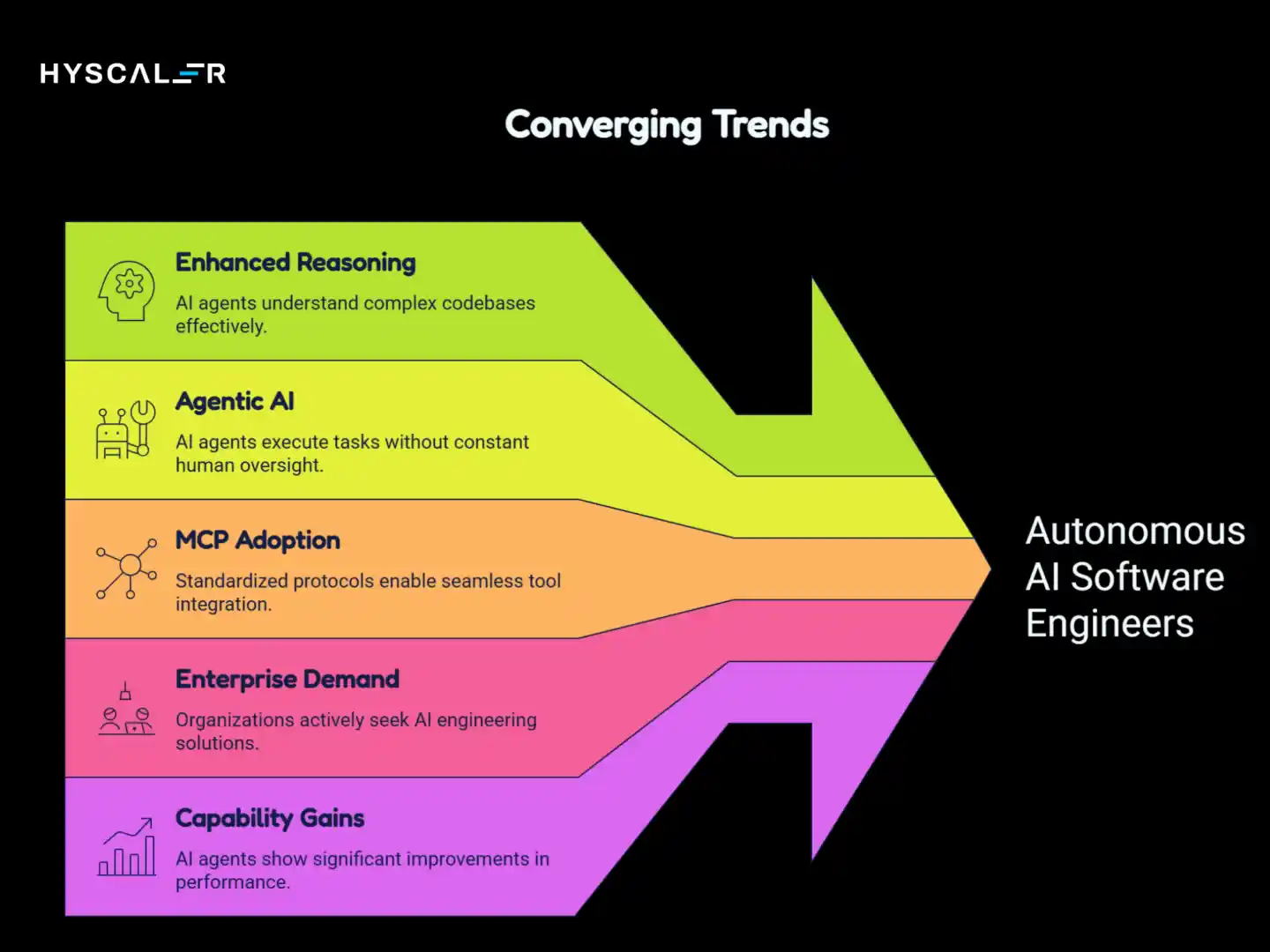
Better reasoning and longer context – Coding agents can now hold an entire codebase’s relevant context in working memory across a session, which is what lets them make changes that respect existing architecture instead of generating isolated snippets.
Agentic AI has gone from research to a production pattern – Autonomous agents capable of multi-step reasoning, tool use, and task execution without constant human oversight are treated as the frontier of enterprise generative AI development, though they reduce operational workload when built correctly and introduce real risk when built carelessly.
MCP (Model Context Protocol) adoption – MCP gives agents a standard way to connect to repositories, ticketing systems, and internal tools, which is what turns a chat-based coding assistant into something that can actually open a pull request or query a production log.
Real enterprise demand – The 2026 Gartner CIO and Technology Executive Survey found only 17% of organizations have deployed AI agents to date, yet more than 60% expect to do so within the next two years, the most aggressive adoption curve among all emerging technologies measured, with software engineering, customer support, and operations as the leading experimentation areas.
Measurable capability gains – A peer-reviewed study found coding agents active in an estimated 22.2% to 28.66% of sampled GitHub projects by February 2026, up from roughly 16–23% in 2025, while agent task success on the OSWorld benchmark jumped from about 12% to roughly 66% per the 2026 Stanford AI Index.
But adoption is running ahead of maturity.
Gartner also expects more than 40% of agentic AI projects to be canceled by the end of 2027 due to escalating costs, unclear business value, or inadequate risk controls, a signal that the technology curve and the governance curve haven’t caught up with each other yet.
Autonomous AI software engineer vs. traditional AI coding assistant
They’re often marketed as the same thing.
They aren’t.
| Capability | Coding assistant (Copilot-style) | Autonomous AI engineer |
|---|---|---|
| Understands the goal, not just the prompt | Limited | Yes |
| Plans multi-step work | No | Yes |
| Writes code | Yes | Yes |
| Tests automatically | No | Yes |
| Fixes its own bugs | No | Yes |
| Executes terminal commands | Rarely | Yes |
| Works across a full repository | Limited | Yes |
| Opens pull requests | No | Yes (with approval) |
| Retains long-term task memory | No | Yes, within a session/task |
| Needs human supervision | Constant | At checkpoints |
| Enterprise readiness today | High | Emerging, pilot-stage |
Developers themselves reflect this gap in trust.
In the 2025 Stack Overflow Developer Survey, the most recent full-scale read on how working engineers actually feel, more developers actively distrust the accuracy of AI tools (46%) than trust it (33%), and only 3% report highly trusting the output; the number-one frustration, cited by 66% of respondents, is “AI solutions that are almost right, but not quite,” which often leads directly into the second-biggest frustration, that debugging AI-generated code is more time-consuming than expected (45%).
That gap is exactly why the “human review” stage in an autonomous engineering workflow isn’t optional; it’s the whole reason the category is trustworthy at all.
Core capabilities of an autonomous AI software engineer
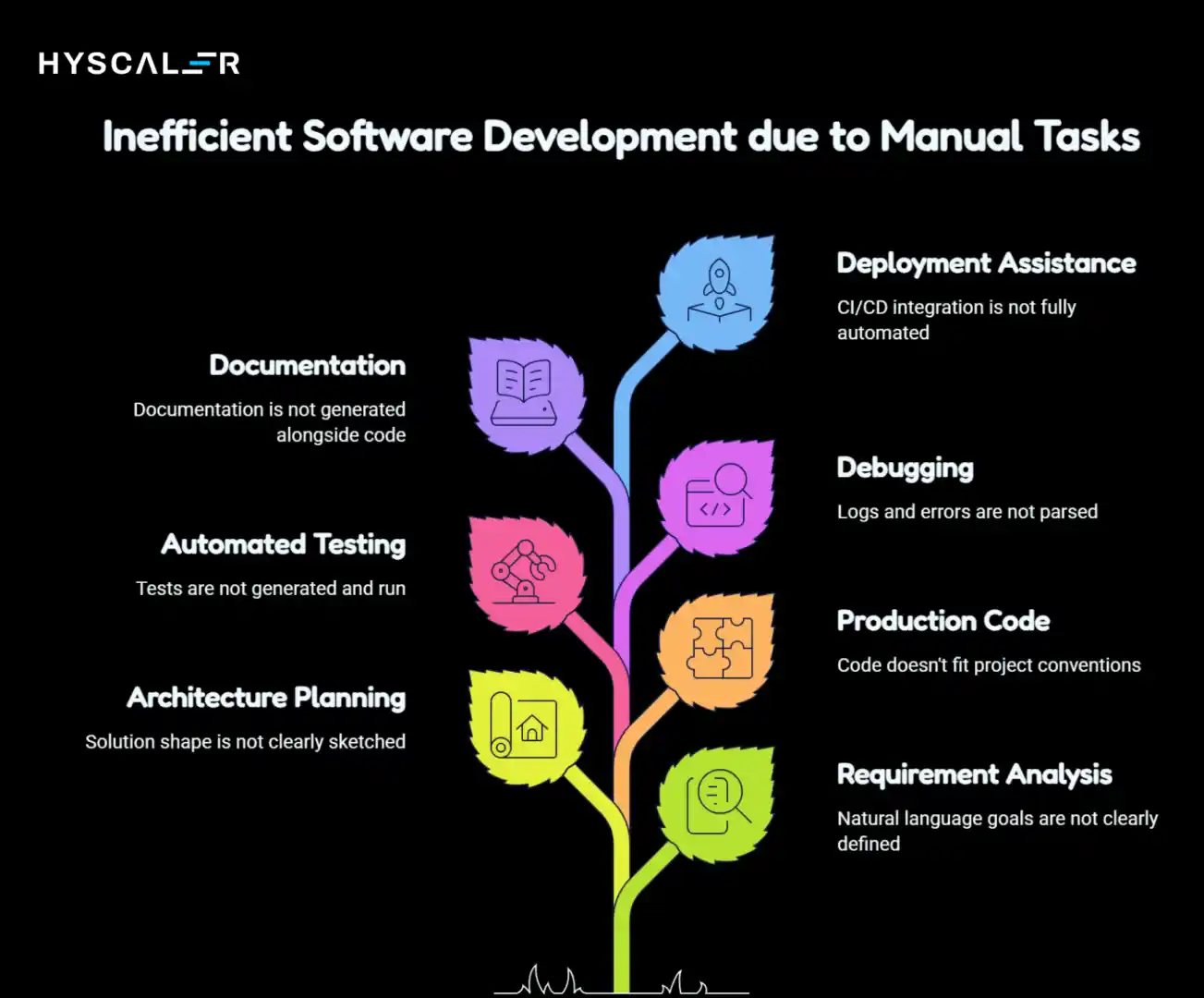
Requirement analysis – The agent parses a natural-language goal, a ticket, or a spec document and translates it into discrete, testable tasks.
Architecture planning – Before writing code, mature agents sketch the shape of the solution: which services are touched, what the data model looks like, where the new logic belongs.
Writing production code – This spans backend logic, frontend components, API contracts, database schema changes, and infrastructure-as-code; the agent is expected to produce code that fits the project’s existing conventions, not a generic solution.
Automated testing – Agents generate and run unit tests, integration tests, and regression tests against the code they just wrote, closing the loop before a human ever sees the change.
Debugging – Beyond running tests, agents parse logs, stack traces, and runtime errors to isolate root causes, including dependency conflicts that would otherwise take an engineer an afternoon to track down.
Documentation – API references, README files, architecture notes, and technical specs are generated alongside the code, which is one of the more consistently valuable outputs since documentation is the task engineering teams most often skip under deadline pressure.
Deployment assistance – Agents can integrate with CI/CD pipelines to stage builds and prepare releases, but production deployment approval remains a human decision in nearly every serious enterprise implementation; this is not full autonomy, and reputable vendors don’t market it as such.
How autonomous AI software engineering works
Put together, the stages form a loop rather than a straight line; the agent returns to earlier stages when tests fail, code review flags issues, or monitoring surfaces a regression.
Each stage carries its own decision point.
Task planning turns a business goal into a scoped backlog.
Architecture sets the technical shape before code exists.
Coding and testing run in the tight loop shown earlier.
Debugging resolves what testing surfaces.
Code review, increasingly a hybrid of automated static analysis and human sign-off, gates what reaches deployment approval, where a person authorizes the release.
Monitoring closes the loop, feeding real-world behavior back into the next planning cycle.
Key technologies behind autonomous AI software engineers
- Large language models: the reasoning core that interprets goals and generates code.
- Agentic AI frameworks: the orchestration layer that turns a single LLM call into a persistent, multi-step task.
- Model Context Protocol (MCP): a standardized way for agents to connect to repositories, ticketing tools, and internal systems. See HyScaler’s take on MCP-based agents.
- Retrieval-augmented generation (RAG): grounds the agent’s decisions in your actual codebase and documentation rather than general training data. HyScaler’s RAG development work covers this pattern in depth.
- Vector databases: power the semantic search that lets an agent find relevant code across a large repository.
- Multi-agent systems: specialized agents (planner, coder, tester, reviewer) collaborating under central coordination. HyScaler’s generative AI development services piece covers where this pattern is heading.
- Long context windows: the memory span that lets an agent hold an entire feature’s worth of code and history in view.
- Code execution sandboxes: isolated environments where the agent can safely run and test code before it touches production.
- Memory systems: persistent state across a session so an agent doesn’t lose track of decisions made three steps earlier.
Both Forrester and Gartner identify 2026 as the breakthrough year for multi-agent systems, where specialized agents collaborate under central coordination rather than one generalist agent trying to do everything.
Single-agent systems held roughly 59% market share in 2025, a share expected to shrink as multi-agent patterns mature.
Real enterprise use cases
| Use case | Problem | AI role | Human oversight | Outcome |
|---|---|---|---|---|
| SaaS product development | New features compete with maintenance for engineering time | Builds and tests feature branches from specs | PM/tech lead approves scope and merges | Faster feature velocity |
| Internal enterprise apps | Internal tools are chronically under-resourced | Builds and maintains low-visibility internal tools | IT reviews security and access | Reduced backlog |
| Legacy modernization | Old codebases resist change and lack documentation | Maps dependencies, proposes refactors incrementally | Architect validates each migration step | Lower modernization risk |
| QA automation | Manual regression testing doesn’t scale | Generates and maintains test suites | QA lead reviews coverage gaps | Broader, more consistent coverage |
| API development | New integrations are repetitive to hand-build | Scaffolds endpoints, generates client SDKs | Engineer reviews contracts and auth | Faster integration delivery |
| Cloud infrastructure automation | Infra changes are error-prone and slow | Drafts and validates infrastructure-as-code | DevOps approves before applying | Fewer manual misconfigurations |
| Data engineering | Pipelines break silently and are costly to maintain | Builds and monitors ETL/ELT pipelines | Data engineer validates schema changes | More resilient pipelines |
| Healthcare software | Compliance requirements slow every change | Drafts compliant code patterns, flags PHI risk | Compliance and clinical review required | Faster, safer iteration |
| Financial software | Regulatory and audit requirements are heavy | Generates auditable code with test trails | Risk and compliance sign-off | Stronger audit readiness |
Benefits for enterprises
| Challenge | AI capability | Business value |
|---|---|---|
| Slow development cycles | Autonomous planning and coding | Faster time to working code |
| Repetitive engineering work | Automated scaffolding and boilerplate generation | Engineers focus on harder problems |
| Inconsistent documentation | Auto-generated docs alongside code | Better long-term maintainability |
| Slow debugging | Automated log and stack trace analysis | Reduced mean time to resolution |
| Inconsistent code quality | Standardized patterns and automated review | More predictable output |
| Knowledge loss on team turnover | Persistent documentation and decision logs | Retained institutional knowledge |
| Fixed engineering capacity | On-demand scalable engineering support | Flexibility during demand spikes |
Current limitations
This section matters more than the benefits table, because it’s where trust is either earned or lost.
- Hallucinations. Agents can generate plausible-looking code that references functions, libraries, or APIs that don’t exist, or that subtly misunderstands business logic.
- Security risks. Autonomous execution of terminal commands and dependency installation introduces an attack surface that didn’t exist with a human typing line by line; 48% of cybersecurity professionals named agentic AI the top attack vector for 2026 in one industry poll.
- Context limitations. Even long-context models lose fidelity across very large, legacy-heavy codebases with tangled or undocumented dependencies.
- Compliance. Regulated industries can’t treat AI-generated code as pre-approved; every change still needs to map to an audit trail.
- Business logic validation. An agent can write code that passes its own tests while still misunderstanding what the business actually needs.
- Human approvals remain necessary for anything touching sensitive production systems or regulated data, and for any change with legal, financial, or safety consequences.
Developers’ own resistance tracks these risks closely: in the 2025 Stack Overflow survey, 76% of respondents said they don’t plan to use AI for deployment and monitoring, and 69% said the same for project planning; the tasks with the highest stakes are exactly the ones where human judgment is least willing to step back.
Human engineers vs. autonomous AI software engineers
The honest framing is division of labor, not replacement.
Autonomous agents are strong at repetitive, well-specified, pattern-heavy work.
Humans remain essential for:
- Product strategy: deciding what to build and why, not just how
- Architecture trade-offs: judgment calls with no clean right answer
- Stakeholder communication: translating business needs into technical scope
- Security decisions: assessing risk in ways that go beyond passing tests
- Ethical judgment: recognizing when a technically correct solution is still the wrong one
- Innovation: original problem framing, not pattern completion
- Final accountability: someone has to own the outcome, and that someone is still a person
Industries seeing the fastest adoption
SaaS, FinTech, healthcare, manufacturing, retail, logistics, government, and telecommunications are the sectors moving fastest, generally those with either high engineering headcount costs or large volumes of repetitive, well-specified engineering work (API integrations, compliance-driven documentation, data pipeline maintenance) that autonomous agents handle well under supervision.
Best practices for implementing autonomous AI software engineers
- Define clear task boundaries before assigning any goal
- Keep humans in approval loops for deployment and anything touching production data
- Use secure, access-controlled repositories for agent-facing code
- Protect secrets and credentials from agent tool access
- Audit generated code before merge, not just before deploy
- Monitor quality metrics over time, not just per-task success
- Track AI decisions with the same rigor as human decisions
- Maintain governance as adoption scales, not just at pilot stage
How HyScaler helps enterprises build autonomous AI engineering solutions
HyScaler works as an AI agent development partner and enterprise AI consultant for organizations moving from pilot to production with agentic engineering tools.
That includes AI agent development and MCP-based agent architectures, RAG system development to ground agents in proprietary knowledge, secure enterprise integrations, and AI governance frameworks that keep human approval where it belongs.
HyScaler pairs this with deep custom software development, cloud engineering, and data engineering capability, all delivered under CMMI Level 5 process maturity.
If your team is weighing where autonomous AI engineering fits into your 2026 roadmap, talk to HyScaler about an AI strategy review.
Future of autonomous AI software engineering
These are industry directions, not guaranteed outcomes:
- Multi-agent engineering teams, specialized agents (planner, coder, tester, security reviewer) working in coordination rather than one generalist agent
- Self-healing systems, agents that detect and patch certain classes of production issues automatically, within tight guardrails
- AI-driven architecture optimization, agents suggesting structural improvements based on usage patterns, not just fixing bugs
- Autonomous testing pipelines, test coverage that expands itself as code changes, rather than lagging behind it
- Human-AI collaborative development, the likely default mode for most enterprise teams well beyond 2026, rather than either fully manual or fully autonomous engineering
Conclusion
Autonomous AI software engineers are best understood as collaborators that automate substantial portions of the engineering workflow, planning, coding, testing, debugging, and documentation, under human oversight, not as replacements for engineering judgment.
The data backs a measured read: adoption is accelerating fast, trust is lagging behind it, and Gartner’s own forecast that over 40% of agentic AI projects will be canceled by 2027 is a useful check against overpromising.
Organizations that adopt these tools with clear governance, defined approval gates, and realistic scope tend to see genuine productivity gains without giving up code quality or accountability.
If you’re evaluating where autonomous AI engineering fits into your organization’s roadmap, HyScaler’s AI and ML team can help you scope a pilot, review security implications, and build the governance structure to scale it safely.
FAQ
What is an autonomous AI software engineer?
An AI system that plans, writes, tests, and debugs software from a stated goal, checking in with a human at key decision points rather than after every step.
Is it different from GitHub Copilot?
Yes. Copilot completes code as you type; an autonomous agent independently plans and executes multi-step engineering tasks with far less step-by-step direction.
Can autonomous AI replace software engineers?
Not currently, and not in most 2026 enterprise deployments; these systems are best understood as collaborators handling well-specified engineering work under human oversight, not as a substitute for engineering judgment.
Can enterprises trust autonomous AI?
Trust is earned through governance, not assumed. Human review, audit trails, and scoped permissions are what make autonomous agents usable in production environments today.
How secure are autonomous AI engineers?
Security depends heavily on implementation. Autonomous execution introduces a new attack surface, which is why access controls, secret management, and security review are standard parts of any serious rollout.
What programming languages are supported?
Most autonomous AI engineering platforms support mainstream languages broadly (Python, JavaScript/TypeScript, Java, Go, and others), though depth of support varies by vendor and by how much training data exists for a given language and framework.
How does MCP improve autonomous AI?
MCP standardizes how agents connect to repositories, ticketing systems, and internal tools, replacing brittle custom integrations with a consistent protocol.
What industries benefit the most?
SaaS, FinTech, healthcare, manufacturing, retail, logistics, government, and telecommunications are currently seeing the fastest adoption.
What skills do engineers need in the AI era?
Strong architecture judgment, the ability to review and validate AI-generated code critically, and comfort directing and supervising agentic systems rather than only writing code line by line.
How much does implementation cost?
Costs vary widely based on scope, existing infrastructure, and whether you’re building custom agent tooling or integrating an existing platform. An AI strategy review is typically the first step to scoping this accurately.
What are the biggest risks?
Hallucinated logic, security exposure from autonomous execution, weak handling of legacy context, and the risk of treating AI-generated code as pre-validated when it isn’t.
How can companies get started?
Start with a narrow, well-scoped pilot use case, put security review and human approval gates in place from day one, and measure outcomes before expanding scope. The enterprise adoption framework above is a reasonable starting template.