
Table of Contents
Finding someone from a photo used to be a niche investigator trick. Today, anyone with an internet connection can run a reverse face search. But as facial recognition tools have gone mainstream, they’ve also become a mess of aggressive marketing, expensive credit systems, and sketchy privacy policies.
To cut through the noise, I tested the leading reverse face search engines. This guide breaks down which tools actually work for real-world investigations and which ones are just trying to collect your credit card details or biometrics.
First, a necessary warning: these tools show you where a face appears on the public web, not who the person is. A facial match is a lead to follow, not a final verdict.
Here are the seven tools we tested:
- AI Face Search (Mobile): A mobile app with high accuracy, but painful ads and pricing.
- FaceCheck.ID: A social-media-focused search engine with a built-in risk flag system.
- Lenso.ai: A Polish search engine that sorts results by people, places, and duplicates.
- Eyematch.ai: A Singaporean tool built for investigators who want a zero data footprint.
- PimEyes: The most popular open-web scanner, useful for tracking where your own photos end up.
- Social Catfish: A broad background-check tool designed to catch romance scammers.
- Yandex Images: A highly accurate, free Russian search engine with major data privacy risks.
Using these platforms effectively starts with understanding the tech behind them.
How Facial Search Actually Works
To get the most out of these tools, it helps to understand the difference between finding matching files and finding matching faces.
Standard Search vs. Biometric Mapping
| Feature | Pixel-Level Hashing (CBIR) | Biometric Vector Mapping |
|---|---|---|
| Examples | TinEye, Google Images (Legacy) | PimEyes, FaceCheck.ID, Eyematch.ai |
| Mechanism | Evaluates color histograms and edge gradients. | Translates facial features into mathematical coordinates. |
| Accuracy | Fails if the image is cropped, tilted, or aged. | Works despite changes in lighting, angles, or age. |
| Core Value | Finding exact duplicates or stock photos. | Finding the same person across different contexts. |
The Math Behind the Match
Most face search engines use deep Convolutional Neural Networks (CNNs) or Vision Transformers (ViTs), such as ResNet-based models optimized for facial recognition, to analyze images in three steps:
- Face Detection and Alignment: The system scans the image to isolate facial clusters and find landmarks (like the eyes, nose, and mouth). It then normalizes the head’s angle to correct for tilt, ensuring a consistent baseline.
- Feature Extraction (Semantic Analysis): The neural network measures spatial proportions, like jawline structure, eye spacing, and forehead height, to build a facial embedding. This embedding is a string of numbers (a high-dimensional vector) representing the unique structure of the face, ignoring temporary details like hairstyles, glasses, or makeup.
- Similarity Indexing: The search engine compares the query embedding against billions of indexed vectors in its database using vector similarity math (like Cosine Similarity). A score closer to 1.0 means a highly probable match.
Where Facial Search Fails
Even the best algorithms have blind spots. Accuracy drops off quickly when dealing with:
- Low Resolution: Heavy compression destroys the fine details needed to build a precise facial embedding.
- Angles and Lighting: Extreme side profiles or heavy shadows make it hard for the network to map facial landmarks.
- Obstructions: Sunglasses, masks, or hands covering the face block the key geometric points the system needs.
- Aging: Decades of aging shift bone structure and skin laxity, sometimes pushing a face past the search engine’s similarity thresholds.
The Consent Problem: Just because a photo is public doesn’t mean the person consented to being indexed. Most of these platforms scrape the web and build searchable “faceprints” without the user’s knowledge or permission.
How We Tested and Rated the Apps
To rate these platforms fairly, we looked at four main areas:
- Accuracy: How well does it handle low-quality or angled photos? Are the match scores reliable?
- Privacy & Data Policy: How long does the service keep your uploaded photos? How easy is it to opt out and have your face removed?
- Cost & Payment: Is the pricing transparent, or are there hidden fees? Does it require cryptocurrency, which can be a hassle for corporate operations?
- Database Size: Does it index social media networks or stick strictly to public websites, blogs, and news articles?
The Best Face Finder Apps, Reviewed
1. AI Face Search (Mobile)
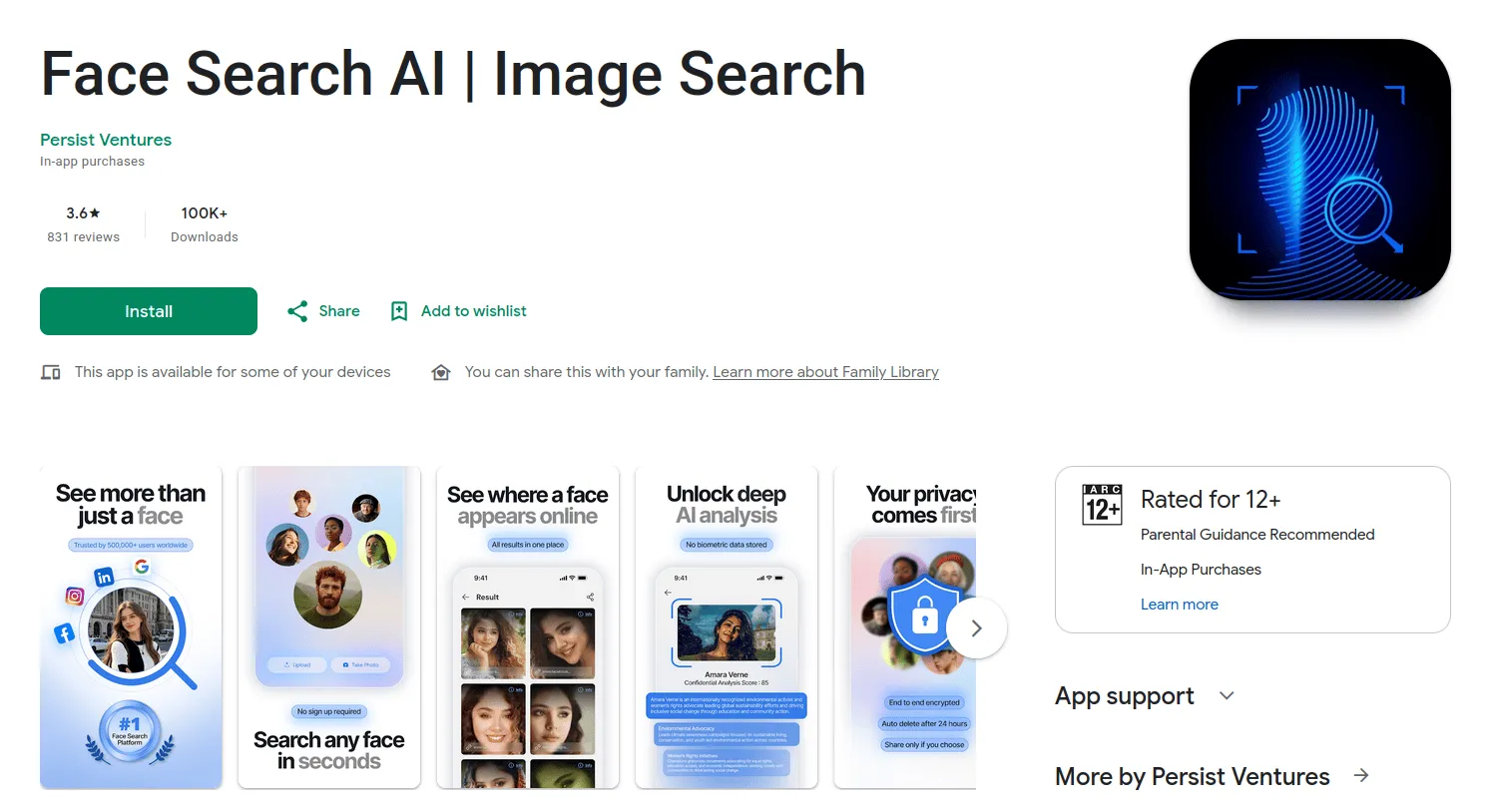
AI Face Search functions as a quick-access mobile facial recognition utility, but it is heavily compromised by predatory monetization and high operational friction.
- Strengths:The basic matching engine performs fast sweeps to locate public web images containing a target face, converting uploads into basic coordinate vector maps.
- Limitations: The app is plagued by aggressive ad injection and deceptive billing. Free users must sit through unskippable video ads to process a query, and watch another ad to download results. It maintains a low 3.0-star rating due to user interface instability and premium billing traps, such as recurring weekly subscription screens that users complain feel like paying “$100 a minute.” Because it is closed-source, it is impossible to verify if the app maintains its own index or simply re-skins other public search engines. Developers also frequently cycle app names and storefront profiles to escape negative reviews.
- Best For: Casual mobile users looking for a quick, low-stakes search who are willing to navigate aggressive ads to avoid setting up a crypto wallet for web-based engines. It is completely unsuited for professional OSINT or corporate workflows.
2. FaceCheck.ID
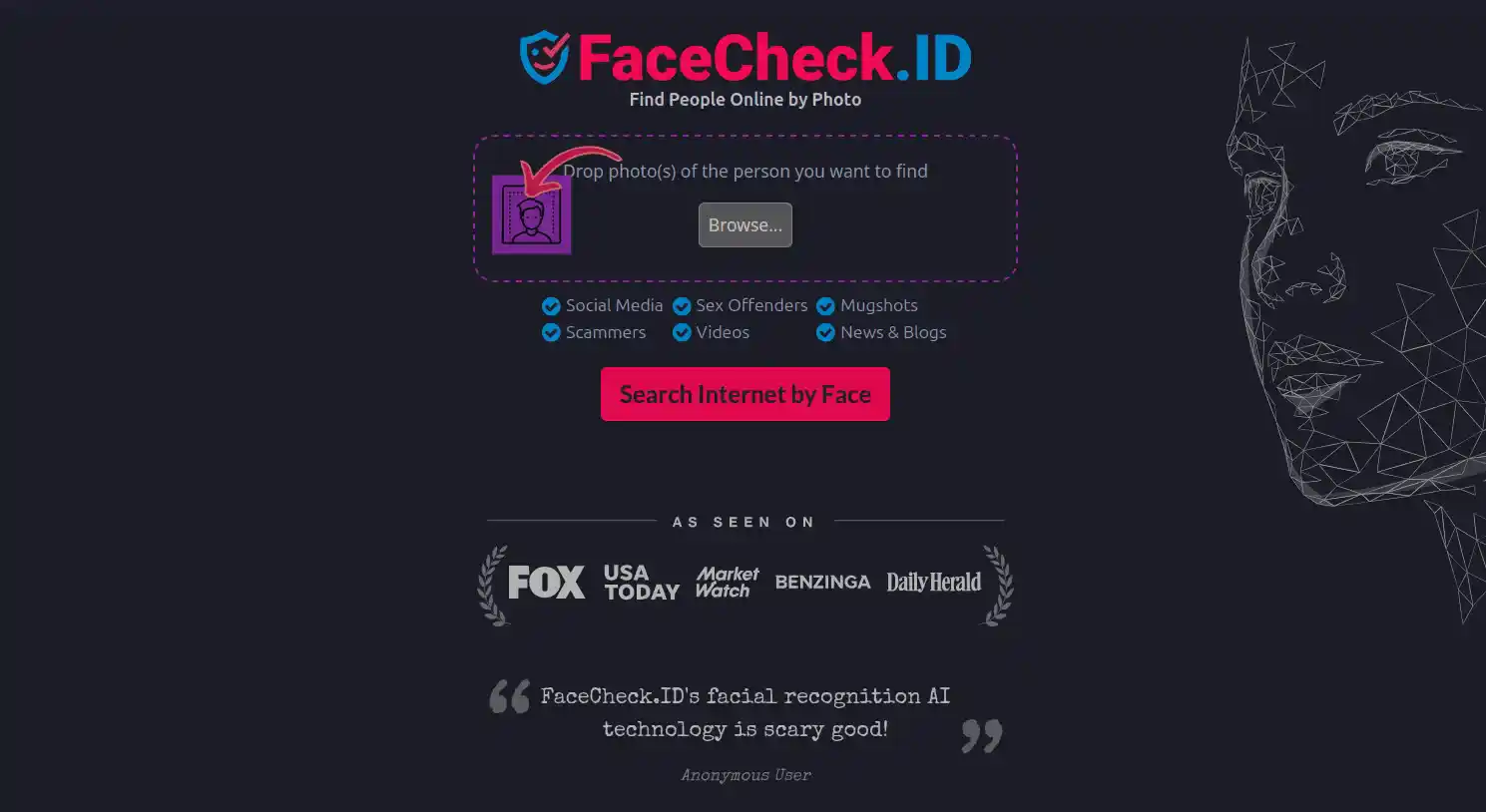
FaceCheck.ID is one of the most effective tools for searching social media profiles, but its cryptocurrency payment structure and strict usage terms are major bottlenecks.
- Strengths: It actively indexes platforms like Instagram, LinkedIn, and Facebook. It also cross-references uploads against mugshots, sex offender registries, and public scam databases, flagging matches with a warning system. Search results feature a percentage-based confidence rating, sorting matches from high-certainty targets (90–100%) to weak resemblances (50–69%).
- Limitations: The platform only accepts cryptocurrency (including Bitcoin, Litecoin, and Solana) for purchasing search credits, and each search costs 3 credits. The pricing ranges from a $19 “Rookie Sleuth” entry tier (150 credits) to a $597 package. The catch is that these credits have strict expiration dates: entry-level packages expire in as little as 14 days, while mid-tier credits last for 2 months.
- Best For: Vetting dating profiles or running personal background checks, provided you can navigate crypto payments and plan to use your credits immediately.
3. Eyematch.ai
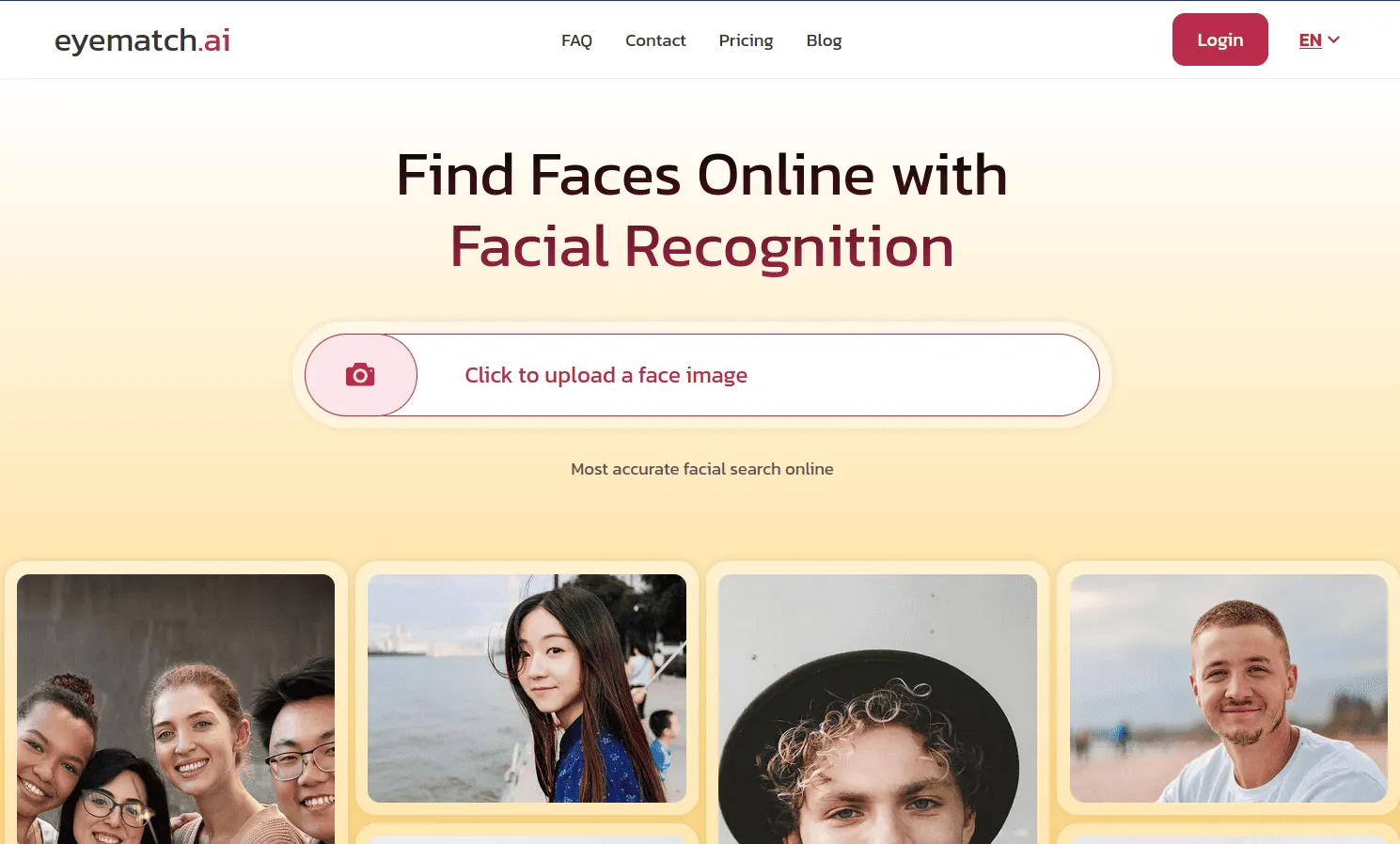
Formally launched in March 2026 by Eyematch AI Pte. Ltd. (based at Vision Exchange, Singapore), Eyematch.ai is a clean, privacy-first tool designed for digital footprint audits.
- Strengths: It uses a zero-retention approach: the system maps facial coordinates to run the search, then immediately deletes your uploaded photo. It is entirely ad-free (ensuring query paths are not tracked for marketing) and serves unblurred destination URLs without requiring account tracking. Under a strict non-surveillance mandate, it only maps visual likeness to public web pages without attaching real names, legal identities, or dossiers. Pricing is flat at $20.99/month for up to 40 searches daily.
- Limitations: To avoid complex liabilities under GDPR and BIPA, the platform geoblocks access in the EU, the UK, Argentina, and Illinois; bypassing this lock with a VPN violates their terms of service and risks account termination. It is also unclear how frequently the engine indexes deep, fast-changing social media layers compared to public blogs and news archives.
- Best For: OSINT professionals and privacy analysts outside restricted zones who need direct web results without leaving a corporate paper trail.
4. Lenso.ai
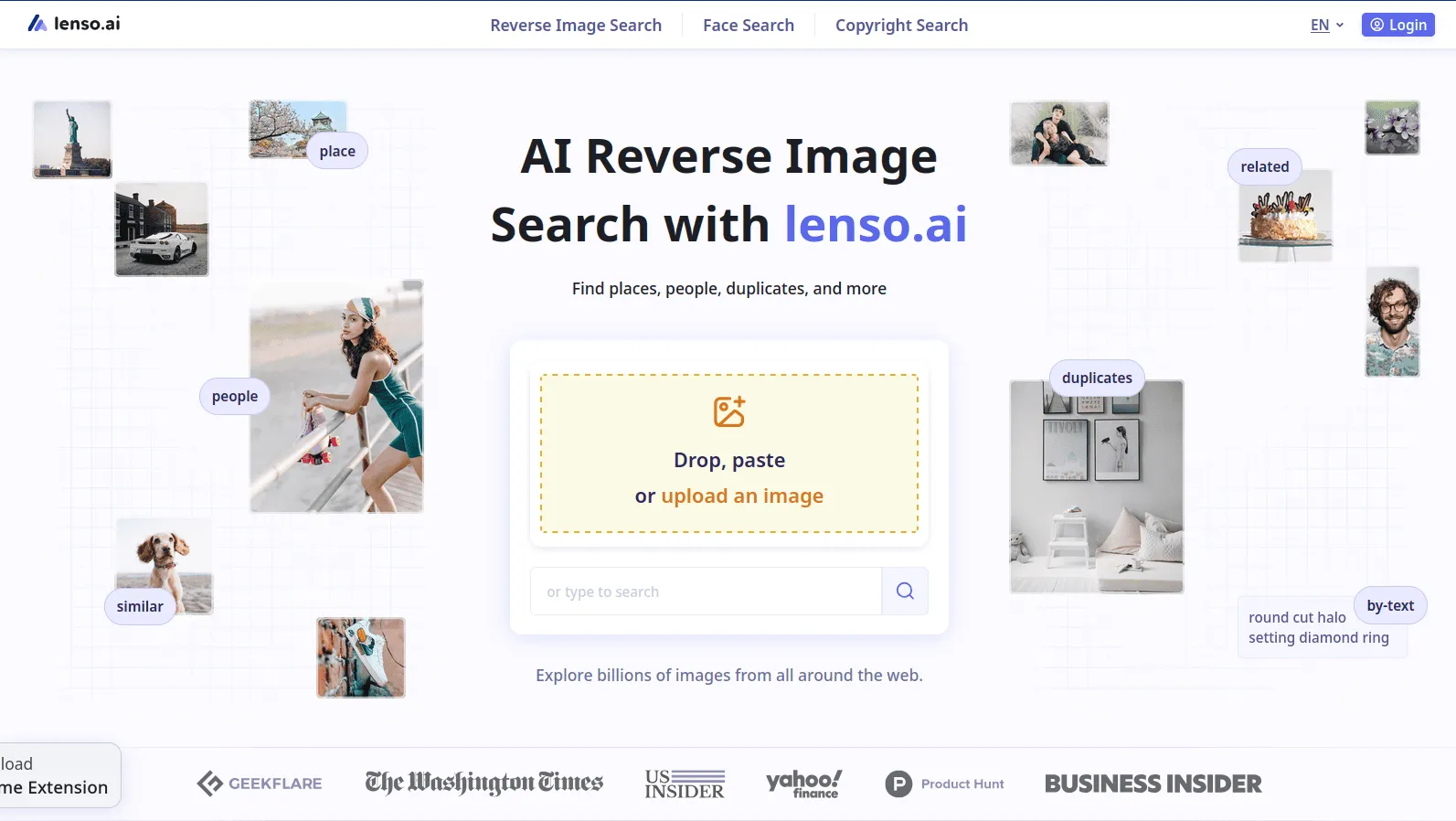
Developed by a tech team in Poland, Lenso.ai is a GDPR-compliant reverse search engine that separates results into distinct category tabs to simplify analysis.
- Strengths: Its four-way filtering system automatically splits matches into “People” (facial likeness), “Places” (landmark and architectural geolocation), “Duplicates” (exact files or edited crops), and “Similar” (visual compositions). As a GDPR-compliant processor, it deletes query uploads within 24 hours and provides a persistent, dedicated opt-out page for index removals.
- Limitations: The free tier completely hides target destination URLs behind watermarked previews. Paid tiers are highly restrictive: the Starter Plan ($17.32–$19.99/month) caps result reveals at just 50 unlocks, which can be exhausted in a single complex OSINT case (the Professional Plan jumps to $60.63–$69.99/month for 500 unlocks). Facial recognition is also throttled in jurisdictions with strict biometric laws, and the “Places” geolocation feature often triggers false positives on generic landscapes that lack clear architectural markers.
- Best For: OSINT teams and copyright auditors who need clean results categorizations and landmark tracking, and have the budget to support the premium unlock limits.
5. PimEyes
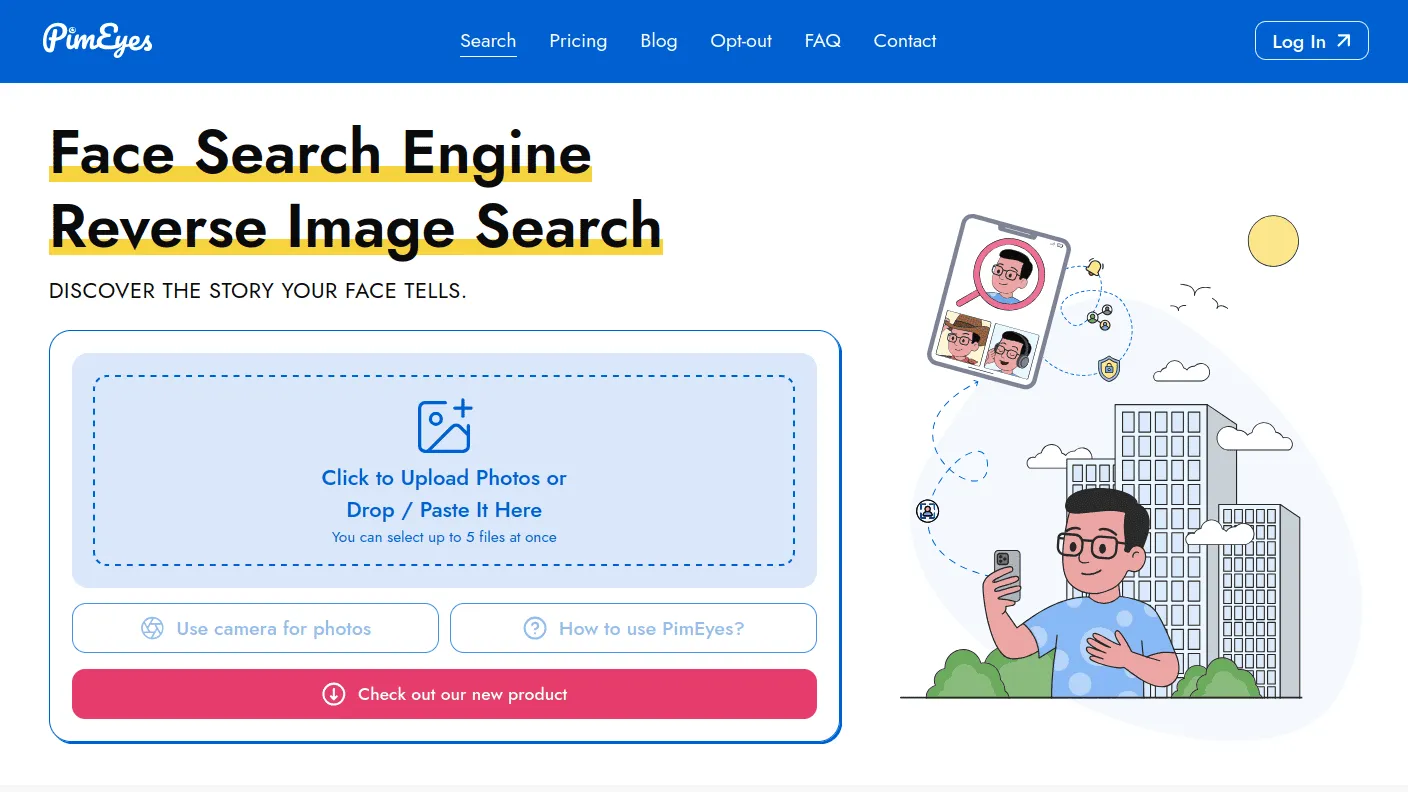
PimEyes is the industry giant for searching the open web, converting facial photos into mathematical vector strings to perform rapid matching sweeps across public websites, news outlets, directories, and message boards.
- Strengths: It maintains a massive footprint indexing everything from news networks to personal blogs. Its premium tiers feature the “PROtect” system, an automated rights enforcement workflow that drafts and submits DMCA and GDPR takedown requests to site administrators hosting unauthorized photos. It also offers a free, accessible opt-out route to remove your face from their public index.
- Limitations: PimEyes strictly excludes mainstream social networks like Facebook and Instagram to avoid regulatory fines. The free tier only displays a basic search grid while completely hiding all source URLs and domain links. Its subscription tiers are very expensive: the entry Open Premium tier is $29.99/month (25 searches daily, unlocks links but no takedown tools), the PROtect plan is $79.99/month (adds automated takedowns), and the Advanced Plan is $299.99/month (scales searches to 200/day). Keep in mind that successful removals still depend on the hosting website’s willingness to comply with those notices.
- Best For: Corporate brand managers, public figures, and privacy-conscious users who need to monitor their online likeness and request content removals from the open web.
6. Social Catfish
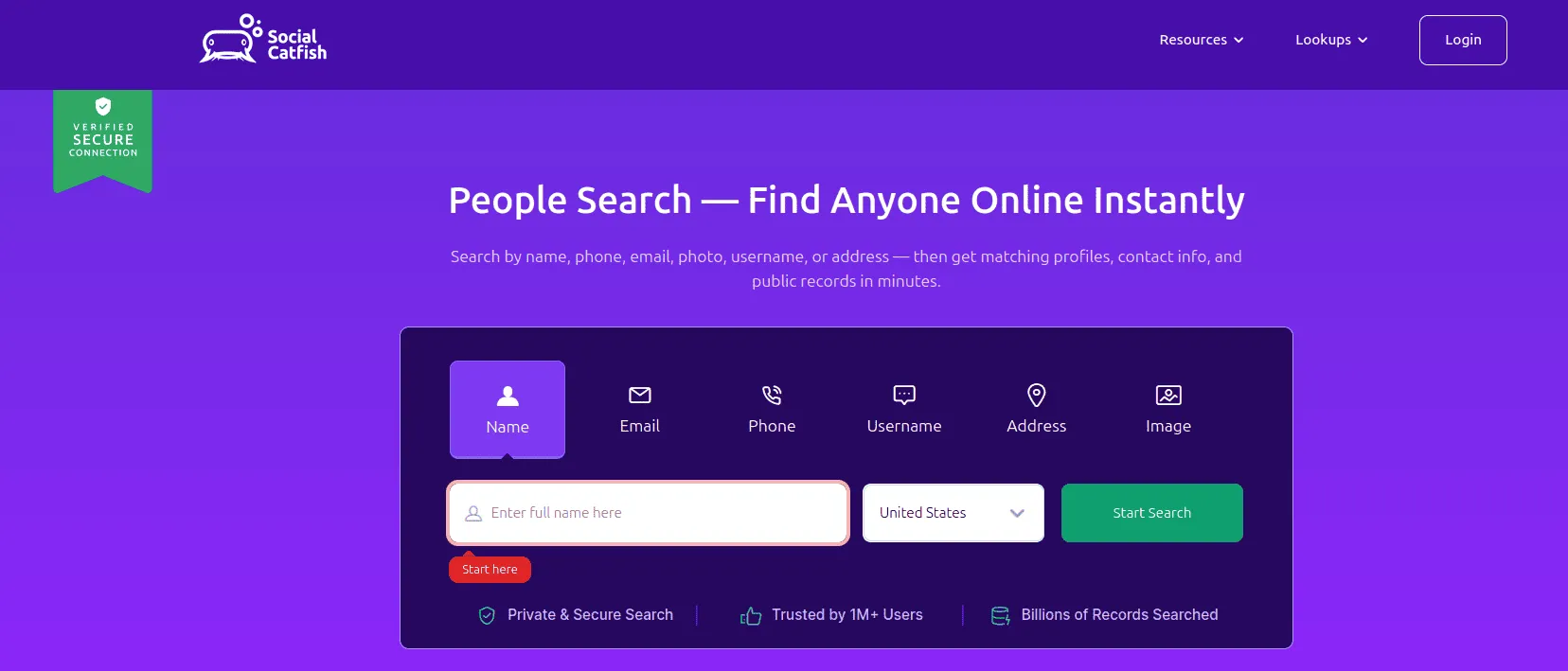
Based in Murrieta, California, Social Catfish is a full-scale digital investigation platform built primarily to expose romance scams and verify online identities.
- Strengths: Unlike pure facial search engines, Social Catfish uses a multi-signal verification framework that pivots across six inputs: photos, names, emails, phone numbers, usernames, and physical addresses. It ingests public court logs, aliases, and financial records, cross-referencing them against deep-web social graphs. It also features a specialized AI message scanner to screen copy-pasted text or screenshots for known romance scam scripts.
- Limitations: The platform enforces strict subscription silos; the Social Search plan (text lookups) and Image Search plan (facial vectors) are separate, independent $36/month plans, forcing you to pay twice to access both tools. The user interface uses slow, staged “metadata analysis” progress bars to build anticipation before displaying paywalls, and low-cost “3-day trials” often hide detailed reports until you upgrade. Because the platform relies on public record brokers, it is also heavily biased toward the US and Canada, offering limited international results, and can occasionally return outdated addresses.
- Best For: Comprehensive identity verification where a face is just one variable in a broader, multi-signal investigation.
7. Yandex Images

Operated by the Russian tech giant Yandex, Yandex Images is a specialized visual search vertical highly regarded for its exceptional computer-vision accuracy.
- Strengths: It is a completely free public utility with unlimited queries and no account requirements. Using advanced neural networks, it converts faces into mathematical vector strings, showing a high tolerance for visual distortions (such as cropped, low-resolution, or flipped files) and isolating individuals in crowd shots. The user interface includes a built-in cropping frame to segment specific faces or objects directly inside the browser. Its database is uniquely dominant across Eastern European and Central Asian networks, indexing deep content layers from platforms like VKontakte (VK) and Odnoklassniki (OK) that Western engines routinely miss.
- Limitations: The platform operates under Russian data retention laws and national security frameworks. Uploading target photos to Yandex’s servers presents a major operational security (OPSEC) risk for threat intelligence analysts, corporate compliance teams, and human rights researchers, as query assets fall within foreign surveillance jurisdictions.
- Best For: Zero-budget visual searches, geolocation investigations, or tracking digital footprints across Eastern European networks, provided you do not upload sensitive assets that require Western privacy compliance.
Professional Comparison Matrix
| App | Accuracy | Social Media Index | Pricing Model | Retention Policy | Primary Use Case |
|---|---|---|---|---|---|
| FaceCheck.ID | High | Full | Credits (Crypto-only; expires in 14d–2mo) | Immediate (Query) / 1–5 Days (Opt-out) | Dating & Scam Safety |
| Eyematch.ai | Moderate | Partial | Subscription ($20.99/mo) | Zero-Retention (Immediate) | Privacy-Conscious Search |
| Lenso.ai | High | Limited | Subscription / Pay-per-unlock | 24-hr Purge (Query) | Digital Footprint Audit |
| PimEyes | High | No | Subscription ($30–$300/mo) | 30-min (Query) / 96-hr (Opt-out) | Online Likeness Monitoring |
| AI Face Search | Moderate | Partial | Mobile Ads / Predatory Paywalls | Variable / Closed Source | Casual Mobile Search (Non-OSINT) |
| Yandex Images | High | Partial | 100% Free | Permanent (Russian Jurisdiction) | Budget OSINT Search |
Which Tool Should You Choose?
- Best for Social Media & Dating Safety: FaceCheck.ID (despite the crypto friction, its social media index is unmatched).
- Best for Professional Investigations: Social Catfish (best for connecting a face to a phone number or email).
- Best for Privacy-Conscious Users: Eyematch.ai or Lenso.ai (clear retention policies and strict deletion protocols).
- Best for Casual & Budget Use: Yandex Images (use with a VPN and caution regarding data-handling risks).
The Legal and Safety Rules of Facial Search
Biometric data is heavily regulated, and using these tools can quickly turn into a legal liability. In the EU (under GDPR) and states like Illinois (under BIPA), collecting or searching someone’s biometric data without their explicit consent is illegal. While many platforms geoblock users in these regions to protect themselves, the ultimate responsibility falls on you.
How to Remove Your Own Photo (Opt-Outs)
If you find your face indexed on these search engines, you can request removal for free:
- PimEyes: You will need to upload a clear photo of yourself for their automated system to scan and hide your matches. If you use their manual opt-out, you may need to upload an ID document, which they promise to delete within 96 hours.
- FaceCheck.ID: They use a unique “Chin-Selfie” verification method, you take a photo of yourself touching your chin with two fingers to prove you are a real person requesting your own removal. Once verified, the photos are hidden from future searches.
- Lenso & Eyematch: Both have simple online forms. You provide a reference headshot and your email, and they purge the search records from their index, typically within 24 hours.
Three Rules for Safe Searching
- Never search for minors: Doing so will result in an immediate lifetime ban on almost every platform, and it carries severe legal consequences.
- Respect local laws: If you reside in the EU, the UK, or Illinois, make sure your search falls under a recognized legal exemption (like official journalism or law enforcement) before proceeding.
- Do not harass: Using these tools to track down, doxx, or harass someone is a criminal offense in most jurisdictions.
How to Verify an Identity in 4 Steps
A single face match is just a lead, it is not proof. Professional investigators use a multi-step pipeline to verify an identity:
- Find the context first: Use Google Lens to identify clothing, background landmarks, or items in the photo. This helps narrow down where the photo was taken.
- Find the oldest copy: Upload the photo to TinEye and sort the results by “Oldest.” This is a classic trick to see if the image was stolen from an old stock photo site or an inactive blog.
- Run a biometric sweep: Use FaceCheck.ID to look for active social media profiles, and PimEyes to search for mentions in news articles or company directories.
- Connect the dots: Check if the dates, locations, and names across all these results tell a consistent story. If a profile was created last week using a photo from a 2018 blog post, you’re likely looking at a fake account.
The Deepfake Problem
The biggest challenge for modern face search is synthetic media.
- AI-Generated Faces: Most facial recognition search engines cannot distinguish between a real human and a deepfake or GAN-generated face. They will simply return lookalikes, giving you a false sense of security.
- Double-checking: To protect yourself, combine facial searches with an AI detector that looks for pixel artifacts in the image. If the person has no online history older than six months, treat their profile with extreme caution.
Common Questions
Is there a completely free face finder?
Yes, Yandex Images is the most powerful free tool available. Google Lens is also free, but Google actively blocks it from doing direct face-to-face matching to avoid privacy lawsuits.
Can these tools find private profiles?
No. These tools can only search the public web. If a profile is set to private, they cannot see or index the photos.
Are these services legal to use?
It depends on where you live. Many engines block users in the EU, the UK, and Illinois to avoid strict biometric privacy laws. Using these platforms for stalking, doxxing, or harassment is illegal everywhere.
How long do they keep my photos?
Privacy-first tools like Eyematch.ai delete your uploaded photo immediately after the search. Lenso.ai keeps query photos for up to 24 hours, while PimEyes deletes search queries within 30 minutes (though they keep opt-out verification data for up to 96 hours).
Final Verdict
Facial recognition search is here to stay, and it has changed online privacy forever. The right tool for you depends entirely on what you’re trying to do:
- To verify a dating profile: Use FaceCheck.ID (if you can navigate the crypto payment).
- To track down a scammer: Use Social Catfish to connect their face to a phone number or email.
- To protect your own privacy: Use PimEyes to find unauthorized uploads, and Eyematch.ai to run clean searches without saving data.
The key rule to remember is: trust, but verify. Biometric matches are highly accurate, but they are still just leads. Always back them up with manual research before making any major decisions.