

Ask three mobile app development companies to quote for the same app, and the numbers can come back far apart. Picking the lowest one is tempting, but you can’t compare them properly until you know what each estimate assumes. Has the firm built something like your app before? Who will own the code? And who picks up the phone when something breaks after launch?
The simplest way to choose is to shortlist three to five firms, ask each of them the same questions, and leave price until you have their answers in writing.
How much does it cost to build a mobile app?
Most mobile app projects cost between $10,000 and $49,999, according to Clutch’s app development pricing guide, which draws on verified client reviews. The average sits much higher, at about $90,780. A handful of very large builds drag it up.
Those figures come from what clients say they paid. When Clutch surveyed 102 app development firms about what they charge, the ranges by project type came out higher:
| Project type | Reported cost | Typical shape |
|---|---|---|
| Basic app | $30,000 to $60,000 | A few screens, sign-in, one platform or a simple cross-platform build |
| Mid-level app | $60,000 to $150,000 | Payments, a back end, both platforms, and integration with a system you already run, such as Salesforce or NetSuite |
| Enterprise app | $100,000 to $500,000 | Many roles, legacy integration, compliance, heavy data |
Hourly agency rates in Clutch’s reviews mostly fall between $25 and $49.
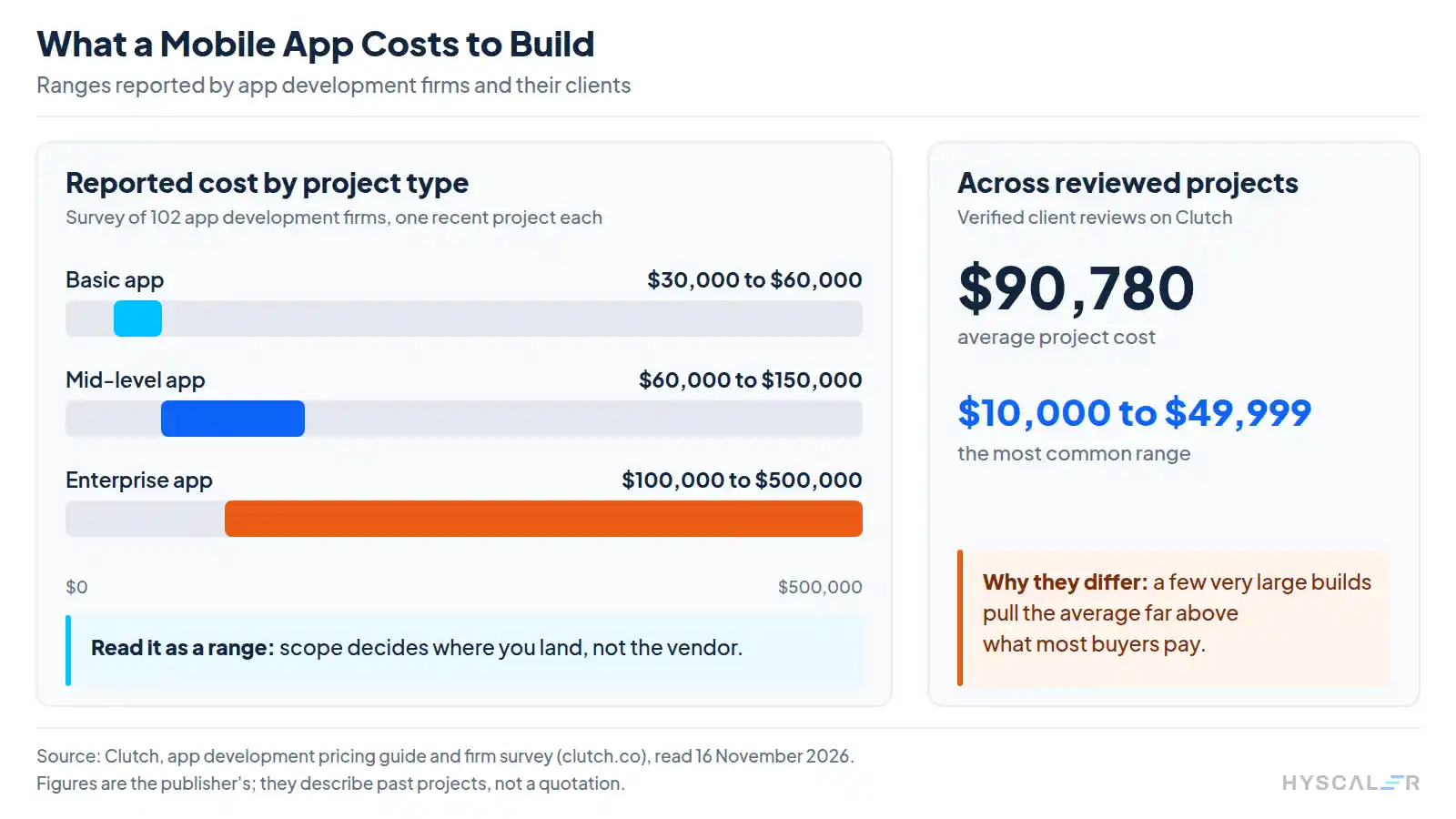
Use these ranges to sanity-check the first quotes you get. Where your project lands depends on its scope, and on how much of that scope is pinned down before anyone starts building.
What are the costs beyond the build?
A vendor’s quote usually covers the build and little else. Three other costs come later, and they are worth raising on the first call. The smallest is the store accounts: the Apple Developer Program costs $99 a year, and Google Play charges a one-time $25 registration fee.
Store commission is the bigger number. Apple takes 30% on digital goods, or 15% under its Small Business Program if your proceeds were $1 million or less in the prior year. On Google Play, 97% of developers distribute at no charge, according to Google, and 99% of those who do pay a service fee qualify for 15% or less. Physical goods, and services delivered outside the app, are mostly exempt. Check which case applies to you before building a revenue model around these percentages.
Then there are running costs. Hosting, third-party services, and monitoring all bill monthly, and every year Apple and Google change their platforms in ways that need updates. Ask for all of it as a monthly figure in the proposal.
What should you ask a mobile app development company?
Ask these on the first call. The first six cover ground buyers have checked for years, and they line up with Clutch’s own hiring guide. The last six cover what has changed going into 2027: AI in the code, AI in the app, new Android rules, and accessibility law.
Can you show me an app you built that is similar to mine, and may I speak to that client?
Ask for the app’s name and a reference you can call this week.
What is included in your estimate, and what assumptions is it based on?
Get the assumptions in writing. If one estimate assumes you will supply finished designs and another does not, the two numbers are not comparable until you know that.
Who owns the code, the designs, and the accounts?
You should, from the first payment, and the contract should say so.
Who exactly will work on my app?
Ask for names and roles, including who leads. Also ask whether any of the work goes to a subcontractor.
How do you test, and on which devices?
Listen for automated tests, testing on real phones rather than only simulators, and one named person responsible for quality.
What support do you provide after launch, and at what response time?
Ask for a response time in hours, written into the support agreement.
Should this be native or cross-platform, and why?
The reason should come from your app: its features, its users, and your budget. See our comparison of mobile app development platforms.
Which AI features would you run on the device and which in the cloud?
Apple and Google both ship on-device models now (see Apple’s WWDC26 machine learning guide and Google’s Gemini Nano documentation). Where a feature runs affects cost, privacy, and whether it works offline. Ask the vendor to walk through that trade-off for the features you have in mind.
How do you review code written by AI tools?
Veracode’s 2026 testing found AI-generated code was secure in about 55% of tasks. In the 2026 Stack Overflow survey, 73% of developers said they use coding assistants every day. Ask whether the vendor’s team uses them and how that code gets checked, and look for security scanning on every change.
How will you handle the 2027 Android policy dates?
Google’s Play policy page lists changes to location, contacts, and network permissions taking effect on 27 January and 25 August 2027. Its developer verification program also expands globally in 2027. Ask how either change affects your app.
Is the app accessible, and to which standard?
If you sell in the EU, the European Accessibility Act covers services that include e-commerce and banking. Ask which guideline the team tests against, and how often.
What would you leave out of version one?
Some vendors will name features to cut and explain what each one costs to keep. Others will accept your full list as it stands. Put the answers side by side.
What are the red flags when hiring an app developer?
A single warning sign may have an innocent explanation, so ask about it. If two or three show up with the same vendor, keep looking.
The most common ones are about scope. Clutch lists reluctance to sign a detailed statement of work among its warning signs, and without a written scope you have nothing to measure delivery against. A fixed price offered before any discovery belongs in the same group. If the vendor has not asked enough questions to define the work, expect that number to move.
Then look at the people. Most of what you pay for is the team doing the work. A vendor who will not say who leads your project, or cannot connect you with a past client, is asking to be judged on a portfolio page alone. Ten minutes on the phone with a former client will tell you whether their last project ran on time and on budget.
Vague answers about code ownership deserve a follow-up too. Ownership disputes tend to surface late, often when you want to switch vendors, and they are expensive to settle by then. The same applies to a missing plan for after launch, because apps need bug fixes, OS updates, and store compliance work long after release.
The last sign is harder to spot because it sounds like good news. Everything is possible, nothing is hard. Every project has risky parts, and teams that have built similar apps usually name them on the first call.
How does the selection process work, step by step?
Plan on three to six weeks between first contact and the start of the build.
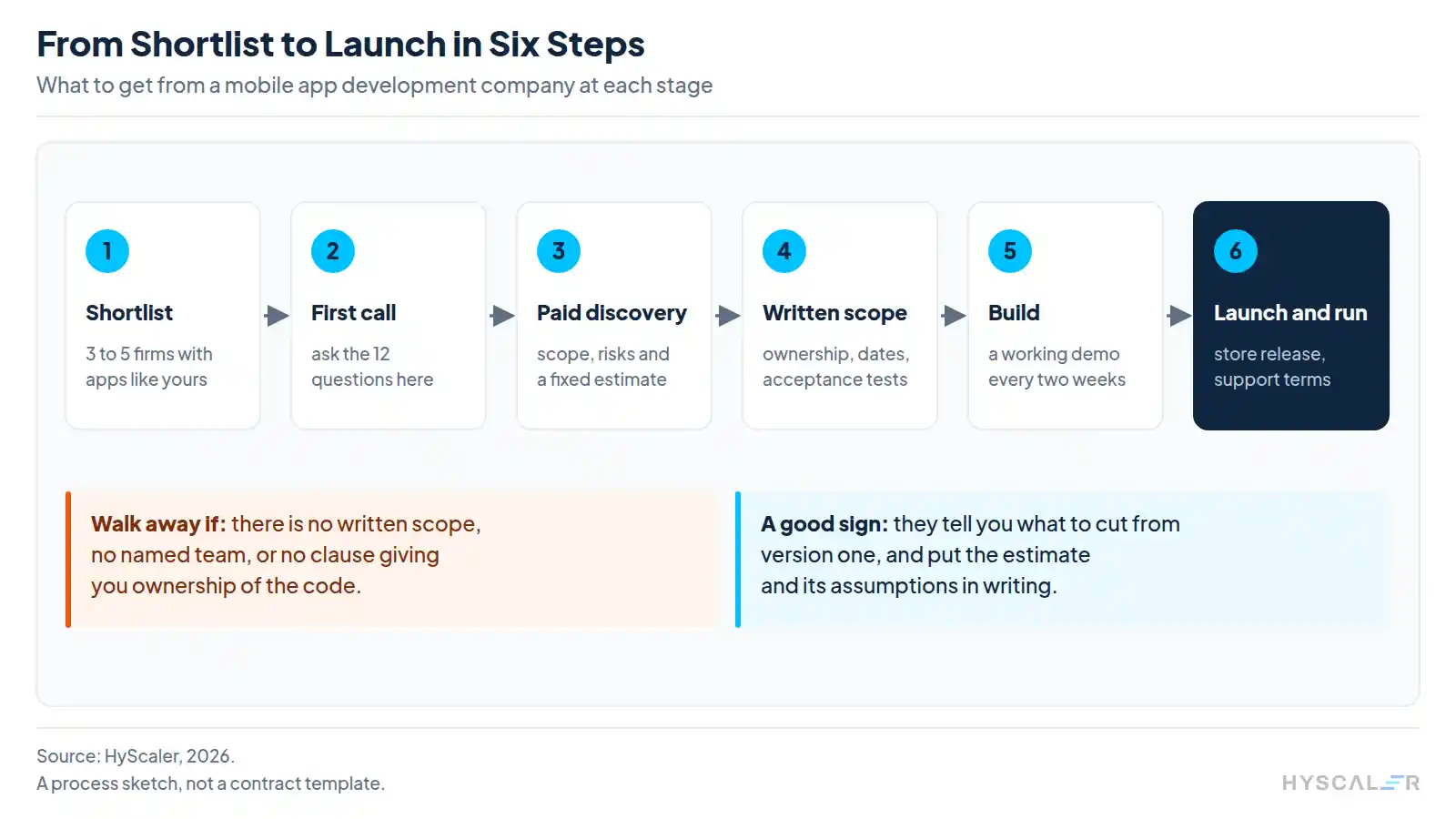
- Shortlist three to five firms that have shipped apps like yours.
- First call, using the questions above.
- Paid discovery. A short paid engagement that produces a scope, a risk list, and a fixed estimate. You own what it produces, so you can take it to another vendor if you prefer.
- Written scope. Ownership, milestones, acceptance tests, and payment terms, all in the contract.
- Build, with a working demo every two weeks.
- Launch and run, with store release and support terms agreed well before launch day.
Should you hire onshore, nearshore, or offshore?
Start with how many working hours your team needs to share with the vendor each day, then compare cost. Whichever model you pick, get the overlap agreed in writing.
| Model | Strength | Watch for |
|---|---|---|
| Onshore | Same hours, easy meetings | Highest rates, smaller talent pool |
| Nearshore | Close time zone, moderate rates | Fewer firms with deep mobile teams |
| Offshore | Larger teams, lower rates | Overlap hours must be agreed up front |
With an offshore team, put the daily overlap hours and a named escalation contact into the contract before work begins.
A scorecard you can copy
Score each vendor from 1 to 5 on every line, and count the first four criteria twice.
| Criterion | What a 5 looks like |
|---|---|
| Relevant shipped work | A live app like yours, with a client you can call |
| Written scope and assumptions | A fixed estimate with every assumption listed |
| Code and account ownership | Yours from the first payment, in the contract |
| Named team | Names, roles, and a lead who joins the calls |
| Testing and security | Automated tests, device testing, scanning of AI-written code |
| 2027 readiness | Knows the Android dates, on-device AI and accessibility duties |
| After launch | A service level in hours and a monthly running cost |
| Honesty about scope | Told you what to cut from version one |
Frequently asked questions
How do I choose a mobile app development company?
Shortlist three to five firms that have shipped a similar app, ask each the same twelve questions, pay one or two for a short discovery, and choose on written scope, code ownership and after-launch support before price.
How much does it cost to hire a mobile app development company?
Clutch reports most projects between $10,000 and $49,999 and an average of about $90,780, with basic apps at $30,000 to $60,000 and enterprise apps from $100,000 to $500,000.
How long does it take to build a mobile app?
It depends on scope. Ask every vendor for a timeline tied to milestones in the written scope, and be cautious of a date given before discovery.
Who owns the code when I hire an app development company?
You should, from the first payment, and the contract must say so. Include the designs, the repositories and the store accounts.
Is it better to hire a freelancer or a company?
A freelancer suits a small, well-defined app. A company suits anything that needs design, back end, testing and support together, or that must keep running if one person leaves.
Sources
- Clutch, App development pricing guide and app development services guide
- Apple, Developer Program pricing and fees and App Store Small Business Program
- Google Play, service fees and developer registration
- Apple, What’s new in AI and machine learning, WWDC26; Android Developers, Gemini Nano
- Veracode, Spring 2026 GenAI code security update
- Stack Overflow, 2026 Developer Survey, AI section
- Android Developers, Google Play policies and developer verification
- European Commission, European Accessibility Act
How HyScaler approaches a mobile project
We start with a short discovery that ends in a written scope and a fixed estimate. You own that document whether or not you build with us.
From there, the work depends on what you are building. For a new app, our mobile app development services and custom mobile application development teams take it from first release through ongoing support. Products that need to grow over several releases go through mobile product development, which covers the roadmap as well as the build. If one codebase for iOS and Android makes sense, that is cross-platform application development, and when the app needs AI features, our AI development team works alongside the mobile engineers.
Bring the twelve questions to a call with us and score the answers. Talk to our mobile team.