

Table of Contents
For the last decade, AI has mostly been judged by what it can do, how fast it can process data, how accurately it can predict outcomes, and how well it can automate tasks.
But a quieter shift has been happening underneath all of that: AI is increasingly being judged by how well it relates.
Can it tell when a customer is frustrated before they say so?
Can it notice when a student is disengaged, or a driver is fatigued, or a patient is in distress?
This is the domain of Emotional Intelligence in AI, sometimes called Emotion AI or affective computing, and it’s quickly becoming one of the defining capabilities separating merely functional AI from genuinely human-centered AI.
The shift is measurable.
Enterprises are no longer satisfied with systems that simply execute instructions; they want systems that understand context, tone, and intent well enough to respond appropriately.
Multiple industry analysts have projected the emotion AI and affective computing market to grow well into the double-digit billions by the end of this decade, driven by adoption in healthcare, customer service, automotive safety, and enterprise software.
Conversational AI agents, in particular, are being redesigned around emotional awareness, not to manipulate users, but to reduce friction, build trust, and make interactions feel less robotic.
In this guide, you’ll learn what emotional intelligence in AI actually means, how it technically works, the technologies powering it, where it’s already being used across industries, the ethical challenges it raises, and where the field is heading between now and 2030.
Whether you’re a business leader evaluating emotion-aware tools or simply curious about how machines are learning to read us, this guide covers it all.
What Is Emotional Intelligence in AI?
Emotional Intelligence in AI refers to a system’s capacity to recognize, interpret, respond to, and in some cases simulate human emotional states.
It draws on technologies like computer vision, speech and voice analysis, natural language processing, and multimodal AI models to understand emotional cues from faces, voices, text, and even physiological signals, then uses that understanding to shape a more appropriate, personalized response.
Definition
At its core, emotional intelligence in AI is not about AI feeling anything.
It’s about pattern recognition applied to emotional signals, tone of voice, choice of words, facial micro-expressions, typing speed, or even pauses in speech, combined with contextual reasoning that lets a system adjust its behavior accordingly.
Why Emotional Intelligence Matters
Traditional software treats every user the same way, regardless of their emotional state.
That works fine for a calculator; it works poorly for a mental health chatbot, a customer support agent, or a car’s driver-monitoring system.
Emotional intelligence in AI matters because human decisions, satisfaction, and even safety are deeply tied to emotional context. Systems that ignore that context tend to feel cold, robotic, or actively counterproductive.
A customer service bot that responds cheerfully to an angry complaint erodes trust rather than building it.
Emotional AI vs Traditional AI
| Traditional AI | Emotionally Intelligent AI |
|---|---|
| Logic-based | Emotion-aware |
| Task execution | Human interaction |
| Data focused | Context focused |
| Predictive | Adaptive |
How Emotional Intelligence in AI Works
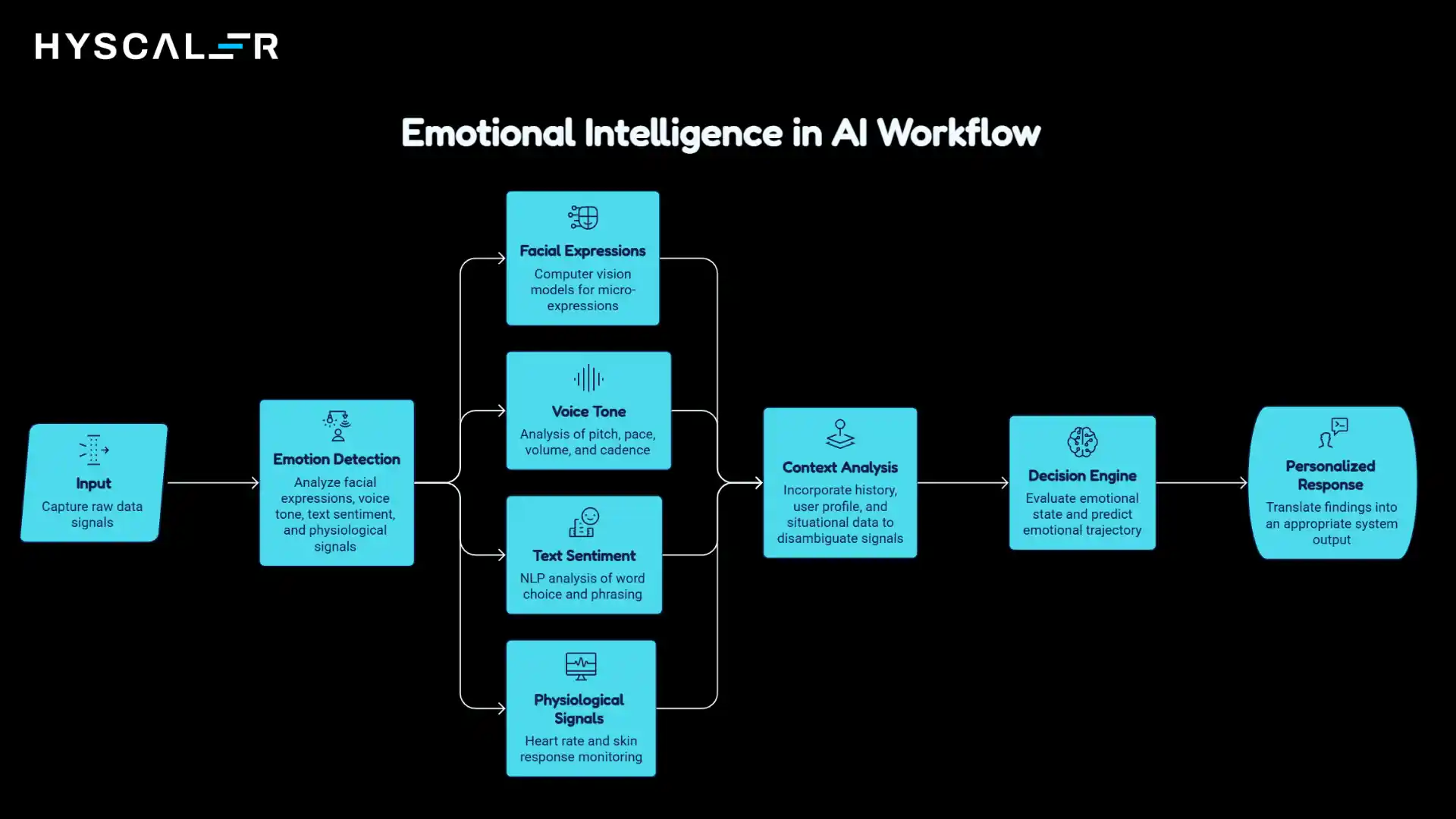
Emotion AI systems typically follow a layered pipeline: signals are captured, interpreted, contextualized, and then translated into a response.
Emotion Detection
Detection draws on several input types:
- Facial expressions: computer vision models trained to detect micro-expressions tied to emotional states like joy, frustration, or confusion
- Voice tone: pitch, pace, volume, and cadence are analyzed for stress, hesitation, or enthusiasm
- Text sentiment: word choice, punctuation, and phrasing are analyzed via NLP for sentiment and intent
- Physiological signals: in wearable and healthcare contexts, signals like heart rate variability or galvanic skin response
Emotion Recognition Models
These are typically deep learning models, often convolutional neural networks for facial analysis, transformer-based architectures for language, and specialized acoustic models for speech, trained on large, labeled emotional datasets.
Multimodal AI
Rather than relying on a single signal, modern systems combine multiple inputs at once.
A voice assistant, for example, might weigh vocal tone alongside word choice and prior conversation history to more reliably infer emotional state than any single signal could alone.
Emotion Prediction
Beyond detecting a current emotional state, some systems attempt to predict emotional trajectory, for instance, flagging that a customer’s frustration is escalating based on the pattern of an ongoing conversation, before it becomes explicit.
Context Understanding
Emotion without context is often misleading; a raised voice could signal anger or excitement.
Context-aware models incorporate conversation history, user profile, and situational data to disambiguate.
Simplified Emotion AI Workflow:
Input → Emotion Detection → Context Analysis → Decision Engine → Personalized Response
Core Technologies Behind Emotion AI
Several technical building blocks make emotionally intelligent AI possible:
- Natural Language Processing (NLP) – powers sentiment analysis and intent detection from written or spoken text
- Computer Vision – enables facial expression recognition and gesture analysis
- Speech Recognition – extracts both what is said and how it’s said (tone, pace, pauses)
- Large Language Models – provide the contextual reasoning and natural, human-like response generation that makes emotionally aware conversation possible
- Multimodal Foundation Models – combine vision, audio, and text understanding into a single system
- Reinforcement Learning – used to fine-tune how a system’s responses are shaped based on feedback about what “lands” well with users
- Edge AI for Real-Time Emotion Detection – allows emotion recognition to run directly on devices (like a car’s dashboard or a wearable) with low latency and improved privacy, since raw data doesn’t always need to leave the device
Emotional Intelligence vs Artificial Intelligence
| AI | Emotional AI |
|---|---|
| Automation | Human interaction |
| Decision-making | Emotion-aware decisions |
| Data processing | Context understanding |
| Logic | Empathy simulation |
Emotional AI isn’t a replacement for AI broadly; it’s a specialized layer that sits on top of core AI capabilities, oriented specifically toward human interaction quality.
Key Components of Emotional Intelligence in AI
- Self-awareness (Simulated): a system’s internal representation of its own confidence or uncertainty about an inferred emotional state
- Emotional Recognition: the detection layer described above
- Emotional Understanding: contextualizing detected emotion against situational and historical data
- Emotional Regulation: the system’s ability to modulate its own tone and behavior appropriately (e.g., slowing down, using calmer language)
- Empathetic Response Generation: producing language or actions that acknowledge and appropriately address the detected emotional state
Real-World Applications of Emotional Intelligence in AI
Healthcare: Mental health assistants use conversational emotion detection to flag concerning patterns; patient monitoring systems track distress signals in real time; elderly care robots and companions use tone and facial cues to detect isolation or discomfort; therapy support tools help clinicians track patient sentiment across sessions.
Customer Service: AI chatbots detect frustration and escalate to human agents proactively; call center analytics platforms score agent-customer interactions for emotional tone; satisfaction prediction models flag at-risk accounts before churn happens.
Education: Personalized learning platforms adapt pacing and difficulty based on detected engagement or confusion; engagement-tracking tools help teachers identify students who are struggling silently.
HR: Emotion-aware tools assist in structuring more consistent candidate interviews; employee wellness platforms monitor sentiment trends across teams; burnout detection systems flag early warning signs in written communication patterns.
Retail: Personalized shopping experiences adapt to a shopper’s mood or urgency; recommendation systems increasingly weigh emotional signals, not just purchase history.
Automotive: Driver fatigue and distraction detection systems use facial and physiological cues to trigger safety interventions.
Banking: Sentiment analysis tools flag distressed or dissatisfied customers during calls or chat interactions, prompting more careful handling.
Gaming: Adaptive NPC behavior responds to a player’s frustration or engagement level, adjusting difficulty or narrative tone in real time.
Smart Homes: Personalized assistants adjust lighting, music, or responses based on detected household mood or stress levels.
Industry Case Studies
Across sectors, similar patterns are emerging: healthcare virtual assistants that triage patient concerns with more empathetic framing; automotive driver-monitoring systems that combine vision and physiological data to prevent accidents; emotion-aware customer support platforms that route frustrated customers to specialized agents; AI tutors that adjust their teaching style based on real-time engagement signals; and mental wellness apps that track emotional trends over time to support (not replace) professional care.
HyScaler Insight: Building emotionally intelligent systems responsibly requires more than bolting a sentiment classifier onto an existing product.
HyScaler works with organizations to design privacy-first, industry-specific AI solutions that incorporate sentiment analysis, multimodal AI, and conversational agents where they genuinely add value, grounded in responsible AI practices and without overstating what the technology can reliably do.
The goal isn’t to make AI seem more “human” for its own sake, but to make interactions with AI systems less frustrating and more useful for the people on the other end of them.
Benefits of Emotional Intelligence in AI
- Better customer experiences through context-aware responses
- Higher engagement in education, gaming, and consumer applications
- Improved personalization across retail, banking, and content platforms
- Increased trust when systems respond appropriately to the user’s emotional state
- Faster support resolution through early escalation of frustrated users
- Better healthcare outcomes through earlier detection of distress
- Smarter AI agents capable of more natural, human-like interaction
- More human-centric automation overall, rather than purely mechanical task execution
Challenges and Limitations
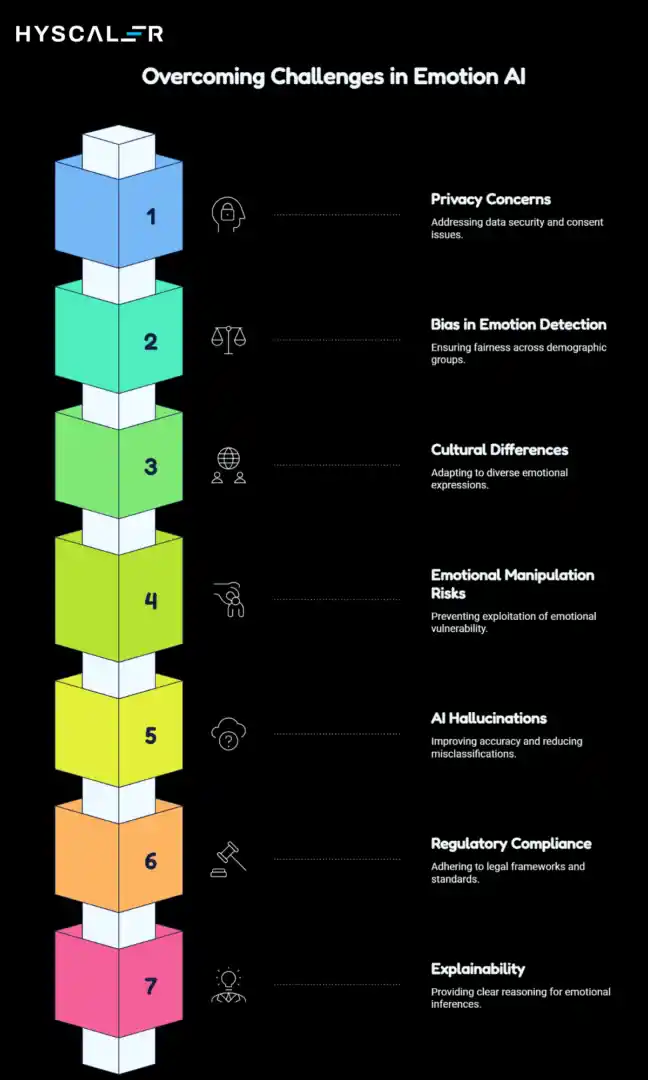
Privacy Concerns
Emotion detection often relies on sensitive biometric data, facial expressions, voice patterns, and physiological signals, raising significant questions about consent, storage, and use.
Bias in Emotion Detection
Emotion recognition models trained on non-representative datasets can misread expressions differently across demographic groups, leading to unequal accuracy and potential harm.
Cultural Differences
Emotional expression is not universal.
A gesture or tone considered warm in one culture may read as neutral or even negative in another, complicating global deployment.
Emotional Manipulation Risks
Systems capable of detecting and responding to emotional vulnerability carry a real risk of being used, intentionally or not, to nudge behavior in ways that exploit rather than serve the user.
AI Hallucinations
Emotion inference is probabilistic, not certain.
Systems can misclassify emotional states confidently, leading to responses that feel jarring or inappropriate.
Regulatory Compliance
Emotion AI increasingly intersects with biometric data laws and AI-specific regulation, requiring careful compliance work across jurisdictions.
Explainability
It’s often difficult to clearly explain why a system inferred a particular emotional state, which complicates both user trust and regulatory auditing.
Ethical Considerations
Responsible deployment of emotional AI depends on several pillars:
Genuine user consent before emotional data is collected.
Transparency about when and how emotion detection is being used.
Strong data governance practices.
Meaningful human oversight rather than fully autonomous emotional decision-making.
Awareness of the evolving landscape of global AI regulation in 2026
And adherence to broader trustworthy AI frameworks that prioritize user welfare over engagement metrics alone.
Emotional Intelligence in Generative AI
Generative AI has accelerated emotional intelligence in a new direction, not just detecting emotion, but generating emotionally appropriate language in real time.
This shows up in emotion-aware chatbots that adjust tone based on conversation history; AI companions designed for sustained, emotionally consistent interaction; AI copilots that read frustration in a user’s phrasing and adjust their explanations accordingly; and personalized assistants and agents that maintain memory and context across long interactions to feel less transactional.
Techniques like emotional prompting, deliberately framing prompts to elicit more empathetic or context-sensitive responses, are becoming a meaningful part of how these systems are designed and evaluated, alongside a broader push toward more natural, human-like conversational patterns.
Emotional Intelligence in AI vs Human Emotional Intelligence
| Human EI | AI EI |
|---|---|
| Genuine emotions | Simulated responses |
| Intuition | Pattern recognition |
| Consciousness | Algorithms |
| Empathy | Empathy modeling |
| Experience | Training data |
It’s worth being direct about this distinction: AI systems do not feel emotions.
What they do is recognize patterns associated with emotional states and generate responses statistically likely to be appropriate to those states.
That’s a powerful capability, but it’s fundamentally different from human emotional experience, and conflating the two leads to both overtrust and unrealistic expectations.
Future Trends (2026–2030)
Looking ahead, several trends are likely to shape the field:
AI agents with emotional memory that retain emotional context across sessions rather than starting fresh each time.
Multimodal emotion understanding that combines voice, text, vision, and biometric data more seamlessly.
Wearable AI bringing continuous, low-friction emotion sensing into daily life.
Emotion-aware robotics in caregiving and service contexts.
Digital humans, AI-driven avatars capable of emotionally responsive interaction.
Personalized healthcare that uses emotional trend data alongside clinical data.
Enterprise emotion analytics for understanding customer and employee sentiment at scale, and a growing emphasis on responsible emotional AI as regulation and public awareness catch up with the technology’s capabilities.
How Businesses Can Adopt Emotional Intelligence in AI
- Identify business goals: get specific about what problem emotional awareness would actually solve, rather than adopting it as a trend
- Choose emotion-aware use cases: prioritize areas where emotional context clearly changes the right action (support escalation, safety monitoring, patient care)
- Ensure ethical data collection: build consent and transparency into the process from day one, not as an afterthought
- Select AI models and infrastructure: choose between building custom models, fine-tuning existing ones, or integrating third-party emotion AI tools based on your data and scale
- Pilot and evaluate: test in a controlled environment and measure real outcomes, not just technical accuracy
- Integrate with existing systems: connect emotion-aware capabilities into your existing CRM, support, or product workflows rather than building isolated tools
- Monitor, improve, and govern: treat this as an ongoing governance responsibility, not a one-time deployment
Organizations navigating this roadmap don’t need to do it alone.
HyScaler works with teams across healthcare, finance, retail, and enterprise software to design, develop, integrate, and govern emotionally intelligent AI solutions, helping translate the roadmap above into systems that are actually production-ready, ethically sound, and matched to real business needs rather than hype.
Conclusion
Emotional intelligence is fast becoming a defining capability for next-generation AI systems, not a novelty feature, but a core expectation in how people want to interact with technology.
The organizations that get the most value from it won’t be the ones that adopt it fastest, but the ones that balance innovation with genuine privacy protection, transparency, and ethical governance.
Done well, emotionally aware AI can meaningfully improve customer experience, employee engagement, and operational outcomes across nearly every industry touched by this guide.
If you’re exploring how to build responsible, human-centric AI into your own products or workflows, HyScaler can help you think through where emotional intelligence genuinely adds value and how to build it in a way that holds up to real-world use, not just a demo.
FAQ
What is Emotional Intelligence in AI?
It’s the capability of AI systems to recognize, interpret, and respond appropriately to human emotional signals using technologies like NLP, computer vision, and multimodal models.
Can AI truly understand emotions?
No, AI recognizes patterns associated with emotional expression and responds accordingly, but it doesn’t have subjective emotional experience the way humans do.
How does Emotion AI work?
It captures signals like facial expressions, voice tone, and text sentiment, analyzes them using trained models, incorporates contextual data, and generates an appropriately adapted response.
What industries use Emotional AI?
Healthcare, customer service, education, HR, retail, automotive, banking, gaming, and smart home technology are among the leading adopters.
Is Emotional AI ethical?
It can be, when deployed with informed consent, transparency, bias mitigation, and human oversight, but it carries real risks around privacy and manipulation if deployed carelessly.
What is affective computing?
Affective computing is the broader academic and technical field concerned with systems that can recognize, interpret, and simulate human affect. It’s essentially the research foundation underlying modern Emotion AI.
What technologies enable Emotional AI?
NLP, computer vision, speech recognition, large language models, multimodal foundation models, reinforcement learning, and edge AI all contribute.
Can ChatGPT recognize emotions?
Large language model-based assistants can infer likely emotional context from text and adjust their tone in response, but this is inference from language patterns rather than genuine emotional perception.
What are the challenges of Emotional AI?
Privacy, bias, cultural variability, manipulation risk, hallucination, regulatory compliance, and explainability are the primary challenges.
What is the future of Emotional Intelligence in AI?
Expect deeper multimodal understanding, emotionally persistent AI agents, wider adoption in healthcare and robotics, and increasing regulatory and ethical scrutiny as the technology matures.