

Table of Contents
The property industry has undergone a fundamental shift. Buyers no longer start at an agent’s office; they start on an app. Sellers expect real-time visibility into listing performance. Investors demand instant market intelligence. At the heart of this transformation is real estate app development, which has evolved from a competitive edge into an operational necessity.
This guide covers every dimension of real estate app development:
Who does it serve?
What challenges to anticipate?
What features define great platforms?
Which technologies are reshaping the space?
What separates a development partner worth hiring from one that will cost you twice in rework and delays?
So, buckle up and join us as we navigate through the exciting world of real estate app development.
Why Real Estate App Development Matters Today
Before diving into the how, it is worth understanding the why. Real estate app development has moved from being a competitive advantage to a baseline requirement for any serious player in the industry.
Here is what is driving that shift:
- Mobile-first buyers and renters now begin their property search on a smartphone, often before speaking to any agent.
- Remote work trends have expanded where people are willing to live, increasing demand for tools that allow property discovery across cities and countries.
- Rising consumer expectations mean users expect personalized recommendations, instant communication, and digital contracts, not phone calls and paperwork.
- Investment in PropTech reached record levels globally, signaling strong market confidence in technology-driven real estate solutions.
Real estate app development addresses all of these demands simultaneously, making it one of the most strategically important investments a real estate business can make.
The Benefits of Real Estate App Development
A well-executed real estate app creates measurable value for every stakeholder in the property ecosystem.
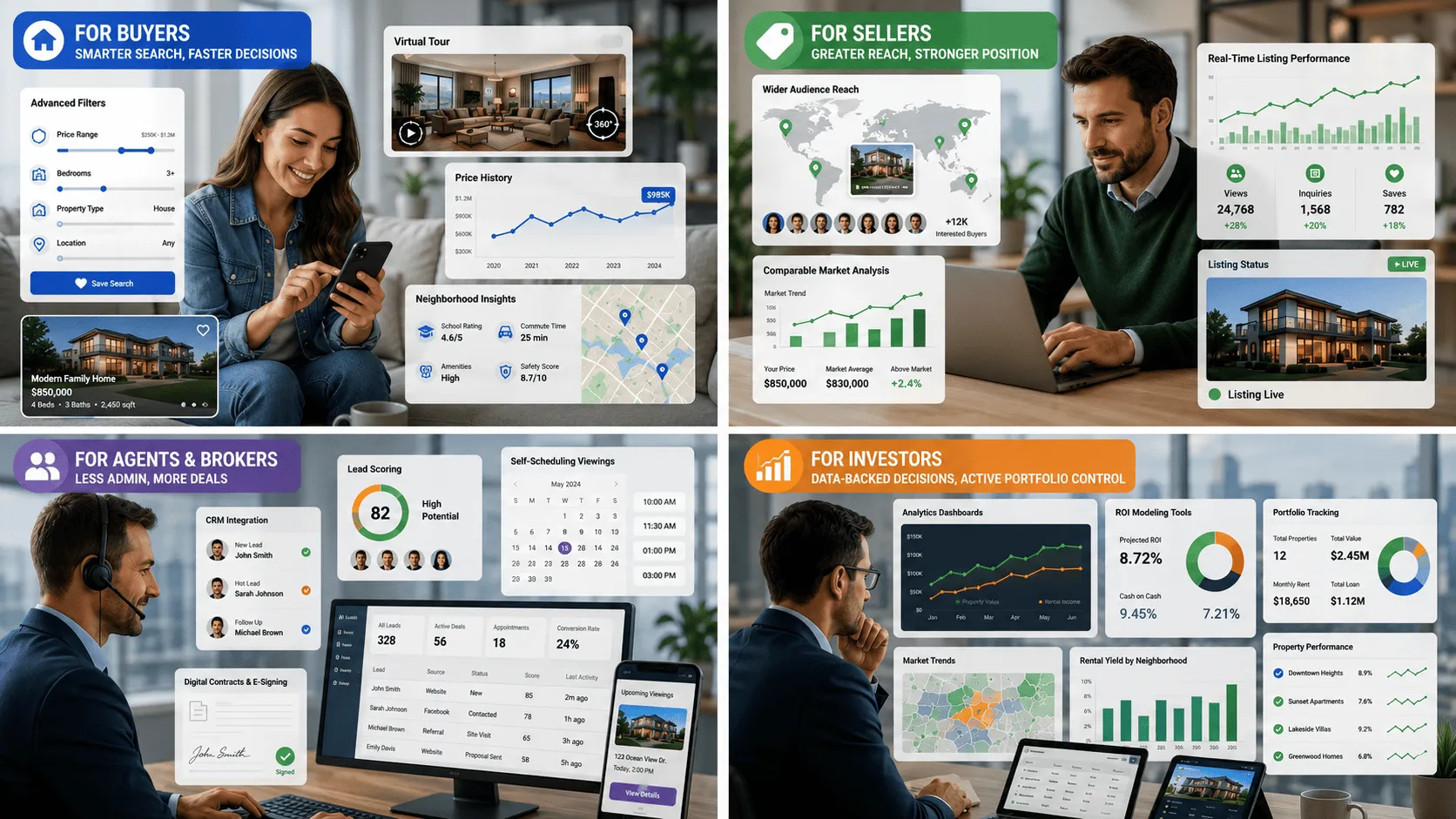
For Buyers: Smarter Search, Faster Decisions
Buyers gain complete control over the search process with tools designed to simplify every step.
- Advanced Filters & Saved Searches: Set precise criteria and receive instant alerts so no relevant listing is missed.
- Virtual Tours: Evaluate properties remotely before committing to an in-person visit.
- Price History Data: Review how a property’s value has changed over time to make informed offers.
- Neighborhood Insights: Access details on schools, commute times, and local amenities without relying entirely on agent guidance.
For Sellers: Greater Reach, Stronger Position
A real estate app removes the geographic ceiling on listing visibility and strengthens a seller’s market position.
- Wider Audience Reach: Properties are visible to thousands of actively searching buyers, including those relocating from other cities far beyond a local agent network.
- Comparable Market Analysis: Built-in tools help sellers price accurately from day one.
- Real-Time Listing Performance: Track how much traction a property is generating with live data and engagement metrics.
For Agents & Brokers: Less Admin, More Deals
Real estate app development gives agents the operational infrastructure to scale without burning out.
- CRM Integration: Centralizes every lead, interaction, and follow-up in one place.
- Lead Scoring: Automatically prioritizes conversion-ready prospects so agents focus where it counts.
- Self-Scheduling Viewings: Buyers book appointments directly through the app, eliminating back-and-forth coordination.
- Digital Contracts & E-Signing: Move deals forward in hours, not days, with fully digital documentation.
For Investors: Data-Backed Decisions, Active Portfolio Control
Real estate apps give individual investors access to intelligence once reserved for institutional teams.
- Analytics Dashboards: Track price trends and rental yields broken down by neighborhood.
- ROI Modeling Tools: Project returns and stress-test scenarios before committing capital.
- Portfolio Tracking: Consolidate valuations, rental income, and mortgage balances in a single view for active management rather than reactive responses.
Real-World Examples Setting the Standard
Several successful real estate apps have defined what users expect from these platforms.
Zillow
Zillow offers one of the most extensive databases of residential and commercial properties across the United States
- 3D Home Tours: Immersive walkthroughs without an in-person visit.
- Price History: Full pricing timeline for every listed property.
- Mortgage Calculators: Including commercial mortgage tools for investment planning.
- Neighborhood Details: Schools, crime rates, amenities, and local market trends.
Realtor.com
Realtor.com provides comprehensive real estate listings paired with powerful decision-making tools.
- Property Comparison Tools: Side-by-side evaluation of multiple listings.
- Mortgage Management: Track and manage financing options within the app.
- Customized Notifications: Alerts tailored to a buyer’s specific search criteria and preferences.
Must-Have Features in Real Estate App Development
The features you build define the value you deliver. Here are the core and advanced features that distinguish high-performing real estate apps from average ones.
Core Features
| Feature | Purpose |
|---|---|
| Advanced Property Search & Filters | Lets users find listings by price, location, type, and size |
| Interactive Map View | Visualizes listings geographically |
| Property Detail Pages | Showcases photos, specs, and neighborhood data |
| Save & Compare Listings | Helps users shortlist and evaluate options |
| Mortgage Calculator | Gives buyers instant affordability insight |
| In-App Messaging | Connects buyers directly with agents or sellers |
| Push Notifications | Alerts users to new listings, price drops, and messages |
| User Profiles & Authentication | Personalizes the experience and secures data |
Advanced Features
| Feature | Purpose |
|---|---|
| AI-Powered Recommendations | Surface relevant listings based on behaviour |
| Virtual Tours (VR/AR) | Allows immersive remote property viewing |
| Blockchain-Based Transactions | Enables secure, transparent peer-to-peer deals |
| Document Management & e-Signing | Digitizes contracts and agreements |
| Market Analytics Dashboard | Provides pricing trends and investment signals |
| Agent/Broker Portal | Manages listings, leads, and client communication |
| Neighborhood Insights | Crime rates, schools, transit scores, and local amenities |
The Current Trends in Real Estate App Development
Technology is redefining what a real estate app can do and what users now expect from one.
These are the five trends driving that shift.
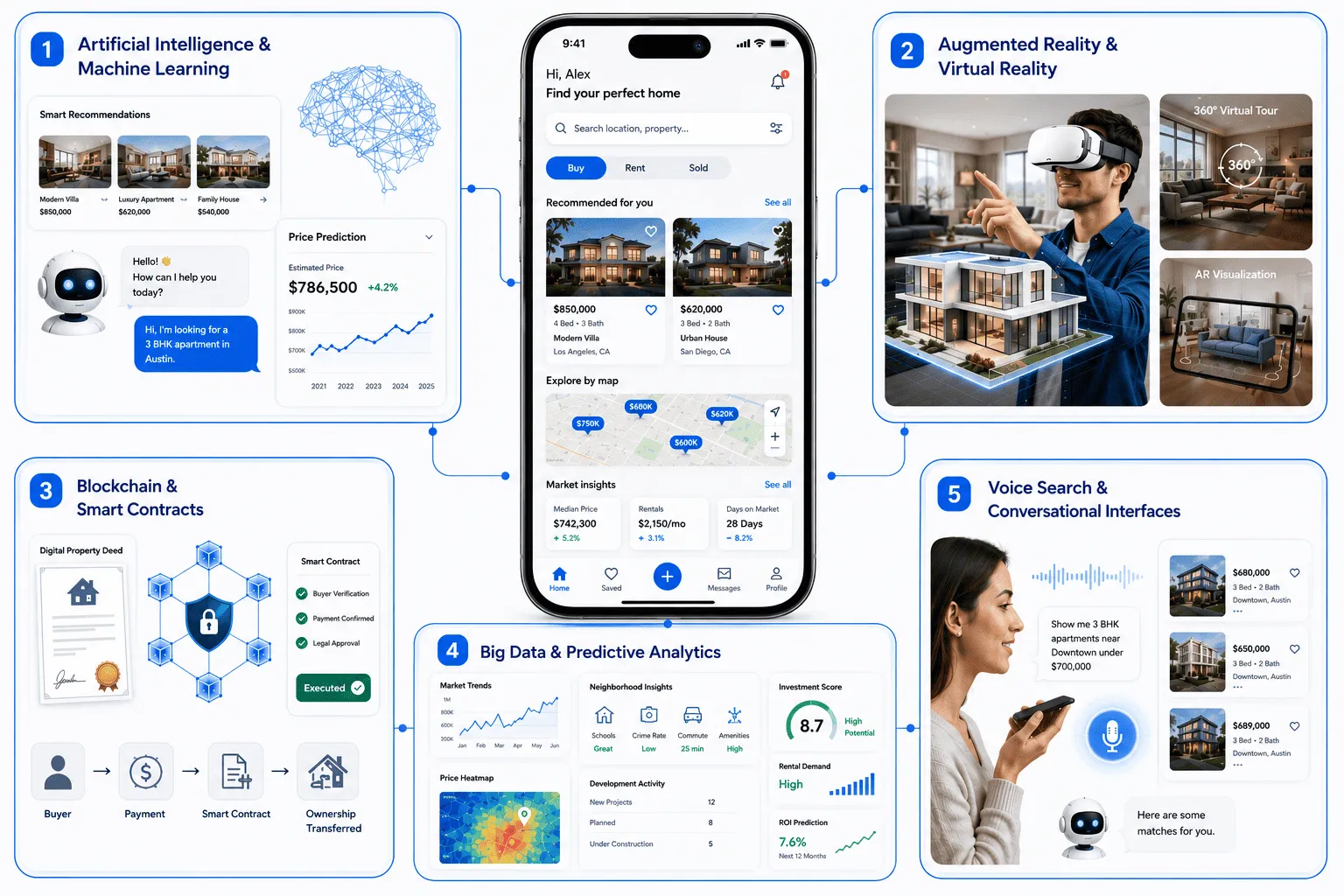
1. Artificial Intelligence & Machine Learning
AI has moved from a differentiator to a baseline expectation in real estate app development.
- Smart Recommendation Engines: Machine learning surfaces genuinely relevant listings based on user behavior, not just search terms, improving match quality over time.
- 24/7 Conversational Chatbots: Handle first-level inquiries around the clock, freeing agents to focus on high-value interactions.
- Price Prediction Models: Give buyers and sellers a credible, data-backed basis for evaluating any listing, leading to faster decisions and better-qualified leads.
2. Augmented Reality & Virtual Reality
Virtual property tours have become a standard expectation among active buyers, no longer a premium feature.
- 360-Degree Virtual Tours: Prospective buyers can walk through a property in full detail from any location, eliminating wasted site visits.
- International & Remote Buyer Access: AR/VR opens the platform to buyers who cannot visit in person, significantly expanding the addressable audience.
- AR Visualization Layers: Users can preview furniture placement or planned renovation changes before committing, compressing the buyer consideration phase significantly.
3. Blockchain & Smart Contracts
Blockchain addresses one of real estate’s oldest problems: trust.
- Tamper-Proof Ownership Records: Transactions recorded on a distributed ledger make ownership verifiable in real time, reducing fraud risk substantially.
- Smart Contract Automation: Agreements execute automatically when pre-agreed conditions are met, releasing funds and transferring title without manual intervention.
- Faster Closings, Lower Costs: Eliminating unnecessary intermediaries cuts both closing timelines and transaction costs for all parties.
4. Big Data & Predictive Analytics
The depth of data a platform surfaces is increasingly what separates strong real estate apps from weak ones.
- Layered Neighborhood Intelligence: School performance, crime trends, commute data, and local development activity are embedded directly into every listing view.
- Investment Opportunity Identification: Predictive analytics forecast rental demand and surface undervalued markets before the broader market catches on.
- Informed Decision-Making at Scale: Data-rich interfaces give both buyers and investors the context to act with confidence rather than guesswork.
5. Voice Search & Conversational Interfaces
Voice search reflects where mobile UX is heading, and real estate platforms are adapting accordingly.
- Always-On Accessibility: Voice-driven interactions make the platform usable in more contexts, commuting, multitasking, or on-the-go property research.
- Hands-Free Property Search: Users can search listings, ask market questions, and get instant answers without navigating menus or typing.
- Natural Language Processing: Conversational interfaces lower the barrier for non-technical users while accelerating the workflow for experienced ones.
The Future Opportunities in Real Estate App Development

The convergence of emerging technology and shifting consumer behavior is opening new directions for real estate platforms well beyond traditional buying and selling.
Emerging Technology Opportunities
- AI & Machine Learning: Automates property search, price estimation, and negotiation while delivering personalized insights based on user behavior, preferences, and current mortgage rates.
- AR & VR Experiences: Enables immersive virtual tours, remote property inspection, and real-time customization, enhancing convenience without requiring an in-person visit.
- Blockchain & Smart Contracts: Facilitates peer-to-peer transactions, eliminates intermediaries, and automates contractual obligations, reducing cost, risk, and closing time.
Expanding Use Cases
Real estate apps are moving well beyond property listings into broader ecosystems:
- Property Management: Maintenance requests, tenant communication, and lease tracking in one platform.
- Home Services: Connecting owners with contractors, inspectors, and renovation professionals.
- Investment Crowdfunding: Enabling fractional ownership and portfolio building for non-institutional investors.
- Real Estate Education: Onboarding first-time buyers, overseas purchasers, and renters with guided, in-app learning.
Best Practices for Building Successful Real Estate Apps
- First, understand your target users and their needs, preferences, and pain points.
- Second, design a user-friendly interface and a seamless user experience.
- Third, offer unique and valuable features that differentiate your app from the competition.
- Fourth, ensure the privacy, security, and reliability of your app.
- Lastly, continuously update and improve your app based on user feedback and market changes.
The future of real estate app development belongs to platforms that combine technological depth with genuine user value, transforming not just how properties are transacted but how they are discovered, managed, and experienced.
The Challenges and Risks in Real Estate App Development
Understanding the challenges is as important as knowing the opportunities. Here are the most significant obstacles in real estate app development and how to approach them.
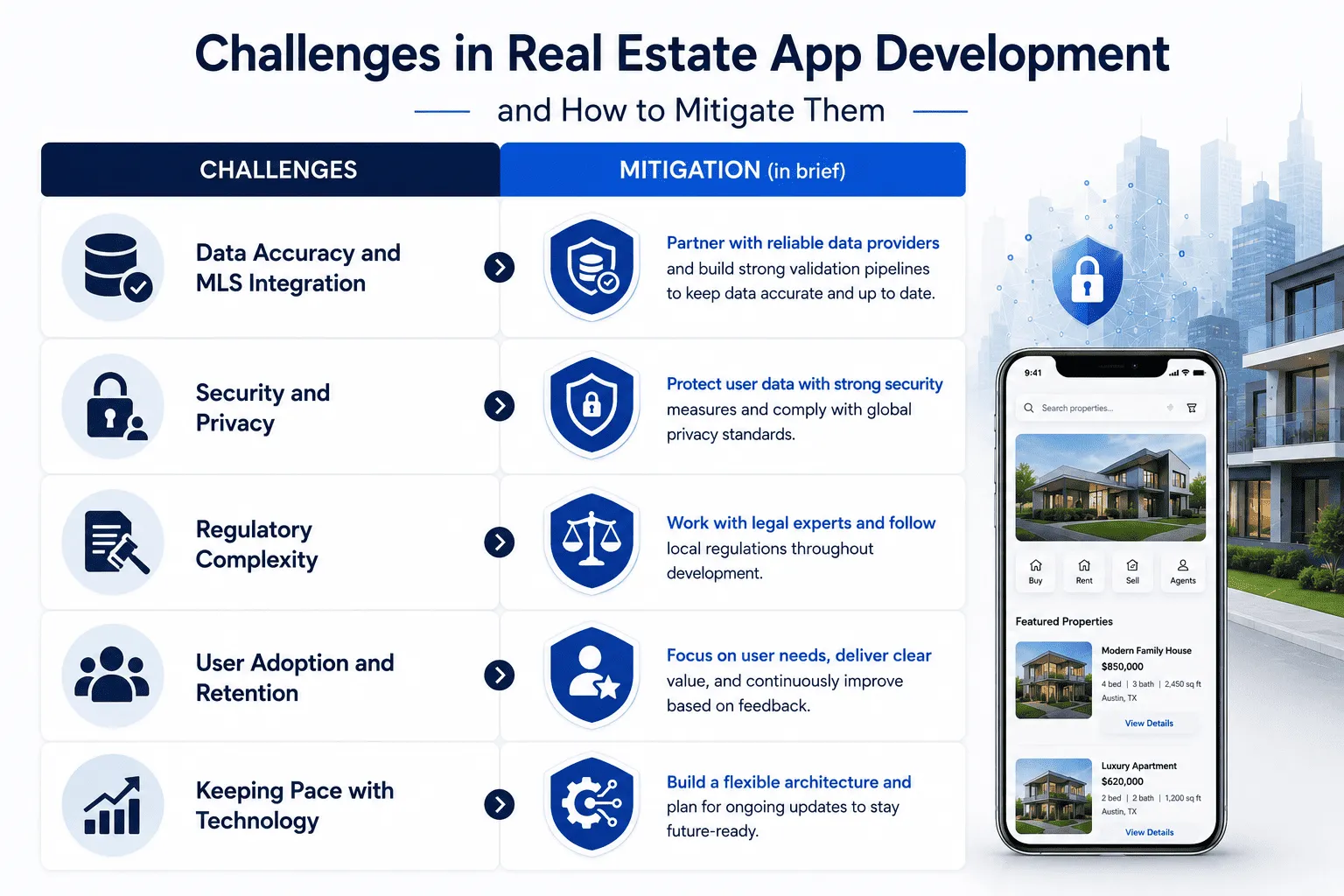
Data Accuracy and MLS (Multiple Listing Service) Integration
Real estate data is complex. Property listings, pricing history, ownership records, and neighborhood data come from dozens of different sources with varying formats and update frequencies. Keeping this data accurate, current, and well-structured is one of the hardest technical problems in real estate app development.
Mitigation: Partner with established data providers and build robust data validation pipelines into your architecture from day one.
Security and Privacy
Real estate transactions involve highly sensitive personal and financial information. A data breach does not just harm users; it can destroy brand trust overnight and trigger significant regulatory penalties.
Mitigation: Implement end-to-end encryption, role-based access control, and secure authentication (including two-factor), and conduct regular security audits. Ensure compliance with GDPR, CCPA, or regional equivalents.
Regulatory Complexity
Real estate is one of the most regulated industries in the world. Licensing requirements, fair housing laws, data disclosure rules, and consumer protection regulations vary by country, state, and even municipality.
Mitigation: Engage legal counsel with real estate industry expertise early in the development process. Build compliance checkpoints into your product roadmap.
User Adoption and Retention
Building the app is step one. Getting users to download, engage, and return consistently is a separate and equally demanding challenge. The real estate app market is crowded, and differentiation is difficult.
Mitigation: Invest in UX research before and during development. Build in feedback mechanisms. Launch with a clearly defined audience and a specific value proposition rather than trying to serve everyone at once.
Keeping Pace with Technology
AR, AI, blockchain, and voice interfaces are all evolving rapidly. An app that feels cutting-edge at launch can feel dated within two years.
Mitigation: Build your architecture to be modular and extensible. Plan for regular feature updates and allocate post-launch budget for ongoing development.
Conclusion
Real estate app development is not a niche within PropTech; it is the foundation of how the modern property industry operates. From AI-powered search to blockchain-secured transactions, the technology available to builders today is extraordinary. The gap between those who invest in excellent real estate app development and those who do not will only widen.
The key is to build with intention: understand your users deeply, choose technologies that solve real problems, prioritize security and compliance from day one, and plan for evolution rather than a one-time launch.
The future of real estate is digital. The question is whether your platform will define that future or trail behind it.
FAQ’s
How long does it take to develop a real estate app?
A basic real estate app typically takes 4 to 6 months to build; a full-featured platform with AI, VR, and analytics capabilities generally requires 9 to 14 months, depending on team size and scope.
Do I need separate apps for iOS and Android?
Not necessarily; cross-platform frameworks like Flutter and React Native allow you to build for both platforms from a single codebase, which significantly reduces development time and ongoing maintenance costs.
What makes a real estate app fail?
The most common causes are poor data quality, a cluttered user experience, a lack of mobile optimization, and launching without a clear differentiation strategy in an already crowded market.
Can a real estate app handle the full transaction end-to-end?
Yes, modern real estate app development can support the complete transaction lifecycle, including search, virtual tours, offer submission, document signing, payment processing, and post-sale management.