

Table of Contents
In today’s fast-paced and highly competitive marketplace, businesses are constantly searching for ways to optimize pricing strategies. One of the most transformative innovations in this domain is AI-Powered Dynamic Pricing.
This approach uses artificial intelligence to adjust prices based on real-time market data, customer behavior, competitor pricing, and other factors, enabling businesses to enhance profitability and respond instantly to changing market conditions.
This approach is now standard practice across e-commerce, hospitality, travel, and retail, and it’s evolving fast as autonomous AI agents enter the picture. In this article, we’ll explore how it works, its benefits, the newest agentic trends reshaping it, and the regulatory challenges businesses need to navigate.
What is AI-Powered Dynamic Pricing?
Dynamic pricing refers to the strategy of adjusting prices in real time based on demand, supply, customer behavior, market conditions, and competitor prices. With AI in the mix, businesses take this a step further by automating the process and making far more accurate, granular pricing decisions.
AI-powered dynamic pricing uses machine learning algorithms to analyze large datasets and surface patterns in real time. These algorithms can process massive amounts of information at high speed, enabling businesses to predict customer behavior and set optimal prices accordingly.
This approach removes the need for manual intervention and allows continuous pricing adjustments based on the latest data, so businesses stay competitive while maximizing revenue and margin.
How AI-Powered Dynamic Pricing Works
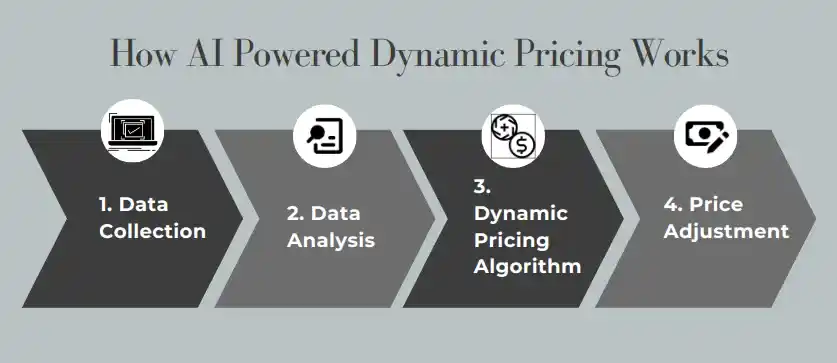
The core of AI-powered dynamic pricing lies in machine learning models that learn from historical and real-time data. Here’s a breakdown of the process:
1. Data Collection
AI models need a variety of inputs to make informed decisions, typically including:
- Historical sales data: Reveals past customer behavior and buying trends.
- Competitor pricing data: Tracks how rivals are pricing similar products, often via real-time web crawling.
- Customer behavior data: Browsing patterns, purchase history, and demographics.
- External factors: Market trends, economic shifts, weather, and seasonal events.
- Inventory data: Current supply levels of products or services.
2. Data Analysis
Once collected, this data is run through machine learning models that turn raw numbers into pricing intelligence. The analysis typically covers:
- Demand Forecasting: Predicting how demand for a product or service will shift over the coming hours, days, or weeks based on historical and real-time signals.
- Price Elasticity Modeling: Measuring how sensitive customers are to price changes. Elasticity varies widely by category; electronics tend to see small demand shifts of roughly 2-5% for every 1% price change, fashion items swing much more sharply at 10-20%, while grocery demand barely moves, around 1-3% (source).
- Scenario Simulation: Testing multiple hypothetical price points against predicted demand before any price actually changes live.
- Customer Segmentation: Grouping shoppers by behavior and predicted lifetime value so pricing can be tailored rather than applied uniformly.
- Competitive Benchmarking: Comparing internal pricing signals against real-time competitor data to spot gaps and opportunities.
3. Dynamic Pricing Algorithm
Once the data is processed, AI algorithms calculate the ideal price for each product or service in real time. The algorithm considers various elements, including:
- Demand fluctuations: If demand increases, the algorithm may raise prices to capitalize on the surge.
- Competitor actions: If competitors lower prices, the algorithm can adjust accordingly to remain competitive.
- Customer willingness to pay: AI can predict how much individual customers or segments are willing to pay, enabling personalized pricing.
- Inventory levels: For products in limited supply, the AI system can increase prices to reflect scarcity.
4. Price Adjustment
Once the algorithm settles on a price, that decision has to reach every channel instantly and safely. This stage typically involves:
- Real-Time Push: Updated prices go live simultaneously across websites, mobile apps, and physical or digital shelf displays.
- Cross-Channel Synchronization: Prices stay consistent across e-commerce, marketplaces, and point-of-sale systems to avoid conflicting listings.
- Guardrail Enforcement: Automated checks confirm a price never drops below a minimum margin or exceeds market-acceptable bounds before it goes live.
- Continuous Feedback Loop: The system tracks how each price change performs and feeds those results back into the model for the next cycle.
- High-Frequency Execution: This isn’t a one-time calculation; Amazon changes prices on a given product roughly every 10 minutes on average, making an estimated 2.5 million price adjustments a day across its catalog (source).
Benefits of AI-Powered Dynamic Pricing

1. Increased Revenue and Profitability: AI-powered dynamic pricing enables businesses to maximize their revenue by setting prices that reflect real-time market conditions and customer demand. By optimizing prices at every stage, businesses can capture more value from each transaction, leading to higher profits.
2. Improved Competitive Edge: In a highly competitive market, businesses must be agile in their pricing strategies. AI-powered dynamic pricing allows companies to stay ahead of their competitors by adjusting prices in response to competitor moves. This ensures that businesses can offer competitive pricing while maintaining profitability. Monitoring competitor pricing can help businesses understand how frequently prices change and how competitors respond to market conditions, while a DataDome scraping benchmark can provide useful context when evaluating competitor data collection at scale.
3. Personalized Customer Experience: AI-powered dynamic pricing can provide personalized pricing based on individual customer behavior. By analyzing purchase history, browsing patterns, and other behavioral data, AI systems can tailor prices to match the willingness to pay of different customers. This leads to a more personalized shopping experience, enhancing customer satisfaction and loyalty.
4. Optimized Inventory Management: Dynamic pricing allows businesses to optimize their inventory levels. For example, if a product is in high demand but inventory is low, the AI system can increase prices to balance supply and demand. Conversely, if there is excess inventory, the system can reduce prices to encourage sales and avoid overstocking.
5. Efficient Time and Resource Allocation: Manual pricing adjustments require significant time and effort. By automating the process, AI-powered dynamic pricing saves businesses time and resources. This allows teams to focus on other critical tasks, such as marketing and customer service.
Industry Applications of AI-Powered Dynamic Pricing
AI-powered dynamic pricing is already embedded across several industries, each applying it a little differently:
- E-commerce: E-commerce platforms remain the heaviest users of this technology. Around 40% of online retailers already use some form of automated pricing, adjusting offers and promotions down to the individual shopper (source).
- Hospitality and Travel: The hospitality and travel industries lean heavily on dynamic pricing to manage fluctuating demand. Airlines in particular are moving toward reinforcement-learning-based fare models that replace older static revenue-management heuristics, adjusting ticket prices continuously based on booking patterns and seat availability.

- Ride-Sharing Services: Uber and Lyft continue to use surge pricing to balance driver supply with rider demand during peak hours and events, a model that’s increasingly informed by predictive demand forecasting rather than simple real-time ratios.
- Retail and Restaurants: Brick-and-mortar retailers are catching up to e-commerce with digital shelf labels and connected menu boards. Fast-food chains are now testing this too; one major chain has committed roughly $20 million toward digital menu boards and AI-driven pricing to move beyond fixed “value menu” pricing.
Agentic AI and the Rise of Agentic Commerce
AI-powered dynamic pricing is entering its next technical phase: autonomy. Instead of a model that simply recommends a price for a human to approve, pricing is increasingly handled end-to-end by AI agents that decide and act on their own. This section breaks down what’s actually changing, technically, and why it matters.
1. Autonomous Pricing Agents (Sell-Side)
The next generation of pricing agents can negotiate B2B contract terms, react to supplier cost changes, and update promotional pricing across channels entirely on their own, moving from “pricing on autopilot” to agents that decide and act independently (source). Technically, this shift relies on:
- Closed-loop execution: The agent doesn’t just output a recommended price; it pushes the price live and monitors the outcome without waiting for human sign-off.
- Continuous supplier and cost-signal ingestion: Agents react to upstream cost changes (materials, freight, supplier contracts) in near real time rather than on a fixed pricing-review cycle.
- Cross-channel synchronization: The same agent coordinates pricing across web, app, marketplace, and in-store channels simultaneously to prevent conflicting prices.
2. Agentic Commerce (Buy-Side)
The same shift is happening on the customer’s side of the transaction. Businesses now also have to price for AI shopping agents, bots that browse, compare, and even complete purchases on a customer’s behalf once a preset price threshold is hit. This emerging pattern, often called agentic commerce, means pricing engines increasingly negotiate with other algorithms rather than directly with people (source). In practice, this introduces new technical requirements:
- Machine-readable pricing APIs: Prices and promotions need to be exposed in structured formats that shopping agents can parse and act on directly, not just rendered as webpage text.
- Bot-aware demand signals: Pricing models need to distinguish between human browsing behavior and automated agent traffic, since the two respond to incentives very differently.
- Threshold-triggered transaction handling: Systems must be able to complete a sale automatically the moment an agent’s preset price target is met, without a human in the loop on either side.
3. What This Means for Businesses
- Pricing infrastructure needs to support both directions of automation: agents setting prices and agents buying at those prices, often at the same time.
- The same agentic frameworks used for data analytics and workflow automation are what now power this kind of autonomous, machine-to-machine pricing negotiation, making agent architecture a foundational investment rather than a nice-to-have.
- Governance and audit trails become essential once pricing decisions are fully automated end-to-end; this is covered in more detail in the next section.
Challenges and Regulatory Considerations
Despite the upside, AI-powered dynamic pricing isn’t risk-free. Here’s a simple breakdown of the main challenges businesses need to plan for:
1. Customer Trust
- The risk: Frequent, opaque price changes can feel unfair to shoppers, especially if a price looks inflated just so it can be “discounted” back down.
- The fix: Frame changes transparently, for example, labeling a price increase as “seasonal demand pricing” rather than leaving it unexplained.
2. Price Transparency Rules (EU Omnibus Directive)
- The rule: Retailers must display the lowest price offered in the past 30 days alongside any discount.
- Who it affects: This applies directly to dynamically generated prices, not just manual sales, so automated systems need to track and surface that 30-day low automatically.
3. Data Privacy Rules (GDPR)
- The rule: Using a shopper’s personal data (location, browsing history, and device type) to set an individualized price requires their explicit consent.
- The workaround: Segment-based pricing (based on general customer groups rather than individual profiles) doesn’t require the same consent and is a common way to personalize pricing while staying compliant.
4. Fairness and Accountability
- The challenge: As both retailers and AI shopping agents optimize against each other, it gets harder to say who is really setting the final price: the retailer’s algorithm, the customer’s agent, or the back-and-forth between the two.
- The fix: Build in human override authority and audit trails so every automated price decision can be reviewed and explained after the fact.
5. Governance, in Practice
Businesses exploring this space should treat governance as a first-class requirement, not an afterthought. In practice, that means:
- Setting clear guardrails and minimum-margin rules before the system goes live.
- Running compliance review from day one rather than retrofitting it later.
- Keeping a human in the loop for exceptions, not just routine price changes.
Future of AI-Powered Dynamic Pricing
AI-powered dynamic pricing is transforming the way businesses approach pricing strategies. By leveraging the power of machine learning and real-time data analysis, businesses can optimize prices, enhance customer experiences, and stay competitive in a fast-evolving market.
Despite some challenges, the benefits of AI-powered dynamic pricing far outweigh the risks, making it a crucial tool for businesses looking to thrive in the digital age.
Ready to bring AI Powered Dynamic Pricing into your business? HyScaler helps companies design and implement AI-driven pricing systems, from elasticity modeling and real-time data pipelines to agentic pricing agents and compliance-ready governance. Talk to HyScaler’s AI and cloud consulting team to get started.
FAQs
Is it even legal for companies to charge me a different price than someone else?
Yes, in most places, but the EU and a few other regions now require transparency around discounts, and personal-data-based pricing needs your consent under GDPR.
Why did the price go up right after I searched for it a few times?
Some sites do track repeat searches as a demand signal, but this is more common with flights and hotels than everyday retail; clearing cookies or using a private window is the usual workaround people try.
What actually makes a pricing “agent” different from a regular pricing algorithm?
A regular algorithm recommends a price for a human to approve; an agent executes that price change itself and monitors the outcome without waiting for sign-off.
Does dynamic pricing only mean prices go up, never down?
No, the same system that raises prices during high demand will drop them just as fast when demand or inventory levels fall.
Will AI agents that shop for me eventually replace comparison shopping?
Partly, agents can already track a target price and buy automatically once it’s hit, but most still need a person to set the preferences first.