

Table of Contents
Healthcare organizations increasingly rely on software to manage patient care, streamline operations, and stay compliant with evolving regulations. But off-the-shelf tools don’t always fit the unique workflows, integrations, or compliance needs of a hospital, clinic, or health-tech company. That’s where custom healthcare software development comes in: software built around your specific business, clinical, integration, and compliance requirements. This guide walks through what custom healthcare software is, its benefits, and the full development journey from discovery to post-launch support.
What Is Custom Healthcare Software Development?
Custom healthcare software development is the process of designing and building software tailored specifically to an organization’s workflows, users, patient requirements, integrations, and security and compliance needs, rather than adapting a generic, one-size-fits-all product.
Examples of Custom Healthcare Software
- EHR/EMR systems for managing patient records
- Telehealth platforms for virtual consultations
- Patient portals for appointments, records, and communication
- Hospital management systems for administrative and clinical operations
- Remote patient monitoring solutions for continuous care outside the clinic
Benefits of Custom Healthcare Software
- Better workflow efficiency: Software is designed around actual clinical and administrative processes, not generic assumptions.
- Improved patient experience: Patients get easier access to appointments, records, communication, and remote care.
- Easier integration: Custom software can connect with EHRs, medical devices, payment systems, labs, and other platforms.
- Better scalability: The system can evolve as the organization grows.
- Greater control over security: Security requirements can be built into the architecture from the very beginning, rather than bolted on later.
Custom Healthcare Software Development Process
1. Discovery and Requirement Analysis
Every successful project starts with a clear understanding of the problem. This phase typically includes stakeholder interviews, workflow mapping, business and technical requirements gathering, integration requirements, regulatory requirements, and defining project scope and priorities. It creates the foundation everything else is built on.
2. Planning and Architecture Design
With requirements in hand, the team moves into technology selection, software architecture, database design, API and integration planning, security architecture, scalability planning, and mapping out a development roadmap. For a deeper look at how this fits into the broader development lifecycle, see HyScaler’s healthcare software development guide.
3. UI/UX Design
Healthcare interfaces need to reduce complexity, not add to it. This stage covers user personas, wireframes, prototypes, and accessibility, all built with the goal of making the software genuinely usable for both clinicians and patients.
4. Development and Integration
Development happens on two fronts. On the backend, teams build APIs, databases, business logic, and authentication systems. On the frontend, they build dashboards, patient interfaces, and mobile or web experiences. Throughout, the software is integrated with EHR/EMR systems, payment systems, laboratories, medical devices, and third-party APIs, typically following Agile/Scrum methodologies to keep development iterative and responsive to feedback.
5. Security, Compliance and Testing
This is one of the most critical, and often overlooked, stages of healthcare software development. It includes meeting HIPAA/GDPR requirements where applicable, data encryption, authentication and authorization, role-based access, audit logs, and secure data storage. It’s paired with rigorous functional, security, usability, and performance testing before anything goes live.
6. Deployment
Once tested, the software is deployed to a cloud or on-premises production environment, with careful attention to data migration, backup and recovery, monitoring, and rollback planning in case issues arise.
7. Post-Launch Support and Maintenance
Healthcare software can’t simply be launched and forgotten. Ongoing work includes performance monitoring, security patches, bug fixes, feature improvements, compliance updates, and scaling as usage grows.
How Much Does Custom Healthcare Software Development Cost?
There’s no single answer, because cost depends on several factors: software complexity, number of users, features, integrations, compliance requirements, technology stack, development team composition, and ongoing maintenance needs.
As a general guide, a basic healthcare application may cost tens of thousands of dollars, while complex EHR, hospital management, or enterprise healthcare platforms can require hundreds of thousands of dollars. The final cost depends heavily on scope, integrations, compliance, and development requirements.
How to Choose a Custom Healthcare Software Development Partner
When evaluating healthcare software development services, look for a partner with:
- Healthcare domain experience, a track record with clinical and administrative workflows
- Security and compliance expertise, familiarity with HIPAA, GDPR, and related standards
- EHR/integration experience, proven ability to connect with existing systems
- Proven development methodology, a structured, transparent process
- Post-launch support, commitment beyond the initial launch
Initial Discovery And Requirement Analysis
To have successful custom healthcare software development, you need to have a thorough discovery phase. By having this step, you will be able to fully understand the client’s vision, operational challenges, and regulatory needs.
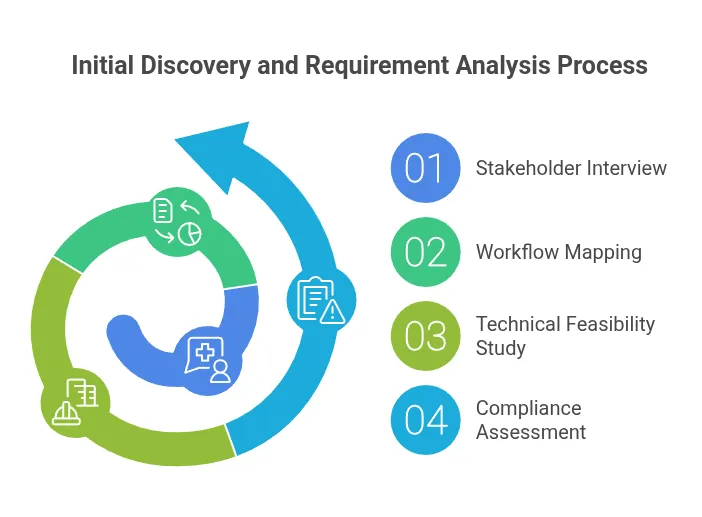
Here are the key steps involved to make it happen:
- Stakeholder Interview: Start talking with doctors, nurses, administrators, and IT teams to understand pain points.
- Workflow Mapping: You need to know how the software is going to fit into the existing process.
- Technical Feasibility Study: Before that, you need to check infrastructure readiness, integration needs, and scalability options.
- Assess Compliance: It’s highly necessary to ensure it meets HIPAA, GDPR compliance, or any local healthcare regulations.
By following these steps, you will be able to use this as a blueprint for design and development.
Post-Launch Updates And Support
You can’t launch the product and forget it in healthcare. Post-launch, the software must be regularly maintained to ensure performance, security, and compliance.
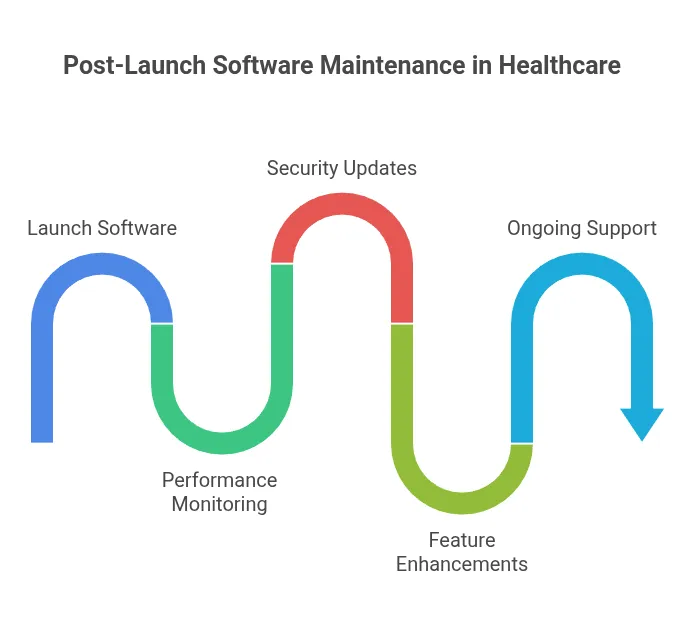
After the launch, you need to check the four major things
- Performance monitoring: Tracking systems’ uptime and response time.
- Security updates: Applying patches to prevent breaches.
- Feature enhancements: Adding new functionalities based on your feedback.
A reliable custom healthcare software development services provider will offer ongoing support to ensure the solution stays aligned with evolving healthcare needs.
Conclusion
Custom healthcare software development is not simply about building an application. It requires understanding healthcare workflows, designing for real users, integrating with existing systems, protecting sensitive information, testing thoroughly, and continuously maintaining the product. With the right development partner, organizations can build healthcare software that fits their workflows today while remaining flexible enough to evolve tomorrow.
FAQ
What is the process for building custom healthcare software?
It involves five main steps: discovery & requirement analysis, designing the solution, development & testing, deployment, and post-launch support.
How do you develop software for a hospital or clinic?
By understanding the facility’s unique workflows, compliance needs, and patient care goals, then creating custom telehealth solutions that integrate with existing systems and enhance efficiency.
What makes healthcare software custom?
It’s designed specifically for the unique needs of the healthcare provider, rather than using generic, one-size-fits-all applications. This customisation ensures better usability, compliance, and scalability.
What is custom healthcare software development?
It’s the process of building software specifically tailored to an organization’s clinical, administrative, and compliance needs, rather than relying on generic, off-the-shelf tools.
What are the main steps in custom healthcare software development?
Discovery → planning and architecture → UI/UX design → development and integration → security, compliance, and testing → deployment → post-launch support and maintenance.
How much does custom healthcare software development cost?
Cost depends on complexity, features, integrations, compliance requirements, and team composition, ranging from tens of thousands of dollars for simpler applications to hundreds of thousands for complex, enterprise-grade platforms.
How long does it take to develop custom healthcare software?
Simple applications can take a few months, while complex healthcare platforms, especially those involving multiple integrations and strict compliance requirements, can take considerably longer.