

Table of Contents
Cyber threats are no longer a distant concern for enterprises; they are an operational reality.
In 2026, organizations in the United States face an unprecedented volume of attacks: ransomware campaigns targeting critical infrastructure, AI-generated phishing at an industrial scale, and sophisticated adversaries exploiting zero-day vulnerabilities faster than security teams can patch them.
Traditional rule-based security tools, firewalls, signature-based antivirus, and legacy SIEM platforms were designed for a different threat era.
They rely on known attack patterns, require constant manual tuning, and struggle to keep pace with adversaries who now deploy machine learning to evade detection.
Security Operations Center (SOC) analysts are overwhelmed, alert fatigue is endemic, and the global cybersecurity talent shortage shows no signs of easing.
This is where AI cybersecurity tools have moved from experimental to essential.
By applying machine learning, behavioral analytics, and generative AI to security operations, these platforms help organizations detect threats in real time, automate responses, reduce false positives, and scale defenses without proportionally scaling headcount.
In this guide, you will find a comprehensive look at the 16 best AI cybersecurity tools in 2026, covering their core capabilities, AI features, ideal use cases, and a comparison framework to help you make informed procurement decisions.
What Are AI Cybersecurity Tools?
Definition of AI Security Tools
AI cybersecurity tools are software platforms that apply artificial intelligence and machine learning to detect threats, analyze security events, automate incident responses, and strengthen cyber defenses across networks, endpoints, cloud environments, and applications.
Unlike traditional tools that match traffic or behavior against static rule sets, AI-driven platforms learn from continuous data streams, adapt to evolving attack patterns, and make probabilistic risk assessments in real time.
How AI Improves Cybersecurity
The fundamental advantage AI brings to cybersecurity is the ability to process and correlate enormous volumes of telemetry data far more than any human team could analyze manually and surface the signals that genuinely require attention.
This translates into faster mean time to detect (MTTD) and mean time to respond (MTTR), fewer missed threats, and a measurable reduction in analyst workload.
AI also enables proactive defense.
Rather than waiting for an attack to match a known signature, AI-driven tools build behavioral baselines and flag deviations, catching novel threats, insider risks, and living-off-the-land attacks that signature tools routinely miss. The growing adoption of AI-powered security platforms is also reshaping cybersecurity education. Professionals looking to stay relevant in this evolving landscape are increasingly seeking the best cyber security course options that provide hands-on experience with AI security tools and real-world threat scenarios.
Key Technologies Behind AI-Based Cybersecurity Tools
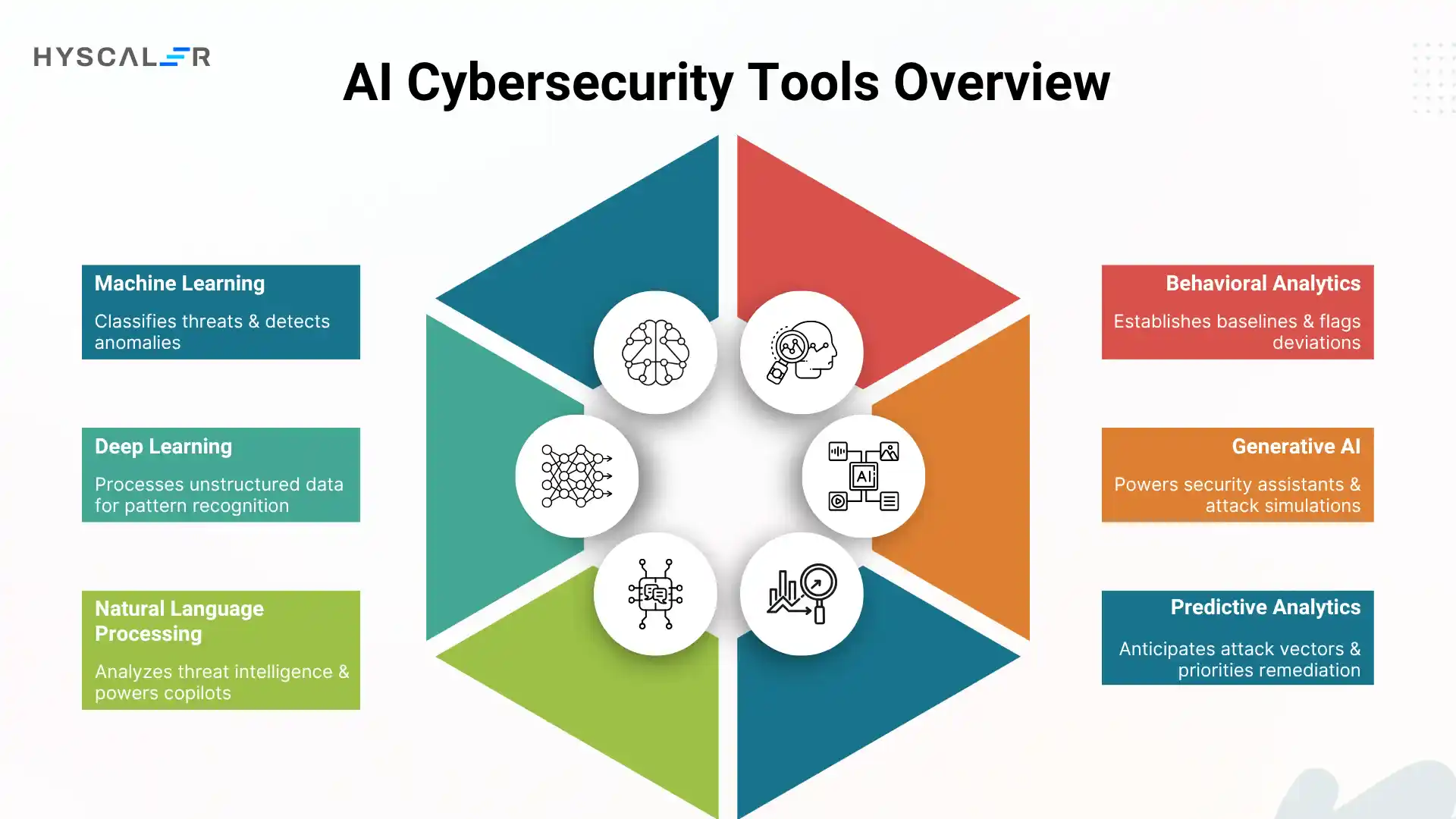
Machine Learning (ML): Supervised and unsupervised ML models classify threats, detect anomalies, and prioritize alerts based on risk scoring derived from historical attack data.
Deep Learning: Neural networks process unstructured data, network packets, log files, and binary code to identify patterns invisible to traditional analysis.
Natural Language Processing (NLP): Used to analyze threat intelligence feeds, parse security advisories, and power AI security copilots that allow analysts to query data in plain English.
Behavioral Analytics: Establishes normal behavioral baselines for users, devices, and applications, then surfaces deviations that indicate compromise or insider threat.
Generative AI: Powers security assistants, automated report generation, and synthetic attack simulation used in red team exercises.
Predictive Analytics: Leverages historical attack data and threat intelligence to anticipate likely attack vectors and prioritize remediation before exploitation occurs.
Why Businesses Are Investing in AI Cybersecurity Tools
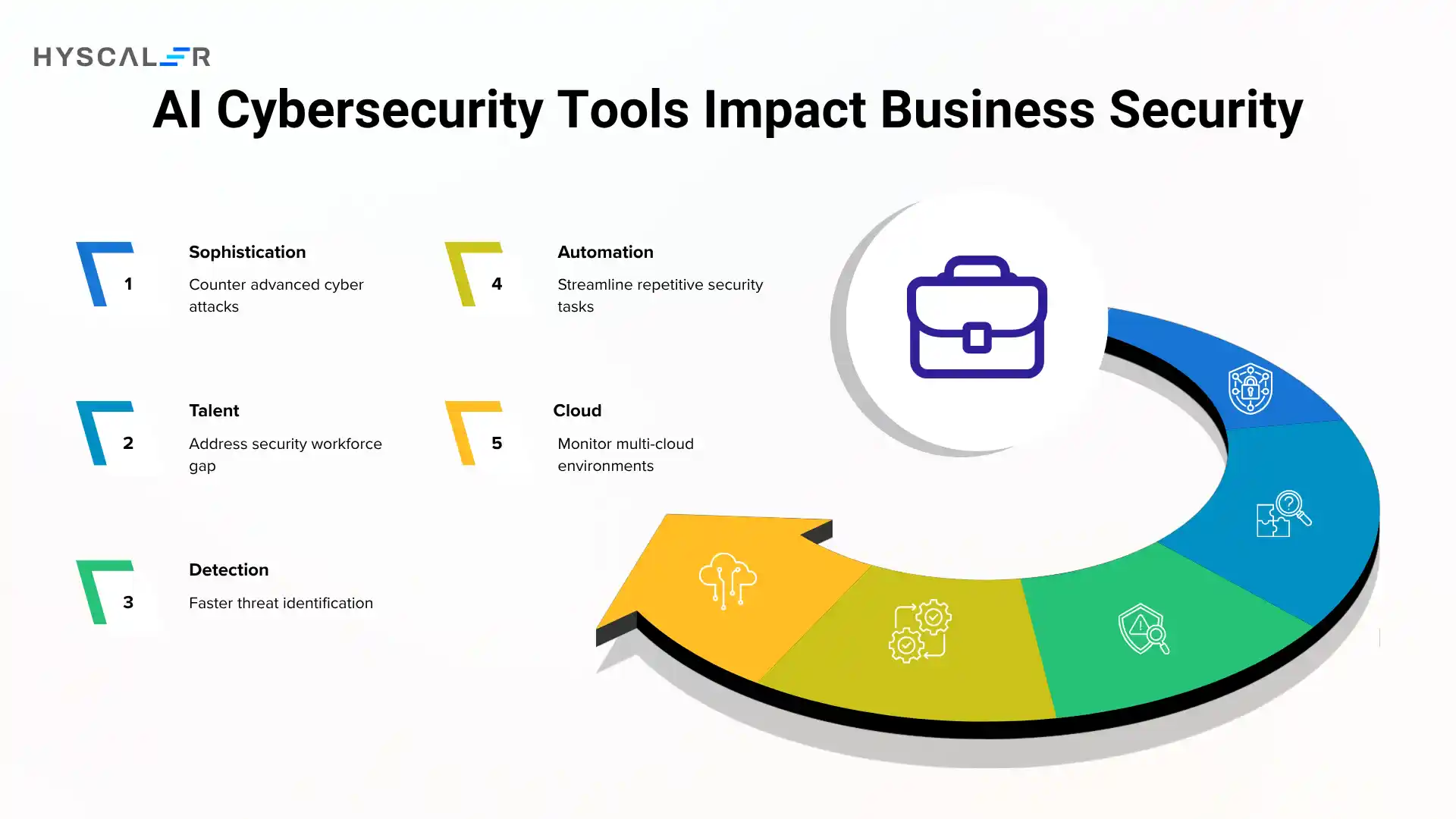
Increasing Sophistication of Cyber Attacks
Threat actors increasingly use AI themselves to craft convincing spear-phishing messages, automate vulnerability scanning, and mutate malware to evade detection.
The 2025 Verizon Data Breach Investigations Report noted a continued rise in AI-assisted social engineering attacks. Security teams that rely on legacy tools face an asymmetric disadvantage.
Security Talent Shortages
The global cybersecurity workforce gap exceeds 4 million professionals, according to ISC2’s 2025 workforce study.
AI tools function as a force multiplier, allowing lean security teams to monitor and defend environments at a scale previously requiring significantly larger staffing. Compliance advisors like Compass IT Compliance note that many understaffed teams pair this kind of AI tooling with an outsourced virtual CISO to cover the strategic oversight automation alone can’t provide.
Faster Threat Detection Requirements
Dwell time, the period between initial compromise and detection, remains dangerously long at many organizations.
AI-powered platforms achieve detection in minutes or seconds rather than the days or weeks characteristic of manual processes, materially reducing breach impact.
Need for Security Automation
Repetitive, high-volume tasks, alert triage, log correlation, threat enrichment, and ticket generation consume analyst capacity that should be directed at complex investigations.
AI-driven security orchestration automates these workflows, freeing analysts for higher-judgment work.
Cloud Security Challenges
Multi-cloud and hybrid environments generate security telemetry at a scale that traditional tools cannot effectively monitor.
AI platforms purpose-built for cloud-native architectures correlate signals across AWS, Azure, GCP, and on-premises infrastructure without the visibility gaps that siloed tools create.
Benefits of Using AI Tools for Cybersecurity
Real-Time Threat Detection
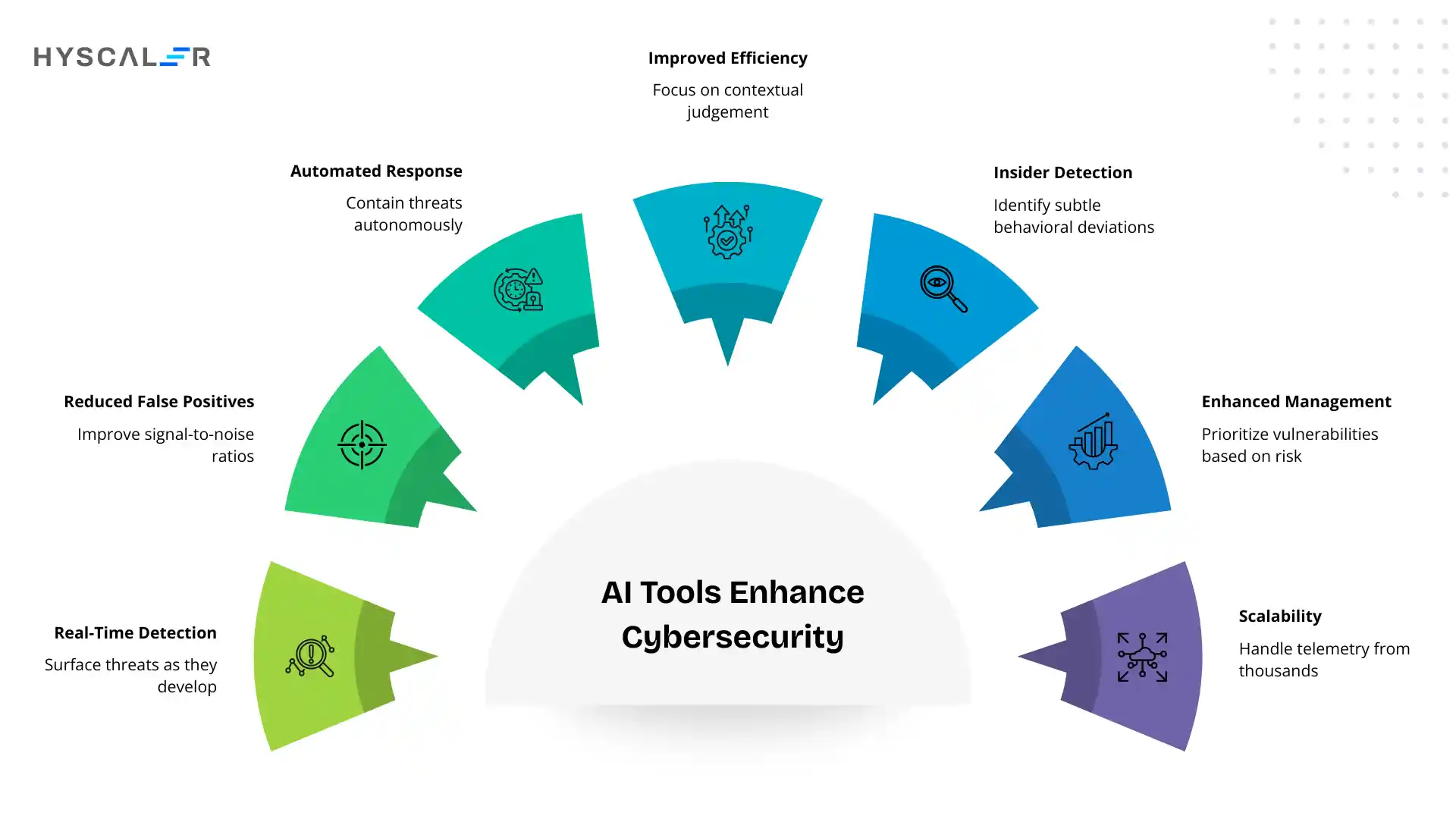
AI engines analyze telemetry continuously and surface threats as they develop, often before significant damage occurs.
This is particularly critical for ransomware and supply chain attacks, where speed of detection directly determines the scope of impact.
Reduced False Positives
Alert fatigue is one of the primary causes of analyst burnout and missed threats.
ML models trained on large, labeled datasets significantly improve signal-to-noise ratios, ensuring that alerts demanding human attention are genuinely high-priority.
Automated Incident Response
Playbook-driven automation allows AI platforms to contain threats autonomously, isolating compromised endpoints, revoking credentials, and blocking malicious IPs within seconds of detection, well before a human analyst can intervene.
Improved Security Operations Efficiency
By automating tier-one triage, AI tools allow SOC analysts to focus on investigations requiring contextual judgment, reducing cost per incident and increasing team throughput.
Better Insider Threat Detection
Behavioral analytics excel at identifying subtle, gradual deviations in user behavior data exfiltration patterns, unusual access requests, and off-hours activity that rule-based tools designed for external threats routinely miss.
Enhanced Vulnerability Management
AI-driven risk scoring prioritizes vulnerabilities based on exploitability, asset criticality, and active threat intelligence, helping security teams address the vulnerabilities most likely to be exploited rather than simply the most recently disclosed.
Scalability Across Large Environments
Cloud-native AI security platforms scale elastically with organizational growth, handling telemetry from thousands of endpoints, dozens of cloud accounts, and complex microservice architectures without degradation in detection quality.
AI Cybersecurity Market Statistics and Trends
AI in Cybersecurity Market Growth
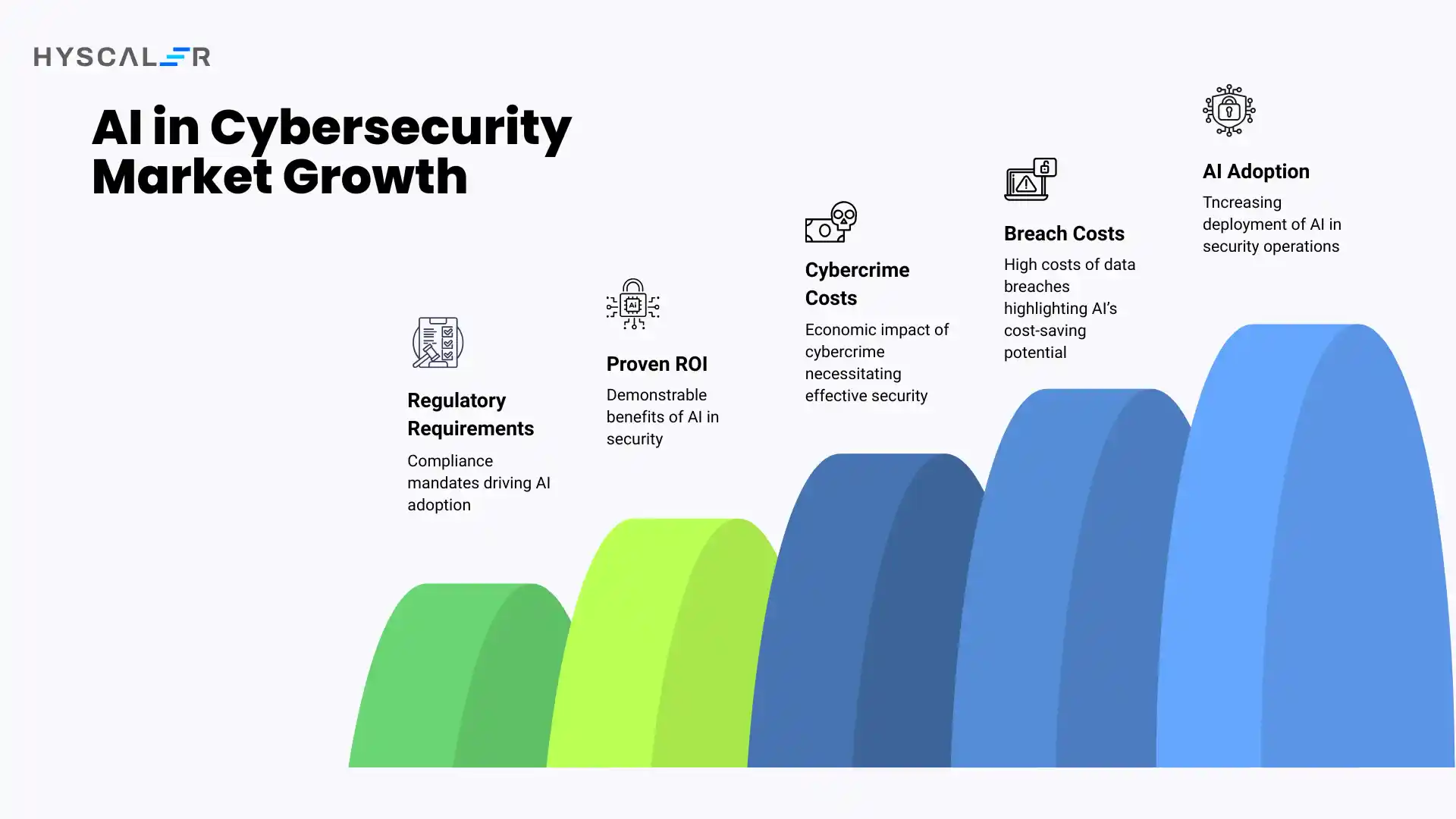
The global AI in cybersecurity market was valued at approximately $24 billion in 2025 and is projected to exceed $60 billion by 2030, driven by rising attack volumes, regulatory requirements, and the proven ROI of AI-augmented security operations.
Cost of Cybercrime
Global cybercrime costs are projected to reach $10.5 trillion annually by 2025, according to Cybersecurity Ventures, a figure that underscores the economic imperative for more effective security investment.
Average Breach Costs
IBM’s Cost of a Data Breach Report 2025 placed the average cost of a data breach at $4.88 million globally, with breaches involving AI-detected threats resolved significantly faster and at materially lower cost.
AI Adoption in Security Operations
Gartner research indicates that by 2026, more than 40% of enterprises will have deployed AI-augmented security operations capabilities, up from approximately 15% in 2023.
Emerging Trends for 2026
Autonomous SOCs: AI platforms are assuming tier-one triage responsibilities end-to-end, routing only complex investigations to human analysts.
AI Security Copilots: Natural language interfaces allow analysts to query security data, generate reports, and run investigations through conversational AI rather than complex query languages.
Predictive Threat Intelligence: AI models fuse dark web intelligence, exploit databases, and organizational context to anticipate attacks before adversaries execute them.
Agentic Security Systems: Multi-agent AI architectures that coordinate autonomous investigation, containment, and remediation workflows across the security stack.
AI-Driven Threat Hunting: Proactive hunt operations augmented by AI that surface latent threats already present in the environment.
16 Best AI Cybersecurity Tools in 2026
1. CrowdStrike Falcon
AI Capabilities: CrowdStrike’s Charlotte AI copilot and Falcon platform leverage a proprietary security-specific large language model trained on trillions of security events from the CrowdStrike Threat Graph. The platform delivers AI-powered threat intelligence, automated detection, and natural language investigation capabilities.
Key Features: Extended Detection and Response (XDR), AI-driven endpoint protection, Identity Threat Protection, Cloud Security, and the Charlotte AI security assistant.
Best For: Large enterprises requiring unified endpoint, identity, and cloud security with strong threat intelligence and managed detection options.
2. Darktrace
AI Capabilities: Darktrace pioneered the “immune system” approach to AI security, using unsupervised machine learning to build individualized models of normal behavior for every user, device, and network segment, then autonomously neutralizing threats in real time through its Autonomous Response capability.
Key Features: Self-learning AI engine, Autonomous Response, coverage across network, email, cloud, OT/ICS environments, and the Darktrace Cyber AI Analyst for automated investigation.
Best For: Organizations that need autonomous threat response with minimal analyst intervention, particularly in complex hybrid or OT environments.
3. Microsoft Security Copilot
AI Capabilities: Microsoft Security Copilot integrates GPT-4-class generative AI with Microsoft’s global threat intelligence from 65 trillion signals processed daily. It provides natural language querying across the Microsoft security ecosystem and step-by-step investigation guidance.
Key Features: Integration with Microsoft Sentinel, Defender XDR, Entra, Intune, and Purview; incident summarization; guided remediation; threat intelligence enrichment.
Best For: Organizations heavily invested in the Microsoft ecosystem seeking to accelerate analyst workflows and reduce investigation time.
4. Palo Alto Networks Cortex XSIAM
AI Capabilities: Cortex XSIAM (Extended Security Intelligence and Automation Management) is built as an AI-native SOC platform. Its ML engine ingests and normalizes data at a massive scale, applies hundreds of detection models in real time, and automates investigation and response workflows.
Key Features: AI-driven alert management, automated root cause analysis, identity analytics, SOAR integration, and the Cortex Copilot for analyst assistance.
Best For: Enterprise SOC teams pursuing high automation levels and seeking to consolidate SIEM, SOAR, and XDR capabilities into a unified platform.
5. SentinelOne Singularity
AI Capabilities: SentinelOne’s Singularity platform uses behavioral AI to detect and autonomously respond to threats at the endpoint in real time without cloud lookups, a critical capability for air-gapped or low-connectivity environments. Its Purple AI copilot provides natural language threat hunting and investigation.
Key Features: Autonomous endpoint protection, Storyline attack context engine, Purple AI for threat hunting, cloud workload security, and identity security.
Best For: Organizations prioritizing autonomous endpoint response speed and deep attack context visualization.
6. IBM QRadar with Watson AI
AI Capabilities: IBM integrates Watson AI throughout its QRadar suite to correlate security events, prioritize alerts using risk scoring, and provide analyst guidance. IBM’s Threat Intelligence integrates with the broader X-Force threat research team’s findings.
Key Features: AI-powered SIEM, user and entity behavior analytics (UEBA), threat intelligence integration, security orchestration, and compliance management.
Best For: Large enterprises with complex compliance requirements and mature security operations teams seeking AI augmentation of existing SIEM workflows.
7. Cisco XDR
AI Capabilities: Cisco XDR applies AI and ML across Cisco’s extensive network, endpoint, email, and cloud security portfolio to correlate telemetry and surface high-confidence incidents. AI-driven prioritization reduces alert volumes and focuses analyst attention on genuine threats.
Key Features: Cross-domain threat correlation, AI-powered incident scoring, integration with Cisco Secure portfolio, network detection and response, and automated playbook execution.
Best For: Organizations with significant Cisco infrastructure investments seeking unified threat visibility and reduced alert fatigue.
8. Google Cloud Security AI Workbench
AI Capabilities: Built on Google’s Sec-PaLM security-specialized large language model, Security AI Workbench provides AI-powered threat analysis, malware reverse engineering assistance, and VirusTotal integration for file and URL analysis at scale.
Key Features: AI-assisted threat intelligence, Chronicle SIEM integration, natural language security queries, malware analysis, and vulnerability assessment.
Best For: Cloud-native organizations and security teams on Google Cloud seeking AI-augmented threat analysis and investigation capabilities.
9. Vectra AI
AI Capabilities: Vectra AI specializes in network detection and response (NDR) powered by its Attack Signal Intelligence, an AI framework that correlates attacker behaviors across network, identity, cloud, and SaaS environments to surface real attacks rather than individual alerts.
Key Features: AI-driven network detection, identity threat detection, cloud and SaaS coverage, Attack Signal Intelligence for noise reduction, and managed detection services.
Best For: Security teams struggling with alert overload who need high-fidelity detection focused on attacker behaviors rather than individual anomalies.
10. Rapid7 InsightIDR
AI Capabilities: InsightIDR combines SIEM, UEBA, and endpoint detection with AI-powered analytics to detect insider threats, credential-based attacks, and lateral movement. Rapid7’s threat intelligence informs detection models continuously updated with real-world attacker behavior.
Key Features: Unified SIEM with UEBA, deception technology, attacker behavior analytics, cloud integrations, and Rapid7’s Managed Detection and Response (MDR) option.
Best For: Mid-market and enterprise organizations seeking a unified SIEM-plus-UEBA platform with strong credential and identity threat detection.
11. Trend Micro Vision One
AI Capabilities: Vision One applies AI and ML to correlate threat data across endpoint, email, network, cloud, and OT environments, providing a unified attack surface risk view. Its AI assistant accelerates investigation and provides contextual threat guidance.
Key Features: Extended detection and response, attack surface risk management, AI-powered correlation engine, threat intelligence integration, and OT/ICS security.
Best For: Organizations with mixed IT and OT environments, or those seeking strong email threat protection combined with XDR capabilities.
12. Fortinet FortiAI
AI Capabilities: FortiAI is an embedded AI engine across the Fortinet Security Fabric that delivers real-time malware detection using deep neural networks, network anomaly detection, and an AI assistant (FortiAI with generative capabilities) for security operations acceleration.
Key Features: AI-driven threat detection integrated with FortiGate, FortiSOAR, and FortiSIEM; generative AI security assistant; network anomaly detection; automated playbook recommendations.
Best For: Organizations with existing Fortinet infrastructure seeking to extend AI capabilities across their existing security fabric without replacing incumbent tools.
13. Exabeam
AI Capabilities: Exabeam specializes in AI-powered UEBA and SIEM, using machine learning to build behavioral baselines for every user and entity and automatically chain related events into timelines. Its Smart Timelines capability dramatically reduces investigation time by surfacing the full attack narrative automatically.
Key Features: AI-driven UEBA, Smart Timelines, behavioral baselines, threat intelligence integration, cloud-native SIEM, and automated detection of lateral movement and privilege escalation.
Best For: SOC teams focused on insider threat detection, compromised credential detection, and reducing manual investigation work through automated alert stitching.
14. Sophos XDR
AI Capabilities: Sophos applies deep learning and ML across endpoint, network, email, and cloud security, and offers a unique Synchronized Security architecture where Sophos products share real-time threat intelligence with each other. Sophos MDR provides AI-augmented managed detection as a service.
Key Features: Deep learning endpoint protection, XDR across Sophos products, synchronized security fabric, managed detection and response, and cloud optix for cloud security posture.
Best For: Mid-market organizations seeking strong AI-powered endpoint protection with the option to extend to fully managed detection and response.
15. Check Point Infinity AI Copilot
AI Capabilities: Check Point’s Infinity AI Copilot is a generative AI-powered security assistant that automates policy management, event analysis, and threat hunting across Check Point’s security platform. It integrates with ThreatCloud AI, Check Point’s threat intelligence engine that aggregates data from hundreds of millions of sensors globally.
Key Features: AI-powered policy management, generative AI copilot for security operations, ThreatCloud AI threat intelligence, prevention-first architecture, and unified management console.
Best For: Organizations seeking AI-augmented prevention-focused security with strong network security capabilities and simplified policy management.
16. NeuralTrust
AI Capabilities: NeuralTrust provides a specialized security layer for autonomous AI agents, governing interactions from reasoning and planning to action execution. The platform utilizes behavioral guardrails and real-time monitoring to ensure agents operate within enterprise safety boundaries, effectively preventing data leakage and unauthorized tool usage in complex agentic workflows.
Key Features: AI Agent Posture Management (TrustLens) for complete discovery and governance, Agent Runtime Security (TrustGuard) for real-time protection, and TrustGate, a secure gateway for connecting agents to models and tools.
Best For: Enterprises and security operations teams deploying autonomous agents that require centralized visibility, risk assessment, and active defense against agent-specific vulnerabilities. Learn more at neuraltrust.ai.
AI Cybersecurity Tools Comparison Table
| Tool | Best For | Core AI Feature | Deployment |
|---|---|---|---|
| CrowdStrike Falcon | Enterprise XDR & Endpoint | Charlotte AI Copilot, Threat Graph | Cloud-native |
| Darktrace | Autonomous threat response | Unsupervised ML, Autonomous Response | Cloud / On-prem |
| Microsoft Security Copilot | Microsoft ecosystem | GPT-4-based security AI | Cloud |
| Palo Alto Cortex XSIAM | AI-native SOC consolidation | Alert automation, Cortex Copilot | Cloud |
| SentinelOne Singularity | Endpoint autonomy & speed | Behavioral AI, Purple AI | Cloud / On-prem |
| IBM QRadar + Watson | SIEM + compliance | Watson AI, risk scoring | Cloud / On-prem |
| Cisco XDR | Cisco-stack orgs | Cross-domain AI correlation | Cloud |
| Google Cloud Security AI Workbench | GCP-native security | Sec-PaLM LLM | Cloud |
| Vectra AI | NDR, identity threats | Attack Signal Intelligence | Cloud / On-prem |
| Rapid7 InsightIDR | SIEM + UEBA, mid-market | Attacker behavior analytics | Cloud |
| Trend Micro Vision One | IT/OT convergence | AI correlation engine | Cloud / Hybrid |
| Fortinet FortiAI | Fortinet fabric extension | Deep neural network detection | On-prem / Hybrid |
| Exabeam | Insider threat, UEBA | Smart Timelines, ML baselines | Cloud / On-prem |
| Sophos XDR | Mid-market + managed XDR | Deep learning, Synchronized Security | Cloud / On-prem |
| Check Point Infinity AI Copilot | Prevention-first, network sec | ThreatCloud AI, GenAI copilot | Cloud / On-prem |
How AI Cybersecurity Tools Detect Threats
Understanding the detection workflow helps security leaders evaluate platforms and set realistic expectations for deployment outcomes.
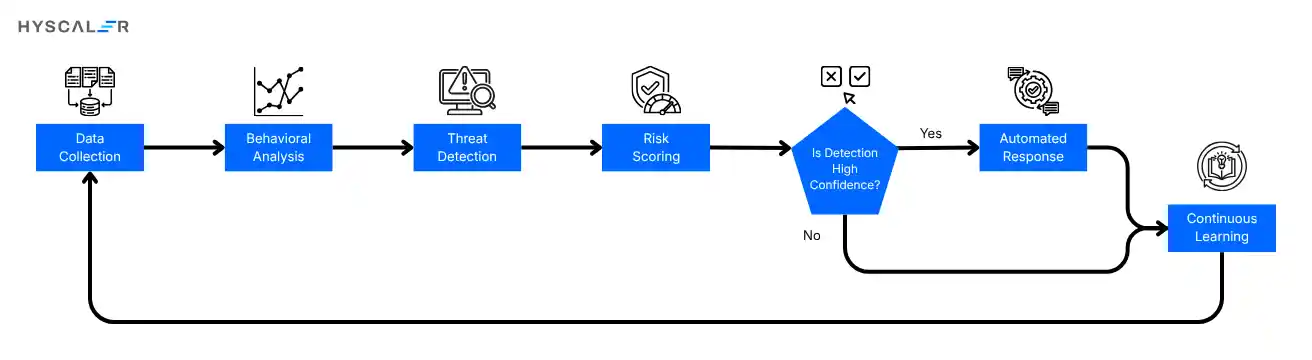
1. Data Collection: The platform ingests telemetry from endpoints, network sensors, cloud APIs, identity providers, and SaaS applications. Coverage breadth directly determines detection scope gaps in telemetry, creating blind spots.
2. Behavioral Analysis: ML models establish baselines for normal behavior across users, devices, and network flows. Supervised models trained on labeled attack data complement unsupervised anomaly detection for both known and novel threats.
3. Threat Detection: Anomalous behaviors, signature matches, and threat intelligence correlations are evaluated against detection models. Modern platforms apply hundreds or thousands of detection rules and ML models simultaneously.
4. Risk Scoring: Detected events are assigned risk scores based on severity, asset criticality, threat intelligence context, and behavioral confidence. This prioritization determines which alerts surface to analysts.
5. Automated Response: High-confidence, high-severity detections trigger automated response playbooks, endpoint isolation, account suspension, and firewall rule updates without waiting for analyst approval.
6. Continuous Learning: Analyst feedback, newly disclosed threat intelligence, and observed attack patterns feed back into detection models, improving accuracy over time and reducing false positive rates.
How to Choose the Right AI Security Tool
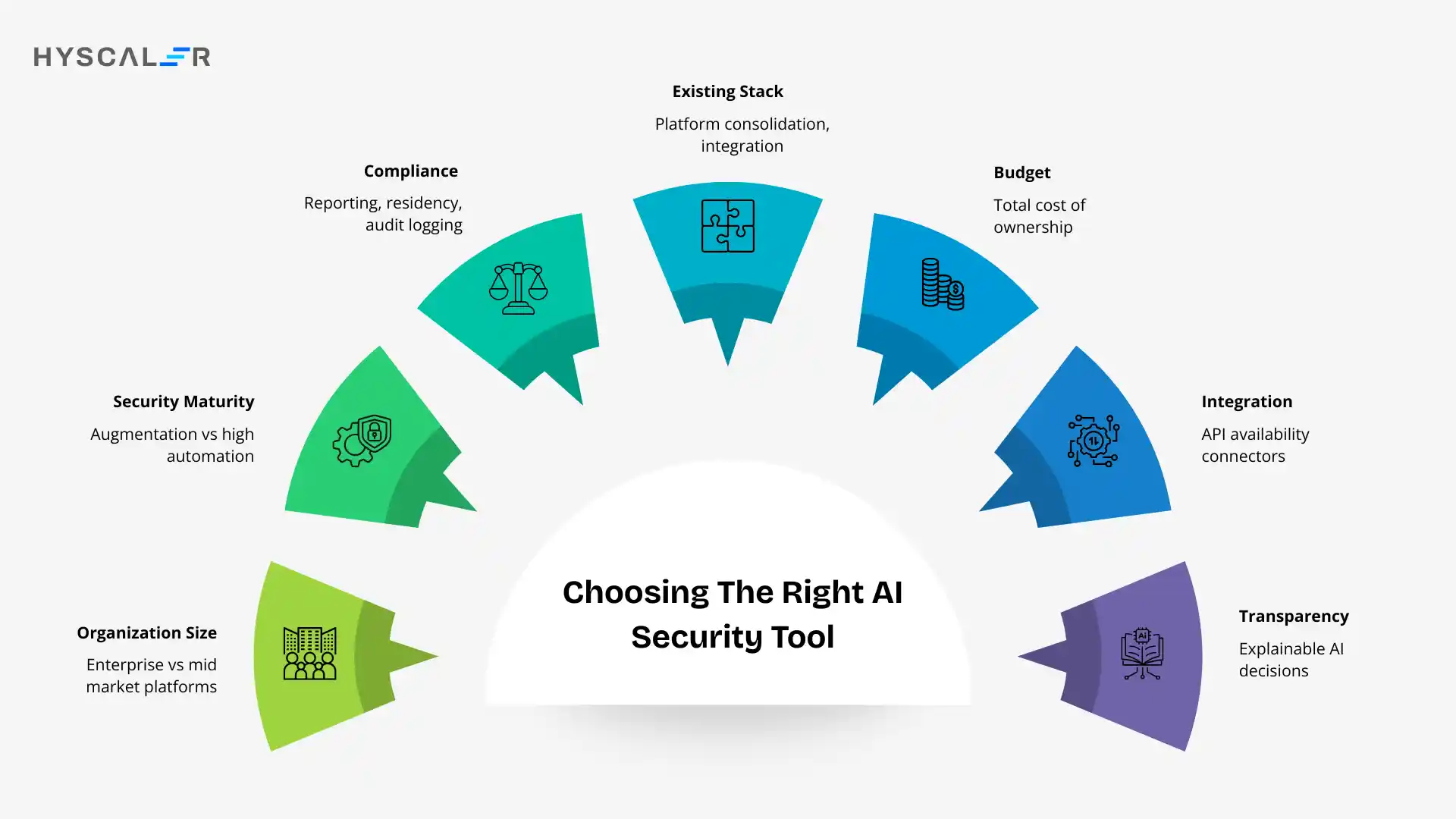
Organization Size
Enterprise platforms like CrowdStrike Falcon and Palo Alto Cortex XSIAM are purpose-built for large, complex environments.
Mid-market organizations may find better value and faster time-to-value with platforms like Rapid7 InsightIDR or Sophos XDR that offer strong capabilities without requiring large dedicated security teams for operation.
Security Maturity
Organizations with mature SOCs can leverage AI augmentation of existing workflows through platforms with strong analyst tooling.
Less mature organizations may benefit more from platforms with high automation levels, such as Darktrace or SentinelOne, that can deliver value without requiring extensive analyst customization.
Compliance Requirements
Regulated industries, such as financial services, healthcare, and government, require platforms with strong compliance reporting, data residency controls, and audit logging.
IBM QRadar and Exabeam have long track records in compliance-driven security operations.
Existing Security Stack
Platform consolidation is a primary driver for many AI security purchases.
Organizations with significant Cisco, Microsoft, or Fortinet infrastructure investments will realize faster time-to-value and lower integration costs by extending AI capabilities within their existing ecosystems.
Budget Considerations
AI security platforms vary significantly in pricing models per endpoint, per data volume ingested, per user, or subscription tiers.
Evaluate the total cost of ownership, including professional services, training, and integration effort alongside license fees.
Managed detection and response (MDR) options from vendors like Sophos and Rapid7 can offer predictable costs for organizations without large in-house security teams.
Integration Capabilities
The value of an AI security platform scales with the breadth of its integrations.
Evaluate API availability, pre-built connectors for your ITSM tools, identity providers, cloud platforms, and ticketing systems.
Platforms that operate in silos, regardless of their AI sophistication, deliver less operational value.
AI Transparency and Explainability
Regulated industries and compliance teams require explainable AI decisions.
Evaluate whether the platform can articulate why a detection was made and what evidence supports an alert, not just that an anomaly was detected.
Build vs Buy AI Cybersecurity Solutions
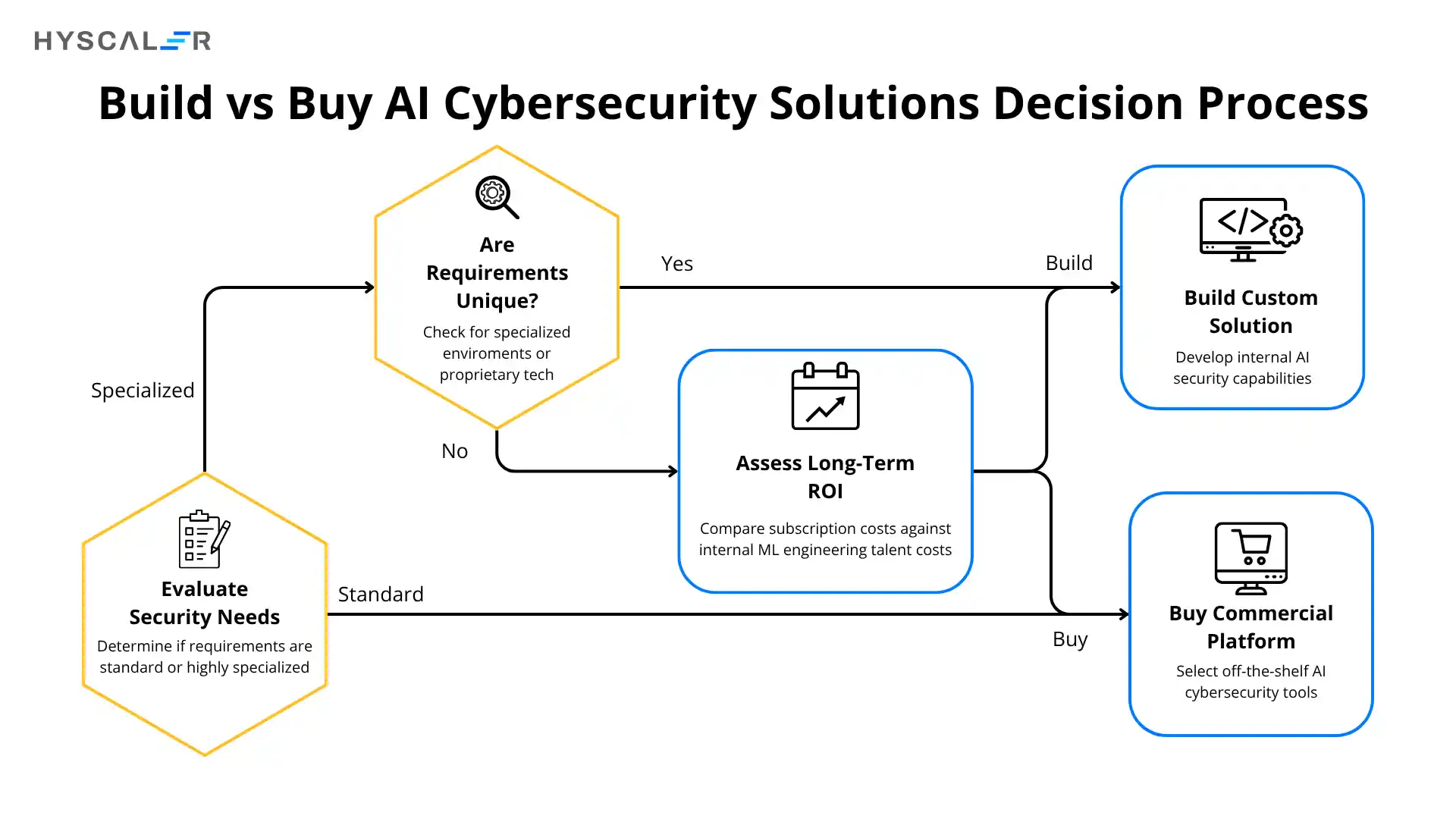
When Off-the-Shelf Tools Make Sense
Commercial AI cybersecurity platforms are the right choice for the majority of organizations.
They deliver proven detection models trained on industry-wide threat data, rapid deployment, continuous updates, and vendor-managed threat intelligence.
For standard enterprise security use cases, endpoint protection, SIEM, and cloud security buying is nearly always faster, more cost-effective, and more defensible than building.
When Custom AI Security Solutions Are Better
Custom development becomes relevant for organizations with highly specialized environments, such as critical infrastructure operators, defense contractors, and financial institutions, with unique data architectures where standard platforms cannot be adapted to specific monitoring requirements, data sovereignty constraints, or proprietary operational technology environments.
Organizations seeking to embed AI security capabilities directly into custom applications and platforms also benefit from purpose-built development.
Cost and Long-Term ROI Considerations
Commercial platforms carry subscription costs but eliminate the ongoing investment required to maintain AI models, update threat intelligence, and keep pace with evolving adversary techniques.
Custom solutions require dedicated ML engineering and security research talent that is extremely expensive to hire and retain.
For most organizations, the total cost of a well-selected commercial platform is substantially lower than equivalent custom development over a three-to-five-year horizon.
The exception is organizations with truly unique requirements where commercial tools cannot be configured to meet them.
Future of AI in Cybersecurity
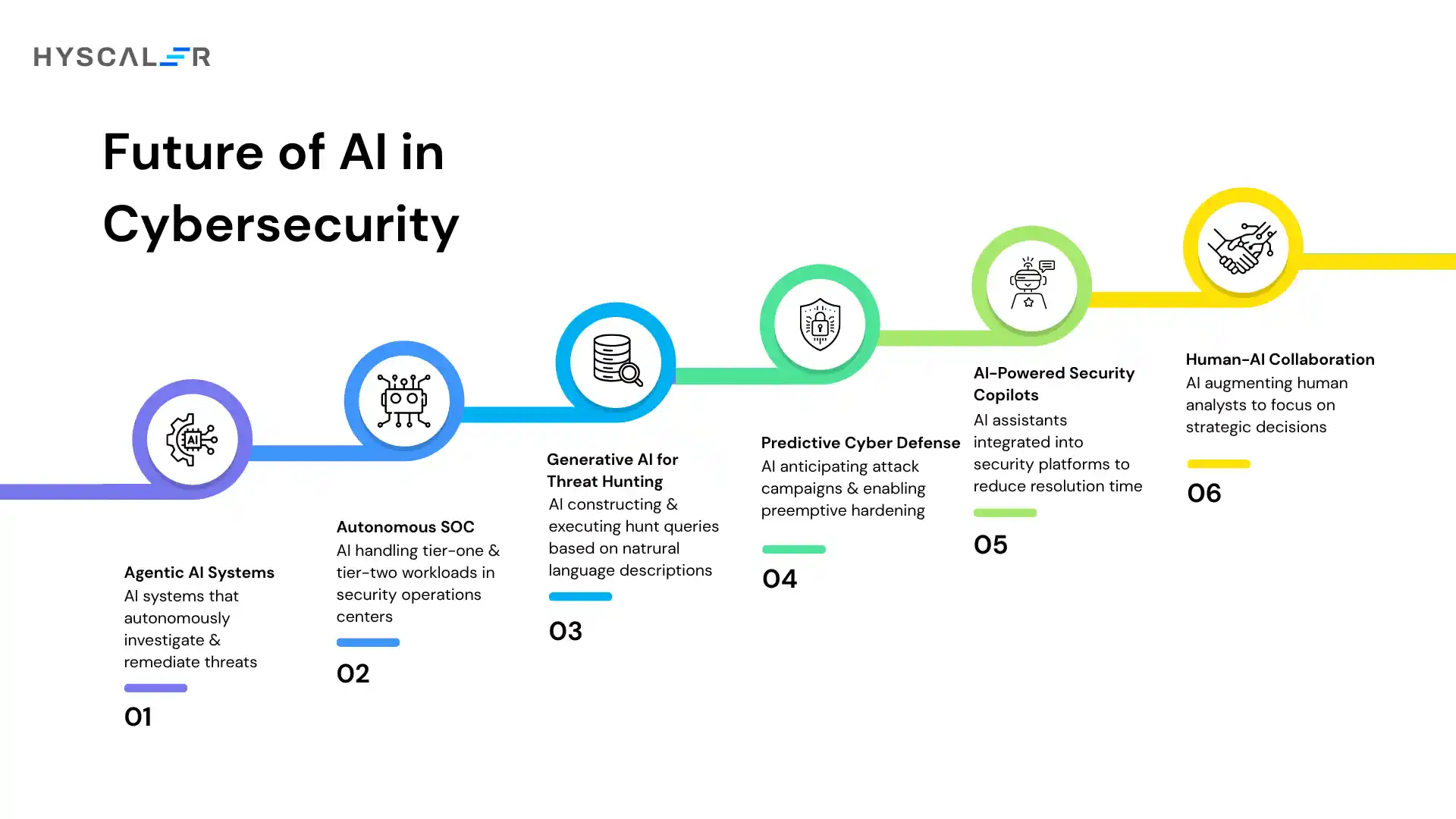
Agentic AI Security Systems
The next frontier in AI security is agentic systems, multi-agent AI architectures that can autonomously investigate, contain, and remediate threats end-to-end without human intervention.
Rather than AI augmenting an analyst, agentic systems operate as autonomous security engineers capable of executing complex, multi-step response workflows.
Autonomous Security Operations Centers
By 2027, leading organizations will have SOCs where AI handles the full tier-one and significant tier-two workloads autonomously.
Human analysts will focus exclusively on novel threat investigation, adversary attribution, and strategic security decisions roles where human judgment remains genuinely superior.
Generative AI for Threat Hunting
Generative AI is transforming proactive threat hunting by allowing analysts to describe hypotheses in natural language and have AI automatically construct and execute hunt queries across the full data lake.
This dramatically lowers the skill floor for threat hunting while increasing the throughput of expert hunters.
Predictive Cyber Defense
AI models are increasingly capable of anticipating attack campaigns before they launch, correlating threat actor activity patterns, newly published vulnerabilities, and organizational exposure to predict likely attack vectors and enable preemptive hardening.
AI-Powered Security Copilots
Every major security platform will ship an AI copilot capability within the next 24 months.
The competitive differentiation will shift from whether a copilot exists to how deeply it is integrated with operational data, how accurately it reasons about security context, and how effectively it reduces time-to-resolution on complex incidents.
Human-AI Collaboration in Security
The long-term model for security operations is not AI replacing security professionals, but AI dramatically augmenting them.
The most effective security teams will be those that develop the skills and workflows to leverage AI as a force multiplier, focusing human judgment on the decisions and investigations where it adds the most value.
How HyScaler Helps Businesses Build AI-Powered Cybersecurity Solutions
For organizations that require custom AI security capabilities, whether to augment commercial platforms, address unique compliance requirements, or build proprietary security tooling, HyScaler provides end-to-end AI development expertise with deep cybersecurity domain knowledge.
HyScaler’s AI development practice covers custom threat detection model development, security automation platforms, AI-powered threat intelligence systems, and cloud-native security architecture.
Whether an organization needs a bespoke Security Copilot built on enterprise LLMs, a custom behavioral analytics pipeline for proprietary OT environments, or AI-augmented SOC tooling that integrates with an existing security stack, HyScaler provides the engineering capability to design, build, and deploy these solutions at enterprise scale.
HyScaler’s approach combines AI engineering with cybersecurity domain expertise, ensuring that custom solutions are built to security-grade standards, not just functional AI applications.
For organizations evaluating whether a commercial or custom approach is right for their security requirements, HyScaler offers structured advisory engagements to objectively assess options and define the right build or buy strategy.
AI cybersecurity tools are no longer optional for organizations operating in today’s threat environment. The question is not whether to invest in AI-driven security capabilities, but which platforms best align with your organizational context, risk profile, and security maturity.
FAQ
What are AI cybersecurity tools?
AI cybersecurity tools are software platforms that use machine learning, behavioral analytics, and other AI techniques to detect threats, automate security responses, and strengthen an organization’s cyber defenses, going beyond the static rule-based detection of traditional security tools.
How do AI security tools work?
They continuously ingest security telemetry from endpoints, networks, cloud environments, and applications; apply ML models to identify anomalies and known attack patterns; assign risk scores to detected events; and trigger automated or analyst-guided response workflows.
What is the best AI cybersecurity tool?
There is no single best tool; the right platform depends on your organization’s size, existing security stack, industry, compliance requirements, and security maturity. CrowdStrike Falcon, Palo Alto Cortex XSIAM, and Microsoft Security Copilot consistently rank among the leading platforms for enterprise use cases.
Can AI replace cybersecurity professionals?
No. AI significantly augments security professionals by automating repetitive tasks and accelerating investigations, but human judgment, contextual reasoning, and adversarial thinking remain essential, particularly for complex incident response, threat hunting, and strategic security decision-making.
Are AI cybersecurity tools worth the investment?
For most organizations, yes. IBM’s research consistently shows that organizations using AI in security operations detect and contain breaches significantly faster, reducing the financial impact of incidents substantially relative to organizations relying on traditional tools.
What industries benefit most from AI-based cybersecurity tools?
Financial services, healthcare, government, energy and utilities, manufacturing with OT environments, and technology companies are industries that are both high-value attack targets and operate under strict regulatory requirements, and derive the greatest benefit from AI security investments.
What are the risks of using AI in cybersecurity?
Key risks include over-reliance on AI leading to reduced analyst skill development, adversarial attacks that attempt to manipulate or evade AI detection models, privacy concerns from broad behavioral monitoring, and the risk of deploying AI tools that lack transparency or explainability in regulated environments. These risks are manageable through thoughtful deployment, ongoing analyst training, and selecting platforms that provide decision explainability.
How much do AI cybersecurity tools cost?
Pricing varies significantly by vendor, deployment scale, and feature tier. Endpoint-focused platforms typically range from $15 to $65 per endpoint per year. Enterprise SIEM and XDR platforms are typically priced on data ingestion volume or user counts, with annual costs for mid-enterprise deployments commonly ranging from $200,000 to several million dollars. Managed detection and response services add a per-endpoint or flat monthly fee on top of platform licensing.