
Table of Contents
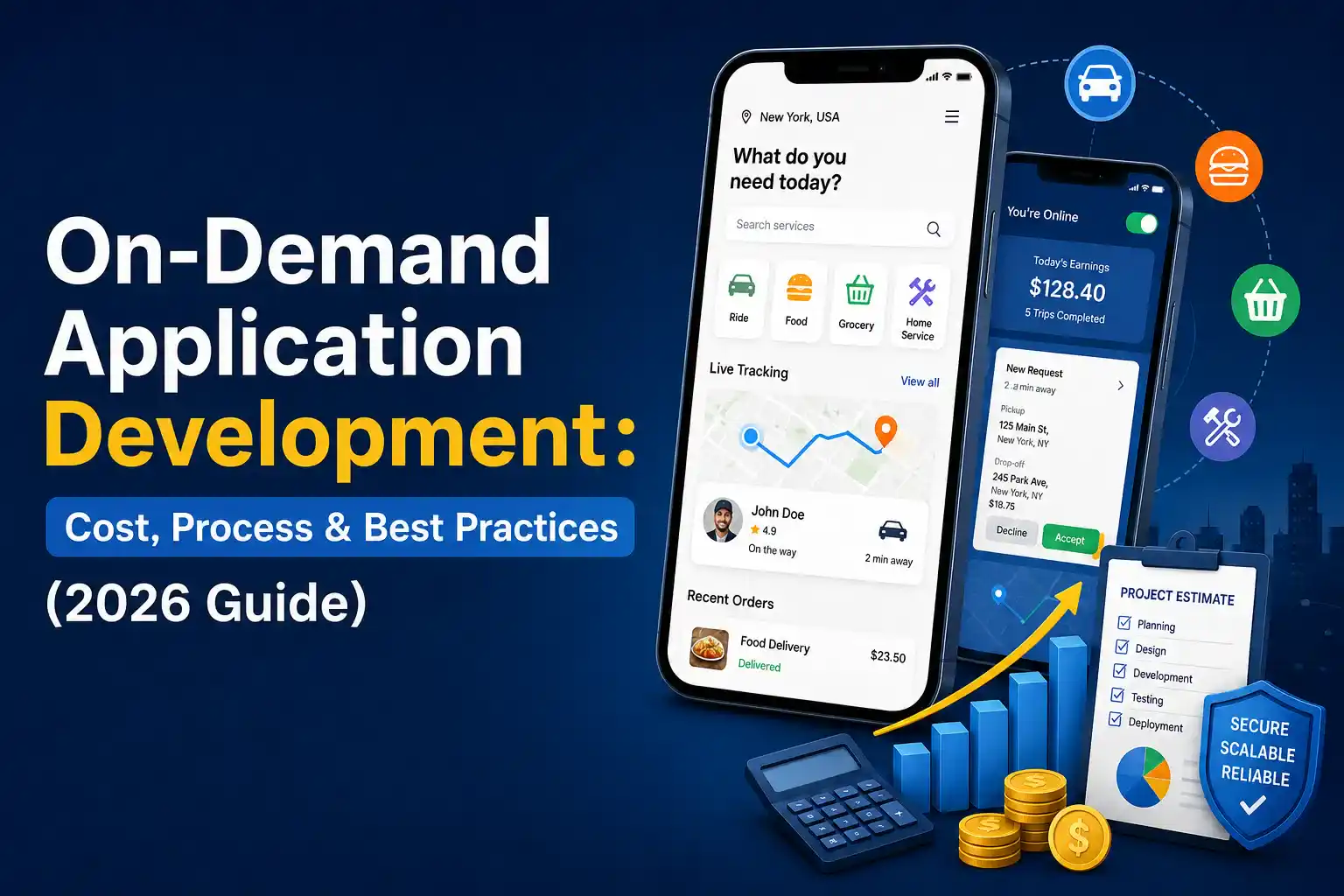
On-demand application development is the process of building apps that connect customers with services or products in real time- think ride-hailing, food delivery, or home repair- all bookable in a few taps.
US businesses build these apps to capture a market where domestic mobile commerce is projected at roughly $410 billion in 2026.
A typical build costs $30,000–$300,000+ depending on complexity, and takes 3–12 months. Industries ranging from healthcare to logistics now rely on this model to meet customer expectations for instant, on-demand access.
What Is On-Demand Application Development?
On-demand application development means designing and building a platform, usually three connected pieces, that lets someone request a service and get it fulfilled almost immediately:
- Customer App – where users browse, book, pay, and track a service
- Service Provider App – where drivers, technicians, or vendors accept and fulfill requests
- Admin Dashboard – the backend that manages users, payments, disputes, and analytics
The workflow is simple in concept: a customer submits a request → the system matches it with an available provider → the provider accepts and completes the job → payment and reviews close the loop.
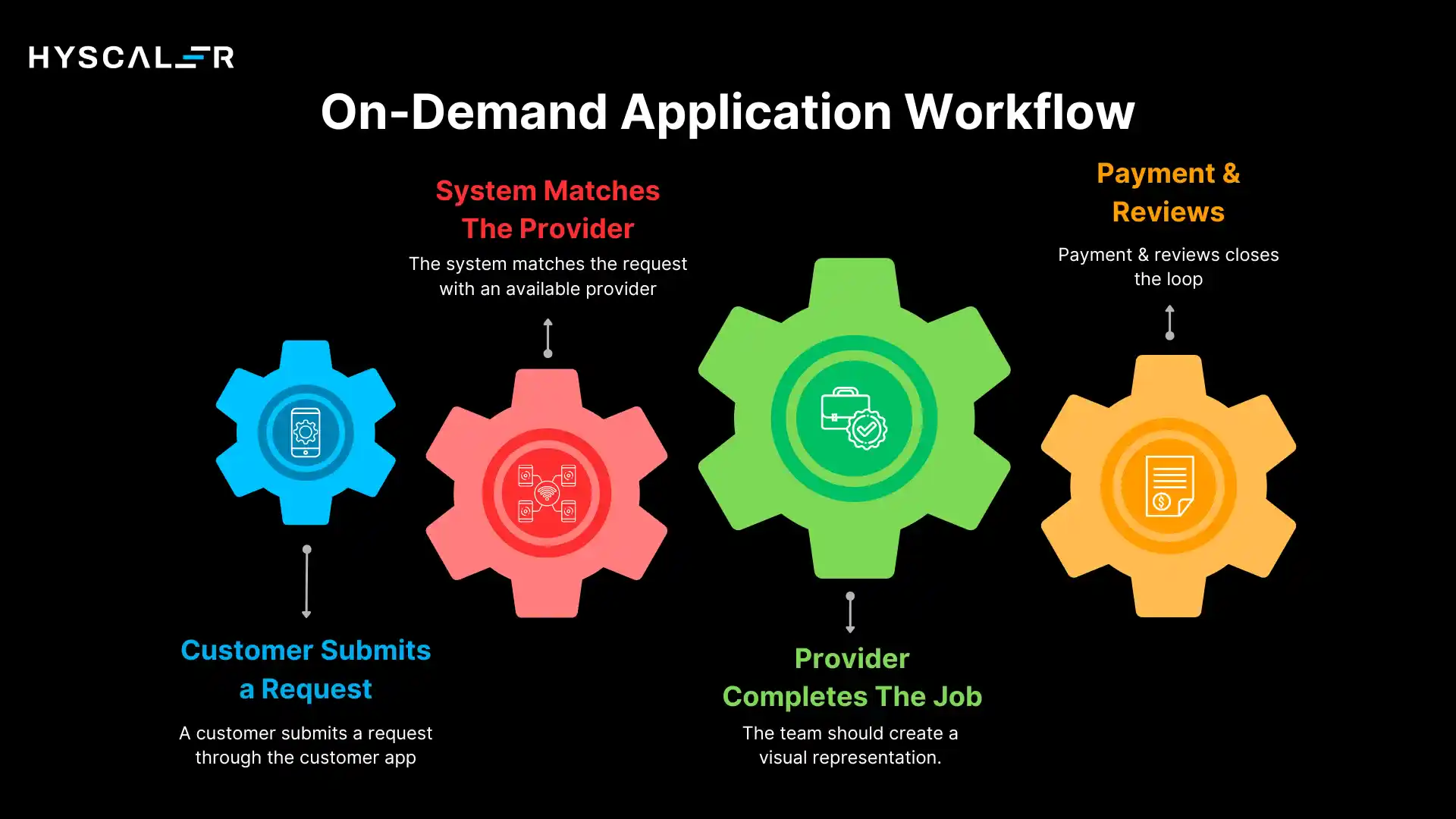
The complexity lives in making that loop feel instant, reliable, and secure at scale.
Why Businesses Are Investing in On-Demand Apps in 2026
The numbers explain the rush.
The global gig economy is projected to reach a valuation of $674.1 billion in 2026, growing at nearly 15.79% annually, and US freelancers are expected to make up close to 48.5% of the total workforce by late 2026, a labor pool that on-demand platforms are built to mobilize.
On the consumer side, mobile is now the default entry point for commerce.
In 2026, the share of U.S. adults who have made a smartphone purchase is projected to rise to 82%, with mobile commerce accounting for $47 out of every $100 spent online in the United States.
Younger consumers are pushing this even further; the 18-34 age demographic is expected to complete 91% of their online purchases exclusively via smartphone.
Zooming out to the broader on-demand services category, the global market is starting at roughly $216 billion in 2026 and is projected to reach $346 billion by 2035, spanning everything from transportation and logistics to healthcare and last-mile delivery.
For US businesses, that combination- a mobile-first customer base and a workforce increasingly built around flexible, gig-based labor- is why 2026 is a practical moment to build.
Industries Using On-Demand Application Development
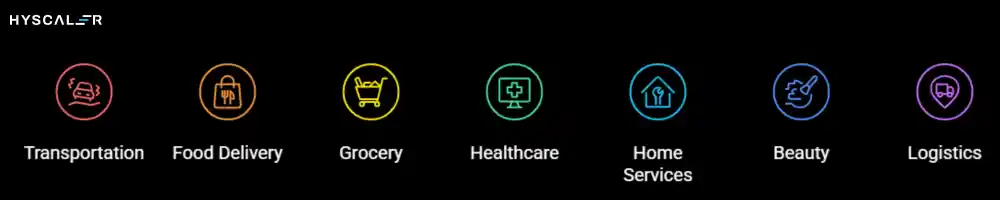
Transportation – Uber, Lyft
Food Delivery – DoorDash, Uber Eats
Grocery – Instacart
Healthcare – telemedicine consults, medicine delivery
Home Services – TaskRabbit, Handy
Beauty – Urban Company, StyleSeat
Logistics – courier services, fleet management
Nearly every service-based industry has an on-demand analog now, and the pattern that works- request, match, fulfill, rate- is largely portable across verticals.
Core Features Every Successful On-Demand App Needs
Customer App: Registration, search and discovery, booking, live tracking, secure payments, ratings/reviews, push notifications.
Provider App: Request acceptance, availability toggling, route optimization, an earnings dashboard, in-app chat.
Admin Panel: User management, analytics, commission handling, coupons/promotions, CMS, fraud detection.
Skipping any one of these three layers is usually where MVPs run into trouble; a beautiful customer app with no fraud detection on the backend, for instance, is a liability waiting to surface.
Step-by-Step On-Demand Application Development Process
- Market research: validate demand, study competitors, define your niche
- Business model selection: commission-based, subscription, or hybrid
- UI/UX design: wireframes and prototypes for all three app layers
- MVP development: build the smallest version that proves the core loop
- Backend development: APIs, databases, matching logic
- API integration: payments, maps, SMS/push, identity verification
- Testing: functional, load, and security testing
- Launch: phased rollout, usually city-by-city or region-by-region
- Maintenance: monitoring, updates, and feature iteration post-launch
On-Demand Application Development Cost in the USA
| Complexity | Estimated Cost (USD) | Timeline |
|---|---|---|
| MVP | $30,000–$60,000 | 3–4 months |
| Medium | $60,000–$120,000 | 4–6 months |
| Enterprise | $120,000–$300,000+ | 6–12 months |
What drives the cost:
- Feature set: real-time tracking and in-app chat cost more than a basic booking flow
- Platforms: iOS + Android + web triples QA and design effort versus a single platform
- Team location: US-based teams command premium rates; nearshore/offshore teams can meaningfully reduce cost when the engagement is managed well
- Third-party APIs: maps, payments, and SMS providers all carry usage fees
- AI features: matching algorithms, dynamic pricing, and predictive models add development time
- Cloud infrastructure: scalable hosting costs grow with user volume
- Security and compliance: HIPAA (healthcare), PCI-DSS (payments) add both cost and time
- Post-launch maintenance: budget 15–20% of the initial build cost annually
Best Tech Stack for On-Demand Application Development
- Frontend: React Native or Flutter for cross-platform mobile
- Backend: Node.js, Python (Django/FastAPI), or Ruby on Rails
- Database: PostgreSQL or MongoDB
- Cloud: AWS, Google Cloud, or Azure
- Payments: Stripe, Braintree, PayPal
- Maps: Google Maps Platform, Mapbox
- Authentication: Firebase Auth, Auth0
- Notifications: Firebase Cloud Messaging, Twilio
- Analytics: Mixpanel, Amplitude
- AI Services: OpenAI/Anthropic APIs, TensorFlow, AWS SageMaker
AI Features Businesses Should Add in 2026
AI has moved from “nice to have” to table stakes for on-demand platforms:
- AI customer support: chatbots that resolve routine issues without human agents
- Smart matching: pairing customers with the best-fit provider, not just the nearest one
- ETA prediction: machine-learning models that account for traffic, weather, and provider behavior
- Route optimization: dynamic routing that adjusts in real time
- Dynamic pricing: surge or demand-based pricing tuned by algorithm
- Personalized recommendations: suggesting services based on past behavior
- Fraud detection: flagging suspicious transactions or fake accounts
- Predictive demand forecasting: anticipating spikes before they happen, useful for staffing and inventory
Common Challenges (and How to Solve Them)
- Traffic spikes: solve with auto-scaling cloud infrastructure and load testing before peak events
- Real-time sync: use WebSockets or similar for live updates across apps
- GPS accuracy: combine GPS with Wi-Fi/cell triangulation for dense urban areas
- Payment failures: build retry logic and support multiple payment processors
- Scalability: design microservices architecture from day one, not after growth hits
- Security: encrypt data in transit and at rest; run regular penetration tests
- Retention: loyalty programs and personalization keep churn down
- Provider management: clear onboarding, rating systems, and dispute resolution keep supply healthy
Best Practices for Building a Successful On-Demand App
- Build an MVP first and validate before scaling features
- Focus relentlessly on UX; friction kills on-demand apps faster than most categories
- Prioritize security and compliance from the start, not as an afterthought
- Use scalable cloud infrastructure that grows with demand
- Monitor analytics continuously to catch drop-off points early
- Optimize onboarding; the first five minutes determine whether a user returns
- Collect user feedback continuously and iterate based on it
Why Choose HyScaler for On-Demand Application Development
Building an on-demand platform that actually holds up under real-world traffic takes more than a development team; it takes a partner who understands both the technical and business sides of the model.
HyScaler brings:
- Custom mobile app development tailored to your specific vertical and user base
- AI expertise for matching, pricing, and forecasting features that set your platform apart
- Cloud-native architecture built to scale from day one
- Agile delivery with transparent milestones and iterative releases
- Enterprise-grade security for platforms handling payments and personal data
- A US-friendly engagement model designed around clear communication and predictable timelines
- End-to-end product engineering: from market validation through post-launch support
Ready to Build Your On-Demand Application?
Partner with HyScaler to design, develop, and scale secure, AI-powered on-demand apps tailored for the US market.
Schedule a free consultation to discuss your product idea, estimated timeline, and development roadmap.
FAQ
What is on-demand application development?
It’s the process of building apps that connect customers with real-time services through a customer app, provider app, and admin dashboard.
How much does it cost to build an on-demand app?
Costs typically range from $30,000 for an MVP to $300,000+ for an enterprise-grade platform, depending on features, platforms, and team location.
How long does development take?
Most projects take 3 to 12 months, depending on scope and complexity.
Which industries benefit the most?
Transportation, food delivery, grocery, healthcare, home services, beauty, and logistics all see strong returns from the on-demand model.
What technologies are used?
Common stacks include React Native or Flutter for mobile, Node.js or Python for backend, and cloud platforms like AWS or Google Cloud.
Can AI improve an on-demand app?
Yes, AI powers smart matching, dynamic pricing, ETA prediction, and fraud detection, all of which directly improve user experience and margins.
How do on-demand apps make money?
Common models include commission per transaction, subscription fees, and hybrid pricing.
Should I build an MVP first?
Almost always, an MVP validates demand and core functionality before you invest in the full feature set.