

Table of Contents
Enterprise AI rarely becomes expensive at launch.
It becomes expensive eighteen months later, when the pipeline feeding it has drifted, the prompts nobody documented have started failing, the provider has retired the model you built around, and three teams are running overlapping assistants against the same CRM.
That is AI technical debt. It is not just bad code.
It is the accumulated cost of shortcuts across data, models, prompts, infrastructure, integrations, evaluation, security, and operations.
Gartner has warned that by 2030, half of enterprises could face delayed AI upgrades or rising maintenance costs because of unmanaged GenAI technical debt.
This article covers what AI technical debt is, the ten problems that create it, how it inflates costs, how to score it, and how to reduce it without a full rewrite.
What Is AI Technical Debt?
AI technical debt is the future cost created when shortcuts in AI architecture, data, models, integrations, or operations make an AI system harder, riskier, or more expensive to maintain and change.
It differs from conventional technical debt because AI systems depend on moving parts that traditional software doesn’t: changing models, evolving data, probabilistic outputs, external APIs, and continuous quality monitoring.
Research in software engineering increasingly treats AI debt as a broad architecture and quality problem affecting maintainability, security, and understandability, not simply a code-quality issue.
AI Technical Debt vs. Traditional Technical Debt
| Factor | Traditional technical debt | AI technical debt |
|---|---|---|
| Main source | Code and architecture shortcuts | Code, data, models, prompts, architecture, operations |
| Behavior | Usually deterministic | Often probabilistic |
| Typical failure | Bugs and outages | Bugs, hallucinations, drift, degraded quality |
| Dependencies | Libraries and infrastructure | Models, APIs, datasets, vector databases, prompts |
| Testing | Unit and integration tests | Tests plus evaluations and curated datasets |
| Monitoring | System health | System health plus output quality |
| Change risk | Code changes | Code, model, data, and provider changes |
| Cost growth | Engineering effort | Engineering plus inference, data, and monitoring costs |
The key takeaway: AI debt can accumulate even when the application code looks clean.
The 10 Hidden Problems Behind Enterprise AI Technical Debt
Each problem below follows the same pattern: what goes wrong, why it happens, what it costs, and what to do.
1. AI Pilots That Quietly Become Production Systems
The problem: A proof of concept succeeds, gets adopted, and becomes business-critical without ever being redesigned for production.
Why it happens: Pilots are built to prove value quickly. They use hard-coded workflows, minimal error handling, and no scaling plan. Success creates pressure to ship, not rebuild.
Business impact: Every new requirement is bolted onto an architecture that was never meant to carry it. Reliability, security, and cost control are retrofitted under pressure.
Example: A customer-service chatbot launched for 500 queries a day now handles 50,000. The original design had no load controls, no failover, and no monitoring, so each traffic spike becomes an incident.
What to do: Treat the pilot-to-production transition as a formal engineering phase with its own architecture review, ownership, and exit criteria. This is the gap HyScaler’s AI services are built around: taking systems from pilot to production, then continuing monitoring, evaluation, and cost control after launch.
2. Poor or Unmanaged AI Data Pipelines
The problem: Stale data, duplicate records, broken ETL/ELT jobs, inconsistent schemas, missing lineage, and unclear data ownership.
Why it happens: Data pipelines are built for the first use case and rarely revisited. Source systems change; the pipeline doesn’t.
Business impact: Teams blame the model for bad answers when the real fault sits upstream. Engineers spend cycles tuning prompts to compensate for data defects that should have been fixed once, at the source.
Example: A forecasting assistant produces inconsistent outputs because two source systems define “active customer” differently and no one owns the reconciliation.
What to do: Treat AI quality as a data engineering problem first. Establish lineage, ownership, freshness checks, and schema contracts before scaling any use case. HyScaler’s data engineering and AI-readiness work exists for precisely this reason.
3. Fragile Prompts and Undocumented AI Logic
The problem: Prompts embedded directly in application code, unversioned, untested, and quietly carrying business rules.
Why it happens: Prompts feel like configuration, so they escape the discipline applied to code. Over time, they accumulate patches and exceptions nobody can fully explain.
Business impact: A model update or a small prompt edit can change behavior across the system, and no one can predict where. Institutional knowledge lives in a text string.
Example: A financial-services assistant applies a refund-eligibility rule that exists only inside a prompt written by an engineer who has since left. When the model changes, the rule is applied differently, and no test catches it.
What to do: Version prompts like code. Separate them from application logic, document the business rules they encode, and put them under regression testing.
4. Model Lock-In and Model Drift
These are two distinct problems that compound each other.
Lock-in: One provider becomes deeply embedded. Prompts, APIs, and workflows become provider-specific, so switching is costly.
Drift and change: Model behavior shifts, whether through provider updates, deprecations, or changing input data. Prompts and evaluations that once worked stop working.
Business impact: You lose negotiating leverage on price and are exposed to forced migrations on someone else’s timeline.
The question every CTO should ask: What happens when your AI provider changes the model your application was built around?
What to do: Introduce an abstraction layer between applications and models, maintain portable prompts and evaluation sets, and review provider dependencies regularly. LLM integration done well keeps the model replaceable.
5. Missing Evaluation Infrastructure
The problem: No golden datasets, no regression evaluations, no hallucination testing, no accuracy benchmarks, no human review process, and no quality thresholds before deployment.
Why it happens: Traditional QA doesn’t transfer. A passing unit test says nothing about whether an answer is correct, grounded, or safe.
Business impact: Changes ship blind. The business learns about quality regressions from customers rather than from tests.
Example: A company switches to a cheaper LLM and cuts inference costs by 40%. Infrastructure spend drops, but support accuracy falls. Without evaluations, the damage surfaces through complaints, and the savings are erased by churn and rework.
What to do: Build evaluation as core infrastructure: curated datasets, automated regression runs, defined quality gates, and human review for high-risk outputs. HyScaler treats evaluations, monitoring, and cost control as part of operating AI after launch, not optional extras.
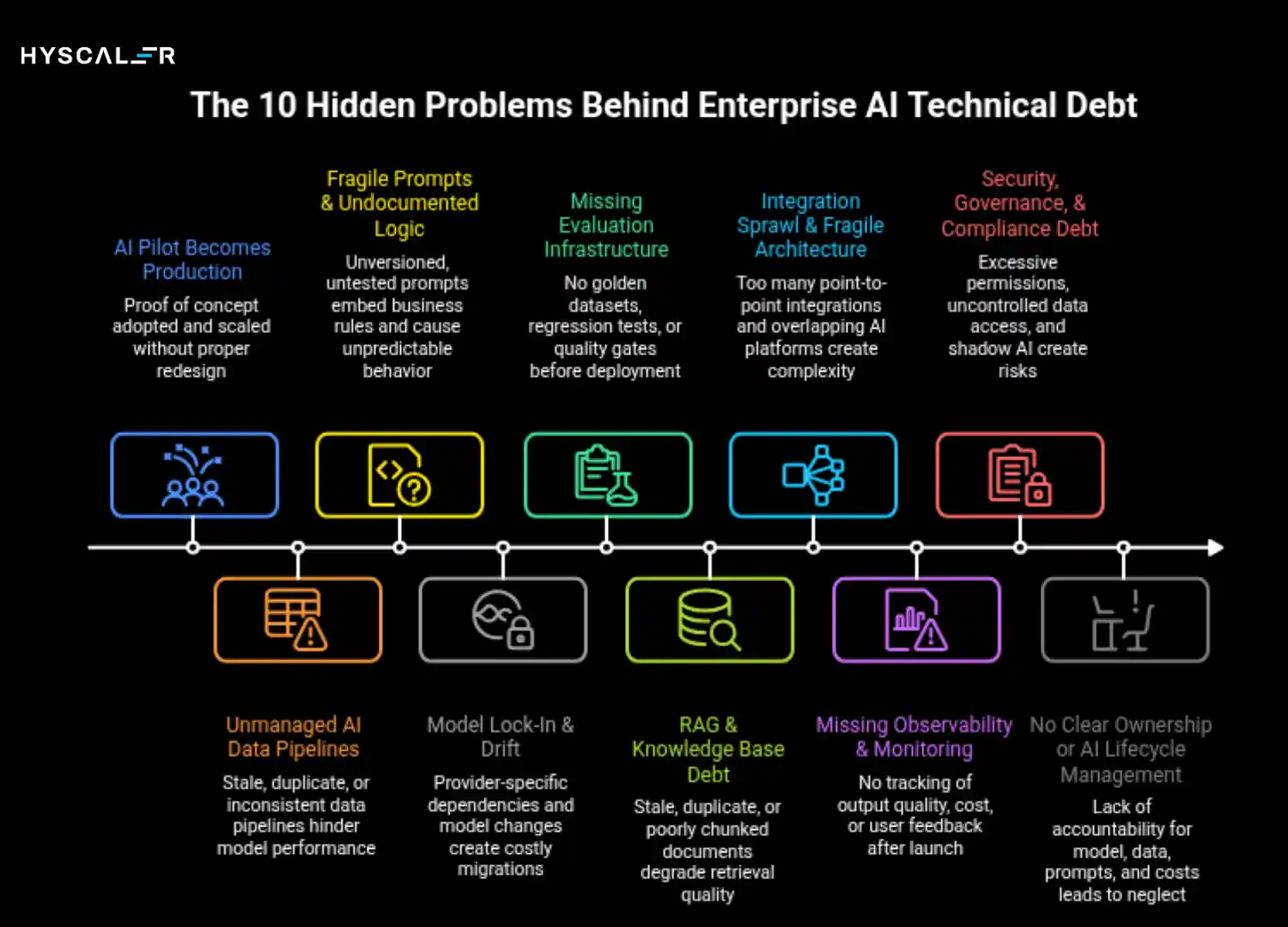
6. RAG and Knowledge-Base Debt
The problem: Retrieval-augmented generation systems degrade silently through stale documents, poor chunking, duplicate content, incorrect metadata, outdated embeddings, and weak retrieval, often with no retrieval-specific evaluation.
Why it happens: Teams treat the knowledge base as a one-time load rather than a living system with its own lifecycle.
Business impact: The assistant sounds confident while citing outdated or contradictory sources, which erodes trust faster than an obvious failure would.
Example: An internal assistant keeps recommending a retired company policy because the pipeline never removed the old document.
What to do: Assign content owners, automate document expiry and re-indexing, evaluate retrieval quality separately from generation quality, and monitor for staleness. HyScaler’s RAG solutions are designed around this lifecycle.
7. Integration Sprawl and Fragile AI Architecture
The problem: Too many point-to-point integrations, custom connectors, hard-coded dependencies, and overlapping AI platforms doing the same job.
Why it happens: Teams move fast and integrate directly. No one owns the overall AI architecture, so each project adds its own wiring.
Business impact: Changes to a single system ripple unpredictably. Duplicate infrastructure drives cost and inconsistent behavior.
Example: Three departments independently build assistants that each connect to the same CRM, document store, and identity provider, with separate permissions, logic, and maintenance.
What to do: Define shared integration patterns and platform standards early. For agentic systems, standardized tool interfaces, such as the MCP-based agent approach HyScaler works with, reduce bespoke connector sprawl.
8. Missing Observability and Monitoring
The problem: An AI system can be technically “up” while the quality of its output deteriorates.
Why it happens: Infrastructure monitoring tracks uptime and latency. It doesn’t track whether answers are right.
Business impact: Quality, cost, and risk problems are discovered late, usually by users.
What to track: latency, error rates, token consumption, cost per request, model quality, retrieval quality, hallucination rates, user feedback, and agent failures.
What to do: Instrument AI systems for quality as well as availability. HyScaler positions monitoring and evaluation as part of the “Run” stage of AI transformation, because that is where most debt either gets caught or compounds.
9. Security, Governance, and Compliance Debt
The problem: Excessive model permissions, uncontrolled data access, sensitive data entering AI systems, shadow AI, missing audit trails, weak access controls, and no vendor governance.
Why it happens: Governance is deferred to “after the pilot.”
Business impact: Governance debt eventually becomes engineering debt, because retrofitting controls into a live AI system costs far more than designing them in. Gartner lists shadow AI, technical debt, interoperability, and vendor lock-in among the blind spots CIOs must address.
What to do: Apply least-privilege access, audit logging, data classification, and vendor review from the first architecture diagram, not the first audit finding.
10. No Clear Ownership or AI Lifecycle Management
The problem: Nobody owns the model, the prompts, the evaluation dataset, the cost, the retraining schedule, or the retirement decision.
Why it happens: AI initiatives cross team boundaries, so accountability dissolves after launch.
Business impact: An AI system without an owner eventually becomes an AI system nobody wants to change. Improvements stall and risk accumulates unseen.
What to do: Assign named owners for model, data, prompts, evaluation, and cost. Define a lifecycle from launch through improvement to retirement.
How AI Technical Debt Makes Enterprise AI More Expensive
The visible AI bill is only one component of what a system costs:
Total AI ownership cost = infrastructure + model/inference + data + engineering maintenance + monitoring and evaluation + security and compliance + remediation
| Cost area | Low-debt system | High-debt system |
|---|---|---|
| Model usage | Optimized | Uncontrolled |
| Infrastructure | Standardized | Duplicated |
| Data | Governed | Reprocessed repeatedly |
| Testing | Automated | Manual |
| Monitoring | Centralized | Fragmented |
| Engineering | Predictable | Reactive |
| Upgrades | Planned | Emergency work |
| Total ownership | Controlled | Increasing |
Debt rarely shows up as one big line item.
It shows up as slower delivery, more incidents, and engineers spending their time keeping the lights on.
How to Measure AI Technical Debt
Here is a simple five-dimension scorecard.
It is a practical framework proposed in this article, not an industry-standard benchmark.
Score each dimension from 1 (healthy) to 5 (severe):
- Architecture
- Data
- Model and prompt management
- Evaluation and observability
- Security and governance
| Total score | Status | Recommended action |
|---|---|---|
| 5-9 | Healthy | Maintain |
| 10-15 | Watch | Prioritize improvements |
| 16-20 | High | Build a remediation roadmap |
| 21-25 | Critical | Refactor before scaling |
How to Reduce AI Technical Debt: A 6-Step Process
- Inventory every AI system – Capture models, prompts, data sources, APIs, agents, infrastructure, and owners.
- Map dependencies – Document what breaks if a model, API, dataset, or vendor changes.
- Measure quality and cost – Baseline accuracy, latency, inference cost, failure rate, and user satisfaction.
- Rank debt by business impact – Prioritize what affects revenue, customers, compliance, security, or critical operations.
- Standardize the AI lifecycle – Introduce versioning, evaluations, monitoring, governance, and ownership.
- Refactor continuously – Make debt reduction an ongoing engineering practice, not a one-time cleanup.
Refactor, Rebuild, Replace, or Retire?
| Situation | Best action |
|---|---|
| Works but is hard to maintain | Refactor |
| Architecture can’t support required scale | Rebuild |
| Vendor or model creates excessive dependency | Replace |
| Business value no longer justifies cost | Retire |
| Quality is good, but operating cost is high | Optimize |
Don’t rewrite an AI system simply because it carries debt.
Rewrite when the cost and risk of maintaining the existing architecture exceed the cost of replacing it.
AI Technical Debt in RAG and AI Agents
Agentic AI amplifies every problem above.
Agents bring more integrations, more tool dependencies, more state, more permissions, more failure modes, and more complex observability and evaluation requirements.
A weak foundation that was tolerable for a chatbot becomes a liability when the system takes actions.
This is why HyScaler’s work across MCP-based agents, RAG, LLM integration, and MLOps is approached as one connected lifecycle rather than separate projects.
A Practical Example: From AI Pilot to Technical Debt
Consider a fictional enterprise customer-service copilot:
- Month 1: The team launches an LLM-based support assistant.
- Month 4: Three departments add their own prompts.
- Month 7: The knowledge base fills with outdated documents.
- Month 9: The company switches models to cut costs.
- Month 10: Response quality drops, and nobody can say why.
- Month 12: Engineers spend more time fixing the AI system than extending it.
The accumulated debt: prompt debt, retrieval debt, evaluation debt, model dependency, integration debt, and observability debt. None of it came from one bad decision.
It came from many reasonable shortcuts left unmanaged.
How to Prevent AI Technical Debt From Building Up
- Design for production, not just the demo
- Version prompts and models
- Maintain evaluation datasets
- Monitor quality and cost together
- Govern enterprise data access
- Document AI dependencies
- Assign clear system ownership
- Standardize AI infrastructure
- Review third-party model dependencies
- Schedule regular AI debt audits
Final Takeaway
Enterprise AI becomes expensive to maintain when deployment speed outpaces engineering discipline.
The goal isn’t to eliminate every shortcut.
It is to make debt visible, measurable, prioritized, and manageable before it becomes a barrier to scaling AI.
If your organization is dealing with fragmented AI systems, weak data foundations, model-management challenges, or production reliability problems, an AI readiness and modernization assessment can show where technical debt is limiting scale and ROI.
HyScaler’s AI services and solutions cover AI transformation, data readiness, agent integration, MLOps, monitoring, evaluations, and cost control, from pilot through production and beyond.
FAQ
What is AI technical debt?
AI technical debt is the future cost created by shortcuts in AI architecture, data, models, prompts, integrations, testing, or operations. These shortcuts may speed up an initial deployment but make the system harder to maintain, upgrade, secure, evaluate, or scale, which can erode AI ROI over time.
How is AI technical debt different from traditional technical debt?
Traditional technical debt mainly comes from shortcuts in code and software architecture. AI technical debt also includes data quality, model dependencies, prompt changes, evaluation gaps, retrieval systems, and drift. Because AI depends on changing models and data, its debt can compound faster than conventional software debt.
What causes AI technical debt?
Common causes include rushing pilots into production, poor data pipelines, undocumented prompts, model lock-in, weak evaluations, fragmented integrations, missing observability, outdated RAG knowledge bases, inadequate governance, and unclear ownership. The pattern is optimizing for deployment speed without designing for long-term operation.
How can enterprises reduce AI technical debt?
Inventory AI systems, map dependencies, measure quality and cost, prioritize high-impact problems, introduce prompt and model versioning, automate evaluations, improve observability, and establish ownership. Debt reduction should be part of the AI lifecycle, not a one-time cleanup.
Does AI technical debt increase AI costs?
Yes. It increases costs through duplicated infrastructure, inefficient model usage, repeated data processing, manual testing, engineering rework, production incidents, and expensive migrations. The financial impact often exceeds the AI infrastructure bill itself.