
Table of Contents
Is the era of “Open Meta” officially over? Mark Zuckerberg is effectively closing the curtains on the open-source theater he used to build market share, rebranding the company’s AI ambitions under the banner of “Superintelligence.”
The debut of Muse Image, the first visual engine from the newly minted Meta Superintelligence Labs (MSL), is the loudest signal yet that the company is moving away from the “open weights” philosophy of Llama. Instead, Meta is building a proprietary, agentic, and social-first ecosystem designed to lock users into a walled garden of “Personal Superintelligence.”
Muse Image is not a simple “prompt-to-pixels” generator. It is the visual execution arm of an integrated stack that treats image creation as a reasoning task. By leveraging Muse Spark, the multimodal reasoning “brain” released in April, Meta has transformed the creative process into a multi-step, tool-using workflow.
Agentic Art and the “Thinking” Engine
The strategic heart of Muse Image lies in “test-time compute.” Unlike legacy generators that map words to images in a single pass, Muse performs a “Visual Chain of Thought.” It doesn’t just guess what a prompt looks like; it reasons through the construction. This process utilizes what MSL calls “thought compression.”
To serve high-level intelligence to billions of users without crushing latency, the model is trained to maximize correctness while applying a “penalty on thinking time.” This forces the AI to solve complex problems using the fewest possible tokens; intelligence per token is the new gold standard.
Technically, Muse Image differentiates itself through deep tool integration. During reinforcement learning (RL), the model learned to write and execute Python code to ensure mathematical accuracy for things like QR codes and data plots. It also utilizes real-time web search to ground its visuals in current facts, such as 2026 fashion trends.
Muse Spark acts as the orchestration layer here, planning the layout and sharing tools with the visual engine to create everything from interactive HTML games to scientifically accurate infographics.
| Feature | Standard Prompting (Legacy) | Muse Agentic Workflow |
| Execution | Direct mapping of text to pixels | Multi-step “Visual Chain of Thought” |
| Accuracy | Prone to visual hallucinations | Invokes Python for precise plots/QR codes |
| Context | Training data cutoff limitations | Real-time web search for factual grounding |
| Refinement | Manual user re-prompting | Emergent self-correction via RL rewards |
| Multimodal Orchestration | Single-turn, static output | Spark-led multi-agent planning & tool use |
Instagram Integration and Privacy
Meta is anchoring Muse inside Instagram, WhatsApp, and meta.ai, utilizing its massive social dataset as a strategic moat. The standout feature is the @-mention capability, which allows users to pull in public Instagram accounts to remix friends and creators into new images. It is a powerful social tool, but it comes with a high privacy cost.
Bold Alert: Your public Instagram photos are now being used to train and remix data by default. If you don’t want your face showing up in your weird cousin’s fantasy football memes or a stranger’s AI-generated storyboard, you must manually navigate your settings to opt out and “protect your pixels.”
To mitigate the inevitable backlash over “deepfake” backlash, Meta is deploying the Content Seal. This is an invisible watermarking system that embeds a provenance signal directly into the image. Crucially, Content Seal is designed to be an “invisible provenance signal” that survives cropping, resizing, and even screenshots. Meta is even previewing a detection tool so the public can verify if an image was created in the Superintelligence Labs.
The Superintelligence Pivot
The shift in Meta’s business model is stark. To build MSL, Zuckerberg essentially “kidnapped” an “Infinity Gauntlet” of Scale AI engineers and top-tier talent like Alexandr Wang. This aggressive talent grab has resulted in a stack that hits Llama 4 Maverick performance levels while using an order of magnitude less compute during pretraining.
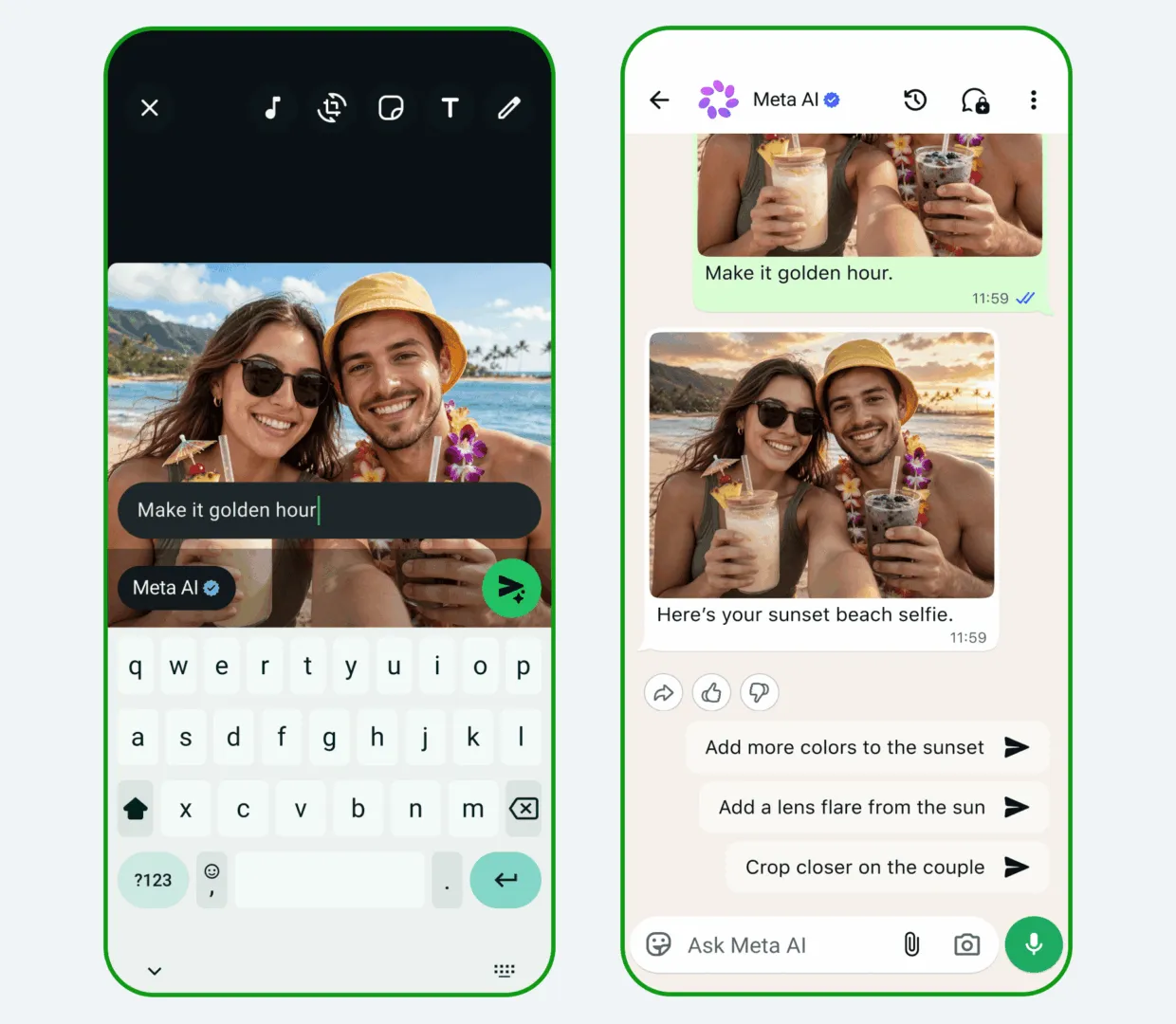
However, the “open-source dream” that Llama represented is nowhere to be found. There is no GitHub link; there is no Hugging Face repository. This is an “open-source funeral” in favor of a proprietary model for monetization. MSL is scaling across three specific axes:
- Pretraining: Rebuilding the stack to extract more capability per unit of compute.
- Reinforcement Learning (RL): Driving predictable, log-linear reliability gains.
- Test-Time Reasoning: Scaling parallel agents to solve “Humanity’s Last Exam” (where Muse hit 58%) and “FrontierScience Research” (38%).
By focusing on the “Contemplating” mode, Muse Image can compete with extreme reasoning models from OpenAI and Google by letting multiple agents collaborate on a single problem without a massive latency spike.
What This Means for You
The arrival of the Muse family signals a new phase in the AI arms race where the “tool” becomes an “active agent.”
- AI is an Active Participant: You aren’t just prompting; you are collaborating with a system that writes code and searches the web to fix its own mistakes.
- Your Social Context is the Product: Meta’s strategic advantage is you. Your public photos are now the raw material for a global remix engine unless you dive into the settings and opt out.
- Proprietary is the New “Open”: The era of Meta releasing its best weights for free is ending. The Muse family is a walled-garden play aimed at ecosystem lock-in.
As Meta teases Muse Video, which already shows off impressive “Bernoulli’s principle” stop-motion animations and UGC-style “Brivo kettle” ads with native audio support, the road to 2026 is clear. We are moving toward “Personal Superintelligence” that will likely live on your face via Oakley Meta Vanguard glasses, powered by a model that knows your friends, your room, and your life, whether you’ve opted in or not.