

Table of Contents
The AI Revolution in telecom has moved past the pilot stage. With Apple, Samsung, and Google embedding on-device AI assistants across billions of handsets, mobile networks are carrying more intelligent, data-hungry traffic than ever. But the more interesting part of that shift isn’t happening on the device; it’s happening inside the network itself, where AI has quietly moved from watching traffic to actively running it.
Telecom operators worldwide are racing to keep pace. At recent industry showcases, Ericsson and Nokia demonstrated agentic AI systems managing radio access network (RAN) optimization, traffic routing, and fault detection across multi-vendor environments, a clear signal that the AI Revolution is no longer a monitoring layer bolted onto legacy infrastructure but a control layer running live networks.
From Monitoring to Control: The New Phase of the AI Revolution
For years, this transformation in telecom meant dashboards: anomaly alerts, predictive maintenance flags, and energy-saving schedules for cell towers during low-demand hours. That groundwork mattered, but it was reactive by design: AI observed, humans decided. That balance is now tipping.
| Use Case | Monitoring Era (AI Observes) | Control Era (AI Acts) |
|---|---|---|
| Fault Detection | AI flags an anomaly; an engineer investigates and decides the fix. | AI diagnoses the root cause and reroutes traffic or reconfigures the affected node itself. |
| Energy Management | AI recommends a low-demand power-saving schedule for review. | AI throttles or wakes cell towers in real time based on live traffic prediction. |
| RAN Optimization | AI reports spectral inefficiency in dashboards for manual tuning. | AI-native schedulers adjust radio parameters continuously, without a human in the loop. |
| Network Emergencies | AI alerts operations teams, who manually reconfigure parameters over hours. | AI agents reconfigure radio parameters in seconds during major events or outages. |
| Customer Service | AI suggests responses; agents review and approve before sending. | AI resolves routine queries end-to-end, escalating only genuinely complex cases. |
Operators today are moving toward what the industry calls autonomous or self-optimizing networks, systems that monitor, analyze, and adjust themselves with minimal human oversight. Intelligent, self-optimizing networks are emerging as AI becomes embedded across RAN, core, edge, and operations, enabling intent-driven orchestration and zero-touch service delivery. Research from the World Economic Forum and TM Forum points to this same shift: the period is marking the transition from AI pilots to autonomous network operations becoming a genuine operational priority, not a lab experiment.
The AI Revolution is also proving itself commercially. Telecom operators that have deployed AI-driven network optimization, predictive maintenance, and automated customer service are reporting opex reductions of 15 to 30 percent on network operations, churn reductions of 10 to 25 percent, and customer service cost reductions exceeding 40 percent. Those figures explain why this shift has stopped being a talking point at industry events and started showing up directly on operator balance sheets.
Proactive Optimization: AI-RAN and 5G Standalone in Action
“Proactive” gets thrown around a lot in telecom marketing, but it has a precise meaning here: the network predicts a problem or opportunity before a human would notice it, then acts on that prediction without waiting for approval. That’s a meaningfully different capability than the alert-and-wait dashboards of a few years ago, and it’s already running on live commercial networks, not just in lab demos. Four real deployments show what this actually looks like once AI Revolution-era tooling leaves the lab and hits live traffic:
How much does AI-RAN actually improve performance right now?
Ericsson and T-Mobile have moved an AI-native Scheduler with Link Adaptation into large-scale commercial trials on live 5G Advanced traffic. A neural network running directly on network hardware predicts radio conditions in real time. This is the practical face of that shift, not a chatbot, but a live scheduler making thousands of micro-decisions a second.
Real use case: During trials with T-Mobile on live 5G Advanced traffic, Ericsson’s AI-native Scheduler achieved close to a 10 percent increase in spectral efficiency and up to a 15 percent boost in downlink throughput compared to legacy rule-based methods, measured on a live commercial network, not a lab bench.
Is AI-RAN ready for prime time, or is it still hype?
Honestly, still early. AI-RAN, AI computing embedded directly into cellular infrastructure, has become one of the most closely watched threads of the AI Revolution, but vendors are candid about where it stands. Despite headline partnerships between NVIDIA, Ericsson, Nokia, and major operators, most AI-RAN projects remain in the trial phase, with no validated benchmark, ROI model, or architectural consensus yet to unlock scale. Treat AI-RAN as directionally proven, not yet commercially settled.
Real use case: Rakuten Mobile and Rakuten Symphony trialed an AI model on a RAN Intelligent Controller that reads historical traffic patterns and adjusts antenna configurations without touching subscriber experience, the trial, run with Japan’s National Institute of Information and Communications Technology, demonstrated power savings of almost 25 percent under optimal conditions. It’s a good example of AI-RAN delivering a real, measured result while still being a trial rather than a global default.
Why does 5G Standalone matter for AI-driven networks?
5G Standalone is the foundation this entire wave of network intelligence is built on. Its dedicated infrastructure, a clean break from patchwork 4G upgrades, gives operators the low-latency, high-density environment AI-driven RAN control needs to function in real time. Manual configuration and static rules simply can’t keep pace with how dynamic and heterogeneous 5G environments have become; that’s precisely the gap AI-driven closed-loop optimization is built to close.
Real use case: Telus deployed Samsung’s RIC platform with a suite of AI applications on its network, including a KPI Anomaly Detector and RAN Anomaly Insight to catch issues early; an Energy Saving Manager that predicts traffic and automates power-saving decisions, and a Load Balancing Manager that redistributes load automatically. Together, they show what “closed-loop” actually looks like across four separate network functions running at once, not just one isolated feature.
Is AI already changing customer service, or is it still just chatbots?
It’s moved past chatbots. Vodafone’s digital assistant Tobi, built on Microsoft’s Azure OpenAI Service, continues to serve millions of customers across 13 countries, but Tobi is now one example among many, not the exception.
Real use case: Airtel uses agentic AI for workflow automation and real-time optimization, extending that same shift from the network core into day-to-day service delivery. Rather than a single chatbot, agentic AI here means multiple coordinated processes, ticket routing, resolution, and follow-up, running with minimal manual handoff.
Toward AI-Native 6G: What the AI Revolution Looks Like Next
If the current chapter of the AI Revolution is about optimization, the next chapter of the AI Revolution is about architecture. Instead of AI sitting on top of the network, it becomes part of the network’s core design. Here’s how that shift is expected to unfold:
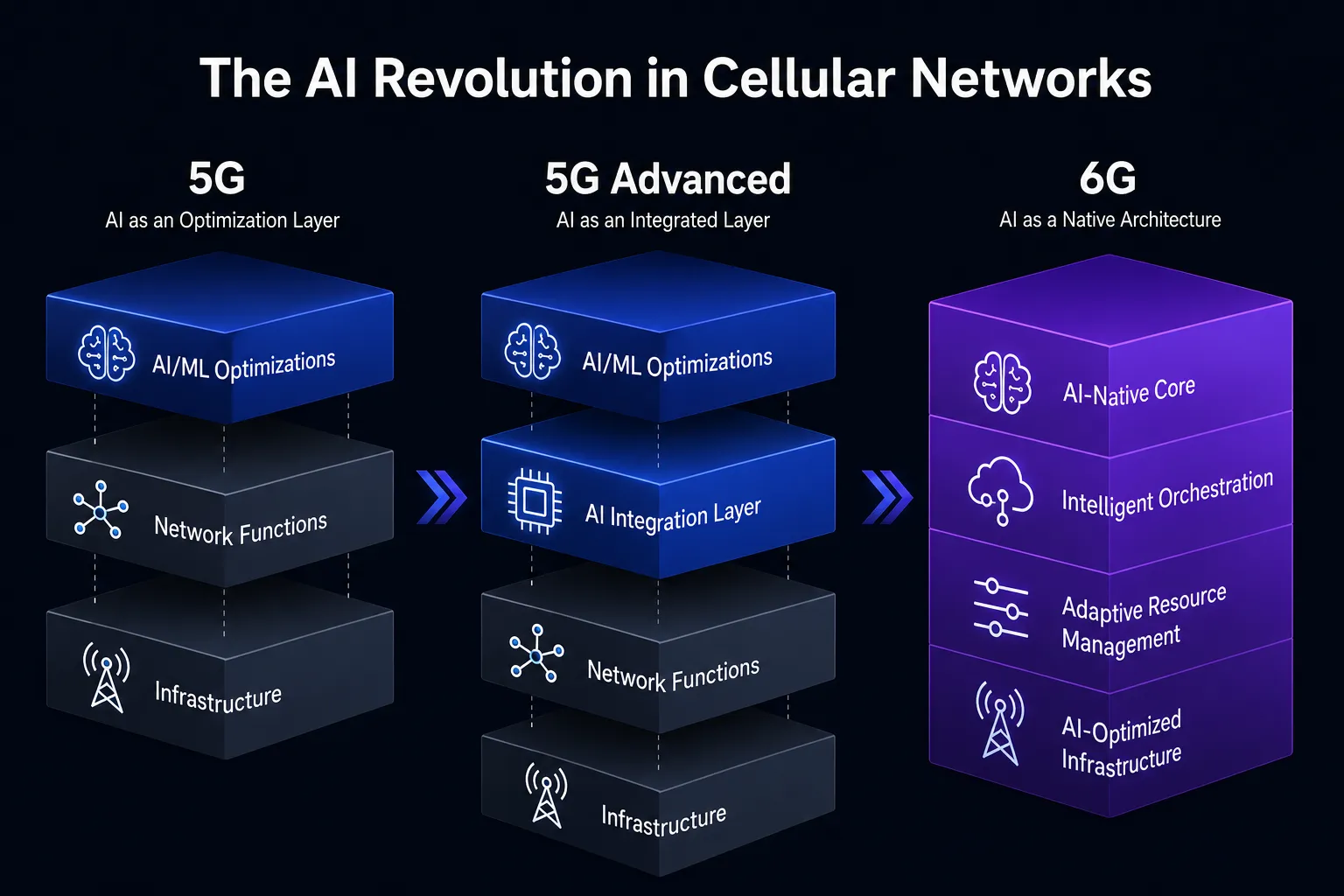
- AI moves from optimization layer to native architecture. In 5G, AI mostly optimizes what’s already there. In 5G Advanced, it becomes more integrated and proactive. In 6G, it’s expected to be built directly into core control, resource management, and orchestration, not added as an external feature.
- A dedicated industry alliance is building the bridge. The AI-RAN Alliance, including NVIDIA, Ericsson, Nokia, T-Mobile, and Samsung, is working specifically to integrate AI computing into cellular infrastructure ahead of 6G, rather than leaving it to individual vendors to solve alone.
- Response times are already collapsing from hours to seconds. Deutsche Telekom and Google Cloud have built AI agents that reconfigure radio parameters in seconds during major events or network emergencies – work that previously took hours of human-supervised effort. It’s the clearest real-world proof point of what the AI Revolution actually delivers in practice.
- Commercial 6G is still years out. Deployment is generally targeted for the early-to-mid 2030s, with standardization expected roughly two to four years earlier. This stage of the AI Revolution is a build-out phase, not a rollout, so treat any “6G is here” headline with caution.
- What operators do with 5G now determines 6G cost later. Industry estimates suggest that modernizing 5G Standalone and edge infrastructure today can cut future 6G migration costs by 20 to 30 percent, since it’s building the same cloud and edge foundations 6G will need.
The Human Touch in the Age of AI Revolution

Even as the AI Revolution automates more of the network, a crucial element remains distinctly human. Here’s why:
- Understanding Context: AI can tell you that fifty devices just joined a network, but it can’t always tell you whether that’s a planned rollout or a misconfiguration routing users onto the wrong VLAN. That judgment call still needs a human with organizational context.
- Ethical Considerations: AI algorithms are only as good as the data training them. Biases can creep into automated decisions, so human oversight remains essential to fair, non-discriminatory customer treatment.
- Novel Failure Modes: Networks fail in new ways constantly, and a fresh bug introduced by a recent software update simply won’t exist in any model’s training data. Experienced engineers develop a sixth sense for spotting these that no automated tool has replicated yet.
The Future: A Symphony of Human and Machine
The next stage of the AI Revolution isn’t a zero-sum contest between humans and machines; it’s a collaborative one. AI increasingly handles the mundane pattern-matching and correlation work, freeing engineers to focus on architecture, automation strategy, and the kind of complex troubleshooting that still requires contextual judgment.
Picture a customer service agent equipped with next-generation AI tooling: real-time network data, full interaction history, and live sentiment analysis of the conversation in front of them. That agent can anticipate needs and resolve issues with a speed no purely manual process could match.
The goal was never to replace telecom’s workforce; it’s to augment it. That combination of human judgment and machine-scale optimization is what will define successful telecom operations as the AI Revolution matures from optimization layer to autonomous, AI-native infrastructure.
FAQs
Will the AI Revolution actually replace network engineers?
Mostly no, AI is taking over repetitive pattern-matching and log correlation, but it still can’t judge business intent behind network changes. Engineers are shifting toward architecture and complex troubleshooting instead of disappearing.
Is AI-RAN just marketing hype right now?
Partly, big-name partnerships exist, but there’s still no agreed benchmark or proven ROI model. Most deployments today remain in trial mode rather than full-scale production.
How is this different from the old rule-based network automation?
Rule-based systems only follow fixed if-this-then-that logic. AI Revolution-era systems predict conditions and adjust continuously, closer to a real-time feedback loop than a static script.
Does AI in telecom mean fewer dropped calls or outages for regular users?
In trial deployments, yes, AI scheduling has already shown measurable throughput and efficiency gains. Full rollout to all users is still gradual, market by market.
What does “agentic AI” actually mean in a telecom context
It refers to AI systems that don’t just alert humans but take action themselves, like rerouting traffic or reconfiguring radio parameters. It’s a step beyond monitoring dashboards toward genuine autonomous control.
Will 6G really be “AI-native”, or is that just another buzzword?
Vendors are designing 6G with AI built into the core architecture itself, not added afterwards. It’s still years from commercial deployment, so the claim hasn’t been tested at scale yet.
Is heavy AI use on phones actually slowing down mobile networks?
On-device AI assistants do add data load, which is part of why operators are investing in smarter network management. It’s a contributing factor, not the sole cause of congestion.