

Table of Contents
TL;DR
Generative AI in healthcare refers to AI systems that produce new content, clinical notes, patient communications, research summaries, synthetic data, and more, rather than only detecting patterns or scoring risk. In 2026, hospitals use it mainly for ambient documentation and administrative work, pharmaceutical companies use it to accelerate early drug discovery, and payers use it for member communication and claims support. Every credible deployment keeps a clinician or reviewer in the loop; none replace clinical judgment.
Introduction: How Generative AI Is Changing Healthcare
For years, “AI in healthcare” mostly meant predictive models: a system that flagged a patient’s sepsis risk, sorted a mammogram into “review” or “clear,” or estimated readmission likelihood.
Generative AI does something different. Instead of classifying existing data, it produces new material: a draft clinical note, a plain-language explanation of a diagnosis, a synthetic patient record for testing software, a candidate drug molecule.
Healthcare is a natural fit for this shift because so much of the industry runs on unstructured information: dictated notes, PDF lab reports, insurance correspondence, medical literature, and patient messages that don’t fit neatly into database fields.
Generative models are built to work with exactly that kind of content, which is why they’re being tested across nearly every part of the industry: clinicians documenting visits, patients asking about medications, researchers scanning literature, payers processing claims, and administrators drafting correspondence.
It’s worth separating two very different things early on: AI that assists a person who remains responsible for the decision, and AI that decides on its own.
Almost everything described in this article falls into the first category.
Generative AI drafts, summarizes, and suggests; a clinician, researcher, or staff member reviews and finalizes. That distinction is the foundation of responsible implementation, and it will come up repeatedly in the sections on risk and regulation below.
Adoption data backs up how quickly this has moved from pilot to production. In McKinsey’s fourth-quarter 2024 survey of 150 U.S. healthcare executives across payers, health systems, and healthcare technology firms, 85 percent said their organizations were either exploring or actively deploying generative AI, and 64 percent of those already deploying it reported a positive return on investment.
The center of gravity has shifted from “should we try this” to “how do we scale what’s already working.”
What Is Generative AI in Healthcare?
Generative AI in healthcare describes models, typically large language models or multimodal models, that generate or transform content rather than simply labeling it. In practice, that includes:
- Clinical text, such as visit notes and referral letters
- Patient-facing summaries and educational material
- Medical documentation for billing and compliance
- Synthetic datasets for research and software testing
- Literature summaries and research drafts
- Image-related outputs used alongside diagnostic workflows
Generative AI vs. Traditional AI in Healthcare
| Traditional AI | Generative AI |
|---|---|
| Predicts or classifies | Generates or synthesizes |
| Detects patterns in existing data | Produces new content |
| Usually built for one narrow task | Can support several workflows |
| Example: readmission risk scoring | Example: drafting a clinical note |
Both approaches are often used together; a traditional model might flag an abnormal lab value, while a generative model drafts the note explaining it.
How Is Generative AI Used in Healthcare?
1. Clinical Documentation and Medical Scribing
This is the most mature and widely deployed use case.
Ambient AI systems listen to a patient encounter (with consent) and draft a structured note, a visit summary, a discharge summary, or a referral letter for the clinician to review before it goes into the electronic health record.
The evidence base here is unusually strong for a healthcare AI application.
WVU Medicine expanded its ambient documentation tool to roughly 2,800 clinicians across a 25-hospital network and, in a survey of more than 200 clinicians before and after rollout, reported a 78 percent increase in “undivided patient attention” and a 61 percent drop in self-reported cognitive load.
Emory Healthcare reported a similar pattern, with a JAMA-published study associating ambient documentation use with a roughly 31 percent increase in documentation-related well-being.
Vendors in this space, including Abridge, now report partnerships with more than 250 health systems, among them Kaiser Permanente, Mayo Clinic, Duke Health, and Johns Hopkins.
A smaller but methodologically careful academic study adds a useful caveat: a simulated inpatient trial found ambient AI cut documentation time dramatically (median 27 seconds versus 128 seconds for progress notes), but researchers noted that the quality gains are strongest where clinicians still actively edit the draft rather than accepting it unchanged.
2. Patient Communication and Healthcare Chatbots
Generative AI increasingly handles patient-facing questions: appointment logistics, pre-visit instructions, post-treatment guidance, medication information, and multilingual communication.
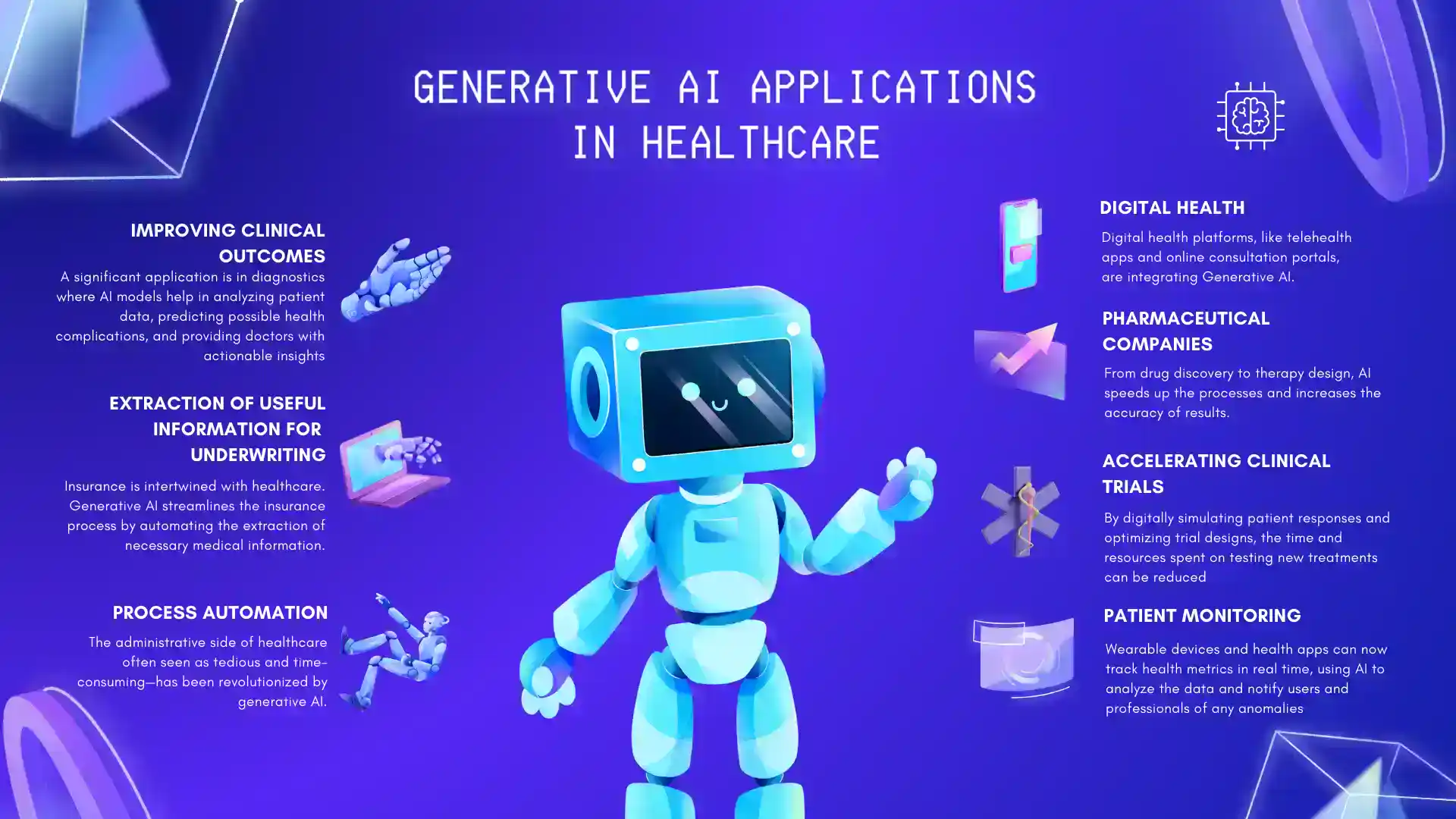
Telehealth apps and online consultation portals, are integrating Generative AI.
These tools work best as a first layer that routes complex or urgent questions to a person; they should never be positioned as an unrestricted substitute for a clinician’s judgment, healthcare chatbot only guide patients.
3. Clinical Decision Support
Here, generative AI helps clinicians summarize a patient’s history, retrieve relevant guideline language, surface potentially relevant evidence, or outline differential-diagnosis considerations.
The output is a starting point for clinical reasoning, not a diagnosis; every credible implementation requires clinician review before anything reaches a patient.
4. Medical Research and Knowledge Management
Researchers use generative AI to summarize literature, retrieve institutional knowledge, and support early hypothesis generation, cutting down the time spent manually reading and organizing large bodies of published work.
5. Drug Discovery and Development
This is where generative AI’s track record has moved furthest beyond promise into hard clinical evidence, with real limits. Insilico Medicine’s rentosertib (also known as ISM001-055), a small-molecule inhibitor developed for idiopathic pulmonary fibrosis, is the most documented example of an AI system proposing both a novel biological target and a novel molecule.
Its Phase IIa results, published in Nature Medicine, showed a measurable improvement in lung function over placebo, and in September 2026 the company dosed its first patient in a 320-patient Phase III trial.
The authors of that Nature Medicine paper were candid that, despite years of progress in generative chemistry, very few AI-discovered or AI-designed drugs have reached this stage of human testing, which is exactly why this example matters more as a proof of concept than as evidence that generative AI now routinely shortens drug development. The technology assisted specific stages of discovery; laboratory work and multi-year clinical trials still validate the result.
6. Healthcare Administration and Revenue Cycle
Generative AI supports claims processing, prior authorization documentation, medical coding assistance, healthcare accounting, billing correspondence, and RFP or policy drafting, making AI insurance software increasingly valuable for healthcare payers.
On the payer side, UnitedHealthcare’s generative AI assistant, Avery, was on track to reach more than 20 million members by the end of 2026, primarily for member-facing questions and administrative support. Stanford’s Institute for Human-Centered AI has cautioned, in a February 2026 policy brief, that the same technology used for utilization review and claims adjudication has also drawn scrutiny over wrongful denials, a reminder that administrative efficiency and patient protection have to be designed for together, not treated as separate problems. including and regulatory updates
7. Personalized Patient Education and Care
Generative AI can adapt existing, clinician-approved health information to a patient’s literacy level, language, or specific situation, turning a standard discharge instruction sheet into something a specific patient is more likely to actually read and follow.
8. Synthetic Healthcare Data
Generative models can produce synthetic patient data for research, software testing, and training environments where real patient data would raise privacy or access concerns.
This is useful, but synthetic data isn’t automatically safe or representative; it still requires validation for bias and re-identification risk before it’s treated as a stand-in for real-world data.
Benefits of Generative AI in Healthcare
- Reduced administrative work – less time spent on notes, correspondence, and documentation
- Faster access to information – quicker retrieval of guidelines, history, and literature
- More personalized patient experiences – communication adapted to language and literacy
- Improved workflow efficiency – administrative and clinical tasks move faster
- Support for clinical research – faster literature synthesis and hypothesis generation
- Better knowledge management – institutional knowledge becomes easier to retrieve
- Scalable patient communication – routine questions handled without added staff time
- Potential cost and productivity improvements – particularly in documentation and claims workflows
These are workflow and productivity benefits, backed by the evidence above.
Broader claims about improved clinical outcomes should be treated cautiously until tied to a specific, published study.
Real-World Generative AI in Healthcare Examples
| Organization | Problem | GenAI Application | Result |
|---|---|---|---|
| WVU Medicine (25-hospital network) | Clinician burnout, documentation burden | Ambient AI scribing across ~2,800 clinicians | 78% rise in reported patient attention, 61% drop in cognitive load (pre/post survey) |
| Emory Healthcare | Clinician well-being tied to documentation load | Ambient AI documentation | ~31% increase in documentation-related well-being (JAMA-published study) |
| Insilico Medicine | Slow, costly early-stage drug discovery | Generative chemistry and target-identification platform (Pharma.AI) | Rentosertib entered Phase III trials for pulmonary fibrosis in September 2026, following positive Phase IIa results |
| UnitedHealthcare | Member-facing question volume, administrative load | Generative AI assistant (“Avery”) | On track to reach 20M+ members by end of 2026 |
None of these figures should be read as guaranteed outcomes for any other organization; results depend heavily on implementation quality, data readiness, and how well clinicians are supported through the transition.
Challenges and Risks of Generative AI in Healthcare
Hallucinations and incorrect information: A generative model can produce fluent, confident text that is factually wrong, a risk that is far more consequential in a clinical note or medication summary than in most other industries.
Patient data privacy: Protected health information moving through third-party models raises questions about data retention, access controls, and unauthorized exposure that go beyond standard IT security practices.
Bias and health inequities: Models trained on unrepresentative data can produce outputs that work well for some patient populations and poorly for others.
Lack of explainability: Clinicians need to understand the basis and limitations of AI-generated content well enough to know when to trust it and when to override it.
Data quality and interoperability: Generative AI is only as useful as the EHR and clinical data it draws from; fragmented or messy source data undermines even a well-built model.
Human oversight: High-risk clinical applications require a person reviewing the output before it affects care; this is the consistent thread across every credible deployment described above.
Model drift and ongoing monitoring: A model validated at launch can degrade in accuracy as clinical practices, patient populations, or documentation habits shift, which makes evaluation an ongoing process rather than a one-time gate.
Intellectual property and data ownership: Vendor contracts should clearly address who owns generated content, how training data was sourced, and what happens to institutional data used to fine-tune a model.
Security and Compliance Considerations

HIPAA and PHI Protection
Any generative AI system that touches protected health information needs the same fundamentals as other clinical systems: strong access controls, encryption in transit and at rest, audit logging, data minimization, and, where a third-party vendor is involved, a signed Business Associate Agreement.
Other Compliance Considerations
Depending on the specific use case, organizations may also need to weigh FDA device requirements, HHS guidance, state-level privacy law, internal governance policy, and clinical safety validation. Not every generative AI healthcare application is regulated as a medical device; that determination depends on intended use, which is exactly the framework the FDA applies, discussed next.
FDA and Regulatory Considerations for Generative AI in Healthcare
The FDA doesn’t regulate “AI” as a category. It regulates devices based on intended use and technological characteristics, a distinction that matters for any organization trying to figure out whether a specific generative AI application falls under device rules.
That said, the agency is actively working through what a GenAI-specific framework should look like.
On August 18, 2026, the FDA’s Digital Health Center of Excellence issued a discussion paper on generative AI-enabled medical devices, outlining a possible two-axis framework for risk assessment, a premarket evaluation approach built around competency assessment (benchmarking a system’s performance the way a physician’s competency might be evaluated), and several potential approaches to postmarket monitoring.
The paper also raises open questions specifically about foundation models and agentic AI systems, and the FDA is accepting public feedback on it through October 19, 2026.
This is an important distinction to hold onto: the August 2026 paper is a discussion document seeking public feedback, not final guidance or a settled regulatory framework. Organizations building or deploying GenAI-enabled devices should treat it as a signal of where regulation is heading, not as a compliance checklist to follow today.
How to Implement Generative AI in Healthcare
- Identify the healthcare use case. Start from a specific workflow, documentation burden, claims backlog, patient FAQ volume, rather than “we need GenAI.”
- Assess data readiness. Evaluate data availability, quality, PHI handling, EHR integration, and governance before selecting a tool.
- Define security and compliance requirements before choosing a model or vendor, not after.
- Select the right AI approach, an existing model or API, a private deployment, a retrieval-based system, or a human-in-the-loop workflow, based on the use case, not the newest available technology.
- Build a proof of concept tested against real workflow requirements, not a demo environment.
- Validate AI outputs for accuracy, hallucination rate, bias, safety, consistency, and usability before wider rollout.
- Integrate with existing healthcare systems, particularly the EHR/EMR and established clinical workflows.
- Deploy with monitoring and human oversight. Production deployment is the start of an ongoing evaluation process, not the finish line.
How to Choose a Generative AI Healthcare Development Partner
Look for a partner that can demonstrate:
- Healthcare domain expertise, not just general AI experience
- Direct HIPAA compliance experience
- EHR/EMR integration track record
- Strong security practices and regulatory awareness
- Data engineering capability, not just model selection
- Post-deployment support and the ability to monitor and validate AI systems over time
For organizations planning a broader healthcare software initiative rather than a single AI feature, HyScaler’s Healthcare Software Development guide covers software types, compliance, and partner-selection considerations in more depth.
For the security and compliance side specifically, see HyScaler’s guide to HIPAA Compliance for AI Healthcare App Development.
Cost of Implementing Generative AI in Healthcare

There’s no single honest number here; cost depends on:
- Use-case complexity and scope
- Model or API costs
- Data preparation and cleanup
- Integration with existing healthcare systems
- Security and compliance work
- UI/UX design
- Infrastructure
- Testing, evaluation, and ongoing monitoring
- Regulatory requirements specific to the use case
A narrow, well-scoped pilot (a single documentation workflow, for example) costs meaningfully less than an enterprise-wide deployment spanning multiple departments and systems.
Organizations should ask any vendor to break down cost by these categories rather than accepting a single flat quote.
Future of Generative AI in Healthcare
- More AI-assisted clinical workflows, expanding beyond documentation into broader care coordination
- Multimodal healthcare AI, combining text, imaging, and structured data in a single workflow
- Early movement toward AI-powered healthcare agents, though Gartner’s 2026 healthcare AI hype cycle places multi-agent clinical orchestration at the earliest “innovation trigger” stage, meaning production use remains rare
- Deeper EHR integration, reducing the friction between AI tools and existing clinical systems
- More personalized patient experiences, particularly in education and communication
- Stronger AI governance and safety practices as organizations move from pilots to production
- Increasing regulatory scrutiny, following the direction set by the FDA’s 2026 discussion paper
The clearest theme across current deployments is that adoption is shifting from “finding new use cases” toward optimizing and scaling the ones that already work, not toward removing clinicians from the loop.
Key Takeaways
- Generative AI supports both clinical and administrative healthcare workflows, but works best as an assistant, not a decision-maker.
- Clinical documentation is currently the most mature and best-evidenced use case.
- Drug discovery applications are real but still early; one AI-discovered drug reaching Phase III is a milestone, not a norm.
- HIPAA, data privacy, and applicable medical-device requirements all need consideration before deployment.
- Human oversight remains essential for any high-impact clinical application.
- Successful implementation requires attention to data quality, integration, validation, and ongoing monitoring, not just choosing a good model.
FAQ
What is generative AI in healthcare?
It’s AI that generates new content, clinical notes, patient communications, research summaries, or synthetic data, rather than only classifying or predicting.
How is generative AI used in healthcare?
Most commonly for clinical documentation, patient communication, clinical decision support, research assistance, drug discovery, administrative work, patient education, and synthetic data generation.
What are the benefits of generative AI in healthcare?
Reduced administrative burden, faster information access, more personalized communication, and improved workflow efficiency, primarily.
What are the risks of generative AI in healthcare?
Hallucinated or inaccurate content, patient data privacy exposure, bias, limited explainability, and the need for ongoing monitoring after deployment.
Is generative AI HIPAA compliant?
Generative AI itself isn’t inherently compliant or non-compliant; compliance depends on how a specific tool is configured, contracted, and deployed, including access controls, encryption, and Business Associate Agreements where applicable.
Can generative AI replace doctors?
No credible current deployment does this. Every well-documented example keeps a clinician reviewing and finalizing AI-generated output.
How is generative AI used for medical documentation?
Ambient AI tools record a patient encounter (with consent) and draft a structured note for the clinician to review before it enters the EHR.
How does generative AI help drug discovery?
It can assist with identifying disease targets and generating candidate molecules, but laboratory and clinical validation still determine whether a candidate becomes an approved drug.
How much does it cost to develop a generative AI healthcare solution?
Cost varies widely based on use-case complexity, data readiness, integration needs, and compliance requirements; there’s no reliable flat estimate.
What regulations apply to generative AI in healthcare?
Depending on the use case: HIPAA, applicable state privacy law, and, where a system meets the definition of a medical device, FDA requirements, which are actively evolving following the FDA’s August 2026 discussion paper.
How can healthcare organizations implement generative AI safely?
By starting with a specific use case, assessing data readiness, defining compliance requirements up front, validating outputs before rollout, and maintaining human oversight and ongoing monitoring after deployment.
What is the future of generative AI in healthcare?
Continued growth in documentation and administrative use cases, early and cautious movement toward multimodal and agentic systems, and increasing regulatory attention rather than reduced oversight.