

Table of Contents
As companies expose more of their data and services through APIs, two terms keep showing up side by side: API Gateway and API Management. They sound similar, get used interchangeably in casual conversation, and even show up bundled in the same product suites, but they solve different problems. This article breaks down what each one actually does, how they relate to each other, and why most mature API strategies end up using both.
Understanding API Management
API Management is the discipline of overseeing an API across its entire lifecycle, from initial design and publishing through versioning, monitoring, and eventual retirement. It’s less a single tool and more a layer of control that sits across all of your APIs, giving you visibility into who’s using them, how they’re being used, and whether they’re performing the way they should.
At its core, API Management answers questions like: which partners have access to which endpoints, how much traffic each API handles, and whether usage patterns are shifting in a way that signals a problem or an opportunity. That visibility typically gets surfaced through dashboards and reports, so both technical and non-technical stakeholders can make decisions about where the API program is heading.
What an API Management Setup Typically Covers
- Lifecycle and version control: tracking an API through design, testing, publication, and deprecation so partners aren’t blindsided by breaking changes
- Self-service onboarding: a portal where developers and partners can find documentation, generate credentials, and test calls without manual back-and-forth
- Tiered access rules: defining what a free user, paid customer, or internal team is allowed to do, and enforcing that consistently
- Adoption and performance reporting: surfacing which APIs are gaining traction, which are underused, and where errors are clustering
- Usage-based billing: for businesses that monetize API access, tracking consumption per client, and feeding it into invoicing
The Business Case for API Management
- One place to see the whole picture. Rather than each team tracking its own APIs in isolation, there’s a single source of truth for usage, performance, and access.
- Smoother partner relationships. A proper developer portal and predictable access policies mean external teams can integrate without constant email threads.
- Decisions backed by data. Usage trends make it obvious which APIs deserve more investment and which are quietly becoming dead weight.
- Flexible access without duplicated infrastructure. Different audiences, public developers, paying customers, and internal teams can be served different slices of the same API.
Understanding API Gateways
An API Gateway is the entry point that sits between client applications and your backend services. Every request, whether from a mobile app, a partner’s server, or another internal service, passes through the gateway before it reaches anything behind it.
Where API Management is concerned with the bigger picture over time, a gateway operates in the moment: it decides, request by request, whether a call gets authenticated, where it gets routed, and whether it gets throttled. It’s infrastructure doing a job, not a strategy being executed.
What an API Gateway Typically Handles
- Authentication and authorization for every incoming request before it ever touches a backend service
- Rate limiting and throttling so one high-volume client can’t degrade performance for everyone else
- Intelligent routing to the correct service, and to a healthy instance of it
- Response caching to reduce redundant load on backend systems
- Load balancing across multiple instances of a service to keep response times consistent
The Business Case for an API Gateway
- Cleaner microservices architecture. Backend services stay focused on business logic instead of each one reimplementing authentication and rate limiting on its own.
- A consistent security boundary. Funneling all traffic through one entry point makes it far easier to apply uniform security rules and catch suspicious activity early.
- Better performance under load. Caching and smart routing reduce latency and protect backend systems during traffic spikes.
- Predictable behavior at scale. As traffic grows, the gateway is what keeps things from degrading unevenly across services.
API Gateway vs API Management
The simplest way to frame it: an API Gateway is a piece of infrastructure, while API Management is a strategic layer, one that frequently includes a gateway as part of how it enforces its own rules.
A gateway operates at request time, concerned with what happens the instant a call arrives. API Management operates across the lifecycle, concerned with planning, publishing, monitoring, and evolving APIs over months and years, using the gateway as the mechanism that actually carries out many of its policies.
Teams that deploy only a gateway tend to get solid traffic control but no real visibility into adoption, partner health, or lifecycle planning. Teams that invest only in management tooling without a strong gateway often end up with policies that look good on paper but aren’t consistently enforced in practice, since nothing is actually intercepting every request to apply them.
| API Gateway | API Management | |
|---|---|---|
| What it is | A technical entry point for traffic | A strategic layer for the whole API program |
| Operates at | Request time, in milliseconds | Lifecycle time, over months and years |
| Main job | Secure, route, and throttle requests | Track adoption and govern how APIs evolve |
| Used by | Infrastructure and platform engineers | Product owners and API teams |
How This Plays Out in Practice
The cleanest way to see why both matter is to walk through a few situations that most growing API programs eventually hit. The pattern is always the same: Management decides, the Gateway acts.
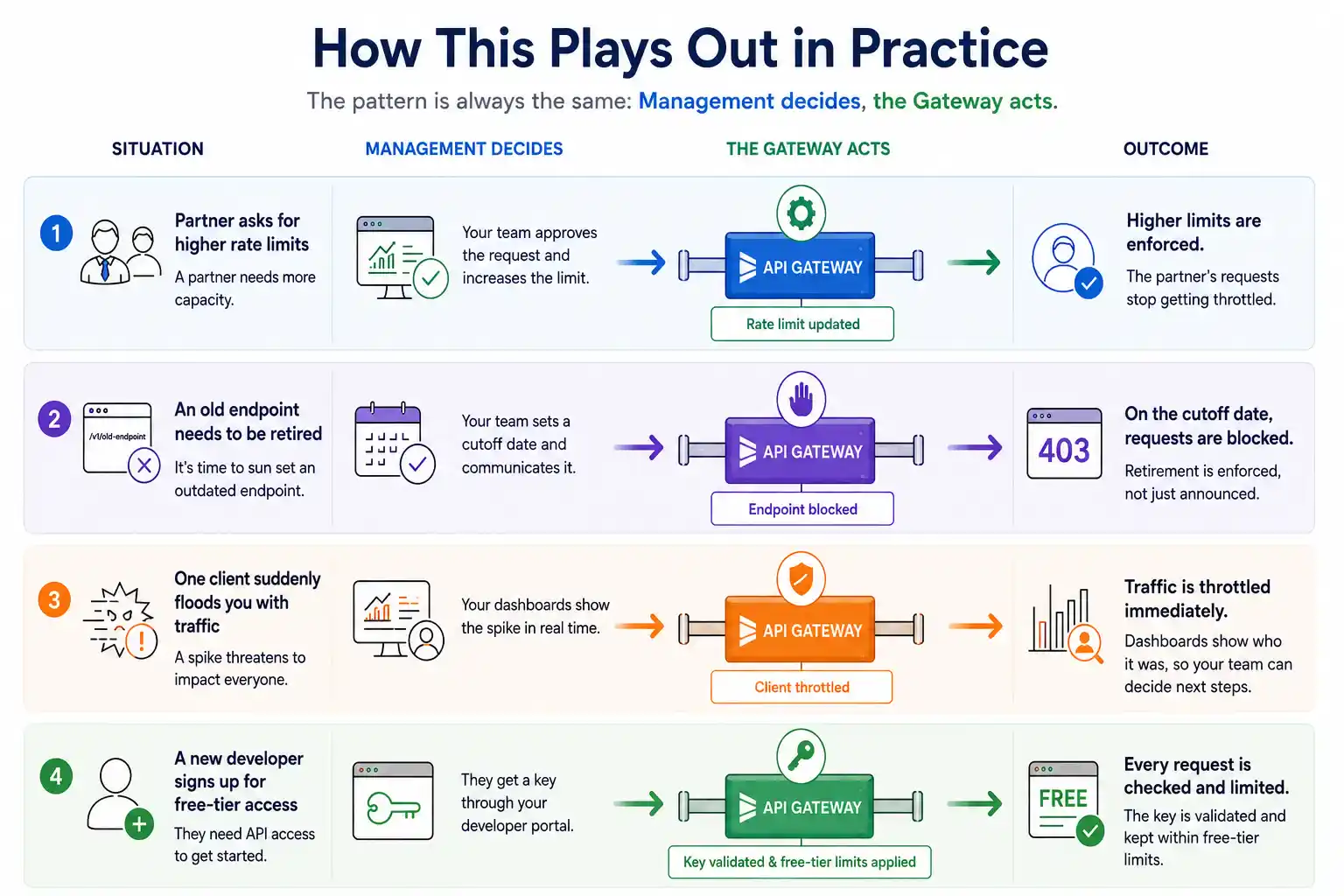
A partner asks for higher rate limits. Your team approves the request. The gateway is what makes it real; it raises the limit, so the partner’s requests stop getting throttled.
An old endpoint needs to be retired. Your team sets a cutoff date and warns developers ahead of time. On that date, the gateway starts blocking calls to the old endpoint. Without it, the “retirement” is just an email nobody enforces.
One client suddenly floods you with traffic. The gateway throttles that client immediately before it can slow things down for anyone else. Afterward, your dashboards show who it was, so your team can decide if it’s worth a conversation.
A new developer signs up for free-tier access. They get a key through your developer portal. From then on, the gateway checks that key on every request and keeps it inside the free-tier limits.
Conclusion
An API Gateway and an API Management platform aren’t competing solutions; they’re two layers of the same system, working at different speeds. The gateway handles the moment-to-moment reality of traffic: authenticating, routing, and throttling every request as it arrives. Management handles everything around that moment: who gets access, how an API evolves, and whether the whole program is actually working.
For a small, internal-facing setup, a gateway alone might genuinely be enough. But the moment external partners, paying customers, or multiple teams enter the picture, the lack of lifecycle tracking and usage visibility becomes a real bottleneck, not a nice-to-have you can put off indefinitely. The good news is that adopting one doesn’t mean ripping out the other later; most platforms today let you start with a gateway and layer management on top as your API program grows.
FAQ’s
Is an API Gateway the same as API Management?
No. A gateway handles live traffic, routing, security, and rate limits. Management covers the bigger picture, like lifecycle, analytics, and partner access.
Do I need API Management if I already have a gateway?
Not always. If you only have a few internal APIs, a gateway may be enough. Once partners or paying users are involved, management becomes worth adding.
Can an API Gateway replace API Management?
No. A gateway can’t track adoption, manage versions, or run a developer portal; those are management functions it simply doesn’t handle.
What’s the difference between an API Gateway and a load balancer?
A load balancer only distributes traffic across servers. A gateway also handles authentication, rate limiting, and routing logic on top of that.
Does API Management include a gateway?
Most modern API Management platforms include a built-in gateway or integrate tightly with one, so you rarely need to buy them as fully separate products.
Is an API Gateway necessary for microservices?
It’s not strictly required, but without one, every microservice ends up handling its own authentication and rate limiting separately, which gets messy fast.
Which one should a startup set up first?
Most startups start with a lightweight gateway to handle security and routing, then add management tooling once external users or partners show up.