

Table of Contents
Organizations today move enormous volumes of sensitive information across cloud infrastructure: citizen records, financial transactions, patient data, and defense intelligence. For years, cloud decisions came down to cost and speed. That calculation has fundamentally changed.
Governments are no longer treating cloud infrastructure as a technology preference. They are codifying it as a compliance-controlled national asset, demanding that data stay within defined legal and geographic boundaries. The global market for this model reflects this shift, growing fast enough that it now ranks among the most closely watched segments in enterprise technology.
At the center of this transformation is sovereign cloud, a purpose-built environment that ensures all data remains within a nation’s legal jurisdiction and is governed by that country’s applicable laws. Leading providers have already committed to this approach at scale: AWS’s offering, Microsoft’s version through Azure, and European frameworks like Gaia-X are reshaping how organizations think about data control.
What Is Sovereign Cloud?
A sovereign cloud is a cloud computing environment designed so that all data, stored records, active workloads, and data in transit are processed and managed within a country or region’s legal framework, in line with its data protection regulations.
The concept is grounded in data sovereignty: the principle that digital information is subject to the governance of the country where it is collected, stored, or processed, regardless of where the provider is headquartered.
Unlike conventional public cloud, where data can cross multiple national borders and fall under multiple legal systems, this environment keeps every layer, infrastructure, operations, access, and encryption under a single, clearly defined sovereign authority.
It’s also important to distinguish a sovereign cloud from data residency. Data residency simply describes where data is physically stored. Your data may sit on servers in Frankfurt, but if your provider is a U.S.-headquartered company, U.S. law can still reach it. Data sovereignty closes that legal gap; it mandates that the laws of the country where data resides actually govern it. This kind of architecture operationalizes both, building that legal protection directly into the infrastructure rather than leaving it as a policy promise.
How It Works: Core Characteristics
It’s not simply a locally hosted data center. It’s an operational and architectural model built around six pillars:
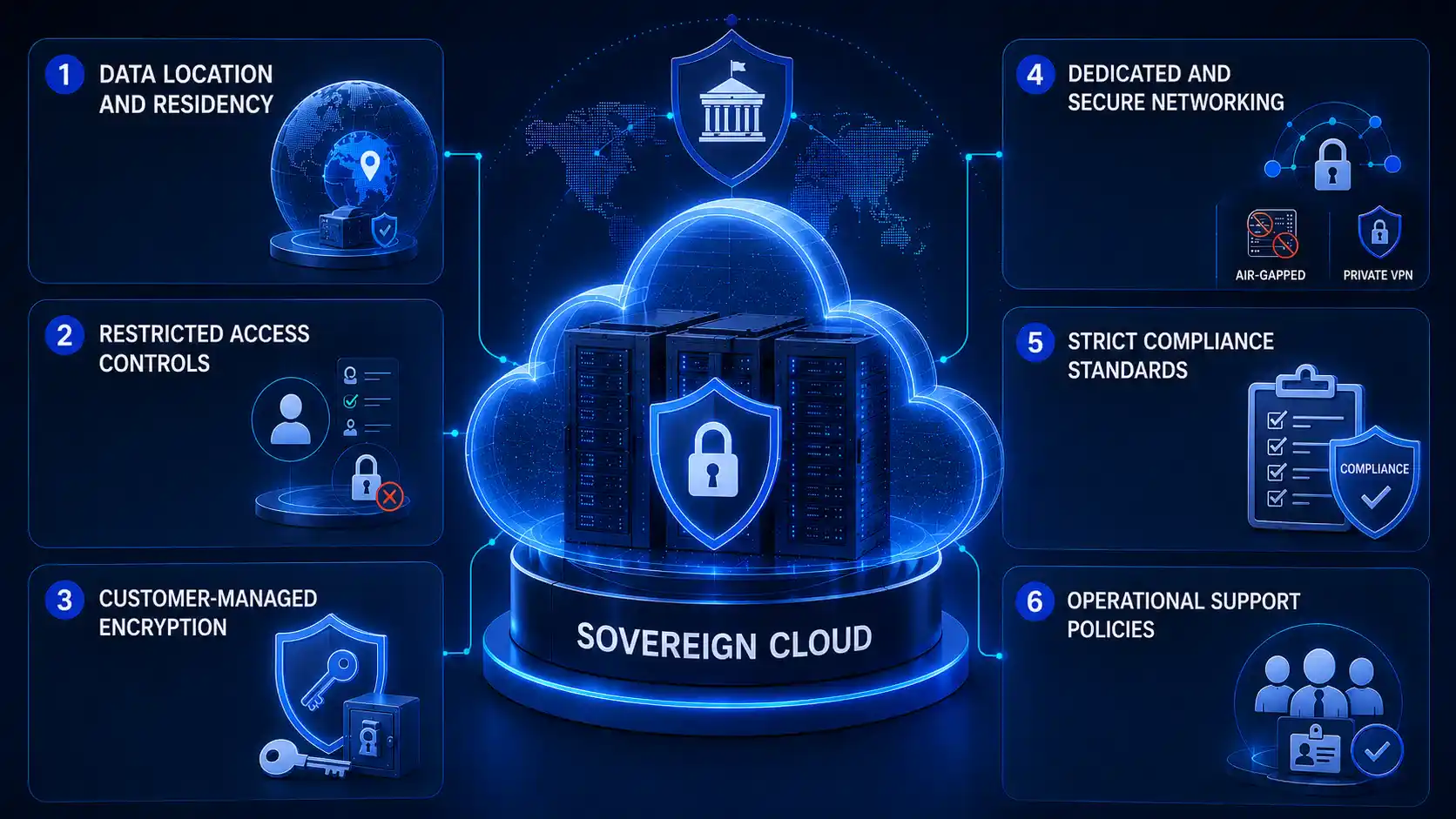
Data Location and Residency: Organizations specify exactly where data must reside, down to a particular country, region, or facility, enforced at the infrastructure level.
Restricted Access Controls: Access is scoped by geography, organizational role, security clearance, and citizenship. Personnel who don’t meet defined criteria are blocked from the environment.
Customer-Managed Encryption: The organization, not the provider, holds the encryption keys, removing even the technical possibility of unauthorized vendor access.
Dedicated and Secure Networking: Configurations range from air-gapped environments to private VPN setups fully segmented from public traffic.
Strict Compliance Standards: Controls cover not just technical infrastructure but documented procedures for how data is handled, audited, and protected under national and sector-specific regulations.
Operational Support Policies: Personnel managing the infrastructure must meet sovereignty requirements: residency, citizenship, and clearance criteria relevant to the organization’s mandate.
Benefits of This Model
Regulatory Compliance Built Into Infrastructure. These environments are designed from the ground up to fulfill the legal requirements of specific countries and regions. Rather than relying on policy documentation, compliance is enforced structurally, at the data, network, and access layers. This reduces legal exposure, simplifies audit preparation, and builds trust with regulators and customers.
Stronger Data Security and Privacy Standards. Public cloud carries an inherent risk: foreign governments can compel a provider headquartered in their territory to produce data, regardless of where that data physically sits. A sovereign cloud eliminates this vector. With national jurisdiction, customer-managed encryption, and tightly restricted access, exposure to foreign surveillance programs and cross-border intelligence gathering drops sharply.
Reduced Data Breach Risk. Authorized-user restrictions, air-gapped or private networking, security clearance requirements, and local encryption key management together create a hardened setup with a far smaller attack surface than a conventional public cloud.
Operational Flexibility Within Compliance Boundaries. This model doesn’t mean rigid, one-size-fits-all infrastructure. Organizations define where data resides, who accesses it, and how it’s deployed, whether in a fully isolated environment or a hybrid configuration that keeps sensitive workloads locked down while running less critical operations on standard public cloud platforms.
Challenges to Consider
Compliance Complexity That Never Stands Still: Laws and standards shift frequently. Organizations must track evolving data residency rules, access controls, and encryption requirements across multiple jurisdictions. Europe illustrates this well. Businesses operating across EU member states must simultaneously comply with EU-wide GDPR, France’s “Cloud de Confiance” initiative, Germany’s strict data localization rules, and other national mandates that don’t always align. Legal consultants, specialized infrastructure, and regular audits add significant overhead regardless of which model an organization adopts.
Interoperability Limitations: These environments are isolated by design; that isolation is what makes them trustworthy. But it creates friction when they need to interact with third-party applications or partners under different jurisdictions. Moving workloads between a tightly governed setup and conventional public cloud requires careful engineering, and the absence of universal standards across these environments further complicates data sharing.
Vendor Lock-In Risk: Deploying a sovereign cloud typically involves significant customization. That investment makes switching providers costly, requiring re-engineering of applications and recertification under a new compliance framework. Organizations should evaluate providers for their commitment to open standards and workload portability from the start.
Sovereign Cloud and AI: An Emerging Priority
As governments and enterprises deploy AI systems trained on citizen data, patient records, and classified information, where those AI workloads run has become a strategic concern. Models trained on data that crosses national boundaries carry risks of leakage, foreign access, and regulatory non-compliance.
This kind of infrastructure is becoming the natural home for compliant AI deployment, enabling governments and regulated industries to use AI-driven analytics while maintaining full legal control over training data and outputs. Microsoft has moved early on this front: in February 2026, it confirmed support for secure AI operations in fully disconnected environments, a capability critical for defense and intelligence agencies. AWS similarly enables air-gapped AI workloads for classified government deployments under FedRAMP High and DoD compliance frameworks.
Key Factors When Adopting This Model
1. Map your regulatory baseline: Every jurisdiction and industry carries different requirements. Know your full compliance landscape before selecting a provider.
2. Evaluate provider type carefully: Government-backed providers prioritize legal compliance but may offer less flexibility. Private-sector providers deliver more scalability but may carry foreign ownership risks. Hybrid providers balance both through public-private partnerships. In practice, major platforms like AWS, which committed EUR 7.8 billion to a dedicated Germany region, and Microsoft’s Azure Cloud for Sovereignty program represent this hybrid model, pairing hyperscaler infrastructure with locally governed operations and compliance controls.
3. Verify encryption control: Customer-managed encryption keys are the technical guarantee that even your provider can’t access your data.
4. Assess operational sovereignty: Confirm that provider staff meet citizenship, residency, and clearance requirements applicable to your mandate.
5. Plan for evolving regulations: Your environment needs to scale alongside new workloads – AI, real-time analytics, and big data without requiring a full re-architecture as the legal landscape shifts.
The Future of Sovereign Cloud
Growing regulatory pressure across more sectors: The compliance cascade that began in government and defense is expanding into banking, healthcare, and telecom. Europe is leading this charge: the European Commission issued a large-scale tender for sovereign cloud services in October 2025, while Germany co-developed Gaia-X as a federated, sovereignty-preserving ecosystem. This regulatory momentum is pulling enterprise buyers from more verticals into adoption globally.
Hybrid sovereignty architectures: Most organizations will adopt a tiered model, sensitive regulated workloads running in a sovereign cloud environment, while less critical operations continue on conventional public cloud. This balances control with scalability.
International interoperability standards: Efforts are underway to create frameworks that simplify compliance and enable controlled interoperability between these environments across countries, removing a significant barrier for multinational organizations.
Conclusion: Sovereignty Is Now a Cloud Strategy
The era when organizations could treat data governance as a secondary concern is ending. Governments are codifying data sovereignty into procurement rules. Regulators are expanding compliance mandates into new industries. Geopolitical uncertainty has made the question of who can legally access your data more consequential than ever.
A sovereign cloud, whether delivered through AWS, Microsoft, European initiatives, or national-level programs, has moved from a niche requirement for defense agencies to a mainstream infrastructure imperative for any organization that handles sensitive or regulated data.
Organizations that invest in this strategy today aren’t just managing compliance risk. They’re building the kind of data trust that will define their relationships with customers, regulators, and partners in the years ahead.
Data sovereignty is no longer optional; it’s infrastructure. If you’re evaluating your next move, HyScaler can help your organization navigate sovereign cloud strategy, compliance architecture, and secure infrastructure modernization. Get in touch with our team.
FAQs
Is sovereign cloud just a marketing term, or is it technically different?
It can be both; some offerings are genuine architectural changes, others are mostly a regional data center with extra paperwork, so check the actual controls before buying in.
Is choosing an EU data center region the same thing?
No, picking a regional data center only covers data residency; true sovereignty also covers who legally controls access to that data.
Can a US company’s EU subsidiary really guarantee sovereignty?
Not fully, if the parent company is US-incorporated, laws like the CLOUD Act can still reach data held by its subsidiaries.
Does this kind of setup cost more than a regular cloud?
Generally, yes, due to dedicated infrastructure, restricted staffing, and added compliance overhead.
Do small businesses actually need this, or is it just for governments?
Mostly governments, defense, finance, and healthcare today, but adoption is spreading into more regulated industries as rules tighten.
What’s the difference between data residency and data sovereignty?
Residency is about where data sits; sovereignty is about whose laws actually govern access to it.
Is it hard to migrate away from a sovereign cloud provider later?
Yes, the customization often involves vendor lock-in, so portability should be evaluated before signing on.