
Table of Contents
What Is Generative AI on iPhone, and Why Does It Matter?
Not long ago, asking Siri to find a photo from your kid’s birthday party or summarize a cluttered inbox felt like science fiction. Today, it’s a standard iPhone feature.
Generative AI iPhone technology refers to artificial intelligence that can understand natural language, create content, and take meaningful action based on context, not just keywords. On iPhone, this technology has moved from rumour to reality through Apple Intelligence, Apple’s own personal intelligence system built into iOS.
The shift matters because it changes what a smartphone fundamentally does. A generative AI iPhone is no longer just a device you tap and scroll through. With Apple Intelligence, it understands you, anticipates your needs, and works across your apps to get things done.
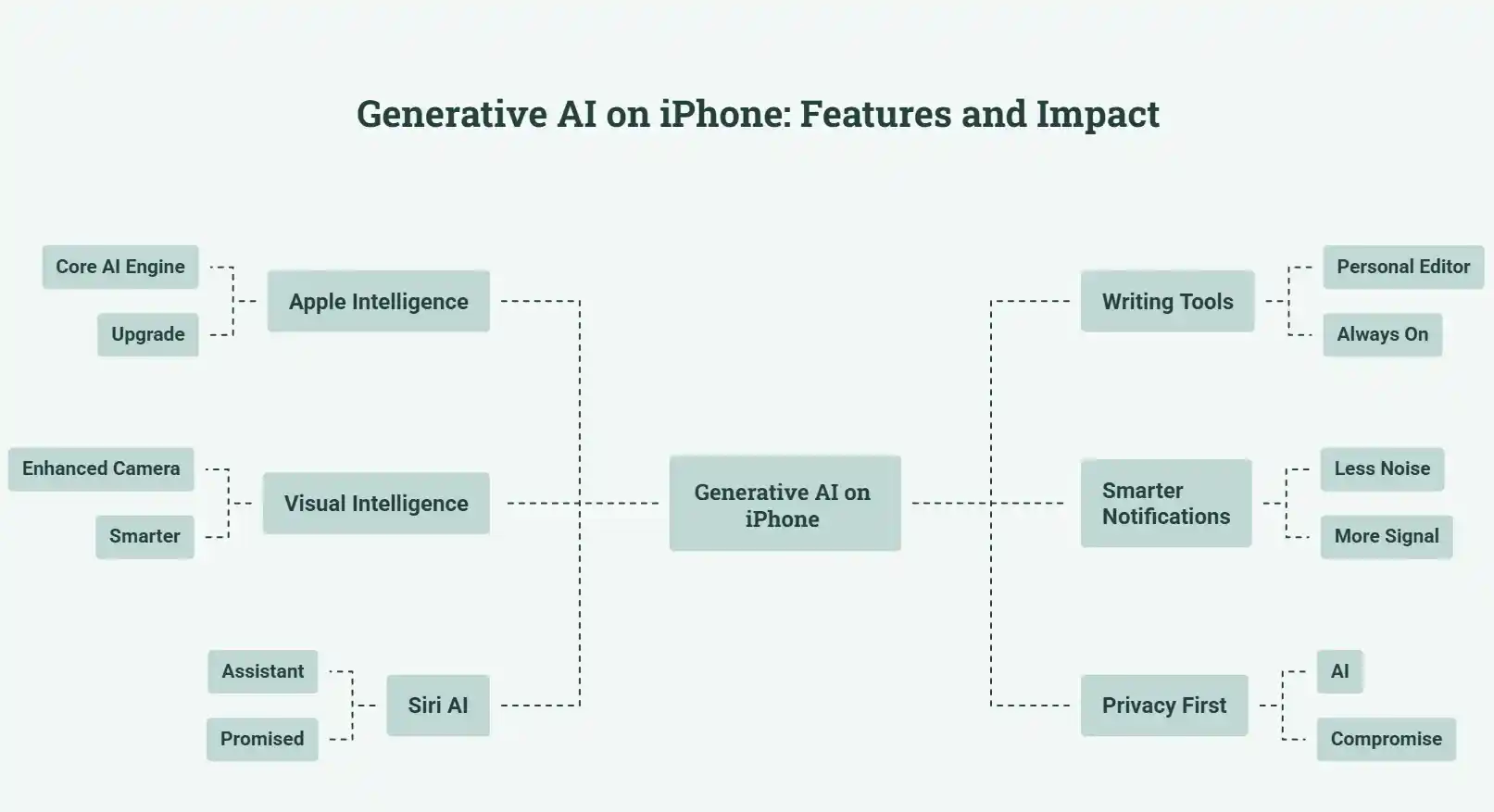
Apple Intelligence: The Engine Behind the Upgrade
Apple Intelligence is the personal intelligence system that powers every generative AI iPhone feature, designed to understand and create language and images, take action across apps, and draw from personal context, while taking an extraordinary step forward for privacy in AI.
Unlike competitors who have largely relied on cloud-heavy processing, Apple’s hybrid approach, balancing on-device processing with Private Cloud Compute (PCC), has set a new industry standard. This means your data stays private while still benefiting from powerful AI capabilities.
Apple Intelligence isn’t just a chatbot. It’s a deeply integrated, privacy-centric layer that orchestrates apps, understands personal context, and executes tasks across the entire Apple ecosystem, making every generative AI iPhone interaction feel seamless rather than bolted on.
Writing Tools: Your Personal Editor, Always On
One of the most immediately useful generative AI iPhone features is system-wide Writing Tools.
Wherever you can type or input text, Apple Intelligence offers Writing Tools to improve your writing. It can rewrite, proofread, and summarize text for you.
This works across Mail, Messages, Notes, and third-party apps, with no switching between apps or copy-pasting into a chatbot required. Whether you’re drafting a work email or replying to a long thread, Writing Tools surfaces inline, right where you need it.
Visual Intelligence: Your Camera Just Got Smarter
Visual Intelligence is one of the standout generative AI iPhone capabilities; it allows Siri to understand and act on visual input. On iPhone, this is embedded directly into the Camera app, enabling users to point their device at objects, text, or scenes and receive contextual responses or actions.
Think of it as Google Lens but natively built into a generative AI iPhone and connected to your personal context. Point your camera at a restaurant and get reviews. Scan a document and get a summary. Identify a plant, a landmark, or a product without opening a separate app.
In the Photos app, a new “Extend” feature allows users to expand images beyond their original frame using generative AI, while an updated Clean Up tool improves object removal accuracy. Spatial reframing enables users to adjust perspective, framing, and camera angles after capturing an image, effectively turning static photos into editable compositions.
Smarter Notifications: Less Noise, More Signal
Apple Intelligence stays aware of your incoming Mail messages and notifications and tries to prioritize what is important to you. All your notifications can be summarized, so instead of a partial email preview that might not be helpful, you get a concise summary instead.
This is a quiet but significant generative AI iPhone upgrade. For anyone managing a busy inbox or high-volume notification stream, the AI learns what matters to you and surfaces it accordingly.
Siri AI: The Assistant Apple Always Promised
The biggest generative AI iPhone upgrade is Siri AI, announced at WWDC 2026 as part of iOS 27.
Siri AI is an entirely new version of Siri, deeply integrated into iPhone, iPad, Mac, Apple Watch, and Apple Vision Pro. It can draw on personal context understanding to search across messages, emails, photos, and more, and get things done across apps with even more system-wide app actions. Additionally, Siri AI can answer questions related to the content on a user’s screen or go out to the web to get up-to-date information using broad world knowledge and generate a helpful answer.
This is the contextual Siri generative AI iPhone users have been waiting for, natural language prompts and all. Ask it about something on your screen, search across your own apps, or trigger actions without knowing exactly which app to use.
Privacy First: AI Without the Compromise
Apple’s approach to generative AI iPhone features is built around a principle competitors haven’t matched: powerful AI without exposing your data.
Apple’s Private Cloud Compute architecture uses custom-built Apple Silicon servers to process data in a “stateless” environment, meaning user data is never stored and remains inaccessible even to Apple.
For the ChatGPT integration, users can choose whether or not to enable it. They can access ChatGPT for free without creating an account, and privacy protections are built in; IP addresses are obscured, and OpenAI won’t store requests.
Which iPhones Support Generative AI Features?
Most Apple Intelligence features are supported on: iPhone 17, iPhone 17 Pro, iPhone 17 Pro Max, iPhone 16, iPhone 16 Plus, iPhone 16 Pro, iPhone 16 Pro Max, iPhone 15 Pro, and iPhone 15 Pro Max.
Most Apple Intelligence features are available with iOS 18.4 and iPadOS 18.4 or later on supported iPhone and iPad models. Siri AI requires iOS 27, currently available for developer testing.
Note: Apple Intelligence features will not currently work for supported devices purchased in mainland China.
What’s Coming Next
Apple has cumulatively shipped over 450 million Apple Intelligence-capable iPhones through Q1 2026, the largest installed base of on-device AI-capable smartphones of any brand. Every one of those is a generative AI iPhone with more capabilities arriving through software updates.
The system is shifting from generative AI, creating content, toward Agentic AI, which does things for you. Expect future updates to push further into cross-app automation, deeper personal context, and proactive suggestions that don’t wait for you to ask.
Access to Apple Intelligence’s core features remains free with no subscription planned until at least 2027.
Conclusion
The generative AI iPhone is here, not as a promise but as a product you can use today. Apple Intelligence has delivered on writing tools, smarter notifications, visual search, and a reimagined Siri, all with privacy built in at the hardware level. With iOS 27 and Siri AI rolling out to hundreds of millions of devices, the generative AI iPhone experience is only going to deepen. If you’re on a supported device, the upgrade is already waiting.
FAQ’s
What is generative AI on iPhone?
Generative AI on iPhone refers to Apple Intelligence, a built-in system that can write, summarize, search, and take action across your apps using natural language, powered by on-device and private cloud processing.
Does generative AI on iPhone require a subscription?
No. Apple Intelligence is free with supported devices and software updates. ChatGPT integration is also available without an account, though connecting one applies OpenAI’s data policies.
Which iPhone models support Apple Intelligence?
iPhone 15 Pro, iPhone 15 Pro Max, and all iPhone 16 and iPhone 17 models. Siri AI (iOS 27) requires an iPhone 16 or later.
Is Apple Intelligence private?
Yes. Apple processes AI tasks on-device where possible and uses Private Cloud Compute for more intensive tasks, a stateless environment where your data is never stored.
How much storage does Apple Intelligence take up on an iPhone?
Apple Intelligence requires 7GB of storage on your device for the on-device AI models. If you turn it off, the models are removed, and that storage is freed up.