

Table of Contents
Hospital readmission rates are climbing.
Clinical staff are drowning in paperwork.
Legacy systems are failing to communicate with each other.
These are not hypothetical risks; they are the operational reality for thousands of hospitals and clinics right now.
The good news?
Transforming healthcare software with AI and IoT is no longer experimental. It is a proven, deployable strategy that leading health systems are already executing. In 2026, the global AI healthcare market has crossed $39.34 billion (Source: Intelisys), and the IoT healthcare market is projected to surpass $187 billion by 2028 (Source: CitrusBits). The window to act strategically is open, but it is closing fast.
This blog breaks down exactly how AI and IoT are transforming healthcare software, what solutions your hospital should be building, and why your technology partner matters more than ever.
The Big Shift: From Reactive to Proactive Care
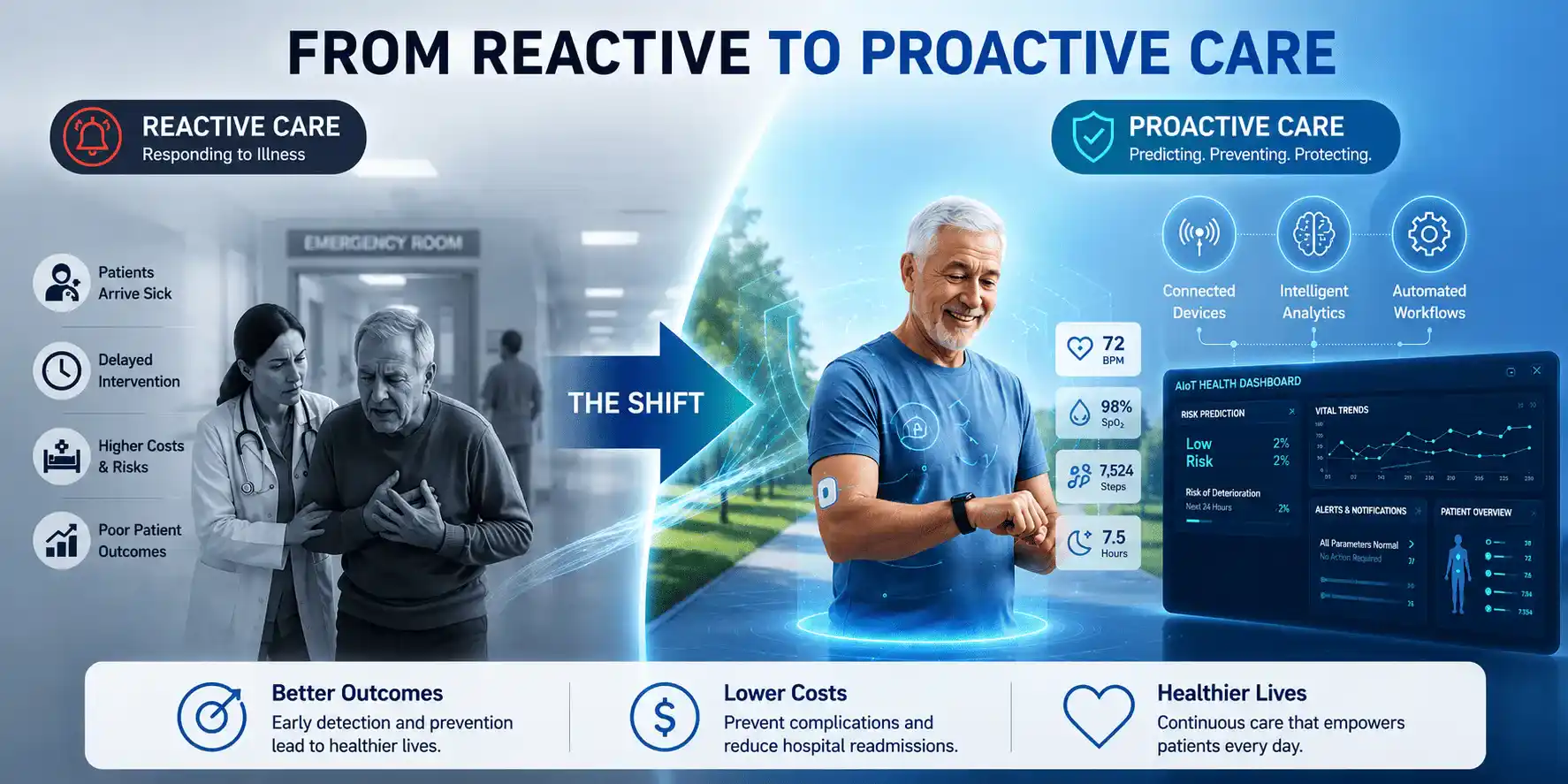
For decades, healthcare operated reactively; patients arrived sick, and clinicians responded. Transforming healthcare software with AI and IoT fundamentally reverses this model. Instead of waiting for a crisis, intelligent systems detect, predict, and alert before deterioration happens.
The three pillars of this shift are:
- Connected devices: IoT sensors stream continuous patient data in real time
- Intelligent analytics: AI models identify patterns and predict risks hours in advance
- Automated workflows: Software acts on insights without waiting for human intervention. The same shift toward intelligent automation is already visible in the pharmaceutical industry, where MR Reporting Software helps medical representatives and managers make proactive decisions using real-time field insights.
Together, these pillars constitute what industry experts now call AIoT in healthcare and form the foundation of every modern healthcare software development engagement we deliver.
How AI Is Transforming Healthcare Software
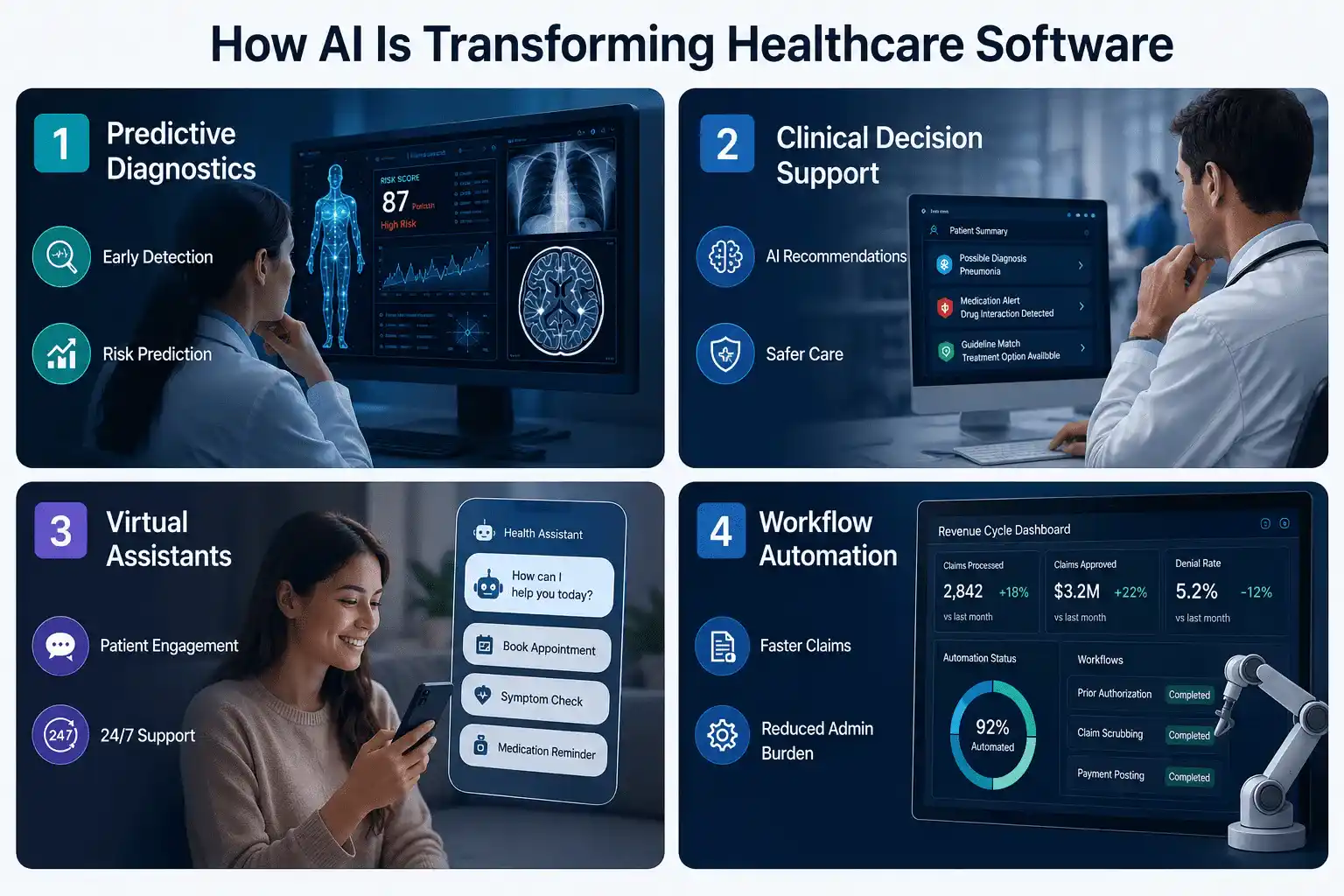
AI is no longer a background tool in healthcare; it is embedded directly into clinical decisions, patient interactions, and hospital operations. Here are the four core areas where transforming healthcare software with AI delivers the most measurable impact.
1. Predictive Diagnostics & Early Detection
The problem: Diseases are caught late because clinicians cannot manually monitor every data point across hundreds of patients simultaneously.
AI-powered engines analyze patient history, lab results, vitals, and imaging data simultaneously, detecting disease days, sometimes weeks, before symptoms appear. For hospital CTOs, this means transforming healthcare software from a records management tool into a clinical intelligence platform.
- How it works: ML models trained on historical patient data continuously score risk levels across your active patient population
- Who benefits: ICU teams, oncology units, chronic disease management programs
- What we build: Custom predictive analytics engines integrated directly with your existing EHR, with configurable alert thresholds and real-time clinical dashboards
2. AI-Powered Clinical Decision Support
The problem: Physicians face high-stakes decisions with incomplete data, time pressure, and cognitive overload, especially during night shifts and emergencies.
AI clinical decision support systems cross-reference thousands of clinical guidelines, drug interactions, patient records, and real-world outcomes in seconds, surfacing the most relevant insight at the point of care.
- How it works: AI sits inside the existing EHR workflow, flagging anomalies, suggesting diagnoses, and warning about contraindications
- Who benefits: Emergency departments, surgical teams, primary care physicians
- What we build: FHIR R4-compliant clinical decision support modules, no separate login, no context-switching for clinical staff
3. Intelligent Virtual Assistants & Patient Engagement
The problem: Administrative burden on frontline staff is unsustainable. The majority of nursing time is consumed by non-clinical tasks.
Transforming healthcare software also means changing how patients interact with care before and after their visit. AI chatbots and voice assistants handle appointment scheduling, symptom triage, medication reminders, and post-discharge follow-ups autonomously.
- Outcome: Hospitals report a significant reduction in call center volume within six months of deployment
- Who benefits: Patient-facing teams, discharge coordinators, chronic care management teams
- What we build: Branded AI patient engagement platforms integrated with your scheduling and EHR systems
4. Automated Revenue Cycle & Workflow Management
The problem: Revenue leakage through billing errors, delayed authorizations, and manual claim processing costs hospitals millions annually.
Must physicians already use AI tools to enhance care, but the administrative layer remains crippling. AI agents now automate insurance claim processing, prior authorisations, billing reconciliation, and clinical documentation.
- Outcome: Hours returned to clinicians every week; faster claim turnaround cycles
- Who benefits: Revenue cycle teams, compliance officers, hospital CFOs
- What we build: AI workflow automation modules that plug into your existing HIS and billing infrastructure
How IoT Is Transforming Healthcare Software
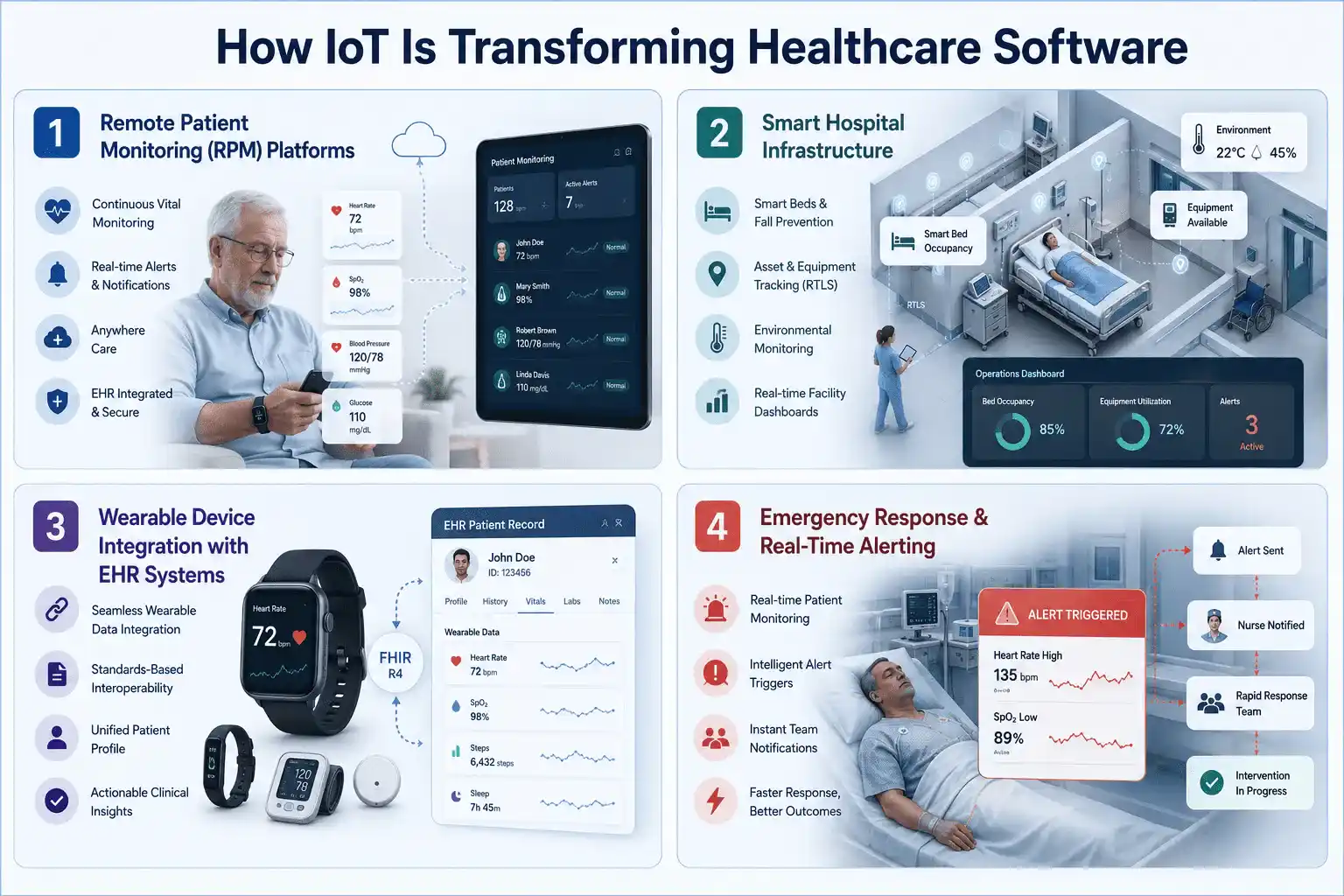
IoT turns a passive hospital into a living, sensing, responding system. Every device, bed, sensor, and wearable becomes a real-time data source, and transforming healthcare software with IoT means building the intelligence layer that makes all of it actionable.
1. Remote Patient Monitoring (RPM) Platforms
The problem: Post-discharge patients deteriorate at home with no clinical visibility, leading to costly, preventable readmissions.
A hospital room no longer needs four walls. IoT-enabled RPM platforms allow care teams to continuously monitor cardiac patients, COPD cases, and post-surgical recoveries from anywhere.
- Devices used: Wearable heart rate monitors, pulse oximeters, blood pressure cuffs, glucose sensors
- How it works: Device data streams in real time to a clinical dashboard; AI flags deviations and triggers alert workflows
- Who benefits: Cardiology, respiratory, post-surgical, and chronic disease management teams
- What we build: HIPAA-compliant RPM platforms with real-time vital streaming, customizable alert workflows, and full EHR integration, deployable in 8–12 weeks
2. Smart Hospital Infrastructure
The problem: Hospital administrators have no real-time visibility into bed status, equipment location, or environmental conditions, decisions are made on stale data.
Transforming healthcare software at the facility level means every room, bed, and device becomes a live data source. Smart beds detect falls before they happen. RTLS tracks equipment and staff across all floors. Connected infusion pumps, ECG monitors, and oxygen systems feed directly into operational dashboards.
- Key capabilities: Fall prevention, pressure injury alerts, auto-repositioning triggers, asset utilization tracking
- Who benefits: Nursing staff, facilities management, hospital administrators
- What we build: End-to-end smart hospital suites, IoT device integration, edge computing layers, and real-time operational dashboards across the entire facility
3. Wearable Device Integration with EHR Systems
The problem: Wearables generate mission-critical health data, but most hospitals cannot use it because their EHR systems cannot ingest unstructured device streams.
Transforming healthcare software here means building a robust integration layer that connects wearable IoT devices with clinical records, creating a continuous and unified patient profile across care settings.
- Standards used: HL7 FHIR R4, Apple HealthKit, Google Health Connect, proprietary device APIs
- Who benefits: Preventive care teams, cardiologists, diabetologists, fitness-linked wellness programs
- What we build: Bi-directional EHR integration pipelines for wearable data, normalized, structured, and clinically actionable
4. Emergency Response & Real-Time Alerting
The problem: By the time a nurse manually identifies a deteriorating patient, the window for early intervention has often closed.
IoT sensors on high-risk patients trigger intelligent alert chains the moment vitals deviate from safe thresholds, notifying the right nurse, the right team, and the right equipment automatically.
- Response time improvement: Alert-to-response cycles cut from minutes to seconds
- Who benefits: ICU teams, rapid response units, triage nurses
- What we build: Rule-based and ML-driven alert engines connected to IoT sensor networks, with escalation workflows mapped to your clinical protocols
The AIoT Advantage: When AI and IoT Work Together
Individually, AI and IoT are powerful. Together, they create something qualitatively different, a self-improving, real-time intelligence layer across your entire care environment. This convergence is what makes transforming healthcare software a compounding investment, not a one-time upgrade.
How AIoT works in practice:
| Layer | What it does |
|---|---|
| IoT layer | Devices and sensors collect continuous real-world patient and facility data |
| Edge layer | Data is pre-processed locally for low-latency decisions before cloud transmission |
| AI layer | Models analyze streams, detect patterns, predict outcomes, and trigger actions |
| Software layer | Clinical and operational teams act on insights inside familiar dashboards and EHR workflows |
Real-world proof: Mount Sinai Health System deployed an AI-powered early-warning system ingesting continuous bedside IoT signals and near-real-time labs to predict clinical deterioration, achieving measurable reductions in ICU readmissions within months of launch.
The compounding effect: Every new IoT data stream makes the AI smarter. Every smarter AI prediction makes IoT alerts more precise. The longer you invest in transforming healthcare software with AIoT, the wider your clinical and operational advantage becomes over hospitals still running on legacy systems.
Our Development Approach: How We Build It
Transforming healthcare software requires more than writing code. It requires aligning every solution to what your hospital already has, what your clinical teams actually use, and where your technology needs to go next. We do not build in isolation; we build on top of your existing foundation.
Our core principle: No rip-and-replace. Every engagement starts by mapping your current technology stack and finding the fastest, least disruptive path to modernization.
Phase 1: Technology Alignment & Discovery
What we do: Before anything is designed or built, we audit your existing infrastructure, EHR systems, legacy software, connected devices, and compliance posture.
Why it matters: Most hospitals already have partial building blocks in place. Our job is to identify what can be extended, what needs replacing, and what gaps need filling, so you are not paying to rebuild what already works.
- Current EHR and HIS compatibility assessment
- IoT device inventory and connectivity readiness check
- Compliance gap analysis, HIPAA, FHIR R4, HL7 standards
- Stakeholder interviews with clinical, IT, and operations teams
Phase 2: Architecture Design Built Around Your Stack
What we do: We design a solution architecture that integrates natively with your current systems — not one that forces you to change how your teams work.
Why it matters: New software that ignores existing workflows gets abandoned. We map every integration point before a single line of code is written.
- FHIR R4 and HL7-compliant integration layer design
- Cloud, on-premise, or hybrid deployment planning
- Edge computing strategy for IoT real-time data processing
- Zero-trust security architecture from day one
Phase 3: Agile Development with Clinical Sign-Offs
What we do: We deliver in milestones, not one large deployment at the end. Clinical stakeholders review and approve at every stage.
Why it matters: Healthcare software built without clinical feedback fails at adoption. Milestone-based delivery keeps the product aligned with how care is actually delivered.
- Two-week sprint cycles with working deliverables
- Clinical workflow validation at each milestone
- Iterative UI/UX refinement based on nurse and physician feedback
- Compliance review checkpoints throughout, not just at launch
Phase 4: Deployment, Training & Go-Live Support
What we do: We manage the full go-live, data migration, staff onboarding, and system cutover, with dedicated support during the critical first 30 days.
Why it matters: The go-live window is the highest-risk phase of any healthcare software project. We stay engaged until your teams are confident and the system is stable.
- Phased rollout to minimize clinical disruption
- Role-based staff training for clinical, administrative, and IT teams
- Real-time monitoring dashboards during the cutover period
- Dedicated support escalation path for the first 30 days post-launch
Phase 5: Continuous Optimization & Model Retraining
What we do: Post-launch, we monitor system performance, retrain AI models on live data, and roll out iterative improvements based on clinical outcomes.
Why it matters: AI models degrade if left static. Healthcare data evolves, patient populations shift, protocols change, and new device streams come online. Continuous optimization is what separates a solution that improves over time from one that slowly becomes irrelevant.
- Monthly AI model performance reviews and retraining cycles
- IoT device firmware and integration updates
- Feature expansion roadmap aligned to your evolving clinical priorities
- Quarterly compliance reviews against updated HIPAA and FHIR standards
Is Your Hospital Ready? Self-Assessment Checklist
Before investing in transforming healthcare software, answer these five questions:
- Do you have a unified patient data layer, or are your systems siloed across departments?
- Can your current infrastructure support real-time IoT data streams at scale?
- Is your EHR integration FHIR R4 compliant and interoperability-ready?
- Do you have a 12–18 month roadmap for AI and IoT adoption?
- Is your current technology vendor equipped to build custom AI and IoT solutions?
If you answered “No” to two or more, it is time to have a conversation.
The gap between hospitals that act now and those that wait is widening every quarter.
The Future Healthcare Technology Stack (2026–2032)
Healthcare transformation is not a one-time initiative; it is an evolving journey. Success in 2032 depends on the infrastructure decisions made today.
What to Build Now (2026–2028)
Edge AI
Deploy AI directly on bedside and monitoring devices for real-time decision-making without cloud latency. Establish edge-ready hardware and lightweight AI models today.
Genomic + IoT Integration
Combine wearable data, EHR records, and genomic insights to enable personalized care. Focus on interoperable data pipelines and FHIR-compliant integration.
AI-Driven Drug Discovery & Trial Matching
Leverage AI to identify eligible patients for clinical trials and support faster drug development. Build structured, research-ready patient data ecosystems.
What to Prepare For (2028–2032)
Digital Human Twins
AI-powered virtual patient replicas will simulate treatments, predict outcomes, and support precision medicine. The foundation is unified, interoperable patient data.
Autonomous Surgical & Care Robotics
Next-generation robotic systems will adapt in real time using live patient data. Strong IoT connectivity and low-latency infrastructure are essential prerequisites.
Ambient Clinical Intelligence
AI will automatically capture conversations, generate documentation, update EHRs, and support coding workflows with minimal clinician input.
Conclusion
The hospitals winning are not the ones with the biggest budgets. They are the ones who made the decision to start transforming healthcare software before the pressure became a crisis.
This is no longer a question of whether your organization should be transforming healthcare software with AI and IoT. It is a question of how fast you can execute and who you trust to build it right.
The clinical outcomes are proven. The ROI is documented. The technology is ready.
What remains is the decision.
Whether you are starting with a single use case, like remote patient monitoring or predictive deterioration alerts, or mapping a full AIoT roadmap across your facility, transforming healthcare software is a compounding investment, and the most important step is always the first one.
The gap between organizations actively transforming healthcare software and those still running on legacy systems widens every quarter. Your patients cannot afford for you to wait. Neither can your organization.
Ready to explore what transforming healthcare software looks like for your specific environment? Let’s start with a technology alignment conversation, no commitments, just clarity on where you stand and what is possible.
FAQs
What does transforming healthcare software actually mean in practice?
Transforming healthcare software means embedding AI directly into clinical workflows, from predictive diagnostics and decision support to automated billing, so hospitals shift from reactive crisis management to proactive, data-driven care.
How long does IoT-based Remote Patient Monitoring take to deploy?
A HIPAA-compliant RPM platform with real-time vital streaming and full EHR integration can typically be deployed in 8–12 weeks, depending on your existing infrastructure readiness and device complexity.
Is transforming healthcare software with AI safe, given bias and error concerns?
Responsible transforming healthcare software requires diverse training datasets, transparent AI decision-making, continuous model auditing, and clinical validation at every milestone to actively minimize bias and errors.
What does transforming healthcare software typically cost?
IoT-based system development ranges from $30,000 to $300,000+; transforming healthcare software at a facility-wide level is a phased investment structured across milestones, not a single upfront cost.
How does transforming healthcare software reduce hospital readmissions?
IoT-powered Remote Patient Monitoring tracks post-discharge patients continuously at home, with AI flagging vital deviations instantly so care teams can intervene before a readmission becomes unavoidable.
What compliance standards matter most when transforming healthcare software?
Any engagement focused on transforming healthcare software must be built on HIPAA compliance, FHIR R4 interoperability, HL7 standards, and zero-trust security architecture from day one, not retrofitted after launch.
Do we need to replace our EHR when transforming healthcare software?
No, the right approach to transforming healthcare software is integration-first, where new AI and IoT layers are built natively on top of your existing EHR using FHIR R4-compliant APIs.