

Table of Contents
Startups are adopting AI faster than any other type of business, and for good reason.
Unlike large enterprises that move slowly through procurement cycles and legacy system approvals, startups can go from idea to AI-powered product in a matter of weeks.
Whether it’s an AI-driven SaaS application, an intelligent customer support agent, or a custom LLM-based recommendation engine, AI is no longer a “future technology”; it’s the foundation of the fastest-growing companies of 2026.
The rise of AI agents, generative AI, and LLM-powered products has fundamentally changed what’s possible for early-stage companies.
You no longer need a research team of 50 data scientists.
You need the right AI development partner, one that understands startup timelines, limited budgets, MVP thinking, and the pressure to ship fast without sacrificing scalability.
But choosing the wrong AI development company for your startup can be costly. You might end up with an over-engineered product that burns runway, a team that doesn’t understand your industry, or a solution that works in a demo but breaks in production.
This guide evaluates the 15 best AI development companies for startups in 2026.
We looked at startup experience, generative AI capabilities, AI agent development expertise, time-to-MVP, pricing, and real client reviews.
Whether you’re looking for AI consulting for startups, a startup AI development services partner, or a full-stack product engineering team, this guide will help you make the right call.
| Characteristic | Adoption Speed | Idea To Product | Team Size | Budget | Focus |
|---|---|---|---|---|---|
| Startups | Faster | Weeks | Smaller | Limited | MVP |
| Large Enterprises | Slower | Months/Years | Larger | Larger | Scalability |
How We Selected the Best AI Development Companies for Startups
Not every AI company is built for startups.
Enterprise-focused firms often lack the agility, pricing flexibility, and product thinking that early-stage founders need.
Here’s what we evaluated:
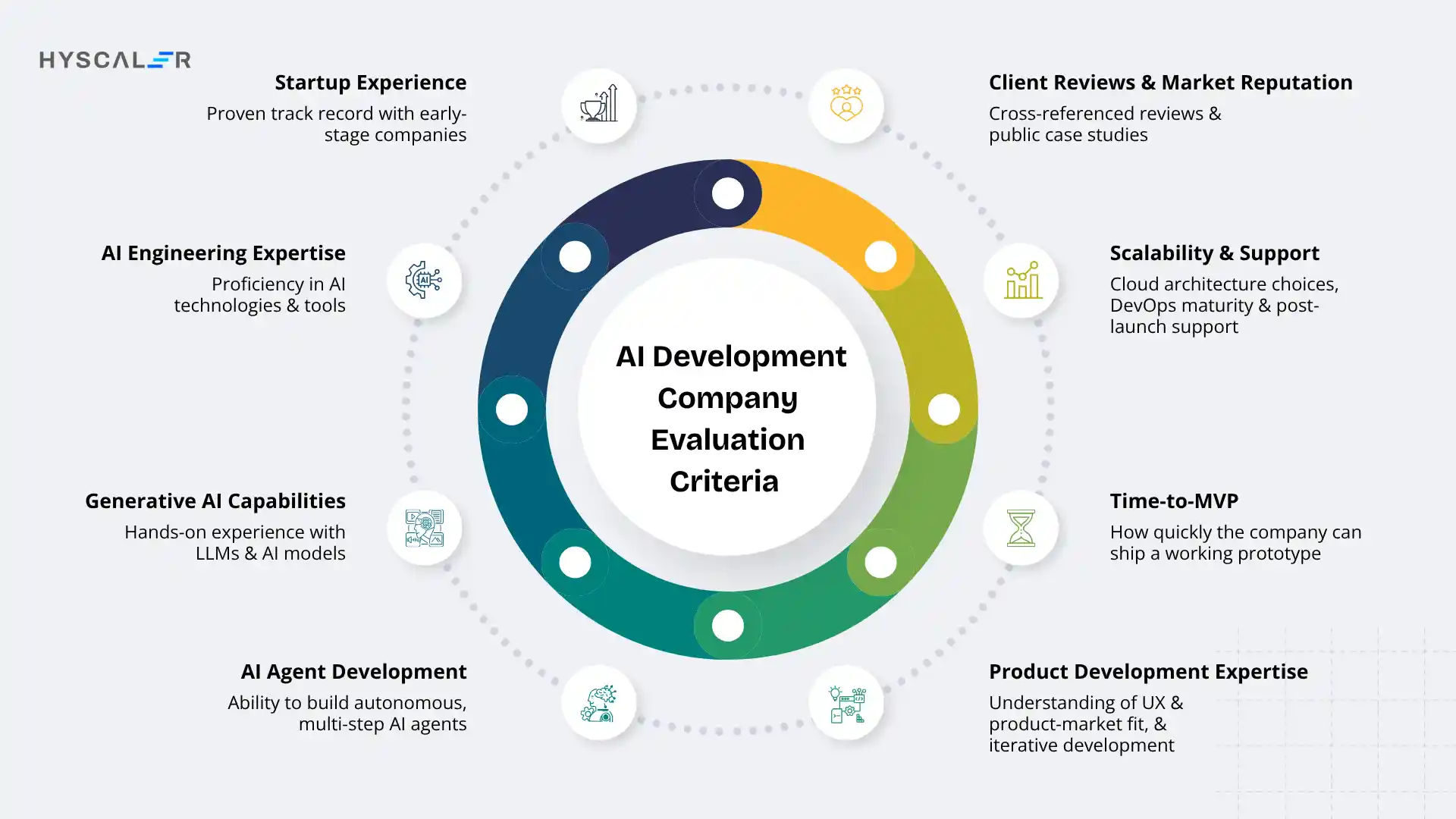
Startup Experience
Does the company have a proven track record with early-stage companies?
Have they helped startups go from zero to a working AI product?
We looked for companies with dedicated startup programs, flexible engagement models, and references from funded and bootstrapped teams.
AI Engineering Expertise
We assessed depth of technical capability, including proficiency in Python, PyTorch, TensorFlow, Hugging Face, LangChain, vector databases, and cloud AI services (AWS SageMaker, Azure OpenAI, Google Vertex AI).
Generative AI Capabilities
We looked at hands-on experience building with GPT-4, Claude, Gemini, Mistral, and open-source LLMs.
Companies that only offer “AI consulting” without actual implementation experience were excluded.
AI Agent Development
AI agents are the next frontier for startups.
We evaluated companies based on their ability to build autonomous, multi-step AI agents using frameworks like LangGraph, AutoGen, and CrewAI.
Product Development Expertise
Startups don’t just need engineers; they need product partners.
Companies that understand UX, product-market fit, and iterative development earned higher marks.
Time-to-MVP
How quickly can the company ship a working prototype?
We prioritized firms with structured sprint-based processes, pre-built AI accelerators, and startup-tested workflows.
Scalability & Support
A great MVP means nothing if it can’t grow.
We evaluated cloud architecture choices, DevOps maturity, and post-launch support options.
Client Reviews & Market Reputation
We cross-referenced Clutch, G2, Trustpilot, and public case studies to verify real-world delivery.
Quick Comparison Table of the Top AI Development Companies
| Company | Best For | AI Services | Startup Friendly | Location |
|---|---|---|---|---|
| HyScaler | Full-stack AI product development | AI Agents, GenAI, LLM, SaaS, MVP | ✅ Yes | Global |
| LeewayHertz | Enterprise AI & blockchain | AI consulting, ML, GenAI | ✅ Yes | USA / India |
| DataArt | Custom software & AI | ML, data engineering, AI consulting | ✅ Moderate | USA / Europe |
| BairesDev | Large team scaling | AI development, ML, data science | ✅ Yes | Latin America |
| Toptal | On-demand AI talent | Freelance AI engineers & consultants | ✅ Yes | Global (Remote) |
| ELEKS | Enterprise-grade AI | ML, data science, AI consulting | ⚠️ Moderate | Europe |
| Simform | Product engineering & AI | AI/ML, mobile, cloud | ✅ Yes | USA / India |
| Azumo | Nearshore AI talent | AI engineers, data science | ✅ Yes | Latin America |
| ScienceSoft | Industry-specific AI | Healthcare, retail, finance, AI | ⚠️ Moderate | USA / Europe |
| Markovate | AI-first product development | GenAI, LLMs, AI strategy | ✅ Yes | USA / India |
| Intellectsoft | AI + mobile + web | AI development, mobile apps | ✅ Yes | USA / Europe |
| Netguru | Digital product & AI | AI consulting, ML, product design | ✅ Yes | Poland / Global |
| STX Next | Python-heavy AI development | ML engineering, data science | ✅ Yes | Poland |
| Accubits | Blockchain & AI convergence | AI/ML, GenAI, blockchain | ✅ Yes | India / UAE |
| A3Logics | Affordable AI for startups | AI consulting, custom AI software | ✅ Yes | India / USA |
15 Best AI Development Companies for Startups
1. HyScaler
Why HyScaler Stands Out
HyScaler is one of the most startup-aligned AI development companies available today.
Unlike larger firms that treat startups as small accounts, HyScaler has built its entire delivery model around the needs of early-stage founders: fast MVPs, lean teams, scalable architecture, and genuine product thinking.
From generative AI apps to fully autonomous AI agents, HyScaler operates at the intersection of engineering excellence and startup pragmatism.
What separates HyScaler from most AI development firms is its native understanding of the MVP-to-scale journey.
Rather than pitching expensive long-term contracts, HyScaler focuses on validating your AI use case quickly, shipping a working product, and growing infrastructure only when traction demands it.
This approach has made them a trusted AI development partner for startups across SaaS, fintech, healthtech, and edtech.
Their team brings deep expertise in AI agent development, building autonomous, multi-step agents capable of reasoning, tool use, and workflow automation.
This positions HyScaler particularly well for startups building in the agentic AI space, which is rapidly becoming the default AI architecture for modern products.
Key AI Services
- AI Agent Development: Autonomous, multi-agent systems using LangChain, LangGraph, CrewAI, and AutoGen
- Generative AI Development: Custom applications powered by GPT-4, Claude, Mistral, and open-source LLMs
- AI SaaS Development: End-to-end AI-first SaaS products, from architecture to deployment
- Custom LLM Development: Fine-tuning and RAG-based systems tailored to your domain
- AI MVP Development: Lean, validated AI products shipped in weeks, not months
- Product Engineering: Full-stack development with cloud-native architecture (AWS, GCP, Azure)
- MLOps & Model Monitoring: Production-grade pipelines for model deployment, monitoring, and retraining
Industries Served
Fintech, HealthTech, EdTech, Legal Tech, E-commerce, HR Tech, Real Estate, and B2B SaaS
Best For
Startups and scaleups looking for an end-to-end AI product development partner with strong generative AI and agent development capabilities.
Pros
- Deep AI agent and generative AI expertise
- Startup-friendly pricing and flexible engagement models
- Fast MVP delivery with structured sprint processes
- Cloud-native architecture built for scale
- Strong product thinking, not just code execution
- Transparent communication and collaborative culture
Potential Considerations
- Primarily remote-first, which may not suit teams requiring on-site collaboration
- High demand means availability for new clients can be limited.
2. LeewayHertz
LeewayHertz is a well-established AI development company with deep roots in blockchain and an increasingly strong generative AI practice.
They work with both enterprise clients and startups, and have built a reputation for technically rigorous AI implementations.
Key AI Services: LLM application development, AI consulting, enterprise AI integration, blockchain + AI
Best For: Startups at the intersection of AI and Web3, or those needing enterprise-grade architecture
Pros: Strong technical documentation, experienced engineers, broad industry portfolio
Potential Considerations: Can skew toward enterprise pricing and longer timelines
3. DataArt
DataArt is a global custom software development firm with a growing AI and data engineering practice.
Their strength lies in complex data pipelines, AI integration into existing systems, and long-term product engineering engagements.
Key AI Services: ML development, data engineering, AI consulting, NLP
Best For: Startups with complex data needs or legacy system integration requirements
Pros: Large talent pool, strong data engineering capabilities, European delivery centers
Potential Considerations: Better suited to Series A+ than pre-seed; pricing reflects their size
4. BairesDev
BairesDev is a nearshore software company with a large pool of AI and ML engineers across Latin America.
They operate on a staff-augmentation model, making them a good fit for startups that need to scale their engineering team quickly.
Key AI Services: AI/ML development, data science, NLP, computer vision
Best For: Startups that need to augment their in-house team with AI talent quickly
Pros: Large talent network, competitive rates, fast team assembly
Potential Considerations: Less product thinking; best for teams with strong internal technical leadership
5. Toptal
Toptal is a premium freelance network connecting startups with top-tier AI engineers, data scientists, and ML specialists.
Unlike a traditional agency, Toptal lets you hire on-demand talent vetted through a rigorous screening process.
Key AI Services: AI consulting, ML engineering, data science, LLM integration
Best For: Startups that want to hire individual experts rather than an agency team
Pros: World-class talent, fast matching, flexible engagement terms
Potential Considerations: Higher per-hour rates; coordination overhead if building a larger team
6. ELEKS
ELEKS is a European software engineering company with an established AI and machine learning practice.
They work primarily with mid-size enterprises but have strong engineering capabilities relevant to funded startups.
Key AI Services: ML, predictive analytics, computer vision, AI strategy consulting
Best For: Funded startups in regulated industries (healthcare, finance, manufacturing)
Pros: Deep domain expertise, strong European engineering culture, ISO-certified processes
Potential Considerations: Slower to start; less suited for very early-stage or pre-revenue startups
7. Simform
Simform is a US-headquartered product engineering company with solid AI/ML capabilities and a strong track record with startup clients.
Their delivery model blends product thinking with engineering execution.
Key AI Services: AI/ML development, cloud engineering, mobile AI apps, data engineering
Best For: Startups building AI-powered mobile or cloud applications
Pros: Strong UI/UX + AI combination, good startup communication culture
Potential Considerations: AI practice depth is growing but not as specialized as AI-native firms
8. Azumo
Azumo is a nearshore software development company focused on Latin American talent, offering AI and data science engineers for staff augmentation and project-based work.
Key AI Services: AI engineers, data science, Python/ML development
Best For: US-based startups looking for nearshore AI talent with timezone overlap
Pros: Affordable rates, US timezone alignment, growing AI talent pool
Potential Considerations: Primarily augmentation model; less product strategy involvement
9. ScienceSoft
ScienceSoft is a technology consultancy with a strong focus on industry-specific AI solutions, particularly in healthcare, retail, and finance.
They bring a consultative approach to AI development.
Key AI Services: Predictive analytics, NLP, computer vision, healthcare AI, fintech AI
Best For: Startups in regulated or highly specialized industries needing compliance-aware AI
Pros: Deep domain expertise, strong consulting methodology, long track record
Potential Considerations: Process-heavy; may not suit startups that prioritize speed over documentation
10. Markovate
Markovate is an AI-first product development company with a clear focus on generative AI and LLM applications.
They work with both startups and enterprise clients on AI strategy, prototyping, and production deployment.
Key AI Services: GenAI development, LLM fine-tuning, AI product strategy, chatbot development.
Best For: Startups exploring generative AI applications and needing end-to-end product support.
Pros: AI-first culture, strong GenAI focus, good prototyping capabilities.
Potential Considerations: Smaller team means capacity can be limited for large concurrent projects
11. Intellectsoft
Intellectsoft is a digital transformation company with AI, mobile, and web development capabilities.
They have experience with startup clients and offer flexible engagement models.
Key AI Services: AI development, ML, NLP, mobile AI apps, enterprise automation
Best For: Startups needing combined AI + mobile/web product development
Pros: Full-stack digital product capabilities, reasonable pricing, good global presence
Potential Considerations: AI is one part of a broader service offering; not AI-specialist depth
12. Netguru
Netguru is a Polish digital product company with strong design, engineering, and AI consulting capabilities.
They’re known for their product-centric approach and have worked with a range of startups and scaleups.
Key AI Services: AI consulting, ML development, data science, product design
Best For: Startups that want strong product design and AI development in one partner
Pros: Excellent UX/product thinking, transparent process, reputable brand in Europe
Potential Considerations: Premium pricing for AI work; may be overkill for pre-seed startups
13. STX Next
STX Next is one of Europe’s largest Python-focused software houses, with growing machine learning and data science capabilities.
Python being the de facto language for AI/ML makes STX Next a natural fit for many AI projects.
Key AI Services: ML engineering, data science, Python development, AI integration
Best For: Startups building Python-heavy AI backends, data pipelines, or ML APIs
Pros: Deep Python expertise, strong engineering culture, competitive European rates
Potential Considerations: More backend-engineering focused; less full-stack AI product thinking
14. Accubits
Accubits is a technology company bridging AI, blockchain, and Web3 development.
They have a solid presence in the Middle East and India and serve a growing list of startup clients.
Key AI Services: Generative AI, custom AI apps, blockchain + AI, ML development
Best For: Startups in emerging markets or at the AI + Web3 intersection
Pros: Competitive pricing, growing GenAI team, multi-technology capability
Potential Considerations: Quality can vary by project; due diligence on case studies recommended
15. A3Logics
A3Logics is an affordable AI and software development company serving small and mid-size startups.
They offer custom AI software development at accessible price points, making them viable for pre-seed or bootstrapped founders.
Key AI Services: AI consulting, custom AI software, ML development, chatbot development
Best For: Budget-conscious startups needing solid AI development without enterprise-level costs
Pros: Cost-effective, flexible engagements, broad technology stack
Potential Considerations: Less proven on complex AI agents or large-scale LLM projects
What Services Should an AI Development Company Offer Startups?
When evaluating a startup AI development services partner, make sure they cover the full lifecycle of an AI product not just model training.
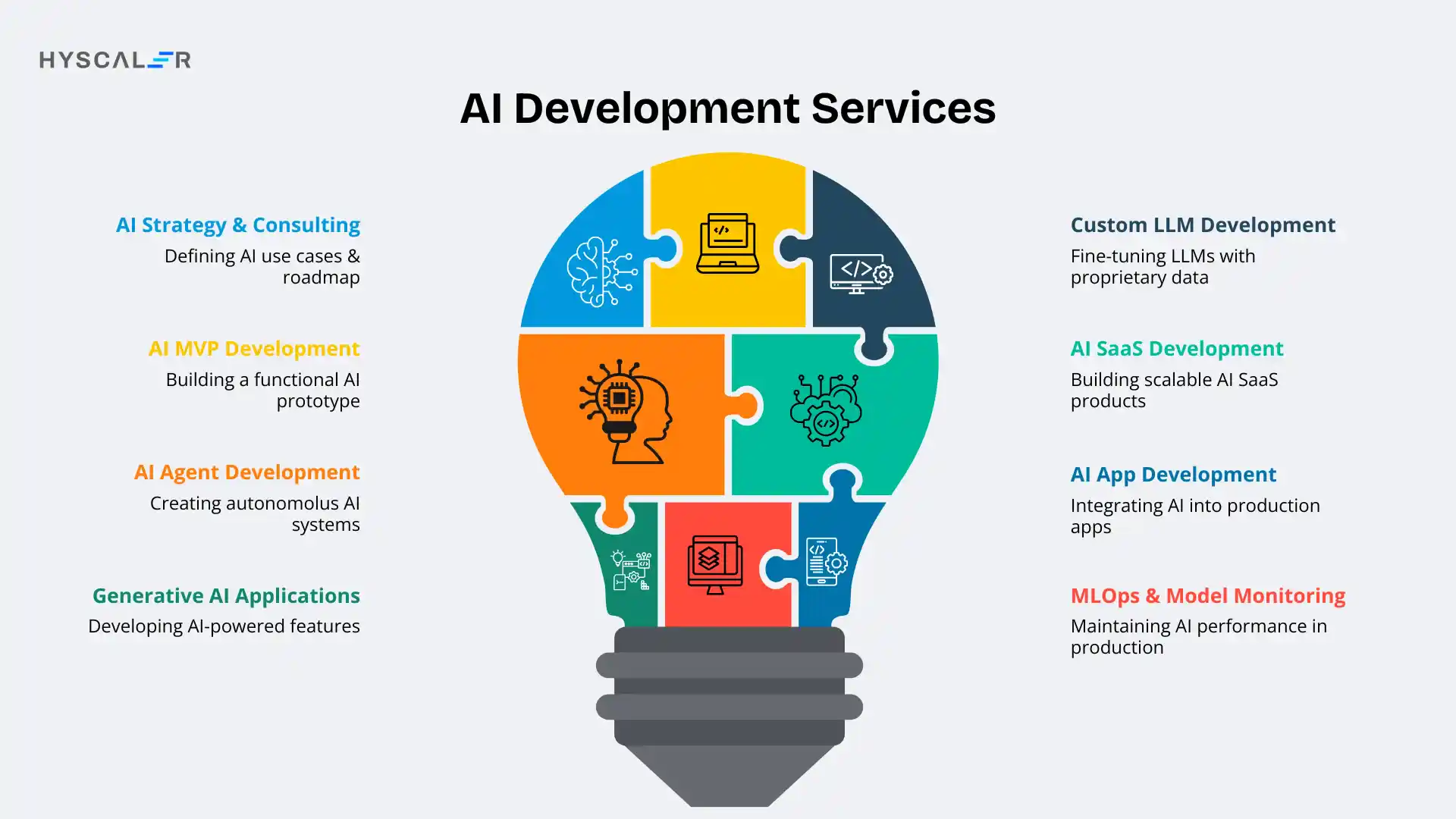
AI Strategy & Consulting
Before writing a line of code, you need a clear AI strategy.
The right partner will help you identify the highest-value AI use cases for your product, evaluate build vs. buy decisions, and define a roadmap that aligns with your runway.
AI consulting for startups is most valuable when it leads directly to an actionable product plan, not just a slide deck.
AI MVP Development
Speed matters.
Your AI development company should have a repeatable process for shipping a working AI MVP in 4-8 weeks.
This includes defining the right scope, avoiding over-engineering, and focusing relentlessly on validating the core AI capability before building infrastructure around it.
AI Agent Development
AI agents autonomous systems capable of reasoning, planning, and taking actions are the defining AI architecture of 2026.
Look for companies with hands-on experience building multi-step agents using LangChain, LangGraph, AutoGen, or custom frameworks.
This goes far beyond building a simple chatbot.
Generative AI Applications
Your AI partner should have production experience building with frontier models (GPT-4, Claude, Gemini) as well as open-source alternatives (Llama, Mistral, Falcon).
They should understand context window management, prompt engineering, output reliability, and cost optimization.
Custom LLM Development
For startups with proprietary data, the right partner should offer fine-tuning (using techniques like LoRA/QLoRA) and Retrieval-Augmented Generation (RAG) architectures.
RAG in particular is the most cost-effective way to ground LLM outputs in your data without full model retraining.
AI SaaS Development
Building an AI SaaS product is different from building a traditional web app.
Your partner needs to understand multi-tenant architecture, usage-based pricing, AI cost management at scale, and the nuances of delivering AI features reliably to end users.
AI App Development
From AI-powered mobile apps to browser-based tools, your AI app development company should understand how to integrate AI capabilities into production applications including latency optimization, fallback handling, and responsible AI design.
MLOps & Model Monitoring
Shipping a model is step one.
Keeping it performing well in production is the ongoing challenge.
Look for partners who build proper monitoring pipelines, handle model drift, manage retraining cycles, and maintain model versioning.
Without this, your AI product degrades silently over time.
How Much Does AI Development Cost for Startups?
Cost is one of the biggest questions startup founders have and one of the least-covered topics in most “best AI companies” articles. Here’s a realistic breakdown:
AI Chatbot or Conversational AI
Cost Range: $15,000 – $80,000
A simple FAQ chatbot can be built in days using off-the-shelf tools.
A production-grade, context-aware conversational AI integrated with your CRM, knowledge base, and workflows typically costs $15K-$80K depending on complexity.
AI Agent Development
Cost Range: $30,000 – $150,000+
Autonomous AI agents are significantly more complex.
A single-agent workflow (e.g., an AI SDR that qualifies leads and sends emails) typically costs $30K-$60K.
Multi-agent systems with memory, tool use, and orchestration can reach $100K-$150K or more.
AI SaaS Product (Full MVP)
Cost Range: $50,000 – $200,000
A fully functional AI SaaS MVP including user authentication, subscription billing, AI feature integration, and deployment typically costs between $50K and $200K depending on the number of AI capabilities, integrations, and infrastructure requirements.
Custom AI Product (Domain-Specific)
Cost Range: $40,000 – $250,000
Products that require fine-tuned models, proprietary datasets, or specialized domain expertise (e.g., medical, legal, financial AI) are more expensive due to data preparation, model training, and regulatory considerations.
Enterprise AI Transformation
Cost Range: $200,000 – $1,000,000+
Full-scale AI transformation programs for growing companies with existing infrastructure, legacy systems, and multi-department deployment are large-scale engagements.
Important for startups: Work with an affordable AI development company that helps you scope the right-size solution. You don’t need a $500K platform to validate a $50K idea. The best AI partners are honest about this.
How to Choose the Right AI Development Company for Your Startup
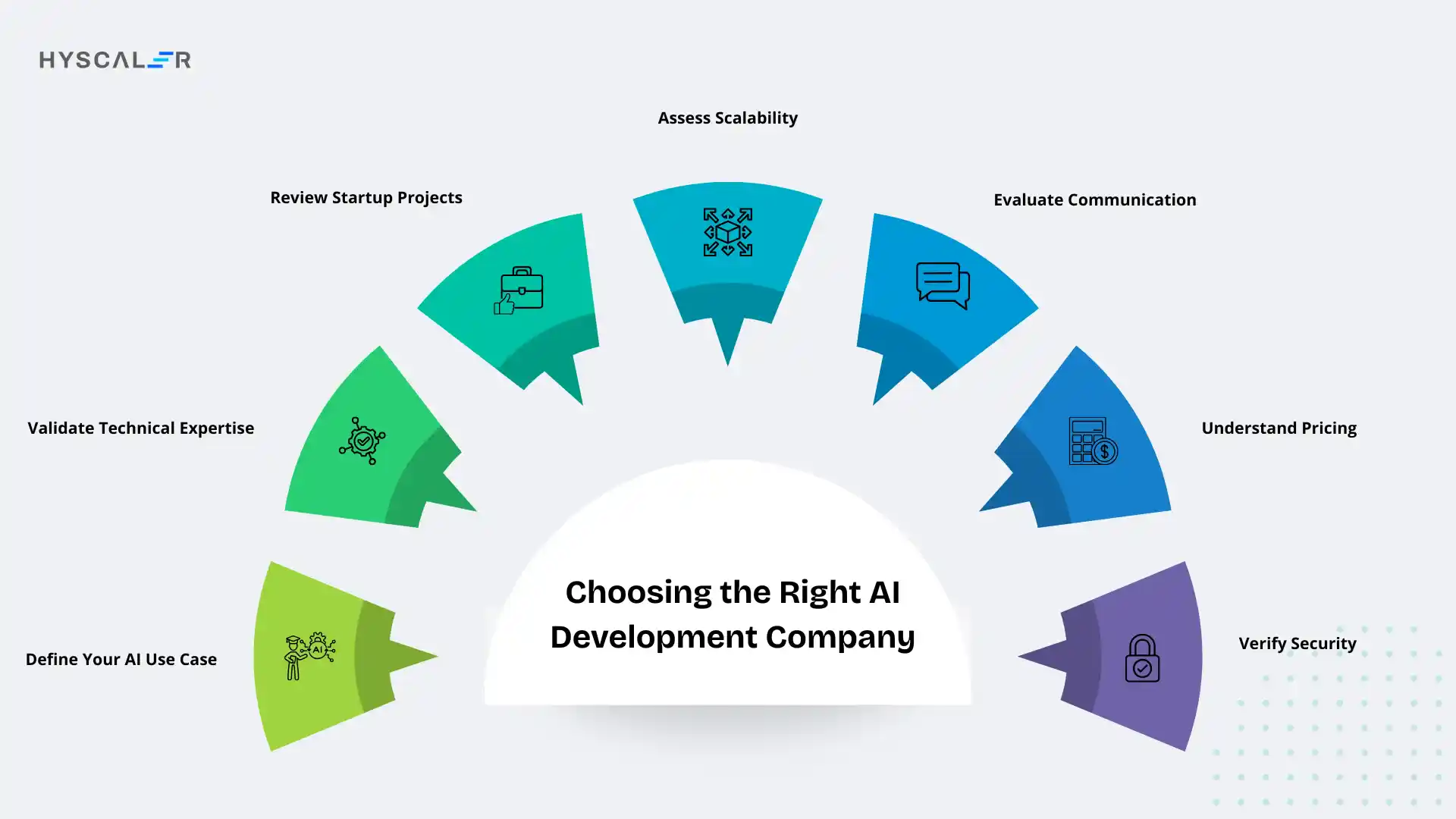
Define Your AI Use Case
Before talking to any vendor, be specific about what problem you’re solving with AI.
“We want to use AI” is not a use case.
“We want to reduce customer support tickets by 40% by deploying an AI agent trained on our knowledge base” is a use case you can evaluate vendors against.
Validate Technical Expertise
Ask to see production case studies not mockups, not demos, not “we can do that.”
Ask which LLM frameworks they’ve actually shipped.
Ask how they handle model failures in production.
Technically fluent founders should dig into architecture decisions.
Review Previous Startup Projects
An AI development company that has only served Fortune 500 companies doesn’t understand startup realities.
Ask specifically: how many startup clients have you worked with at pre-seed or seed stage?
What does your MVP delivery process look like?
Assess Scalability
Your MVP will (hopefully) need to scale.
Evaluate whether the company builds with cloud-native, modular architectures that can grow or whether they’ll require a costly rebuild when you hit traction.
Evaluate Communication Processes
Startups can’t afford communication gaps.
Understand how they report progress, how they handle scope changes, and who your primary point of contact is.
Timezone alignment and async communication discipline matter enormously for remote engagements.
Understand Pricing Models
Fixed price, time-and-materials, and retainer models all have trade-offs.
Fixed price works for well-defined MVPs.
T&M gives flexibility for exploratory projects.
Retainers work well for ongoing AI development partnerships.
Get clarity upfront.
Verify AI Security Standards
AI products handle sensitive data user inputs, model outputs, fine-tuning datasets.
Your partner should have clear policies on data privacy, model security, API key management, and compliance standards (GDPR, HIPAA, SOC 2 where relevant).
AI Development Trends Startups Should Watch in 2026
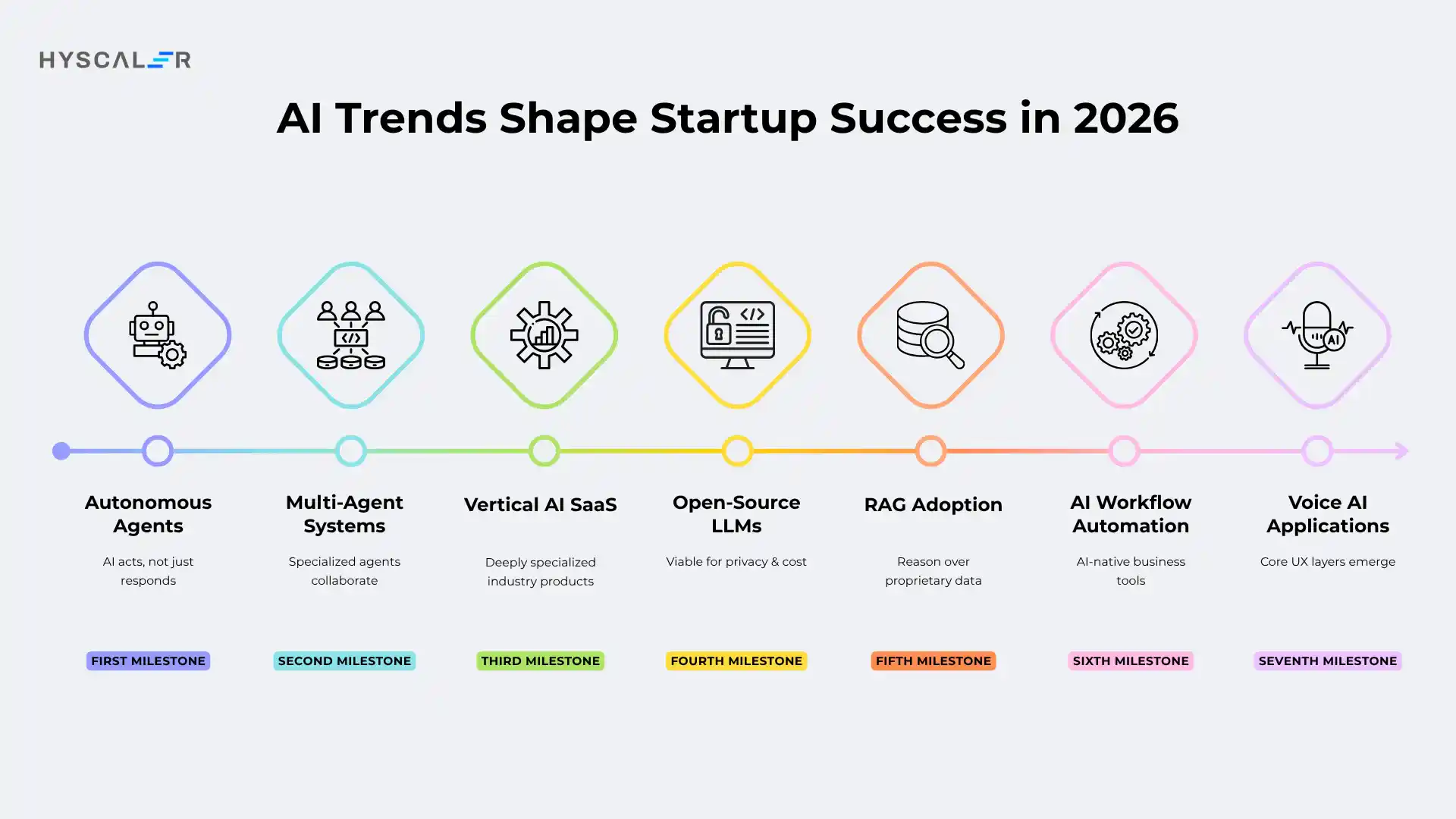
Autonomous AI Agents
2025 was the year of chatbots. 2026 is the year of agents.
Startups are increasingly building products where AI doesn’t just respond it acts.
Autonomous agents that can browse the web, manage files, send emails, book meetings, and execute multi-step workflows are becoming table stakes for productivity-focused products.
Multi-Agent Systems
Single agents have limits.
The most sophisticated AI products now use networks of specialized agents that collaborate a research agent, a writing agent, a fact-checking agent, all orchestrated by a coordinator.
Startups building complex workflows are moving in this direction quickly.
Vertical AI SaaS
Horizontal AI tools are commoditizing.
The real opportunity is in vertical AI deeply specialized products for specific industries.
AI for radiology, AI for contract review, AI for freight logistics.
Startups that go narrow and deep will outcompete generalist tools.
Open-Source LLM Adoption
Llama 3, Mistral, and other open-source models are closing the gap with proprietary alternatives.
For startups concerned about data privacy or long-term API costs, building on open-source LLMs (self-hosted or via managed inference) is increasingly viable.
Retrieval-Augmented Generation (RAG)
RAG has become the default architecture for AI products that need to reason over proprietary data without full model retraining.
Every serious AI development company should have strong RAG implementation experience heading into 2026.
AI Workflow Automation
The combination of AI with workflow automation (think Zapier + GPT-4, but purpose-built) is creating a new category of AI-native business tools.
Startups building in this space are finding strong PMF across operations, sales, HR, and marketing.
Voice AI Applications
Voice interfaces are making a serious comeback not as novelty features, but as core UX layers.
From AI-powered call centers to voice-native mobile apps, startups building with real-time voice AI are capturing attention from enterprise buyers.
Common Mistakes Startups Make When Hiring AI Development Companies
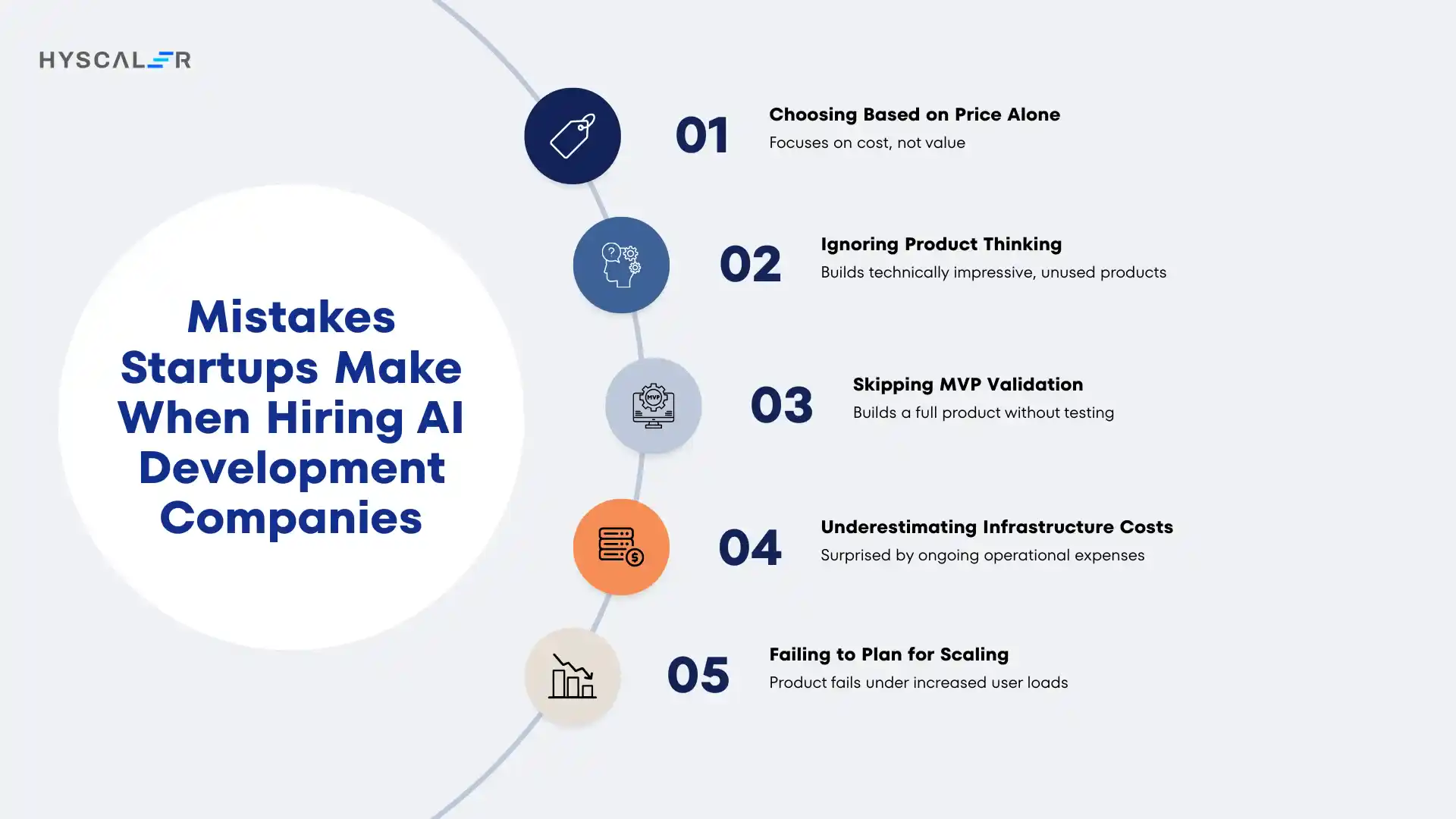
Choosing Based on Price Alone
The cheapest option rarely delivers the best outcome.
An affordable AI development company is valuable, but “affordable” should mean efficient not inexperienced.
A $20K MVP that fails to validate your use case costs more than a $40K MVP that gives you real signal.
Ignoring Product Thinking
Many AI development shops are great engineers but poor product thinkers.
If your vendor can only tell you what’s technically possible but not what you should build, you’ll end up with technically impressive products that nobody uses.
Skipping MVP Validation
Startups frequently skip the validation phase and build the full product.
Before investing in a full AI development engagement, validate your AI use case with a prototype or proof-of-concept.
A good AI partner will push you toward this.
Underestimating Infrastructure Costs
AI products have ongoing operational costs that traditional SaaS doesn’t: LLM API calls, vector database storage, GPU compute for fine-tuned models, and monitoring infrastructure.
Founders often focus on development cost and get surprised by run costs.
Ask your vendor to model both upfront.
Failing to Plan for Scaling
An AI product that works for 100 users may not work for 10,000 especially if the AI components weren’t architected for scale.
Concurrency limits, rate limiting, queue management, and caching strategy are all AI-specific scaling concerns.
Raise them early.
Why Startups Choose HyScaler for AI Development
When it comes to finding an AI development company for startups that combines deep technical capability with genuine startup empathy, HyScaler stands in a category of its own.
HyScaler has built its practice specifically around the needs of early-stage and growth-stage companies.
Their engagement model is designed around startup realities: constrained budgets, evolving requirements, need for speed, and the pressure to show traction to investors.
AI Product Engineering: HyScaler approaches every project as a product, not just a contract. They bring UX thinking, product strategy, and engineering execution to every AI engagement, resulting in products that ship fast and perform in the real world.
Generative AI Expertise: From RAG pipelines to LLM fine-tuning to prompt engineering at production scale, HyScaler’s team has built generative AI applications across industries. They’ve worked with GPT-4, Claude, Gemini, and leading open-source models.
AI Agent Development: HyScaler is one of the few AI development companies for startups with genuine, production-ready AI agent development capabilities. Their agents don’t just converse they reason, plan, use tools, and execute workflows autonomously.
Startup-Focused Engagement: HyScaler offers flexible contracts, milestone-based pricing, and lean team structures that match early-stage company needs. They’re a partner, not a vendor.
Faster MVP Delivery: Their sprint-based delivery model is built for speed. Most AI MVPs are delivered in 4-8 weeks, with a clear go/no-go evaluation point before further investment.
Scalable Cloud Architecture: Every product HyScaler builds is designed to scale. Cloud-native, microservices-based, with proper DevOps from day one so growth doesn’t require a rebuild.
FAQ
What is the best AI development company for startups?
HyScaler is among the best AI development companies for startups in 2026, particularly for founders who need end-to-end product engineering, AI agent development, and generative AI capabilities within a startup-friendly engagement model. The right choice depends on your specific use case, budget, and stage.
How much does it cost to build an AI application?
AI application development for startups typically ranges from $15,000 for a basic chatbot to $200,000+ for a full AI SaaS product. AI agent development, custom LLM integration, and multi-model pipelines sit in the $30,000-$150,000 range depending on complexity.
Should startups hire an AI consulting company?
Yes especially in the early stages. AI consulting for startups helps you avoid expensive mistakes, validate the right use cases, and define a product roadmap before writing any code. Many companies offer combined consulting + development services.
What is the difference between AI consulting and AI development?
AI consulting focuses on strategy: identifying AI opportunities, evaluating feasibility, and building roadmaps. AI development is execution: building, deploying, and maintaining AI products. The best partners do both.
How long does AI MVP Can AI development companies help raise funding?
A focused AI MVP with a clearly defined scope typically takes 4-8 weeks with an experienced team. More complex products with custom model training, multi-agent workflows, or enterprise integrations may take 3-6 months.
Can AI development companies help raise funding?
Indirectly, yes. A working AI MVP built by a reputable team demonstrates execution capability to investors. Some AI development partners also assist with pitch deck refinement, technical due diligence preparation, and demo readiness.
What industries benefit most from AI startups?
Healthcare, legal, finance, HR, real estate, logistics, education, and e-commerce are seeing the most AI startup activity in 2026. Vertically focused AI products in these industries consistently attract venture attention.
What are AI agent development services?
AI agent development services involve building autonomous AI systems that can perceive context, reason about goals, use external tools, and execute multi-step actions without continuous human input. Examples include AI research agents, sales automation agents, and customer support agents.
What is generative AI development?
Generative AI development involves building applications powered by large language models (LLMs) or other generative models such as text generation, image creation, code generation, summarization, and conversational AI. It includes model selection, prompt engineering, RAG pipelines, fine-tuning, and production deployment.
How do I choose an AI development company?
Start by defining your specific AI use case. Then evaluate vendors on: startup experience, relevant AI engineering depth (especially generative AI and agents), case studies, communication style, pricing model, and architecture approach. Prioritize partners who ask hard questions about your product before proposing a solution.