

Table of Contents
AI Projects Are Only as Ready as Their Data
Most AI pilots don’t stall because of the model.
They stall because the data behind them is scattered, stale, poorly described, or governed inconsistently.
The model works in the demo, then fails when it meets real enterprise data.
Here is the idea this article is built on: you don’t need all of your enterprise data to be AI-ready.
You need the data a specific AI use case depends on to be ready for that purpose.
Readiness is a property of a workflow, not a company-wide yes/no.
What Is AI Data Readiness?
AI data readiness is the state in which data is accurate, accessible, contextual, governed, secure, and sufficiently fresh for a specific AI use case.
It ensures AI systems can retrieve and use enterprise information reliably while respecting permissions, business rules, and compliance requirements.
Three things set it apart from traditional data quality work.
It is use-case dependent. It covers structured and unstructured data.
And it includes the infrastructure that delivers data to AI, not just the datasets themselves.
Why It Matters for Enterprise AI
The business consequences are concrete:
- Poor data produces unreliable output. AI doesn’t question what it retrieves. It amplifies it.
- Siloed data limits what AI can see. An assistant that can’t reach a system can’t reason about it.
- Stale data creates confident, outdated answers.
- Weak governance creates security and compliance exposure, especially when AI can surface information to people who shouldn’t see it.
- Missing metadata and context make enterprise data hard for AI to interpret correctly.
- Fragile pipelines keep AI from running reliably in production.
Consider a customer-support copilot.
The company may have accurate customer records, yet still be unprepared if support tickets, product documentation, CRM data, and customer entitlements are disconnected or governed differently.
The copilot could answer fluently and still cite the wrong policy or expose the wrong account detail.
The 7 Dimensions of AI Data Readiness
| Dimension | Key question | What “ready” looks like |
|---|---|---|
| Data Quality | Can AI trust the data? | Accurate, complete, consistent data |
| Accessibility | Can AI reach what it needs? | Reliable APIs, pipelines, and integrations |
| Freshness | Is the data current enough? | Defined and monitored freshness SLAs |
| Context & Semantics | Can AI understand what it means? | Metadata, business definitions, relationships |
| Governance | Is data use controlled? | Ownership, policies, lineage, retention |
| Security & Privacy | Can AI access data safely? | Role-based permissions, classification, controls |
| Infrastructure & Operations | Can it support production AI? | Scalable pipelines, monitoring, observability |
The last dimension is the one most often missed.
A dataset can be clean and well documented, and still fail in production because the pipeline feeding it has no monitoring or alerting.
How to Assess AI Data Readiness: A 5-Step Process
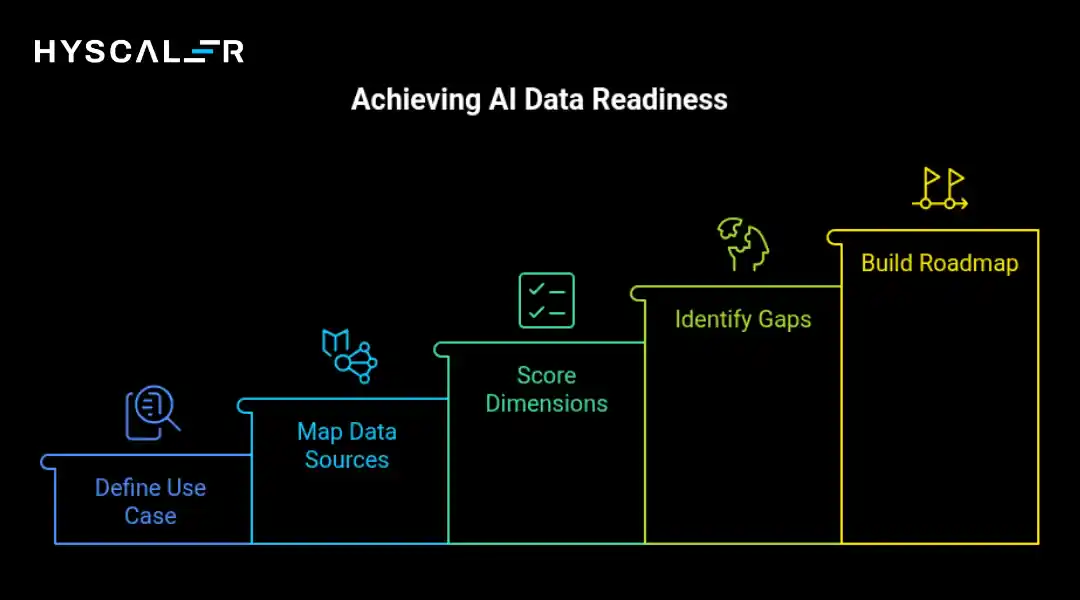
Step 1: Define the AI use case. Capture the business objective, users, AI workflow, required outputs, and risk level. A summarization tool for internal notes carries very different data requirements than an agent that issues customer refunds.
Step 2: Map the required data. List the systems of record, databases, APIs, documents, knowledge bases, event streams, and external sources the use case depends on.
Step 3: Score each dimension. Rate each of the seven dimensions on a simple scale: 0 = missing, 1 = partially ready, 2 = production-ready. A score out of 14 gives you a readiness baseline you can track over time.
Step 4: Identify critical gaps. Prioritize by business impact × AI risk × remediation effort. A governance gap on a customer-facing use case outranks a freshness gap on an internal tool.
Step 5: Build a remediation roadmap. Sort the work into three buckets: must fix before pilot, must fix before production, and can improve after launch. This separation stops teams from either over-engineering a pilot or shipping a production system on pilot-grade data.
AI Data Readiness Checklist
Data
- Data sources and authoritative sources are identified
- Duplicate records are addressed
- Required fields are complete
- Data quality rules are defined
Access
- Required data is programmatically accessible
- APIs or pipelines exist
- Access latency meets the use case
Context
- Business definitions are documented
- Metadata is available
- Entity relationships are understood
- Unstructured content is searchable and contextualized
Governance & Security
- Data owners are assigned
- Sensitive data is classified
- Permissions are enforceable at retrieval time
- Lineage is available
- Retention and compliance policies are defined
Operations
- Freshness is monitored
- Pipelines have automated validation
- Failures generate alerts
- Data changes are traceable
- Production monitoring is in place
AI Data Readiness vs. Traditional Data Readiness
| Traditional | AI-focused |
|---|---|
| Mostly structured data | Structured and unstructured data |
| Built for reporting and analytics | Built for retrieval, reasoning, and action |
| Quality is central | Quality, context, and provenance are central |
| Humans interpret business meaning | AI needs machine-readable context |
| Governance focuses on storage | Governance extends into retrieval and usage |
| Batch processing is common | Continuous updates may be required |
The shift matters because an analyst can spot a misleading column name.
An AI system usually can’t.
How to Make Data AI-Ready: 10 Practical Steps
- Inventory enterprise data
- Identify authoritative sources
- Profile and clean the data
- Standardize schemas and business definitions
- Add metadata and semantic context
- Establish governance and access controls
- Build reliable ETL/ELT or streaming pipelines
- Integrate structured and unstructured data
- Validate the data against the AI use case
- Monitor continuously in production
Notice that step 9 tests data against the use case, not against a generic quality standard.
That is where use-case-specific readiness becomes real.
Example: Preparing Data for a RAG-Based AI Assistant
This is an illustrative scenario, not a client case study.
Before readiness. A company has policy PDFs in SharePoint, customer data in a CRM, product data in an ERP, and support tickets in a separate system. Documents are duplicated, some policies are outdated, and permissions are inconsistent. An assistant built on top of this will retrieve something, but not necessarily the right, current, or authorized information.
After readiness. The flow looks like this:
Sources → Pipelines → Cleaning → Metadata → Access controls → Indexing → Retrieval → AI application
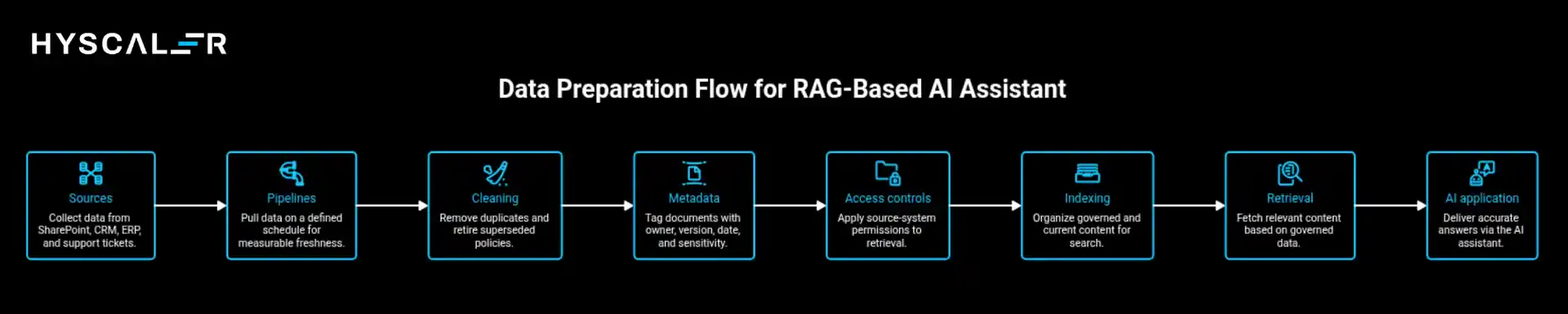
What changes at each stage:
- Pipelines pull from each system on a defined schedule, so freshness is measurable.
- Cleaning removes duplicates and retires superseded policies.
- Metadata tags each document with owner, version, effective date, and sensitivity.
- Access controls carry source-system permissions into retrieval, so users only get answers from content they’re allowed to see.
- Indexing and retrieval operate on governed, current content rather than a raw dump.
The assistant’s quality now depends on a foundation you can inspect and improve, not on luck.
Common AI Data Readiness Mistakes
- Assuming clean data is automatically AI-ready. Clean data can still lack context, permissions, or freshness.
- Preparing the whole data estate before choosing a use case. This is slow and expensive, and delays value.
- Treating a vector database as the solution. Tools help, but they don’t fix underlying data problems.
- Ignoring unstructured data. Much of the knowledge AI needs lives in documents, tickets, and messages.
- Forgetting permissions and sensitive information.
- Using stale data.
- Skipping metadata and business context.
- Treating preparation as a one-time project. Data changes, so readiness has to be maintained.
What Does an AI-Ready Data Architecture Look Like?
Think in layers:
- Enterprise sources: CRM, ERP, databases, APIs, documents, logs, SaaS
- Data integration: ETL/ELT, streaming, APIs
- Data foundation: lakehouse, warehouse, data lake
- AI readiness layer: quality, metadata, semantics, governance, lineage, security
- AI data access: search, RAG, APIs, feature and data services
- AI applications: copilots, agents, predictive models, automation
The AI readiness layer is the differentiator.
It sits between raw storage and AI consumption and is where trust is established.
When Should a Business Invest in AI Data Engineering?
Consider dedicated data engineering support when:
- Data lives across multiple disconnected systems
- AI projects repeatedly stall during data preparation
- Pipelines can’t meet freshness requirements
- Data quality varies widely across sources
- Governance requirements are complex
- Unstructured data needs to become AI-accessible
- Existing infrastructure can’t scale AI workloads
- Internal teams lack capacity to build production-grade pipelines
HyScaler’s Data Engineering Services cover data migration, ETL/ELT pipelines, data lake architecture, data architecture and warehousing, DataOps, and governance and compliance. That foundation is what AI initiatives depend on.
AI Data Readiness Roadmap
| Phase | Focus | Typical outcome |
|---|---|---|
| Assess | Inventory and gap analysis | Readiness baseline |
| Clean | Quality and standardization | Trusted data |
| Connect | Pipelines and integration | Accessible data |
| Contextualize | Metadata and semantics | AI-understandable data |
| Govern | Security and policies | Controlled AI access |
| Operationalize | Monitoring and DataOps | Production-ready foundation |
Conclusion: AI Readiness Starts With the Data Foundation
AI data readiness is not about making every enterprise dataset perfect.
It is about making the data required by a specific AI workflow reliable, accessible, contextual, governed, and operationally sustainable.
Organizations that treat readiness as an assessable, improvable property move from experimentation to production faster.
They know where the gaps are, in what order to close them, and what each gap costs.
Assess your current data foundation, identify the gaps blocking AI adoption, and build the pipelines and governance needed to move from AI experimentation to production.
[Assess Your Data Readiness for AI →]
FAQ
What is AI data readiness?
It is the degree to which data is accurate, accessible, contextual, governed, secure, and fresh enough for a specific AI use case. It determines whether AI systems can reliably and compliantly use enterprise information.
How do you assess AI data readiness?
Define the use case, map the data it needs, score seven dimensions from 0 to 2, prioritize gaps by impact, risk, and effort, then build a roadmap separating pilot blockers from production blockers.
What makes data AI-ready?
Seven things: quality, accessibility, freshness, context and semantics, governance, security and privacy, and operational infrastructure. Weakness in any one can undermine an otherwise strong AI use case.
Why is data readiness important for enterprise AI?
AI inherits the strengths and flaws of its data. Unready data leads to unreliable answers, compliance exposure, and pilots that never reach production, regardless of how capable the model is.
What is the difference between AI-ready data and traditional data?
Traditional readiness centers on structured data for reporting. AI readiness adds unstructured data, machine-readable context, retrieval-time permissions, provenance, and often continuous updates.
How can companies improve AI data readiness?
Follow a repeatable process: inventory data, identify authoritative sources, clean and standardize, add metadata, apply governance, build pipelines, integrate data types, validate against the use case, and monitor continuously.