

Table of Contents
Artificial intelligence chat refers to conversations between humans and AI-powered systems that understand, generate, and respond in natural language.
Unlike traditional chatbots, AI chat uses large language models (LLMs) to interpret context, reason through requests, and generate human-like responses, powering everything from customer support to enterprise copilots.
What Is Artificial Intelligence Chat?
Artificial Intelligence chat refers to conversations between humans and AI-powered systems capable of understanding, generating, and responding in natural language.
Instead of following rigid scripts, these systems interpret meaning, context, and intent, then generate original responses tailored to the conversation.
A simple example: when you type a question into an AI assistant and it responds with a relevant, conversational answer rather than a pre-written reply, you’re experiencing artificial intelligence chat in action.
This is fundamentally different from traditional messaging or basic chatbots, which rely on fixed decision trees (“Press 1 for billing, Press 2 for support”).
Traditional systems can only respond to inputs they were explicitly programmed to recognize.
AI chat, by contrast, can handle open-ended, unpredictable questions because it’s built on models trained to understand language itself, not just match keywords.
AI chat has gone mainstream for a simple reason: it works.
As language models improved dramatically in the early 2020s, everyday users and businesses alike found that AI chat could answer questions, draft content, troubleshoot problems, and even reason through complex tasks, all through natural conversation.
Why Artificial Intelligence Chat Is Growing So Fast
Several forces have converged to accelerate AI chat adoption:
- Rise of large language models (LLMs) – models trained on massive datasets can now generate coherent, context-aware responses across nearly any topic.
- Better natural language processing (NLP) – modern systems understand nuance, tone, and intent far more accurately than earlier keyword-based tools.
- Increased enterprise adoption – companies are integrating AI chat into support, sales, HR, and internal knowledge systems to save time and cut costs.
- Improved customer experiences – AI chat delivers instant, 24/7 responses, reducing wait times and improving satisfaction.
A quick timeline of AI chat evolution:
| Year | Milestone |
|---|---|
| 2016 | Rule-based bots dominate, scripted, limited responses |
| 2020 | GPT-3 demonstrates human-like text generation |
| 2023 | AI assistants become mainstream in consumer and business tools |
| 2025–2026 | Agentic AI and multimodal conversations (text, voice, image) become standard. |
How Artificial Intelligence Chat Works
At a high level, AI chat follows five steps:
- User enters a prompt – a question, command, or statement in natural language.
- Natural Language Processing (NLP) – the system breaks down the input to understand grammar, structure, and meaning.
- Large Language Model interprets intent – the model analyzes context and determines what the user actually wants.
- Reasoning & response generation – the model generates a relevant, coherent response based on patterns learned during training.
- Response delivered – the answer is returned to the user, often in real time.
Simplified flow:
Human → Prompt → Natural Language Processing → Large Language Model → Knowledge & Context → Generated Response → User
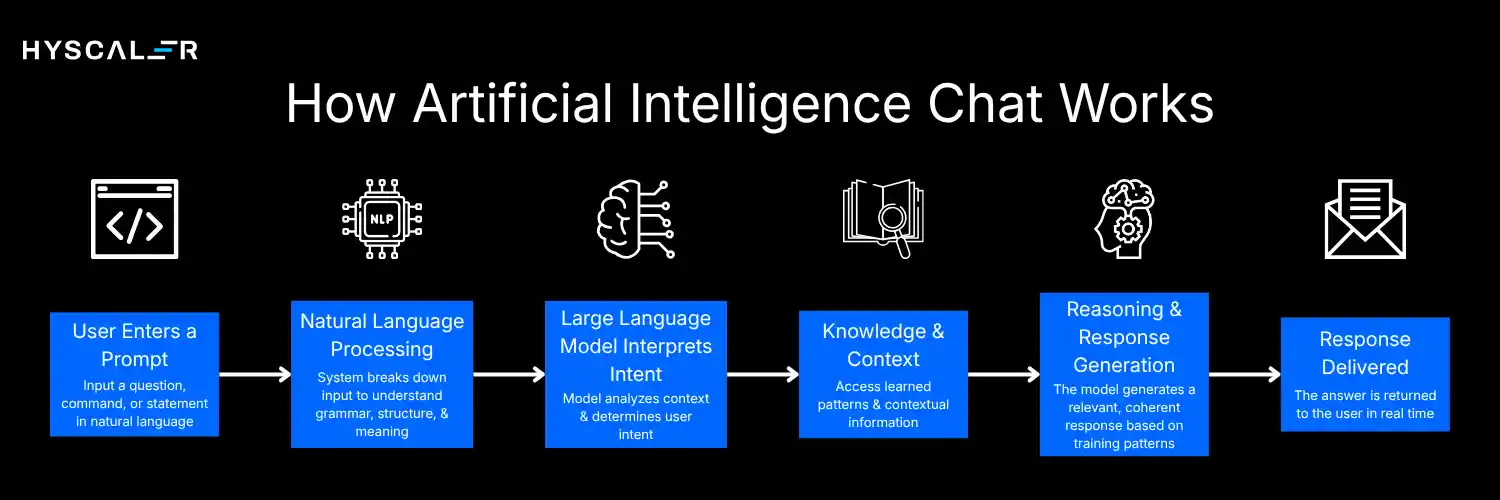
Each step happens within seconds, even though the underlying computation involves analyzing billions of learned language patterns.
Core Technologies Behind AI Chat
Several technologies work together to make AI chat possible:
Natural Language Processing (NLP) – the field of AI focused on enabling machines to understand and generate human language.
Machine Learning – algorithms that improve performance by learning patterns from data rather than following fixed rules.
Deep Learning – a subset of machine learning using neural networks to process complex patterns, especially effective for language tasks.
Large Language Models (LLMs) – models trained on vast text datasets that can generate human-like responses across countless topics.
Context Windows – the amount of conversation history an AI model can “remember” and reference within a single interaction.
Memory – increasingly, AI chat systems retain information across sessions to provide more personalized, continuous conversations.
Retrieval-Augmented Generation (RAG) – a technique that lets AI models pull in real-time or proprietary data before generating a response, improving accuracy for specific or up-to-date information. Businesses building custom AI assistants often rely on RAG development to ground responses in their own data.
Types of Artificial Intelligence Chat
AI chat isn’t one-size-fits-all.
Common categories include:
- AI Personal Assistants – help with scheduling, reminders, and everyday tasks.
- Customer Service AI – handle support queries, troubleshooting, and FAQs.
- Enterprise AI Assistants – support internal teams with knowledge retrieval and workflow automation.
- Healthcare AI Chat – assist with symptom checking, appointment scheduling, and patient education.
- Education AI – provide tutoring, explanations, and personalized learning support.
- Financial AI – help with account queries, budgeting insights, and fraud alerts.
- Voice AI Chat – extend conversational AI into spoken interactions via smart speakers and voice assistants.
Real-World Examples of Artificial Intelligence Chat
Rather than comparing specific products, it’s more useful to look at how AI chat is applied across everyday scenarios:
- Customer support – resolving common issues without waiting for a human agent.
- Virtual assistants – managing calendars, reminders, and quick research tasks.
- Healthcare symptom guidance – helping users understand potential causes of symptoms before seeing a doctor.
- Banking support – answering account questions and flagging suspicious activity.
- E-commerce shopping assistance – recommending products and answering pre-purchase questions.
- Coding assistance – helping developers debug, write, and understand code faster.
- Employee knowledge assistants – giving staff instant access to internal documentation and policies.
- Travel planning – suggesting itineraries and answering logistics questions in real time.
Benefits of Artificial Intelligence Chat
| Benefit | For Individuals | For Businesses |
|---|---|---|
| Faster Answers | ✓ | ✓ |
| 24/7 Availability | ✓ | |
| Productivity | ✓ | ✓ |
| Cost Savings | ✓ | |
| Personalization | ✓ | ✓ |
| Scalability | ✓ | |
| Knowledge Access | ✓ | ✓ |
For individuals, AI chat means faster, more personalized answers without digging through search results.
For businesses, it means round-the-clock support, lower operational costs, and the ability to scale conversations without scaling headcount proportionally.
Artificial Intelligence Chat vs Traditional Chatbots
| Feature | AI Chat | Traditional Chatbot |
|---|---|---|
| Intelligence | Understands context and nuance | Follows fixed scripts |
| Context Awareness | Retains and uses conversation history | Little to no memory |
| Personalization | Adapts responses to the user | Generic, one-size-fits-all replies |
| Learning Capability | Improves via training on large datasets | Static, rule-based logic |
| Response Quality | Natural, human-like | Often robotic or repetitive |
| Multilingual Support | Strong, often near-native | Limited, usually pre-translated scripts |
| Reasoning | Can work through multi-step logic | Cannot reason beyond programmed rules |
| Integration Capabilities | Connects with data sources, tools, and APIs | Typically standalone |
Common Use Cases Across Industries
- Healthcare – patient triage, appointment scheduling, health education.
- Finance – account support, fraud detection alerts, financial guidance.
- Retail – shopping assistance, order tracking, personalized recommendations.
- Manufacturing – equipment troubleshooting and internal knowledge access.
- Education – tutoring, personalized learning paths, administrative support.
- Legal – contract review assistance and legal research support.
- Logistics – shipment tracking and supply chain query resolution.
- HR – employee onboarding, policy questions, and benefits support.
Challenges and Limitations
Despite its benefits, AI chat isn’t without drawbacks:
- Hallucinations – AI models can generate confident but incorrect information.
- Privacy concerns – conversations may involve sensitive personal or business data.
- Data security – improperly secured AI systems can expose information to risk.
- Bias – models can reflect biases present in their training data.
- Lack of human judgment – AI chat can’t fully replace nuanced human decision-making in sensitive situations.
- Compliance considerations – regulated industries must ensure AI chat meets legal and ethical standards.
- Cost of implementation – building and maintaining custom AI systems requires investment in infrastructure and expertise.
Best Practices for Using AI Chat Effectively
- Write clear prompts – specific, well-structured questions produce better responses.
- Verify critical information – especially for medical, legal, or financial decisions.
- Protect sensitive data – avoid sharing confidential information unnecessarily.
- Use human oversight – keep people in the loop for high-stakes decisions.
- Continuously evaluate outputs – regularly review AI responses for accuracy and relevance.
How Businesses Can Implement Artificial Intelligence Chat
- Identify use cases – determine where AI chat adds the most value (support, sales, internal tools, etc.).
- Select the right AI model – choose a model suited to your data, scale, and use case.
- Connect data sources – integrate relevant business data so responses are accurate and grounded.
- Build conversational flows – design how the AI should handle common scenarios and edge cases.
- Test and optimize – refine prompts, responses, and logic based on real user interactions.
- Deploy securely – implement safeguards for data privacy and compliance.
- Monitor and improve – track performance and update the system as needs evolve.
Implementing AI chat well requires more than plugging in an off-the-shelf model; it means designing systems that reflect how your business actually operates.
This is where experienced AI development partners can help.
HyScaler works with organizations to design, build, and integrate secure, tailored AI-powered conversational solutions, from generative AI development to MCP-based AI agents and multi-agent systems, ensuring AI chat is grounded in real business context through practices like RAG development and thoughtful context engineering.
Future of Artificial Intelligence Chat
AI chat continues to evolve rapidly.
Key trends shaping its future include:
- Agentic AI – systems that can take multi-step actions, not just respond to queries. Explore how autonomous AI software engineering is pushing this forward.
- Multimodal conversations – AI chat that understands and generates text, voice, and images together.
- Voice-first interactions – more natural, hands-free conversational experiences.
- Personalized AI companions – assistants that adapt deeply to individual preferences over time.
- Enterprise AI copilots – AI embedded directly into business workflows and tools.
- Real-time memory – systems that retain and apply context across long-term interactions.
- AI collaboration with business systems – deeper integration with CRMs, databases, and internal platforms.
As these capabilities mature, AI chat will move from being a helpful tool to a foundational layer of how people and businesses interact with technology.
FAQ
What is artificial intelligence chat?
Artificial intelligence chat refers to conversations between humans and AI systems that understand and generate natural language responses, rather than following fixed scripts.
Is AI chat the same as ChatGPT?
No. ChatGPT is one specific example of an AI chat application. “AI chat” is the broader category that includes many different assistants and systems built on similar underlying technology.
How does AI chat work?
AI chat works by processing a user’s input through natural language processing, interpreting intent with a large language model, and generating a relevant response in real time.
What is the difference between AI chat and chatbots?
Traditional chatbots follow scripted rules and can only respond to predefined inputs. AI chat understands context and generates original, natural responses to a much wider range of inputs.
Is AI chat safe?
AI chat can be safe when implemented with proper data protection, human oversight, and compliance measures. Users should avoid sharing sensitive information with unsecured systems.
Can AI chat replace customer support?
AI chat can handle many routine support queries effectively, but complex or sensitive issues often still benefit from human involvement.
Which industries use AI chat?
Healthcare, finance, retail, manufacturing, education, legal, logistics, and HR are among the industries actively using AI chat today.
What are the limitations of AI chat?
Common limitations include hallucinations, potential bias, privacy risks, and the need for human oversight in high-stakes decisions.
Can businesses build custom AI chat solutions?
Yes. Businesses can build tailored AI chat systems by connecting their own data sources and designing workflows suited to their specific needs, often with support from experienced AI development teams.
What is the future of artificial intelligence chat?
The future includes more agentic, multimodal, and memory-driven AI systems that integrate deeply into everyday business and personal workflows.