
Table of Contents
Ever wondered how large organizations keep sprawling IT systems running smoothly while millions of events fire off every second? Cloud platforms, distributed apps, and remote-first teams have made IT operations more complex than traditional monitoring tools can handle. That complexity is exactly why AIOps has moved from buzzword to necessity.
By combining machine learning, big data, and automation, AIOps acts as the central nervous system of modern IT operations, helping teams detect issues, predict failures, and resolve incidents before they ever reach an end user.
What is AIOps?
AIOps stands for Artificial Intelligence for IT Operations. It is the practice of applying AI and machine learning to the day-to-day management of IT systems so teams can move from reactive firefighting to proactive, data-driven operations.
An AIOps platform continuously pulls data from applications, servers, cloud environments, and networks and then analyzes it to
- Detect unusual patterns or errors as they emerge
- Predict outages before they disrupt users
- Automate repetitive, manual operational tasks
- Help IT teams work faster with far less noise
In simple terms, this approach gives IT teams a tireless assistant that watches the entire environment around the clock.
Types of AIOps
AIOps platforms generally fall into two categories:
- Domain-Centric Platforms: Built to address a specific IT area, such as network monitoring, cloud performance, or application tracking. These tools excel at specialized use cases but often lack visibility across the wider environment.
- Domain-Agnostic Platforms: Broader in scope, these solutions unify data from multiple IT domains to deliver organization-wide insights, predictive analytics, and automation. They suit enterprises that want one consistent operations strategy.
How Does It Work?
An AIOps solution brings together disconnected IT data, tools, and teams into a single AI-powered platform. It ingests and analyzes diverse data types, including:
- Historical logs and performance records
- Real-time events from applications and infrastructure
- Metrics from servers, networks, and databases
- Packet-level network data
- Incident and ticketing system records
- Application usage and demand trends
- Cloud and on-premises infrastructure data
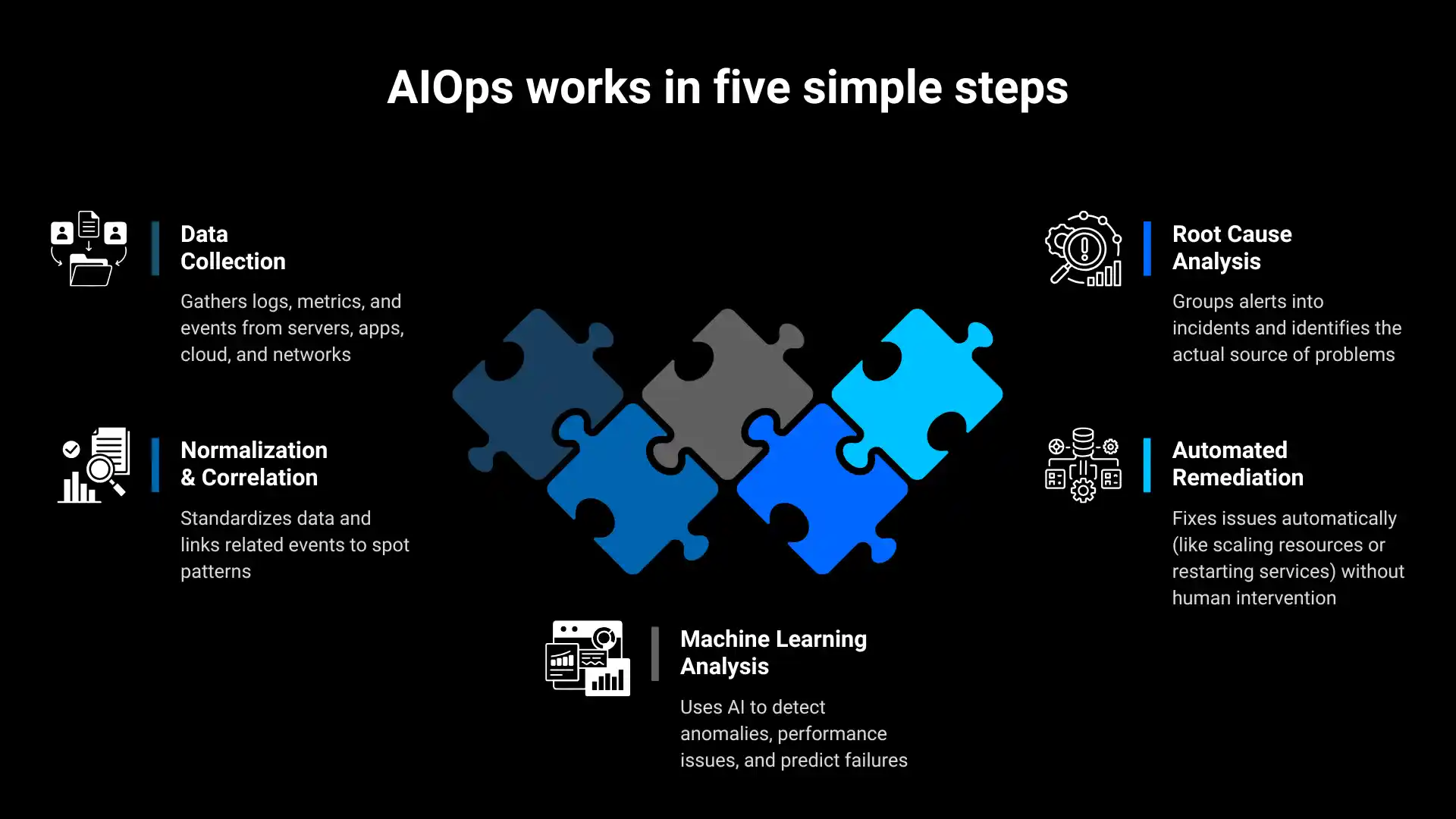
Once the data is collected, advanced analytics and machine learning make sense of it through four core actions:
- Filter out the noise: Meaningful alerts are separated from irrelevant background events, so teams focus on what actually matters.
- Pinpoint root causes: Correlating data across environments reveals the true source of an outage or slowdown, along with suggested fixes.
- Automate resolutions: Alerts route to the right team automatically, and proactive responses trigger before users even notice a problem.
- Continuously learn and adapt: The underlying models evolve with every incident, growing sharper as infrastructure, deployments, and workloads change.
Components of AIOps
AIOps platforms are built on several core components that work together to make IT operations smarter, faster, and more reliable:
1. Data Collection
- Gathers logs, metrics, traces, and events from applications, servers, cloud platforms, and networks.
- Provides a single source of truth for IT operations.
2. Data Ingestion & Normalization
- Standardizes raw data from multiple sources into a common format.
- Ensures that all data is consistent, structured, and ready for analysis.
3. Event Correlation
- Groups related alerts and incidents together to reduce “alert fatigue.”
- Helps IT teams focus only on what truly matters.
4. Anomaly Detection
- Uses AI/ML to identify unusual patterns or abnormal system behavior.
- Helps predict potential failures before they impact users.
5. Machine Learning & Analytics Engine
- Applies algorithms to detect patterns, trends, and root causes.
- Continuously learns and improves accuracy over time.
6. Root Cause Analysis (RCA)
- Identifies the exact reason behind an issue, rather than just the symptoms.
- Speeds up problem resolution and prevents recurrence.
7. Automation & Orchestration
- AIOps reduces manual effort and accelerates incident resolution.
8. Visualization & Dashboards
- Provides IT teams with real-time insights through easy-to-understand dashboards.
- Enhances collaboration across Dev, Ops, and Security teams
Why AIOps Matters
The case for adopting this approach in today’s digital-first environment is hard to ignore:
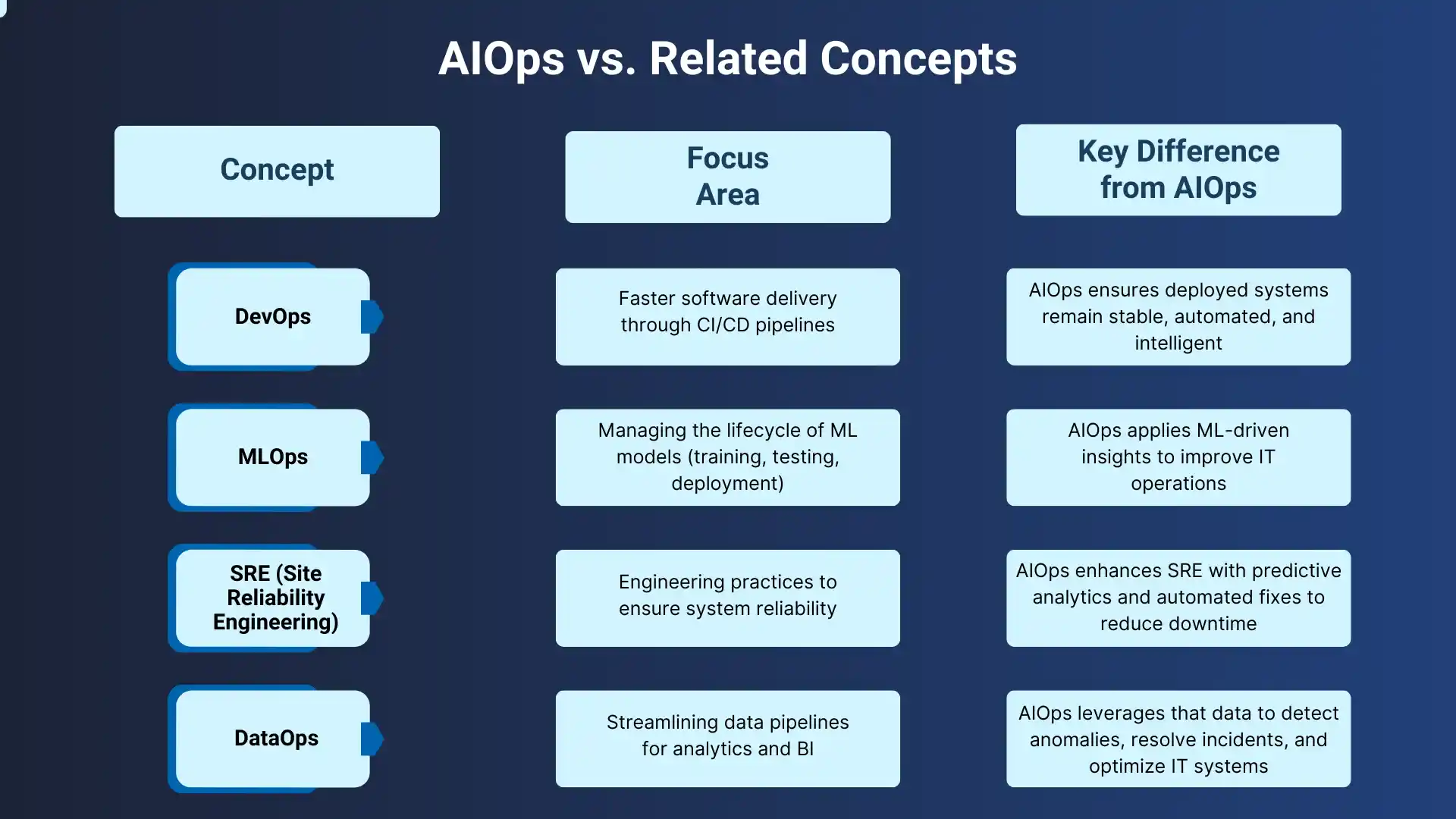
- Complex IT environments: Hybrid and multi-cloud setups are harder than ever to manage manually, and intelligent automation simplifies them.
- Data overload: IT systems generate enormous volumes of data daily, and automated analysis makes sense of it.
- Downtime costs: Every minute of downtime carries a real cost, and early detection helps prevent or minimize outages.
- Faster incident response: Problems that once took hours to resolve can now be solved in minutes.
- Improved collaboration: Developers, operators, and security teams all work from a unified view of the environment.
Key Capabilities of AIOps
AIOps is more than just automation. Its true power lies in multiple capabilities:
- Anomaly Detection: Identifies unusual activity that may signal an outage or cyberattack.
- Event Correlation: Groups similar alerts to avoid “alert fatigue” for IT teams.
- Predictive Insights: Uses historical data to forecast when a system might fail.
- Intelligent Automation: Automates routine tasks like patching, scaling, and restarting.
- Root Cause Analysis: Quickly finds the real reason behind an issue.
- Cross-System Visibility: Provides a single dashboard view of the entire IT ecosystem.
Future Trends in AIOps
The future of AIOps is exciting, with trends shaping how businesses will use it:
- Generative AI integration: Tools will move beyond analysis to generate plain-language recommendations for engineers.
- Edge computing support: Coverage will extend to IoT devices and edge networks, not just centralized data centers.
- Self-healing systems: Increasingly, systems will resolve certain issues without any human input.
- Stronger security posture: AI will take on a larger role in threat detection and automated response.
- Business-centric focus: Instead of tracking IT metrics alone, platforms will tie performance directly to revenue and customer experience.
Can AIOps Replace Human Operators?
This is a question many people ask, and the simple answer is no.
- Automates routine work: AIOps is great at handling repetitive tasks like log analysis or alert filtering.
- Humans add judgment: Complex problems need creativity, strategic thinking, and business knowledge that AI cannot provide.
- Works as a partner, not a replacement: AIOps helps IT teams respond faster, make fewer mistakes, and focus on bigger challenges.
Think of AIOps as a co-pilot that boosts productivity, not a replacement for the pilot.
What Are the Key Use Cases of AIOps?
AIOps isn’t just a buzzword; it’s transforming how IT and operations teams manage modern, complex systems. By combining machine learning, big data, and automation, AIOps enables businesses to detect problems earlier, respond faster, and operate more efficiently.
Here are the most impactful use cases:
1. Application Performance Monitoring (APM)
Modern applications often run across cloud platforms, APIs, microservices, and databases. Traditional monitoring struggles to capture all interactions.
With AIOps, IT teams gain real-time visibility into application performance, identify slowdowns, and optimize performance at scale.
2. Root Cause Analysis
Instead of chasing endless alerts, AIOps pinpoints the true cause of issues by correlating data from multiple sources.
Example: It can detect that a slow app isn’t just due to heavy traffic but a database query bottleneck.
3. Anomaly Detection
AIOps identifies unusual patterns or “outliers” in IT data that may indicate threats or failures.
- Detects abnormal traffic spikes
- Flags suspicious user behavior
- Predicts hardware or software failures
By spotting anomalies early, AIOps prevents small glitches from turning into major outages.
4. Cloud Automation and Optimization
Managing cloud workloads manually is inefficient. AI Ops enables:
- Auto-scaling resources during peak traffic
- Optimizing costs by shutting down unused resources
- Improving observability across multi-cloud environments
Example: An e-commerce business can automatically scale up servers during holiday sales.
5. App Development Support
DevOps teams integrate AIOps to improve code quality and release speed.
- Automated code reviews
- Early bug detection
- Continuous quality checks
Example: Atlassian uses Amazon CodeGuru with AIOps to cut investigation time from days to minutes.
Conclusion
As organizations accelerate digital transformation, IT complexity will only keep rising, and AIOps is no longer optional. By weaving AI and automation into daily operations, businesses can stay proactive, minimize costly downtime, and deliver the seamless digital experiences customers now expect.
At HyScaler, we believe this isn’t reserved for large enterprises alone; small and mid-sized teams can unlock enterprise-grade efficiency and reliability with the right approach. Most importantly, the goal isn’t to replace people. It’s to free IT teams to focus on strategy, innovation, and growth while AI handles the heavy lifting. The organizations that embrace it now will shape the resilient, intelligent IT ecosystems of tomorrow.
FAQs
What is AIOps?
AIOps is the use of artificial intelligence and machine learning to automate and improve IT operations. It collects and analyzes data from applications, networks, and infrastructure to detect anomalies, predict outages, and automate fixes, acting like a round-the-clock assistant for IT teams.
What kind of data does the platform actually use?
It pulls from logs, metrics, traces, events, incident tickets, and infrastructure data across cloud and on-premises environments to build a complete picture of system health.
Why is AIOps important for businesses today?
IT systems now span cloud, hybrid, and on-premises environments, generating more data than traditional tools can process. This approach helps businesses catch problems before they affect users, cut downtime, and automate repetitive work.
Can AIOps replace human operators?
No. It automates repetitive tasks like log analysis and ticket routing, but humans still bring the creativity, judgment, and strategic decision-making that automation can’t replicate.
How does AIOps help in cloud and DevOps environments?
AIOps helps DevOps teams detect bugs earlier, automate performance monitoring, and scale cloud resources automatically, ensuring smoother deployments and reliability.
Is this the same thing as MLOps?
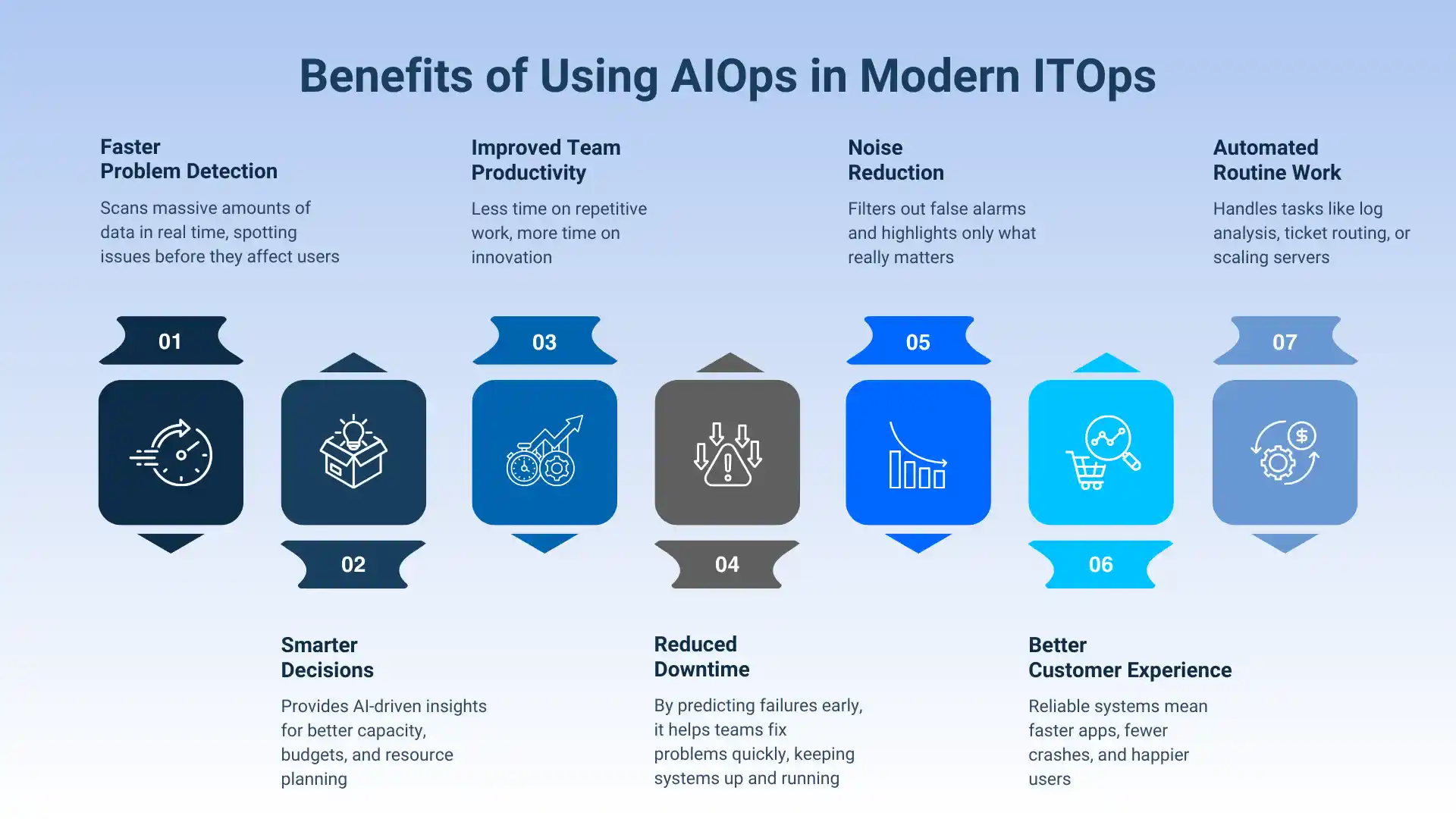
No. MLOps focuses on managing the lifecycle of machine learning models, while AIOps applies AI to manage IT infrastructure and operations. The two can intersect, but they solve different problems.