
Table of Contents
OpenAI has initiated a restricted preview of its GPT-5.6 series, a release that signals a fundamental change in how the laboratory brings high-intelligence models to market. This latest generation consists of a three-tiered family, Sol, Terra, and Luna, and arrives following an unprecedented period of coordination with the U.S. government.
For the first time, the flagship model, Sol, is not being released to the general public immediately. Instead, at the request of federal officials, OpenAI has limited access to a select group of “trusted partners”. This phased rollout is a direct response to the model’s “step change” in autonomous capabilities, particularly in the sensitive domains of cybersecurity and biological research. By involving the Administration ahead of the launch, OpenAI is setting the stage for what it describes as a future “cyber Executive Order framework,” intended to create a repeatable process for future frontier model releases.
The Sol System: A New Hierarchy of Intelligence
In a departure from previous iterative updates, the 5.6 series introduces a “capability tier” naming convention designed to offer developers clearer trade-offs between reasoning power and operational economics.
- GPT-5.6 Sol (Flagship): The most capable model in the lineup, optimized for complex reasoning and agentic tasks.
- GPT-5.6 Terra (Balanced): Designed for high-volume enterprise work, Terra provides performance parity with the previous GPT-5.5 while being 2x cheaper.
- GPT-5.6 Luna (Affordable): The entry point of the series, Luna focuses on speed and “strong capability” at the lowest cost point OpenAI has offered to date.
The pricing structure reflects this aggressive push for efficiency. Sol is priced at $5 per 1M input tokens and $30 per 1M output tokens. Terra sits at exactly half those rates ($2.50/$15), and Luna drops to $1 per 1M input tokens. To further assist developers with cost management, the series introduces refined prompt caching. Cache writes are billed at 1.25x the uncached input rate, while cache reads receive a 90% discount. These caches now include explicit breakpoints and a 30-minute minimum life, allowing for more predictable billing in recurring workflows.
From Chatting to Doing: The Agentic Shift
The technical centerpiece of the 5.6 series is the transition from passive text generation to active “agentic” autonomy. While previous LLMs were largely reactive, Sol is built to execute. This shift is enabled by two primary architectural innovations: Max Reasoning Effort and Ultra Mode.
Max Reasoning Effort allows the model to allocate significant time to “reason deeply” before providing an answer. This is not merely a slower response; it is a dedicated processing state designed to navigate the multi-layered logic required for genomics or vulnerability research. For tasks that exceed the capacity of a single reasoning chain, OpenAI has introduced Ultra Mode. This mode allows Sol to function as a lead agent, orchestrating a team of subagents to accelerate complex, multi-step work.
This “multi-agent” approach allows the system to plan, execute, and iterate on a scale that simple chat models cannot match.
The Regulatory Nexus and the “Cyber Order”
The most controversial element of the GPT-5.6 launch is the level of government involvement. OpenAI confirmed it previewed the model’s capabilities and its release roadmap to the U.S. government well ahead of the launch. The resulting “phased release” is a short-term step as the lab works with the Administration to finalize the upcoming cyber Executive Order framework.
However, OpenAI has made its stance clear: government-managed access should not be the “long-term default”. The company argues that withholding high-performance tools from the broader market risks keeping essential technology out of the hands of cyber defenders, global partners, and legitimate enterprises.
To justify this temporary restriction, the lab spent weeks “pressure-testing” a layered safety stack. This system is designed to prevent “persistent malicious behavior” while preserving access for dual-use security work, like code review and patch development. The stack includes:
- Model-Level Refusals: Training the AI to reject prohibited cyber assistance even when the intent is disguised.
- Real-Time Classifiers: Systems that evaluate output as it is generated, occasionally pausing generation so a larger reasoning model can review the context for potential violations.
- Automated Red-Teaming: OpenAI dedicated over 700,000 A100-equivalent GPU hours to its own models to find “universal jailbreaks”, attacks that could work across any prompt or context.
This automated defense is supplemented by human expert red-teaming, which tests the AI against “creative experts” attempting to find weaknesses the automated systems might overlook.
Benchmarks: Proving the Efficiency Frontier
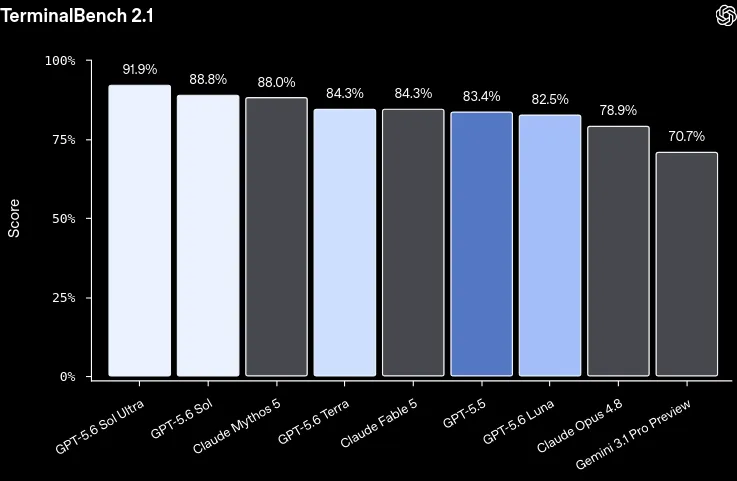
The performance gains in the 5.6 series are most visible in technical and scientific workflows. On Terminal-Bench 2.1, which tests command-line workflows requiring planning and tool coordination, Sol established a new state of the art.
In biology, the model demonstrated an improved “performance-efficiency frontier”. Testing on GeneBench v1, a benchmark for long-horizon genomics and quantitative analysis, showed that Sol achieves stronger results than GPT-5.5 while consuming fewer tokens.
The results in cybersecurity are equally significant. On ExploitBench², Sol matched the performance of specialized models like Mythos Preview but used only one-third of the output tokens to reach the same conclusion. Despite these gains, OpenAI emphasizes that Sol has not yet crossed the “Cyber Critical” threshold defined in its internal Preparedness Framework.
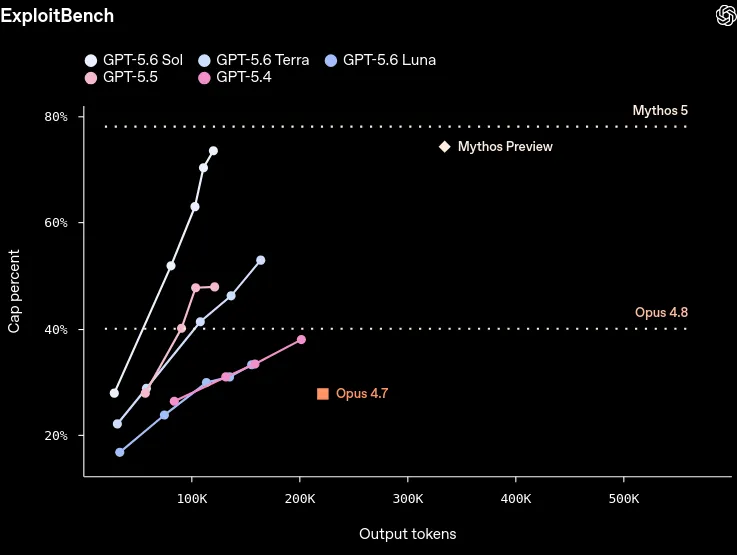
In evaluations involving the Firefox and Chromium browsers, the model could identify “exploitation primitives”, the building blocks of an attack, but was unable to autonomously produce a functional, full-chain exploit.
The Road to General Availability
While the current preview is limited to the API and Codex for select partners, OpenAI expects to make the full GPT-5.6 series available to ChatGPT and broader API users in the “coming weeks”.
For users requiring massive throughput, the company is launching Sol on Cerebras hardware in July. This partnership claims to offer speeds of up to 750 tokens per second, effectively bringing “frontier intelligence” to market at a velocity previously reserved for much smaller, less capable models.
The release of GPT-5.6 suggests that the era of “unvetted” frontier model launches is coming to an end. By integrating federal oversight into the release cycle, OpenAI is attempting to normalize a model of responsible deployment that balances high-speed innovation with national security interests. Whether this “government access process” remains a short-term exception or becomes the blueprint for the industry will likely be decided by the success of the upcoming Executive Order framework.