

Table of Contents
Zero trust security represents a fundamental shift in how organizations approach cloud protection. The traditional perimeter model build strong walls around your network and trusts everything inside, is obsolete. In today’s cloud-native world, where workloads are distributed, teams are remote, and applications span multiple cloud providers, every access request must be verified, authenticated, and authorized regardless of where it originates.
Amazon Web Services provides the comprehensive native toolset needed to implement enterprise-grade zero-trust security at scale. Organizations that embrace this approach report up to an 80% reduction in breach impact and a reduction in detection time from months to days. This guide covers the architecture, AWS-native services, and phased strategy required to build truly resilient infrastructure.
Why Perimeter Security No Longer Works
For decades, security teams deployed firewalls at network edges, managed VPNs, and controlled access through bastion hosts. This castle-and-moat approach assumed that if attackers stayed outside, everything inside was safe.
That assumption collapses in modern cloud environments. Remote workers access applications from anywhere. Containerized microservices communicate across regions and cloud providers. Attackers no longer need to breach your perimeter; they compromise an endpoint, a vendor, or a supply chain component and move freely inside because the network implicitly trusts internal traffic.
Zero trust security reverses this entirely. Rather than asking “Is this traffic from inside the network?”, it asks “Can I verify the requester’s identity, validate their authorization, and confirm their device is healthy?” Every transaction requires proof, every time, regardless of origin.
Three Core Dimensions
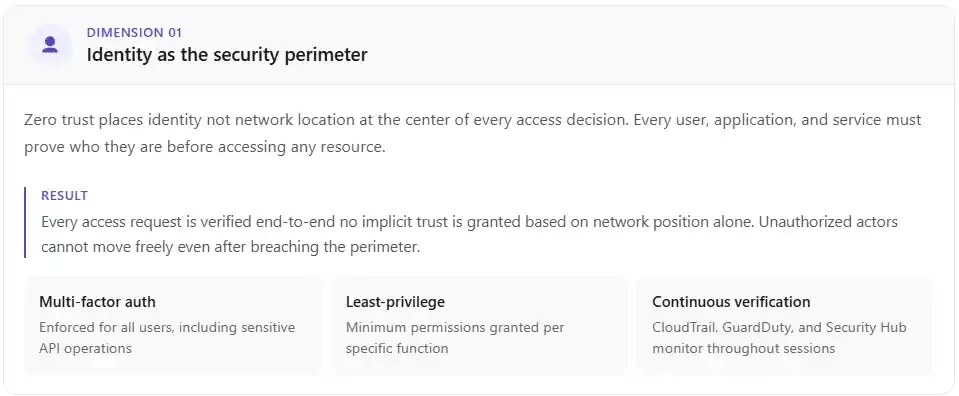
Identity as the Security Perimeter
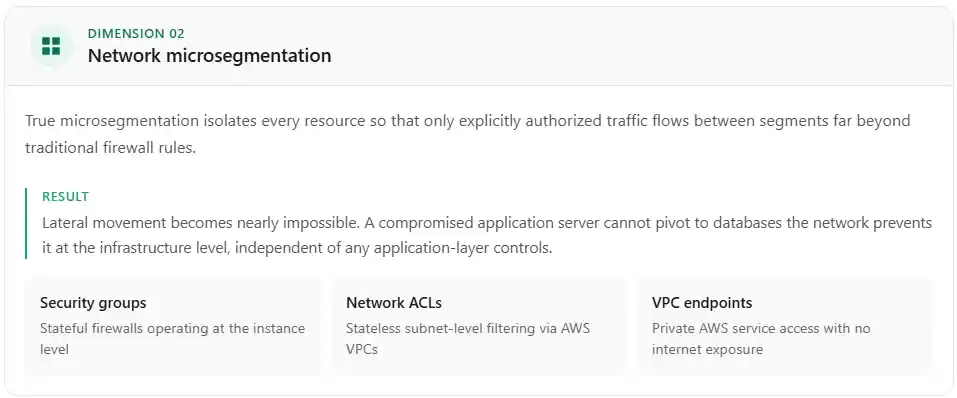
Network Microsegmentation
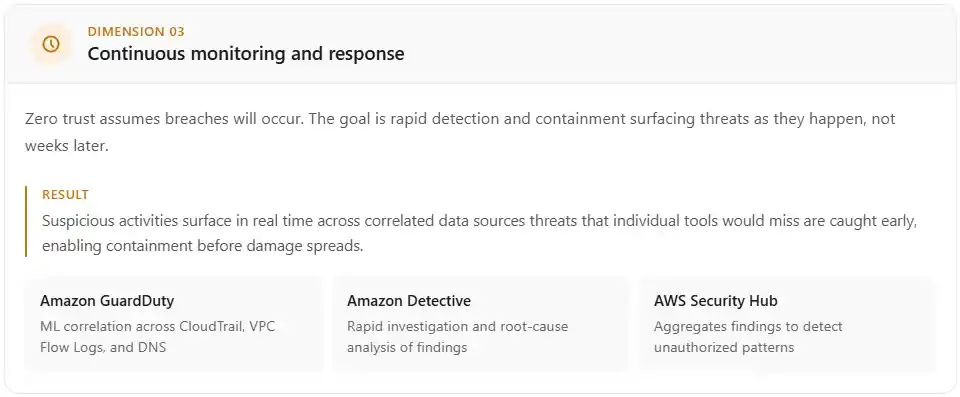
Continuous Monitoring and Response
AWS Architecture for Zero Trust Security
Multi-Account Foundation
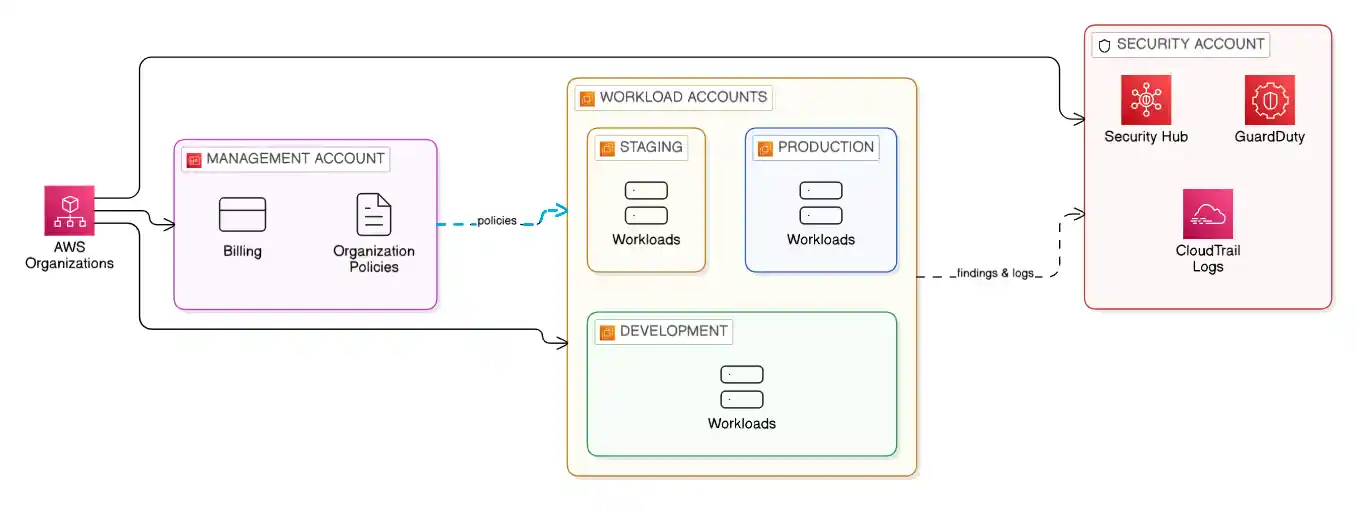
Zero trust security architecture on AWS begins with AWS Organizations and a multi-account structure that provides meaningful isolation between environments. Each account is a separate security boundary:
- Security account: Aggregates GuardDuty findings, Security Hub data, and CloudTrail logs organization-wide
- Management account: Handles billing and organizational policies with minimal workload activity
- Production, staging, and development accounts: Host workloads with controls appropriate to each environment’s risk level
Compromising one account does not cascade to others; the blast radius is contained by design.
Three-Tier VPC Design
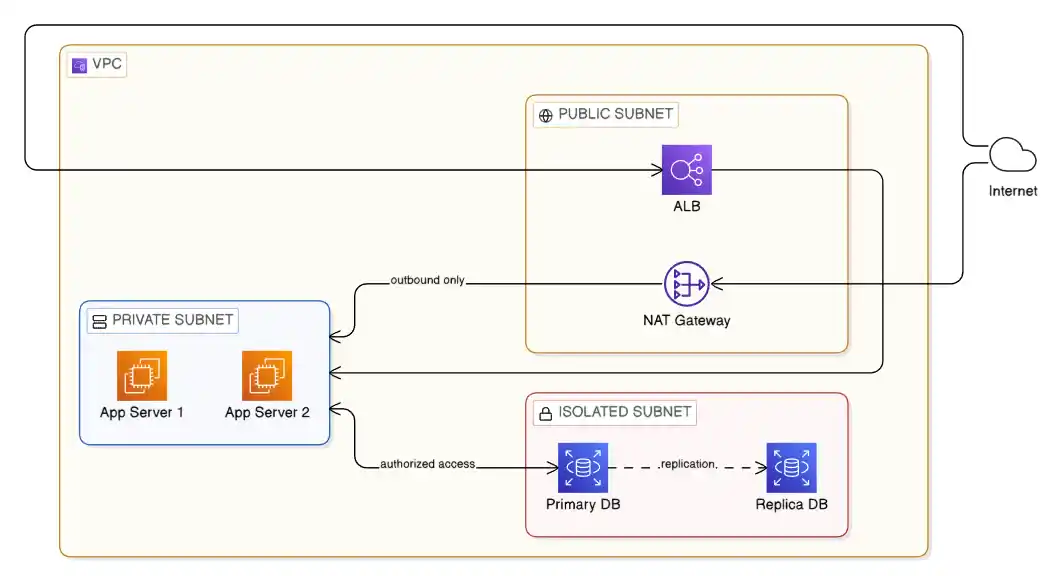
Network segmentation in zero-trust security uses a tiered VPC architecture that prevents attackers from moving freely through infrastructure.
Public subnets contain load balancers and NAT gateway entry points that never directly access sensitive resources.
Private subnets run application workloads with no direct internet access.
Isolated subnets house databases and sensitive services, communicating only with authorized application-tier resources through explicitly configured security group rules.
Security groups follow a deny-first philosophy. All traffic is implicitly denied unless explicitly permitted. A compromised web server cannot directly query a database because the network itself blocks that path.
Identity and Access Management
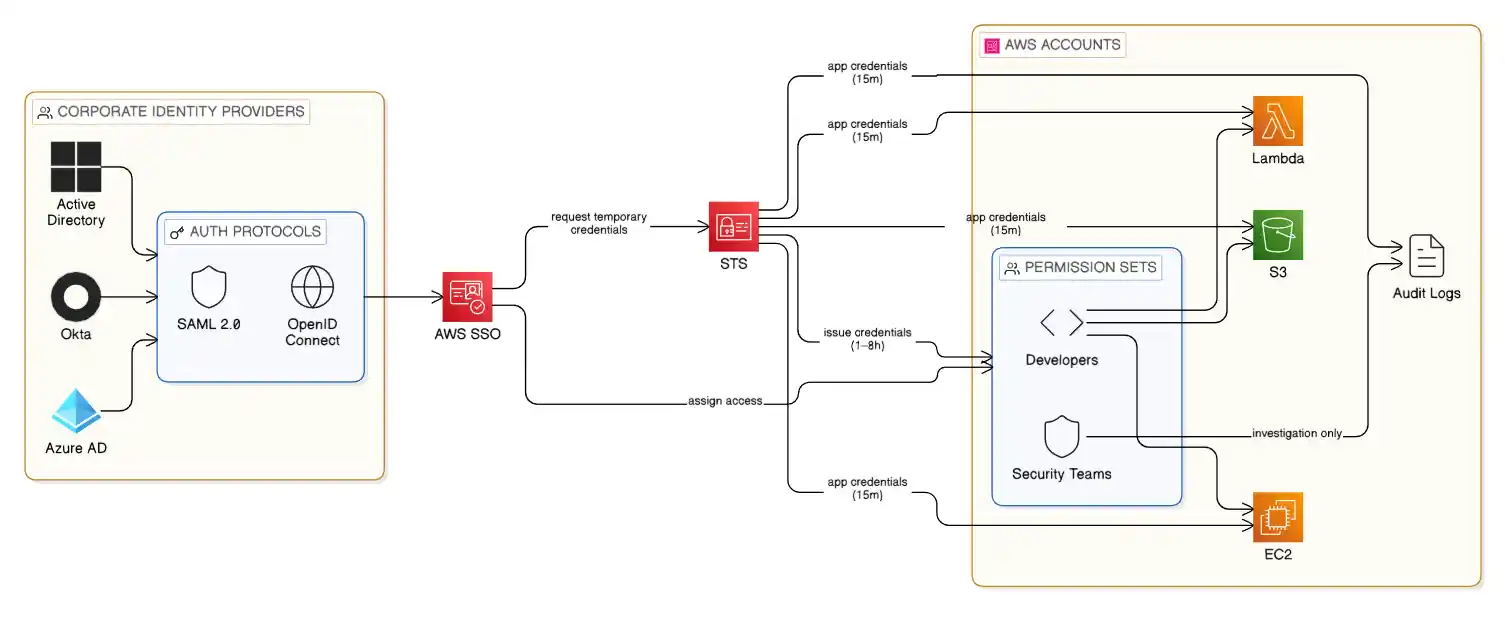
Enterprise zero-trust security requires a comprehensive identity strategy beyond basic IAM configuration. AWS SSO integrates with corporate identity providers, Active Directory, Okta, and Azure AD, through SAML 2.0 or OpenID Connect, centralizing access management across all accounts.
Long-lived credentials are eliminated. AWS STS generates temporary credentials with short lifespans: 1–8 hours for interactive human sessions, as little as 15 minutes for application credentials. This limits the damage any compromised credentials can cause. Permission sets align with job functions. Developers get EC2, Lambda, and S3 access; security teams get investigation permissions, but cannot delete audit logs. This approach also supports SSH key management best practices.
Encryption Architecture
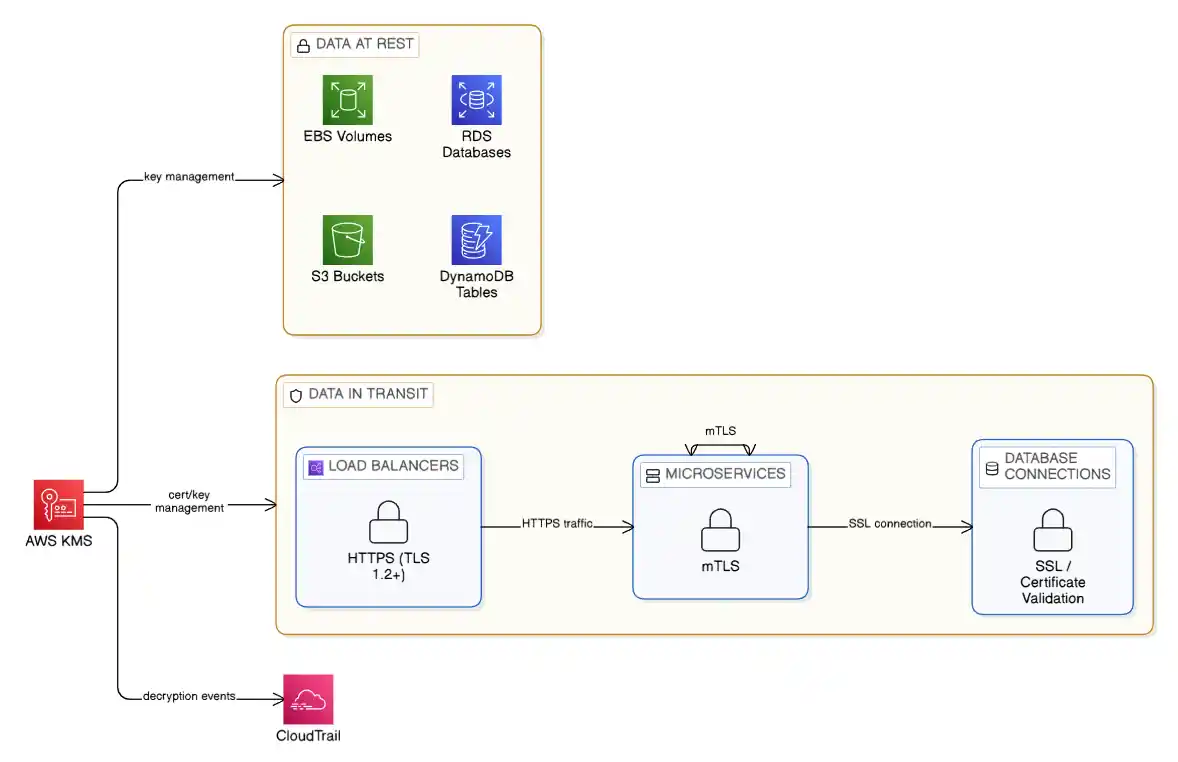
Comprehensive encryption is non-negotiable in zero-trust security. AWS KMS manages encryption keys centrally, with every decryption operation logged in CloudTrail.
For data at rest, all EBS volumes, RDS databases, S3 buckets, and DynamoDB tables use customer-managed KMS keys, giving organizations full visibility and control. For data in transit, load balancers enforce HTTPS-only with minimum TLS 1.2. Microservices communicate via mutual TLS (mTLS), cryptographically verifying peer identity at every call. Database connections require SSL with certificate validation.
Threat Detection and Automated Response
Amazon GuardDuty is the continuous threat intelligence layer for zero-trust security on AWS. It detects reconnaissance activity, instance compromise, credential theft attempts, and unauthorized crypto mining by correlating signals that individual tools would miss.
When GuardDuty detects a high-confidence threat, AWS Lambda can respond automatically, isolating affected resources by modifying security groups, disabling compromised credentials, and triggering investigation workflows. Automated response shrinks the mean time to remediation from hours to minutes.
AWS Security Hub aggregates findings across GuardDuty, AWS Config, and IAM Access Analyzer into one unified dashboard. AWS Config Rules can automatically remediate common misconfigurations, closing security gaps without waiting for manual intervention.
Phased Implementation Roadmap
Complete zero-trust security across an enterprise is a multi-phase journey that builds capability progressively rather than attempting a disruptive all-at-once transformation.
- Months 1–3: Visibility Foundation: Enable CloudTrail organization-wide, deploy GuardDuty across all accounts, activate VPC Flow Logs, and establish CloudWatch monitoring. This phase doesn’t change controls but establishes the visibility needed for every subsequent phase.
- Months 4–6: Identity Hardening: Implement AWS SSO with corporate identity provider integration. Enforce MFA for all console users. Migrate from long-lived access keys to temporary credentials. Establish cross-account roles for inter-account access.
- Months 7–10: Network Segmentation: Design or migrate VPCs to the three-tier architecture. Update security groups to a deny-first philosophy. Deploy VPC endpoints to eliminate internet gateway dependencies for AWS service traffic.
- Months 11–14: Encryption: Create customer-managed KMS keys per application and environment. Enable encryption for all storage services. Implement Secrets Manager with automatic credential rotation.
- Months 15–18: Advanced Monitoring: Deploy custom CloudWatch alarms for application-specific anomalies. Build and test incident response playbooks. Conduct organization-wide training on zero trust security principles and each team’s role in maintaining security posture.
The Business Case
The argument for zero-trust security is financially clear. The average cost of a data breach now exceeds $4 million, and faster detection dramatically reduces that figure. Organizations implementing this model detect intrusions in days rather than months, containing damage before it compounds.
Beyond direct breach costs, zero trust security delivers compliance benefits that reduce regulatory risk and audit burden. The continuous logging, MFA enforcement, and comprehensive audit trails required by this model align precisely with HIPAA, PCI DSS, SOC 2, and other major frameworks. Auditors receive evidence of actual working controls, not policy documents.
Operationally, zero trust security reduces manual security work through automation. Centralized identity management simplifies user administration. Automated key rotation eliminates manual processes. Automated threat response reduces analyst workload. The model pays dividends across security, compliance, and operations simultaneously.
Common Implementation Challenges
Legacy applications that cannot support modern authentication can be handled by placing AWS API Gateway in front as an authentication proxy, enforcing zero-trust security controls without modifying the underlying application code.
Performance concerns are largely unfounded in practice. AWS KMS caching reduces encryption overhead. VPC endpoints eliminate internet gateway latency. Security group evaluation occurs at wire speed. The vast majority of zero-trust security controls add negligible latency to transactions.
Cost concerns should be weighed against breach costs. GuardDuty, Security Hub, and CloudWatch require investment but represent a fraction of what a single undetected breach would cost an organization.
Conclusion
Zero trust security is not a product you purchase; it is an architecture you build and a philosophy you embed into every layer of your infrastructure. AWS provides the native services to implement it comprehensively: IAM and SSO for identity, VPCs and security groups for network isolation, KMS for encryption, and GuardDuty, Security Hub, and CloudTrail for continuous monitoring and response.
The journey requires phased implementation, organizational change management, and sustained commitment. But the outcome dramatically reduced breach risk, faster incident response, and a stronger compliance posture make the investment clearly worthwhile.
The question is no longer whether to implement zero-trust security. It is how quickly your organization can begin.
FAQ’s
What exactly is zero-trust security?
Zero Trust assumes no implicit trust in any user, device, or network location, requiring continuous verification of identity and device health for every access request, unlike traditional security that trusts everything inside the network perimeter.
How does AWS Organizations enable Zero Trust in a multi-account strategy?
AWS Organizations creates security boundaries between accounts so compromising one account doesn’t cascade to others; each account is isolated with separate IAM policies, resources, and audit logs, containing a breach blast radius.
What’s the difference between AWS SSO and traditional IAM for Zero Trust?
AWS SSO integrates with enterprise identity providers (Active Directory, Okta, Azure AD), enabling centralized identity management across multiple AWS accounts with MFA enforcement, while traditional IAM manages credentials per account.
How do AWS temporary credentials (STS) improve Zero Trust security?
AWS STS generates short-lived credentials (1-8 hours for humans, 15 minutes for apps) instead of long-lived access keys, so compromised credentials have a limited window of use and require continuous re-authentication.
How do I monitor and audit Zero Trust access across AWS?
AWS CloudTrail logs every API call with caller identity, timestamp, and parameters; combine with CloudWatch for real-time analysis, AWS Security Hub for aggregated findings, and create custom alerts for suspicious patterns.
How should multi-region AWS deployments implement Zero Trust?
Replicate VPC architecture and security controls across regions, use CloudTrail organization trail for cross-region audit logging, replicate KMS keys to regions, configure GuardDuty in each region, and implement cross-region IAM policies for consistent access control.
How do VPC Endpoints support Zero Trust security?
VPC Endpoints allow private access to AWS services (S3, DynamoDB, SNS) without traversing the internet, eliminating internet gateway dependencies and enabling granular resource policies that restrict access only to authorized principals.
What’s the role of AWS Security Groups in Zero Trust?
Security Groups act as stateful firewalls at the instance level, implementing the deny-first principle by blocking all traffic by default and explicitly allowing only required connections, preventing compromised servers from freely accessing other resources.
What AWS services form the foundation of Zero Trust Security?
AWS provides the complete Zero Trust stack: IAM for identity, VPC/Security Groups for microsegmentation, KMS for encryption, GuardDuty for threat detection, Security Hub for centralized findings, and CloudTrail for complete audit logging.