

Table of Contents
The Invisible Price of Every Prompt
You type. ChatGPT answers. Simple, right?
Not quite. Behind every response lives a physical machine, racks of GPUs running at full throttle, generating intense heat inside a data center that needs to be cooled around the clock. And that cooling runs on water. Real, drinkable, freshwater.
AI water consumption has quietly become one of the most urgent environmental debates of 2026. The conversation around ChatGPT water usage and AI data center water consumption sits at the crossroads of Big Tech growth, global water scarcity, and a public that has no idea their daily chatbot habit has a physical cost.
This blog breaks it all down: the numbers, the science, the corporate reality, and what you can actually do about it. Understanding AI water consumption starts with understanding why water and technology are now inseparable.
Why Does ChatGPT Need Water at All?
Before we get to the numbers, let’s answer the obvious question: why does software need water?
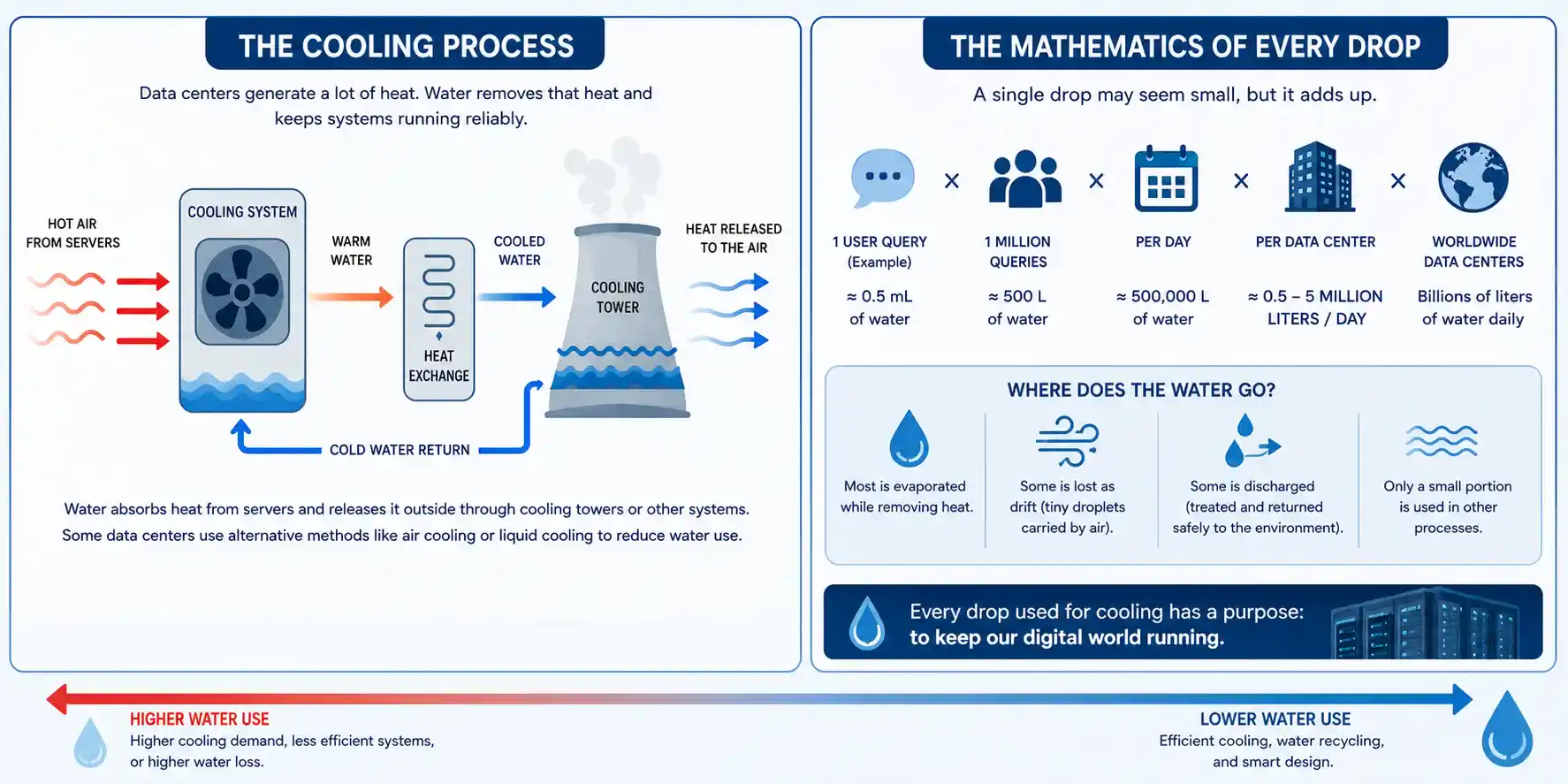
When you send a prompt to ChatGPT, it travels to a data center a warehouse packed with thousands of high-performance processors. Those processors run calculations at extreme speeds, generating enormous heat. Left unchecked, that heat would destroy the hardware within minutes.
To prevent that, data centers use cooling towers, the backbone of all data center water cooling operations. These systems pump water through the facility, absorb the heat, and evaporate it into the air. That evaporated water is permanently lost from the local supply. It cannot be recovered.
This is the root of the AI water consumption problem. It is not a software issue. It is a physics issue.
“Every time you ask an AI chatbot a question, you are also consuming water, without realising it. AI doesn’t just require computing power; it needs cooling, and that cooling comes with a cost.”
— Shaolei Ren, Associate Professor, University of California, Riverside
The Numbers: How Much Water Does ChatGPT Actually Use?
Here is where things get complicated and controversial.
According to UC Riverside research (reported by The Washington Post), generating a single 100-word ChatGPT response, what researchers call the ‘AI prompt water bottle equivalent’, consumes approximately 519 ml of water. That figure covers on-site cooling water at the data center level and represents the core of the ChatGPT water footprint debate. When you look at the water usage of ChatGPT 2026, this number scales to billions of litres daily.
OpenAI CEO Sam Altman pushed back on this in his blog post “The Gentle Singularity” (OpenAI Blog, 2025), stating the average query uses just 0.3 ml, “about one-fifteenth of a teaspoon”. His figure only accounts for direct operational water, not the water used in electricity generation or chip manufacturing.
The gap between 0.3 ml and 519 ml is not a rounding error. It is a measurement choice, and understanding that gap is essential to grasping the true scale of AI water consumption.
| Source | Water Per Prompt | What It Measures |
|---|---|---|
| Sam Altman / OpenAI (OpenAI Blog, 2025) | 0.3 ml | Direct operational only |
| Academic estimate (Readers Club / Medium, Feb 2026) | 5–10 ml | On-site cooling |
| UC Riverside / Washington Post | 519 ml | Full 100-word response |
| Full lifecycle (power plant + chips) | Higher still | (IE University Insights, Oct 2025) |
The Scale Problem: One Prompt Is Nothing. A billion is everything.
Here is the uncomfortable truth about AI water consumption: the per-prompt number is not the story. The aggregate are.
ChatGPT now serves over 1 billion messages every day (OpenAI via Reuters, Dec 2025). When you multiply even a conservative water estimate across that volume, the numbers become staggering.
Daily water use of ChatGPT (full supply chain): approximately 148 million litres, enough to fill 59 Olympic swimming pools (Business Energy UK, Jan 2026).
Zoom out further: by 2027, total global AI water consumption from all models combined could reach 4.2 to 6.6 billion cubic metres annually, equivalent to one-third of California’s entire agricultural water supply (WifTalents Research, Feb 2026). This is what researchers are now calling the AI water crisis, and the water cost of AI is only accelerating.
That is not a distant projection. That is 12 months away.
Where Does AI’s Water Supply Come From, And Who Pays?
AI water consumption does not happen in a vacuum. It happens in specific places, drawing from specific water sources that real communities depend on. Understanding tech giants’ environmental impact starts with understanding where their data centers are built.
Northern Virginia alone, nicknamed “Data Center Alley”, hosts nearly 600 data centers, with over 100 more under construction. In 2024, data centers accounted for almost 40% of Virginia’s total electricity consumption (Bloomberg, cited in Consumer Reports, Mar 2026).
Arizona and Texas, two of the driest states in the US, have become AI infrastructure hotspots. They are also tapping into the Colorado River, a water system already in crisis.
The Middle East is building massive AI hubs in regions with virtually no natural freshwater, relying entirely on energy-intensive desalination to power AI water consumption needs (TRENDS Research & Advisory, 2026).
And at the community level: a single Meta data center in Newton County, Georgia, uses 500,000 gallons of water per day, 10% of the entire county’s consumption (Lincoln Institute of Land Policy, Feb 2026).
This is not just a tech story. It is a water rights story.
Training vs. Inference: The Hidden Cost Nobody Mentions
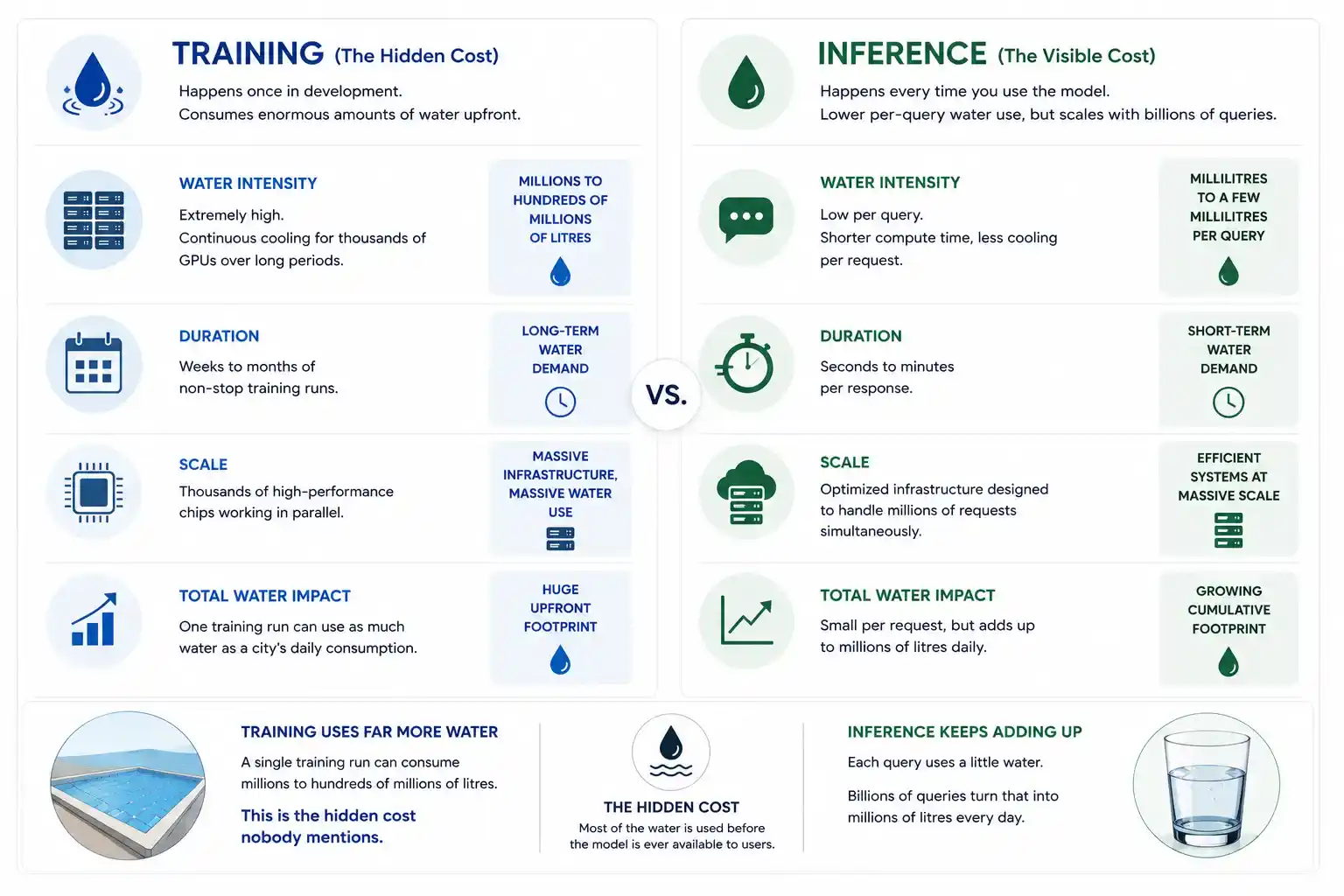
Every conversation you have with ChatGPT adds to AI water consumption through inference, running the live model. But training the model in the first place is far more water-intensive. Most public discussions focus only on running AI, ignoring the much larger AI carbon and water footprint generated before you ever open the app.
- Training GPT-3 alone consumed an estimated 700,000 litres of water at Microsoft’s Iowa data centers (UC Riverside / AP News)
- Training GPT-5 is projected to require 500 million litres, enough to fill 200 Olympic swimming pools (WifTalents, Feb 2026)
Every version upgrade, every new model release, every fine-tuning run compounds total AI water consumption before a single user types a prompt.
What Are Tech Giants Actually Doing About It?
To be fair, the industry is not standing still. But the pace of solutions is slower than the pace of growth. The push toward sustainable AI and data center sustainability is real, but voluntary commitments alone are proving insufficient.
Microsoft has committed to being water positive by 2030 and is rolling out immersion cooling systems that can reduce data center water use by 31–52% (Devera AI Environmental Impact Report, Feb 2025, devera.ai). The company now tracks Water Usage Effectiveness (WUE), a metric that measures litres of water used per kilowatt-hour of energy, as a core sustainability benchmark (Microsoft 2025 Environmental Sustainability Report, microsoft.com).
Google disclosed that In 2024, we replenished 4.5 billion gallons of water, increasing replenishment of our freshwater consumption from 18% in 2023 to 64% (Google’s 2025 Environmental Report).
European researchers published findings in March 2026 showing that data center waste heat can be redirected to power water purification and carbon capture, potentially making facilities water-positive (European Commission Science for Environment Policy, Mar 2026, environment.ec.europa.eu).
Regulators are also catching up. In 2026, lawmakers in more than 30 US states introduced over 300 bills on data center environmental impact, including water consumption limits (Consumer Reports, Mar 2026, consumerreports.org; see also MultiState legislative tracker, multistate.us).
Progress is real. But with AI water consumption projected to triple over the next decade, “good progress” is not the same as “enough.”
What Can You Do Right Now?
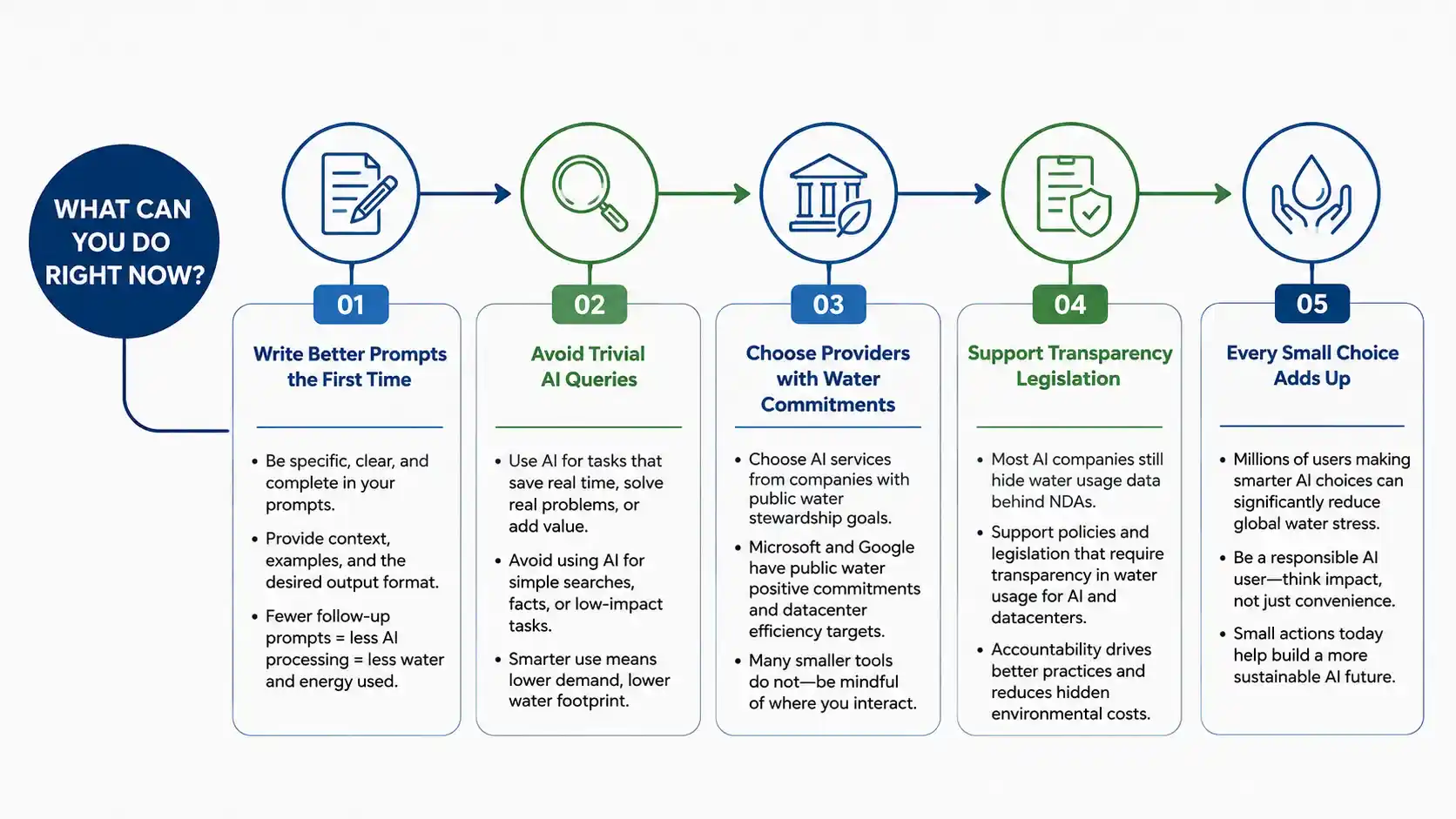
Reducing your personal contribution to AI water consumption does not mean quitting AI. It means using it smarter. Here is how to reduce AI water footprint impact and shrink your overall AI footprint without giving up the tools you rely on:
- Write specific, complete prompts the first time; fewer retry prompts means less water used
- Avoid trivial AI queries; save AI for tasks where it genuinely saves time
- Choose providers with water commitments; Microsoft and Google have public pledges; many smaller tools do not
- Support transparency legislation; most companies still hide their water data behind NDAs (Lincoln Institute of Land Policy, Feb 2026)
The Prompt You Don’t Think About
AI water consumption is not a future problem. It is a 2026 problem, happening right now in data centers built on rivers, aquifers, and municipal water supplies that communities depend on.
The technology is not going anywhere. But how we build it, power it, cool it, and regulate it is entirely within our control as users, as voters, and as citizens who share the planet’s water. Tracking AI water consumption is no longer optional. It is a civic responsibility.
Every prompt has a cost. Knowing that cost is the first step to demanding better.
FAQs
How much water does one ChatGPT prompt use?
Data centers use water in cooling towers to prevent GPU and CPU chips from overheating during AI computations.
Why does AI need water to function?
Data centers use water in cooling towers to prevent GPU and CPU chips from overheating during AI computations.
Is AI water consumption worse than that of other industries?
Not yet individually, but at the projected 2027 scale, global AI could consume as much water as a third of California’s annual farm water supply (WifTalents, Feb 2026).
Which company uses the most water for AI?
Google reported 5.6 billion gallons in 2023; Microsoft’s water use rose 34% to 6.4 billion litres in FY2022 (Microsoft Sustainability Report FY2022).
Does using AI on my phone also consume water?
Yes, the water cost happens at the data center, not your device, so every query, regardless of your device, contributes.
Will AI become more water-efficient in the future?
Per-query efficiency is improving with immersion cooling, but total query volume is growing faster, meaning aggregate AI water consumption is still rising (WaterFreeChat, May 2026).
Is there a water-free way to run AI?
Air-cooled and immersion-cooled facilities use far less water, and some newer Microsoft facilities have eliminated evaporative cooling (Devera AI, Feb 2025).