
Table of Contents
Retailers worldwide lose an estimated $1.7 trillion a year to inventory distortion, the combined cost of stockouts and overstocks. That single number explains why inventory management software has moved from a “nice to have” to a core operating requirement for almost every product-based business.
If stock is still being tracked on spreadsheets or a register, the odds of overselling, understocking, or losing money to shrinkage go up fast. The right software closes that gap by giving teams a single, accurate view of what’s on hand, what’s moving, and what needs to be reordered.
This guide breaks down what inventory management software actually does, why it matters, how it improves day-to-day efficiency, and who should be using it.
What Is Inventory Management Software?
Inventory management software is a digital system that helps businesses order, store, track, and control stock across one or multiple locations. Instead of relying on manual counts or disconnected spreadsheets, teams get a live, centralized view of inventory levels.
With the right system in place, businesses can build a more reliable process around ordering, storage, and fulfillment, while also freeing up staff time that would otherwise go toward manual data entry.
Done well, this kind of platform helps ensure:
- Right-sized stock: the right products are available in the right quantity.
- Balanced inventory: stock is neither overstocked nor understocked.
Next, let’s look at why this category of tools has become so important for businesses of nearly every size.
Why Is Inventory Management Software Crucial For A Business?

Managing inventory is one of the highest-stakes operational tasks a business runs. Get it wrong, and the losses show up fast, in lost sales, tied-up cash, or unhappy customers. Good inventory management software can directly improve the following:
- Cash flow optimization: inventory is a major business asset, and poor tracking quietly erodes working capital.
- Operational efficiency: it streamlines procurement and order processes end-to-end.
- Customer satisfaction: running out of stock hits sales fast, and proactive alerts keep teams ahead of shortages.
- Data-driven decisions: visibility into inventory trends improves forecasting, planning, and pricing.
Some of the best platforms on the market today combine most of these capabilities out of the box.
How Does It Improve Efficiency?
Buying inventory management software doesn’t automatically fix inventory problems; it’s the strategy behind how a business uses it that drives the improvement. Here are six practical strategies businesses use to turn a modern inventory tracking system into real gains in speed, accuracy, and profitability.
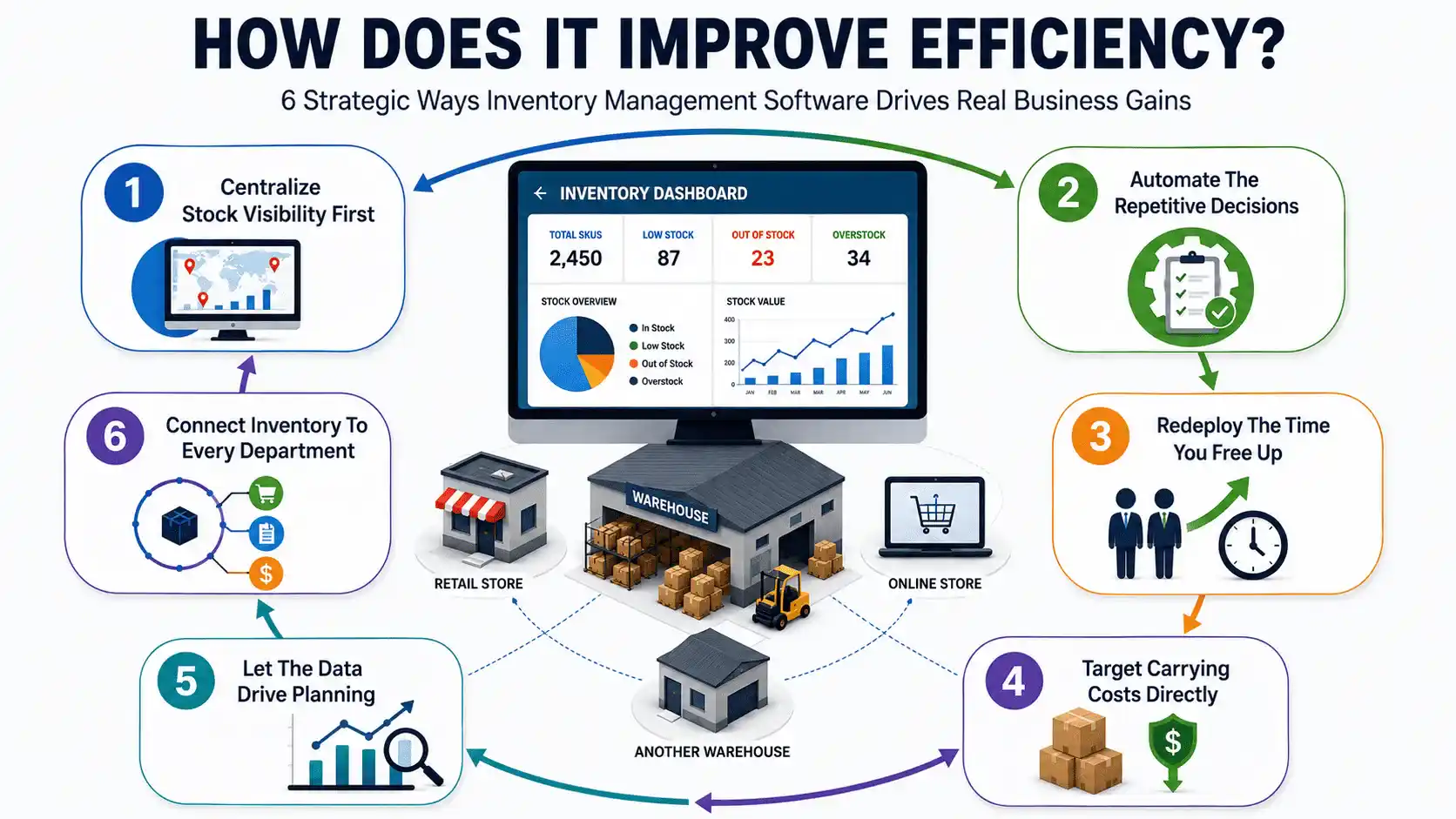
1. Centralize Stock Visibility First
Before automating anything else, get every location- warehouses, retail stores, and online channels- reporting into one dashboard. Fragmented visibility is the root cause behind most of the stock problems that follow.
Why this strategy works:
- Teams always know what’s in stock, what’s running low, and what’s sitting in excess.
- It closes the gap that causes stockouts, customer frustration, and missed sales.
- It flags overstocking early, before it ties up cash and drives up storage costs.
2. Automate The Repetitive Decisions
Once visibility is centralized, the next move is to stop manually deciding things that follow a predictable pattern. Set rules for reordering, alerts, and threshold triggers instead of handling each one case by case. This is where inventory management software earns its keep turning routine judgment calls into automatic actions like:
- Triggering reorders the moment stock runs low.
- Sending alerts for low stock, expiry dates, or discrepancies.
Why this strategy works:
- It saves hours that would otherwise go into manual data entry.
- It reduces human error across SKUs.
- It ensures no item gets lost track of in the warehouse.
3. Redeploy The Time You Free Up
Automation only pays off if the time it saves gets pointed somewhere useful. The strategic move is to deliberately shift staff away from manual counts and toward the work that actually grows the business.
Why this strategy works:
- More focus: teams spend more time on customer service, fulfillment, or strategic planning.
- Faster processing: order processing, stock receiving, and audits get completed faster and more accurately.
- Less counting: manual counting time drops significantly, boosting productivity and reducing operational bottlenecks.
4. Target Carrying Costs Directly
Cost reduction shouldn’t be a side effect; treat it as a deliberate target. Use inventory management software to actively monitor where money is quietly leaking out through storage, shrinkage, and slow-moving stock.
How to apply it:
- Reduce carrying costs like storage, insurance, and spoilage.
- Minimize over-purchasing of stock that doesn’t move.
- Track product movement to help flag theft or misplacement.
Why this strategy works: more accurate data leads to smarter purchasing decisions, and lower operating costs directly improve profitability.
5. Let The Data Drive Planning
Once the basics are running smoothly, shift from reactive tracking to forward-looking planning. AI-based forecasting alone can reduce supply chain forecasting errors by 20–50%, which is a meaningful edge for any inventory-heavy business willing to act on what the data shows.
How to apply it: use reporting to analyze:
- Fast-moving versus slow-moving inventory.
- Stock turnover rates.
- Seasonal trends and regional demand variations.
Why this strategy works:
- Businesses can optimize their product mix, stocking more of what sells and phasing out what doesn’t.
- It enables dynamic pricing, promotions, or bundling based on real-time performance.
- It guides inventory planning ahead of peak seasons.
6. Connect Inventory To Every Department
The final strategic step is to stop treating inventory as a siloed function. Deliberately wire it into the systems other departments already rely on, so everyone works from the same numbers:
- Sales systems.
- Procurement systems.
- Finance tools.
Why this strategy works:
- It creates a single source of truth for everyone involved.
- It reduces communication gaps and duplicate effort.
- It keeps information consistent and up to date across departments.
Software vs. Manual Tracking
Here’s a quick side-by-side of what changes when a business moves from spreadsheets to a dedicated system.
| Factor | Manual Tracking | Inventory Management Software |
|---|---|---|
| Stock visibility | Delayed, location-by-location | Real-time, across all channels |
| Reordering | Manual, reactive | Automated, rule-based |
| Error rate | Higher, prone to human error | Lower, with barcode/RFID scanning |
| Reporting | Static spreadsheets | Live dashboards and analytics |
| Scalability | Breaks down as SKUs grow | Scales across warehouses and channels |
Who Should Use It?
Inventory management software isn’t limited to a specific industry. Any business handling stock, materials, or products can put it to use.
1. Retailers: For Multi-Channel Inventory Syncing
Retailers benefit greatly from this kind of software, especially across physical stores, websites, and marketplaces.
How it helps them:
- Stock syncs in real time across all sales channels.
- Inventory updates automatically the moment a sale is made, in-store, online, or through a third party.
2. e-Commerce Sellers
Online sellers operating across multiple platforms often find manual inventory tracking leads to errors, overselling, and higher return rates.
How it helps them:
- It integrates easily with platforms like Amazon, Flipkart, and Shopify.
- It centralizes stock control from multiple channels into one dashboard.
- It handles returns and restocking more efficiently.
3. Manufacturers And Warehouses
Manufacturers deal with more complex supply chains, where raw materials, work-in-progress, and finished goods all need to be tracked separately.
How it helps them:
- It supports precise demand forecasting and automated reordering.
- It reduces waste and lowers production costs.
Conclusion
Inventory management is one of the most consequential functions a business runs; get it right, and profitability and scale follow. Get it wrong, and the losses compound quietly for months before anyone notices.
The right inventory management software improves efficiency, protects profitability, and gives teams precise operational control across every location and channel.
If a business is still relying on spreadsheets or manual counts, now is a good time to explore what a modern system can do instead.
Looking to build or integrate inventory management software into your business systems? HyScaler’s engineering team designs custom inventory and supply chain solutions tailored to how your business actually operates. Talk to our team to get started.
FAQs
Q1. What is inventory management software, and why is it important?
Inventory management software is a tool that helps businesses manage their stock levels, track inventory across different locations, and streamline ordering and storage processes. It is crucial for maintaining accurate stock levels, optimizing cash flow, improving operational efficiency, and enhancing customer satisfaction by minimizing stockouts.
Q2. How can inventory management software improve operational efficiency?
By automating routine tasks, providing real-time visibility into stock levels, and reducing manual data entry, inventory management software significantly enhances operational efficiency. It allows staff to focus on customer service and strategic planning instead of being bogged down by inventory counting and management.
Q3. Can inventory management software help reduce costs?
Yes, effective inventory management software can lower costs by reducing carrying expenses, minimizing over-purchasing of slow-moving stock, and identifying issues such as theft or shrinkage. The improved accuracy in inventory management also leads to smarter purchasing decisions, ultimately increasing profitability.
Q4. Who can benefit from using inventory management software?
Any business that handles stocks, materials, or products can benefit from inventory management software. This includes retailers, wholesalers, e-commerce businesses, and manufacturers looking to streamline their inventory processes and improve overall efficiency.
Q5. How does inventory management software facilitate data-driven decisions?
With advanced reporting and analytics capabilities, inventory management software allows businesses to track inventory turnover rates, identify seasonality, and analyze product performance. This data helps optimize stock levels, inform pricing strategies, and guide inventory planning, ensuring that products align with market demand.