
Table of Contents
The global gaming industry has never moved faster.
With over 3.3 billion players worldwide and the market projected to surpass $300 billion by the end of the decade, gaming is no longer just entertainment; it’s a technology-first industry reshaping how we interact, compete, create, and connect.
But what’s actually driving this transformation in 2026?
From AI-generated game worlds to blockchain-powered economies, a wave of innovations is rewriting the rules.
Whether you’re a developer, a publisher, a gamer, or a business leader, understanding these trends isn’t optional; it’s a competitive necessity.
This guide breaks down the top trending technologies in the gaming industry and what they mean for the road ahead.
The State of Gaming in 2026: Why Technology Is Everything
Today’s players expect more than graphics and gameplay.
They want personalized experiences, zero latency, cross-device freedom, and worlds that feel alive.
Meeting those expectations requires a technology stack that would have seemed like science fiction just a decade ago.
The biggest shifts are happening at the intersection of AI, cloud infrastructure, immersive hardware, and decentralized ownership, and companies that are investing in these areas today are the ones defining tomorrow’s gaming landscape.
Trending Technologies in the Gaming Industry
Artificial Intelligence (AI) in Gaming
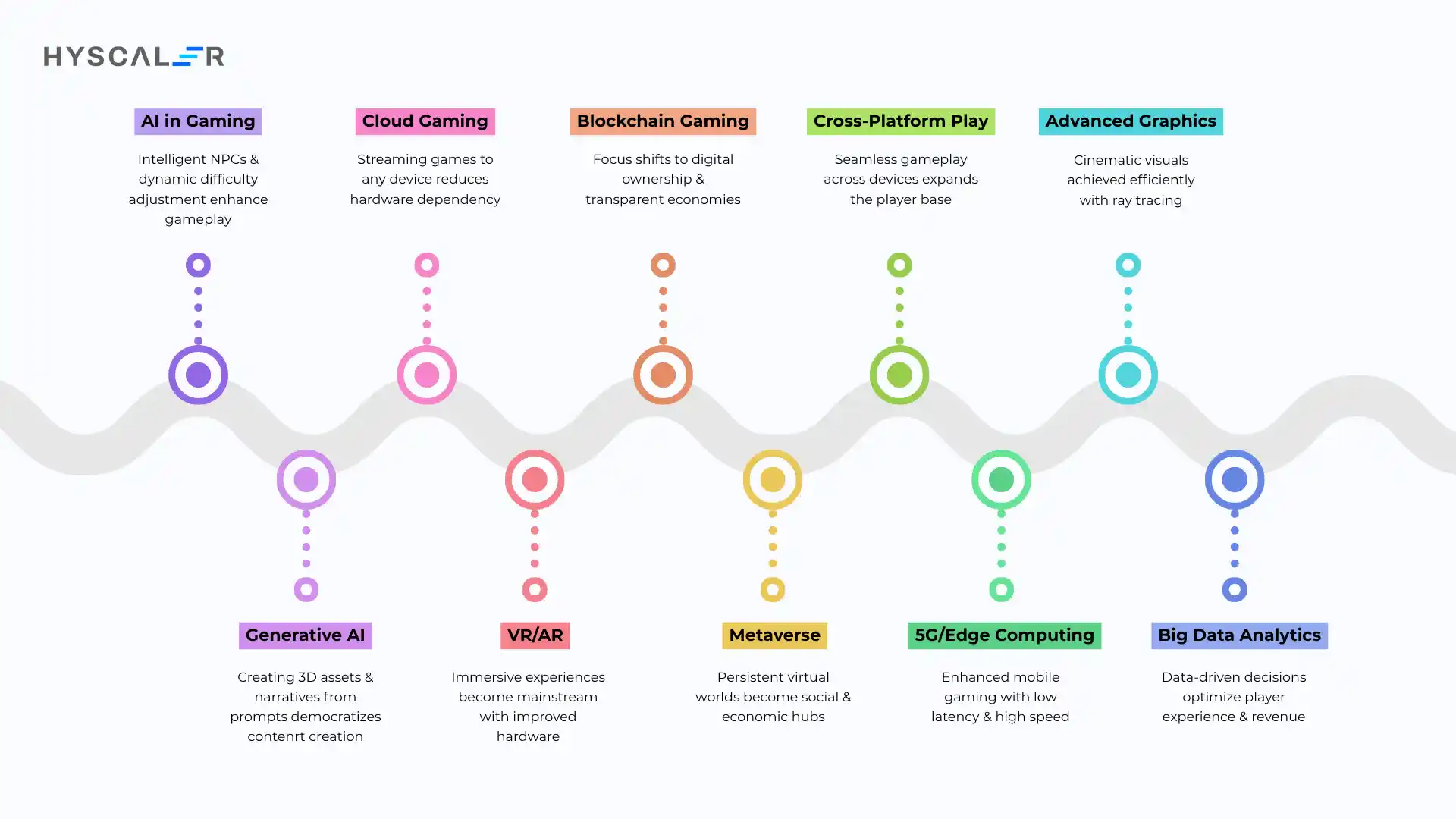
AI has moved from a background tool to the centerpiece of modern game development.
In 2026, studios are using AI in almost every stage, from pre-production to post-launch live services.
What’s changing:
- Intelligent NPCs: Characters now learn, adapt, and respond contextually rather than following scripted behavior trees. This makes game worlds feel genuinely reactive.
- Dynamic difficulty adjustment: AI monitors player performance in real time and adjusts challenge levels on the fly, reducing frustration without removing satisfaction.
- Automated QA and testing: AI agents can run thousands of test simulations overnight, cutting testing cycles that once took weeks down to hours.
- Personalized experiences: AI analyzes play patterns to serve up tailored content, recommendations, and even adaptive storylines.
For gaming companies, the ROI is significant: shorter development timelines, lower QA costs, and higher player retention through better personalization.
HyScaler’s AI & ML services help gaming studios integrate intelligent systems across the full development lifecycle from recommendation engines to real-time behavioral analytics.
Generative AI for Game Creation
If traditional AI improves existing workflows, generative AI is creating entirely new ones.
In 2026, generative models are being used to produce:
- 3D environments and assets from simple text or sketch prompts
- Dynamic dialogue and branching narratives that respond to individual player choices
- Procedural character design faces, costumes, and backstories generated on demand
- Music and sound design that adapts to gameplay in real time
The implications are enormous for indie developers and mid-size studios that previously couldn’t compete with AAA production budgets.
Generative AI is democratizing content creation at scale.
The challenge?
Ensuring quality, consistency, and IP protection in AI-generated content.
Studios that build the right guardrails and pipelines early will have a massive edge.
Cloud Gaming: Play Anywhere, on Anything
Cloud gaming has crossed a critical threshold.
Platforms like Xbox Cloud Gaming, NVIDIA GeForce NOW, and PlayStation Cloud are no longer experimental; they’re mainstream delivery channels.
The core promise: stream a AAA game to any screen without requiring expensive local hardware.
In practice, this opens gaming up to billions of users who can’t or won’t invest in high-end consoles or PCs.
Why it matters in 2026:
- Reduced hardware dependency lowers the barrier to entry
- Publishers can ship updates, patches, and new content instantly
- Subscription models create stable, recurring revenue
- Data from streamed sessions gives developers richer behavioral insights
The infrastructure challenge is that real cloud gaming at scale demands low latency, high availability, and enormous compute capacity.
That’s where purpose-built cloud architecture makes the difference.
HyScaler’s cloud solutions are designed for high-performance, latency-sensitive workloads, exactly the kind gaming platforms demand.
VR and AR: Immersive Gaming Goes Mainstream
Virtual and augmented reality have been “almost there” for years.
In 2026, they’re finally there or at least meaningfully closer.
Headset hardware has improved dramatically in weight, resolution, and price. Standalone devices no longer require a tethered PC.
VR continues to dominate for fully immersive single-player and co-op experiences. Fitness gaming, simulation, and narrative-driven VR titles are showing the highest engagement and retention.
AR is finding its footing in mobile and mixed-reality contexts, location-based gaming, overlay experiences, and social AR filters that blur the line between digital and physical play.
The biggest remaining challenges: adoption cost, motion sickness for some users, and content depth.
But the trajectory is clear: immersive gaming is becoming a standard part of the portfolio, not a niche experiment.
Blockchain and Web3 Gaming
After the volatility of 2021–2023, blockchain gaming has matured considerably.
The play-to-earn craze has given way to more sustainable models focused on genuine digital ownership rather than speculation.
In 2026, the most compelling use cases for blockchain in gaming are:
- True digital asset ownership: players own their in-game items as NFTs and can trade, sell, or use them across compatible games
- Transparent in-game economies: smart contracts govern item scarcity and marketplace rules without central control
- Cross-game interoperability: an item earned in one game has utility in another, within the same ecosystem
The key shift: blockchain is being positioned as infrastructure, not a marketing feature.
The best Web3 games are games first; the blockchain layer enhances the experience without demanding players understand the technology.
HyScaler’s Web3 and blockchain services support gaming companies building decentralized economies, NFT marketplaces, and tokenized reward systems.
The Metaverse: Persistent Virtual Worlds
The metaverse conversation has shifted from hype to pragmatism.
What survives is the underlying idea: persistent, shared virtual spaces where players socialize, create, compete, and transact.
Platforms like Roblox, Fortnite Creative, and newer entrants are demonstrating that the most engaging “metaverse” experiences are those built around community and user-generated content, not just impressive visuals.
Virtual concerts, brand activations, in-world economies, and creator monetization are all maturing rapidly.
For gaming companies, the opportunity is in building the infrastructure and tools that power these spaces.
Cross-Platform and Cross-Play Technologies
Players don’t think in platforms; they think in games and friends.
In 2026, cross-play (the ability to play together across different devices and ecosystems) has shifted from a differentiator to a baseline expectation.
Enabling cross-platform experiences requires significant backend investment: unified account systems, synchronized game states, platform-agnostic matchmaking, and consistent monetization layers.
Studios that solve this well dramatically expand their addressable player base.
The technical challenge is real, but the competitive advantage of a unified playerbase, better matchmaking, longer game lifespan, and higher LTV makes it worth the investment.
5G and Edge Computing
5G and edge computing together represent a step-change for mobile gaming quality.
5G enables faster, more reliable connections for on-the-go players.
Edge computing pushes processing closer to the player, slashing the round-trip latency that makes real-time multiplayer and cloud streaming feel sluggish.
For mobile game developers, this opens the door to experiences previously impossible on mobile: real-time competitive titles, cloud-streamed AAA games, and AR applications that require instant response.
Markets across Asia, the Middle East, and increasingly Africa are seeing rapid 5G rollout, creating a massive new demographic of high-connectivity mobile gamers.
Advanced Graphics: Ray Tracing and Real-Time Rendering
Visual fidelity continues to advance, though the most interesting story in 2026 isn’t raw polygon counts, it’s efficiency.
Tools like Unreal Engine 5’s Nanite and Lumen system allow studios to achieve cinematic-quality visuals at game-engine speeds, reducing the traditional trade-off between beauty and performance.
Ray tracing, once a GPU-intensive luxury, is now broadly supported across mid-range hardware.
Combined with AI-powered upscaling technologies (NVIDIA DLSS, AMD FSR), games can look stunning on hardware that would have struggled with them a generation ago.
Big Data and Gaming Analytics
Data has always been important in gaming.
In 2026, the scale and sophistication of analytics have reached a new level.
Studios track thousands of behavioral signals, session length, drop-off points, in-game purchasing triggers, and social graph activity to continuously optimize experience and revenue.
The best-run gaming companies are running A/B tests on everything: UI layouts, tutorial flows, pricing strategies, and notification timing.
Analytics is no longer a reporting function; it’s a real-time feedback loop that drives product decisions.
Privacy regulations (GDPR, CCPA, and regional equivalents) are reshaping how data is collected and used, pushing studios toward first-party data strategies and consent-based personalization.
Building a data-driven gaming operation requires the right infrastructure and expertise. HyScaler’s digital transformation consulting helps gaming companies design analytics stacks that are both powerful and compliant.
Technologies to Watch Beyond 2026
The technologies covered above are already reshaping the industry.
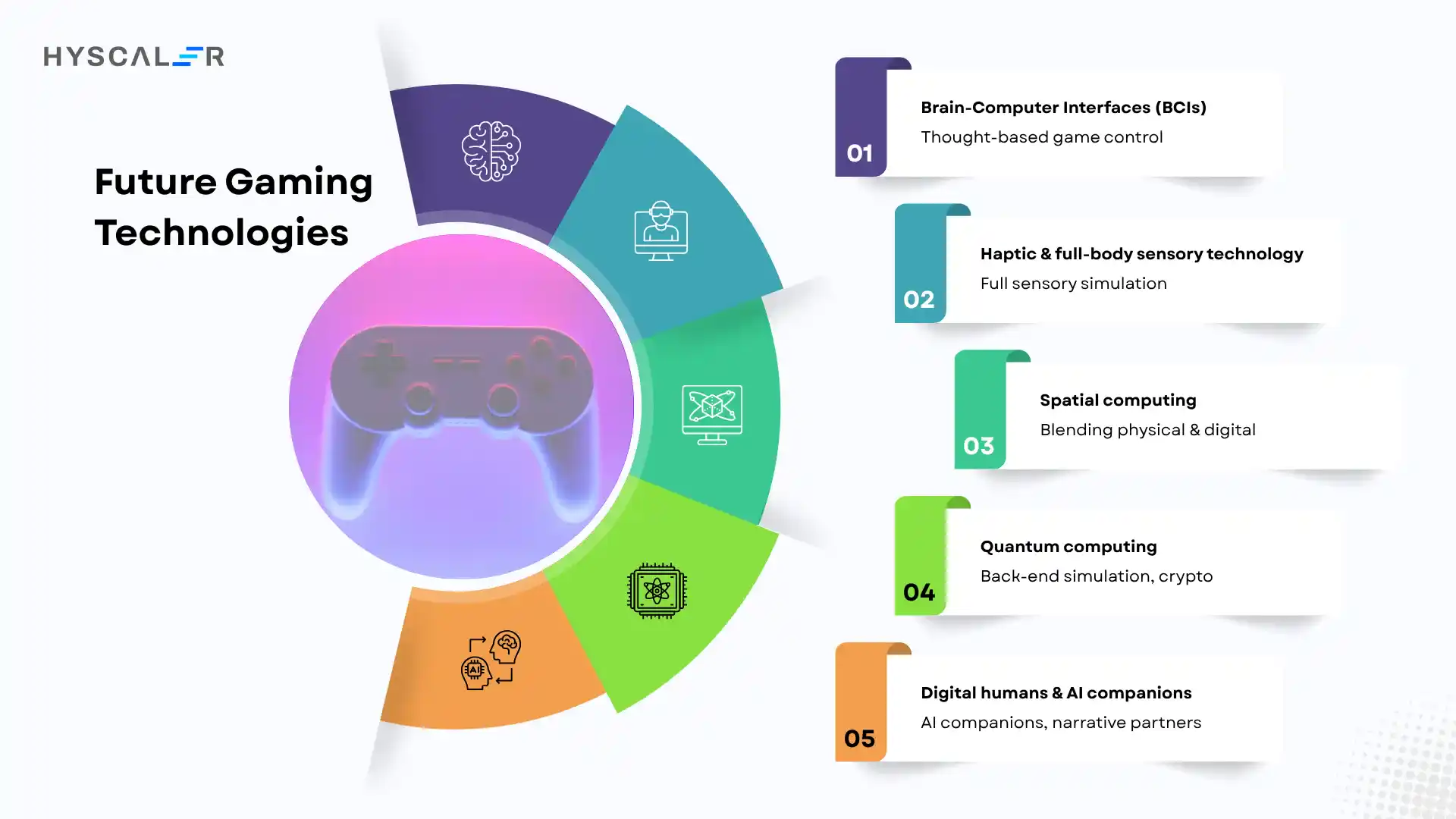
But the next wave is already forming:
- Brain-Computer Interfaces (BCIs) – Companies like Neuralink are advancing non-invasive BCIs that could eventually allow thought-based game control. Still early, but the research is serious.
- Haptic and full-body sensory technology – Moving beyond vibration controllers to full haptic suits and gloves that simulate physical sensation in virtual environments.
- Spatial computing – Apple Vision Pro and its successors are pushing spatial interfaces that blend physical and digital in new ways for gaming.
- Quantum computing – Not imminent for consumer gaming, but relevant for back-end simulation, cryptography in blockchain games, and complex AI training.
- Digital humans and AI companions – Hyper-realistic AI characters that serve as persistent companions, coaches, or narrative partners across sessions.
How Gaming Companies Can Stay Ahead
Technology adoption alone isn’t a strategy.
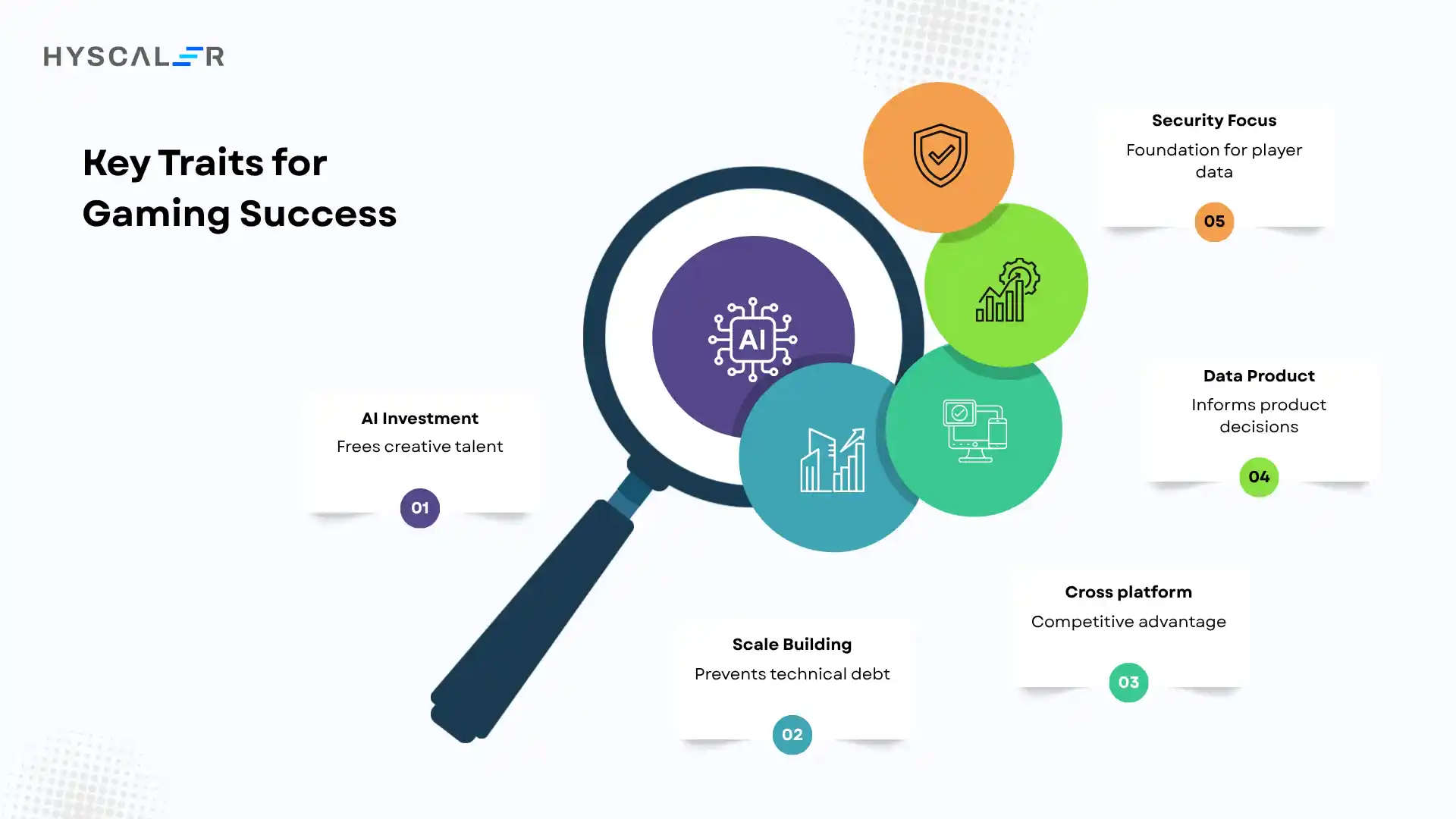
The gaming companies winning in 2026 share a few key traits:
They invest early in AI and automation. Not as a cost-cutting measure, but as a capability multiplier freeing creative talent from repetitive tasks.
They build for scale from day one. Cloud-native infrastructure, modular codebases, and scalable data pipelines prevent the technical debt that slows growth.
They prioritize cross-platform from the start. Retrofitting cross-play into an existing game is painful. Building for it from the ground up is a competitive advantage.
They treat data as a product. Not just a reporting layer, but a live feedback mechanism that informs every product decision.
They take security and privacy seriously. With player data, financial transactions, and digital assets all in play, security isn’t a feature; it’s a foundation.
Final Thoughts
The gaming industry in 2026 isn’t just growing, it’s transforming.
The technologies driving that transformation, AI, generative tools, cloud infrastructure, blockchain, and immersive hardware, aren’t independent trends.
They’re converging into a new kind of interactive experience that’s more personal, more persistent, and more connected than anything that came before.
For gaming companies, the question isn’t whether to engage with these technologies.
It’s how fast, and with the right partners.
HyScaler works with gaming companies at every stage, from building AI-powered recommendation engines to architecting cloud infrastructure for live service games to launching Web3 economies.
If you’re ready to move faster and build smarter, let’s talk.
Looking for more insights on AI, cloud, and digital transformation for technology-driven industries? Explore HyScaler’s blog and services.
FAQs
What are the latest technologies shaping the gaming industry in 2026?
The latest gaming technologies in 2026 include Artificial Intelligence (AI), Generative AI, Cloud Gaming, Virtual Reality (VR), Augmented Reality (AR), Blockchain, Web3 gaming, 5G connectivity, Edge Computing, and advanced graphics technologies such as Ray Tracing and real-time rendering.
How is AI transforming the gaming industry?
AI is transforming gaming by enabling intelligent NPCs, personalized gameplay experiences, dynamic difficulty adjustment, automated game testing, real-time player analytics, and AI-generated content. These innovations help developers improve player engagement while reducing development costs.
What is Generative AI in game development?
Generative AI is a technology that creates game assets, characters, environments, dialogue, music, and storylines automatically. It helps game studios accelerate content production and build more personalized gaming experiences at scale.
Why is cloud gaming becoming more popular?
Cloud gaming allows players to stream games directly from remote servers without needing expensive gaming hardware. This accessibility, combined with subscription-based gaming services and cross-device compatibility, is driving its rapid adoption worldwide.
How does blockchain technology impact gaming?
Blockchain technology enables true digital ownership of in-game assets, transparent gaming economies, NFT-based items, and secure peer-to-peer transactions. It also supports cross-game asset interoperability and decentralized gaming ecosystems.
What role does VR and AR play in the future of gaming?
VR and AR technologies create immersive gaming experiences by blending digital and physical environments. As hardware becomes more affordable and powerful, these technologies are expected to play a major role in gaming, training simulations, and interactive entertainment.