

Table of Contents
Businesses today are rethinking how they build software. Rather than growing every function in-house, more companies are turning to dedicated development teams and external specialists who plug into a project with the commitment and focus of an internal hire, minus the overhead.
Working with a software development agency gives businesses access to specialized expertise without months of interviewing and onboarding. But the real value goes well beyond convenience; a well-chosen dedicated team can shape how efficiently a project moves and how well it scales.
Here’s what a dedicated team actually looks like, when it makes sense for your business, and the six steps to hiring one the right way.
What is a Dedicated Software Development Team?
- A dedicated software development team is a model of long-term collaboration where you partner with an external team of developers tailored to meet your specific business goals. This model stands as one of the preferred methods for project development, alongside fixed-price and time-and-material contracts.
- Opting for a dedicated team means having a group of skilled professionals who function similarly to an in-house team but without the overheads related to HR, tax, and benefits management.
- This arrangement allows you to focus on strategic business challenges while the development team handles the technical workload, essentially providing you with a seamless extension of your own company focused on delivering your project.
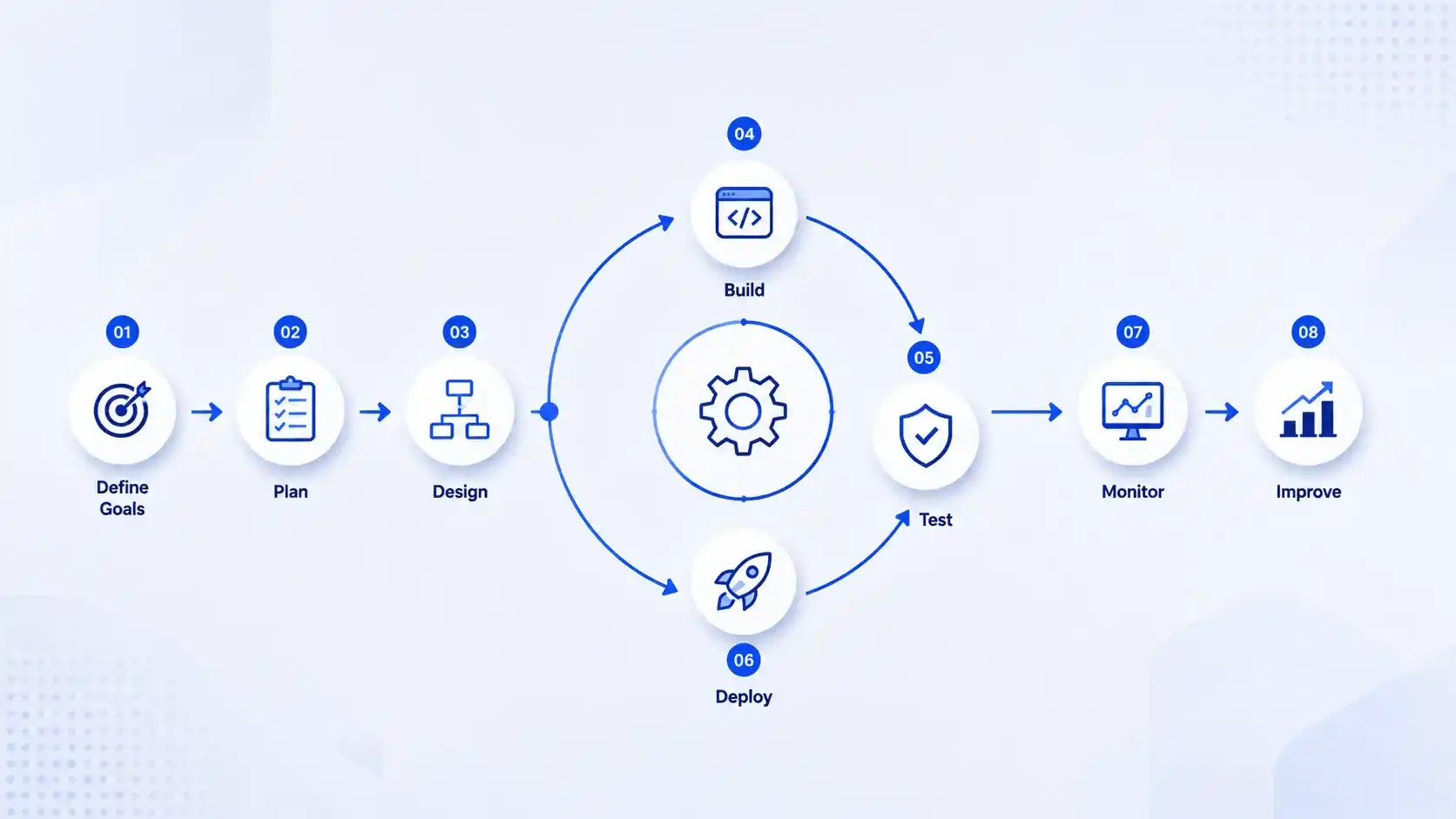
The composition of a dedicated development team is flexible, tailored to your project’s requirements, and can include a range of specialists:
- Front-end and back-end developers, including full-stack and mobile developers
- UX/UI designers
- DevOps engineers
- Quality assurance experts
- Business analysts
- Product and project managers
When Should You Consider Hiring A Dedicated Development Team?
The dedicated team model is ideal for complex, evolving projects requiring a committed team for long-term success. It’s particularly suited for situations like the following:
- Early-Stage Startups: For startups poised for growth, a dedicated team can rapidly scale your development capabilities, reduce recruitment overheads, and speed up product development, allowing your core team to concentrate on business priorities.
- Companies with Limited Budgets: Small businesses or startups in high-cost regions can find it more economical to engage a dedicated team from countries with lower labor costs, without compromising on talent quality and expertise.
- Projects with Fluid Requirements: Projects in the ideation phase or those needing extensive discovery benefit greatly from the flexibility of a dedicated team, providing the necessary bandwidth to refine project scopes without fiscal strain.
- Long-Term Projects: For projects with a vision that extends into the future, a dedicated team ensures continuity, commitment, and a deep understanding of project goals, ensuring consistent progress toward long-term success.
6 Steps for Hiring A Dedicated Development Team
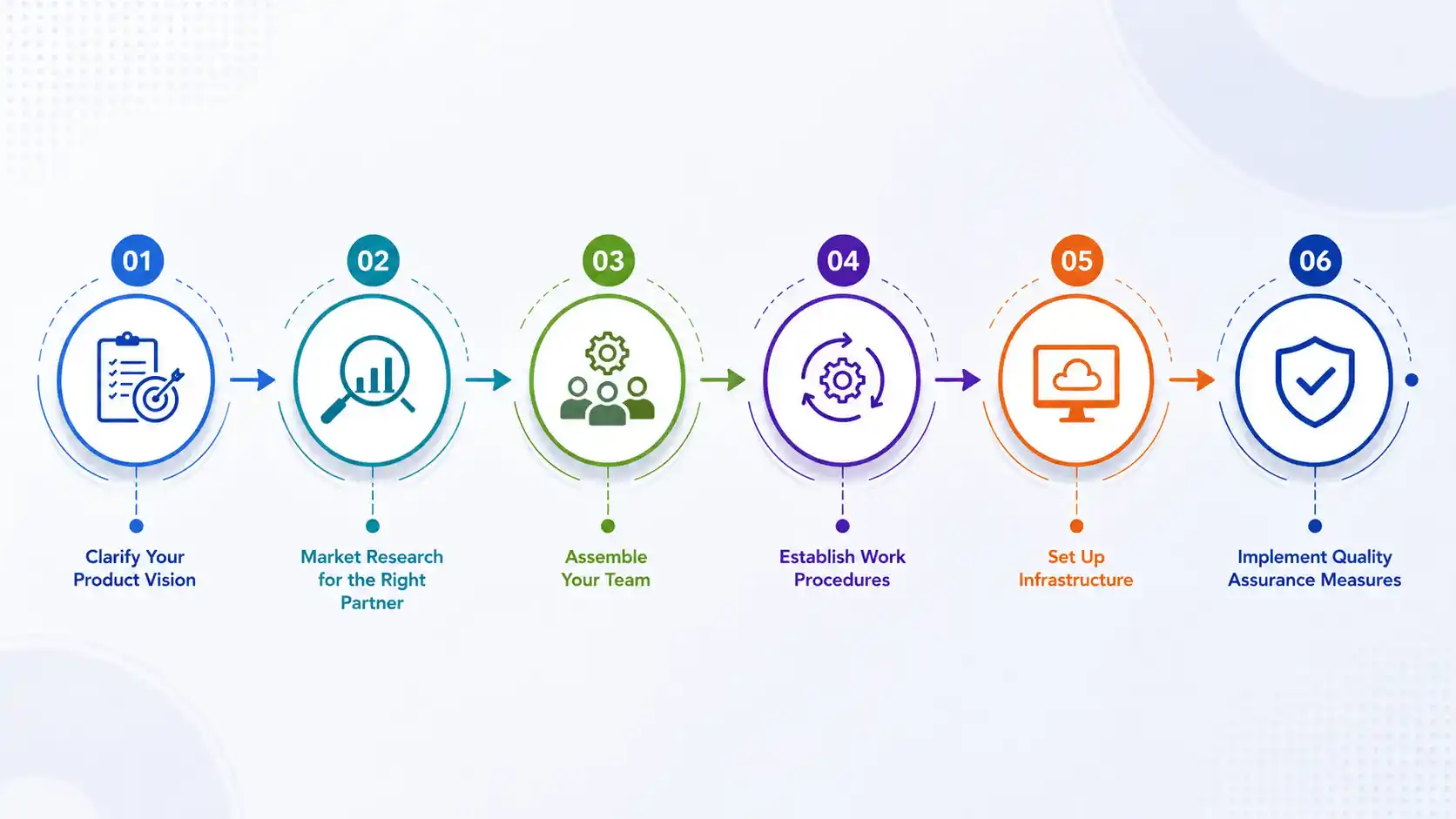
Hiring a dedicated development team is a strategic move for any project, demanding a methodical approach from the initial vision to execution. Here’s a refined guide on how to accomplish this:
1. Clarify Your Product Vision
The takeaway: An external team can only build what you can clearly explain.
Your dedicated team won’t inherit years of context about your company the way an in-house hire might. Every assumption you don’t write down becomes a question later, or worse, a wrong guess. A sharp product vision is what turns a vague idea into a buildable plan.
Do this:
- Write down the core problem and target user in one paragraph
- Separate must-haves from nice-to-haves
- Set a budget range grounded in real scope
- List any systems or platforms the product must integrate with
2. Market Research for the Right Partner
The takeaway: The cheapest option and the right option are rarely the same one.
This is where most of the long-term risk in the engagement gets decided. A vendor’s location, past work, and security posture will shape how smoothly or roughly the next twelve months go.
Do this:
- Weigh onshore, offshore, and nearshore trade-offs against your budget and timezone needs
- Study portfolios for projects similar in scale or industry
- Talk to at least one past client if you can
- Ask directly about security certifications and data handling
3. Assemble Your Team
The takeaway: A dedicated team is only as strong as its weakest role gap.
Once you’ve picked a vendor, the real team-building starts. This might mean reviewing resumes, sitting in on interviews, or trusting the vendor’s internal staffing, but either way, the roles need to match the actual shape of the work ahead.
Do this:
- Map out every role the project needs, not just developers and QA
- Review CVs and portfolios for role-specific fit
- Sit in on interviews wherever your contract allows it
- Confirm working hours overlap enough for real-time collaboration
4. Establish Work Procedures
The takeaway: A great team without a shared process still ships late.
Agile is the default for a reason; it adapts well to changing requirements, but what matters most is that everyone, internal and external, is working from the same playbook.
Do this:
- Pick a methodology and stick to it: Agile, Scrum, or Kanban
- Set a sprint rhythm with standups and review checkpoints
- Define who signs off on decisions and how escalations work
- Agree on how and how often progress gets reported
5. Set Up Infrastructure
The takeaway: The right tools remove friction before it starts.
Communication gaps are the single biggest threat to a distributed team. Solid infrastructure plus one clear point of contact on your side keeps everyone aligned without constant back-and-forth.
Do this:
- Set up shared communication channels from day one
- Configure a shared project and issue-tracking tool
- Lock down version control and access permissions
- Name an internal liaison responsible for check-ins
6. Implement Quality Assurance Measures
The takeaway: QA built in from the start costs less than QA bolted on at the end.
Testing shouldn’t be the last box checked before launch; it should run alongside development the whole way through, catching problems while they’re still cheap to fix.
Do this:
- Define both functional and non-functional test requirements upfront
- Assign a dedicated QA owner or team
- Set severity levels and resolution timelines for bugs
- Build QA checkpoints into every sprint, not just the final one

Final Thoughts on Hiring a Dedicated Development Team
Opting for hiring a dedicated development team not only offers access to top-tier talent at a cost-effective rate but also flexibly caters to projects of various durations, whether long-term, short-term, or one-off initiatives. To truly capitalize on this model, businesses must grasp the nuances of engaging and collaborating with outsourced teams effectively.
Meanwhile, hiring a dedicated development team brings a wealth of expertise and experience to the table, ensuring that the tech projects are not only completed efficiently but also aligned with the latest industry standards and practices.
Hiring a dedicated development team offers a strategic advantage that transcends the mere completion of tech-related tasks; it allows your business to zero in on its core competencies with an unparalleled focus.
In today’s rapidly evolving technological landscape, the ability to adapt and innovate while maintaining a laser-sharp focus on what your business does best is not just beneficial; it’s critical for survival and growth.
FAQs
How much does a dedicated development team cost?
It depends on region, seniority, and project scope. Offshore teams tend to be the most cost-effective, while onshore/nearshore costs more but cuts communication friction. Most providers bill a monthly retainer per team member; get a role-by-role rate breakdown before signing.
What’s the difference between a dedicated team and staff augmentation?
Augmentation adds individuals to your existing team and process. A dedicated team is a self-contained unit that owns a defined scope end-to-end, often with its own PM. Need extra hands for your process? Go augmentation. Need a team to own a feature or product? Go be dedicated.
Who owns the code and IP?
In a properly structured agreement, you retain full ownership of all code and IP. Don’t assume this; get it spelled out explicitly in the contract, and have a lawyer review the assignment and confidentiality clauses.
What security measures should I expect from a dedicated team vendor?
Look for NDAs, role-based access controls, secure VPNs, and compliance certifications relevant to your industry (SOC 2, ISO 27001, etc.). Ask the vendor to walk you through their data-handling policy before signing anything.
What’s a realistic timeline to see the first working deliverable?
For most projects, a functional first sprint output lands within two to four weeks of kickoff, assuming requirements were clear going in. Complex integrations or unclear scope can push this further out.