

Table of Contents
Warehouses that still run on spreadsheets, manual cycle counts, and on-premise servers are bleeding time and money and losing ground to competitors who’ve already moved on. Order volumes keep climbing. Customers expect two-day or same-day delivery.
The old approach of duct-taping legacy tools together just doesn’t hold up anymore. Picking a cloud-based warehouse management system is probably the biggest technology call your supply chain team will make this year, and the sheer number of vendors pitching near-identical promises makes the process feel like drinking from a fire hose.
You need a framework that cuts through the noise. Seth Godin talks about the Purple Cow, the idea that in a world full of boring products, only the truly remarkable ones get noticed. The right WMS shouldn’t just digitize your warehouse. It should change how your warehouse competes. This guide covers the criteria that actually matter: features, true costs, security, rollout strategy, and long-term flexibility.
Understanding the Evolution of the Cloud Warehouse Management System
Ten years ago, warehouse management software sat on local servers, managed by IT teams who spent weekends patching systems and praying nothing broke. That model made sense when order profiles were predictable and distribution networks were simple. But by 2026, supply chains touch multiple geographies, sales channels, and fulfillment methods. The push toward cloud warehouse management reflects something the industry has learned the hard way: agility matters more than hardware ownership.
According to industry research, including data captured in supply chain technology surveys, 71 percent of mid-market distributors have either fully migrated to or are actively evaluating a cloud-native WMS. This represents a substantial surge from just 48 percent three years prior, highlighting an accelerating industry-wide pivot toward cloud adoption.
Key Differences Between On-Premise and Cloud WMS
On-premise systems need upfront licensing, a dedicated server room, and people to manage upgrades. A cloud WMS system runs on the vendor’s infrastructure and pushes updates automatically. You pay a recurring subscription instead of a big capital outlay. Downtime for version upgrades, once measured in days, drops to minutes on well-architected platforms.
The trade-off: you’re tied to the vendor’s roadmap and release cadence. So before signing a multi-year deal, look at their track record. How often do they ship meaningful updates? Do existing customers feel heard on feature requests?
The Scalability Benefits of Cloud-Based Warehouse Management
Peak season is the stress test every warehouse dreads. With on-premise software, scaling means buying more server capacity months ahead of time and hoping your volume forecast holds up.
Cloud-based warehouse management lets you dial compute resources up or down on demand, adding users or processing power when holiday rushes and flash sales hit, then pulling back during slower months so you’re not paying for idle capacity. For companies running multiple facilities, a single cloud instance can unify inventory visibility without the headache of syncing separate on-premise databases.
Essential Features to Look for in a Cloud WMS System
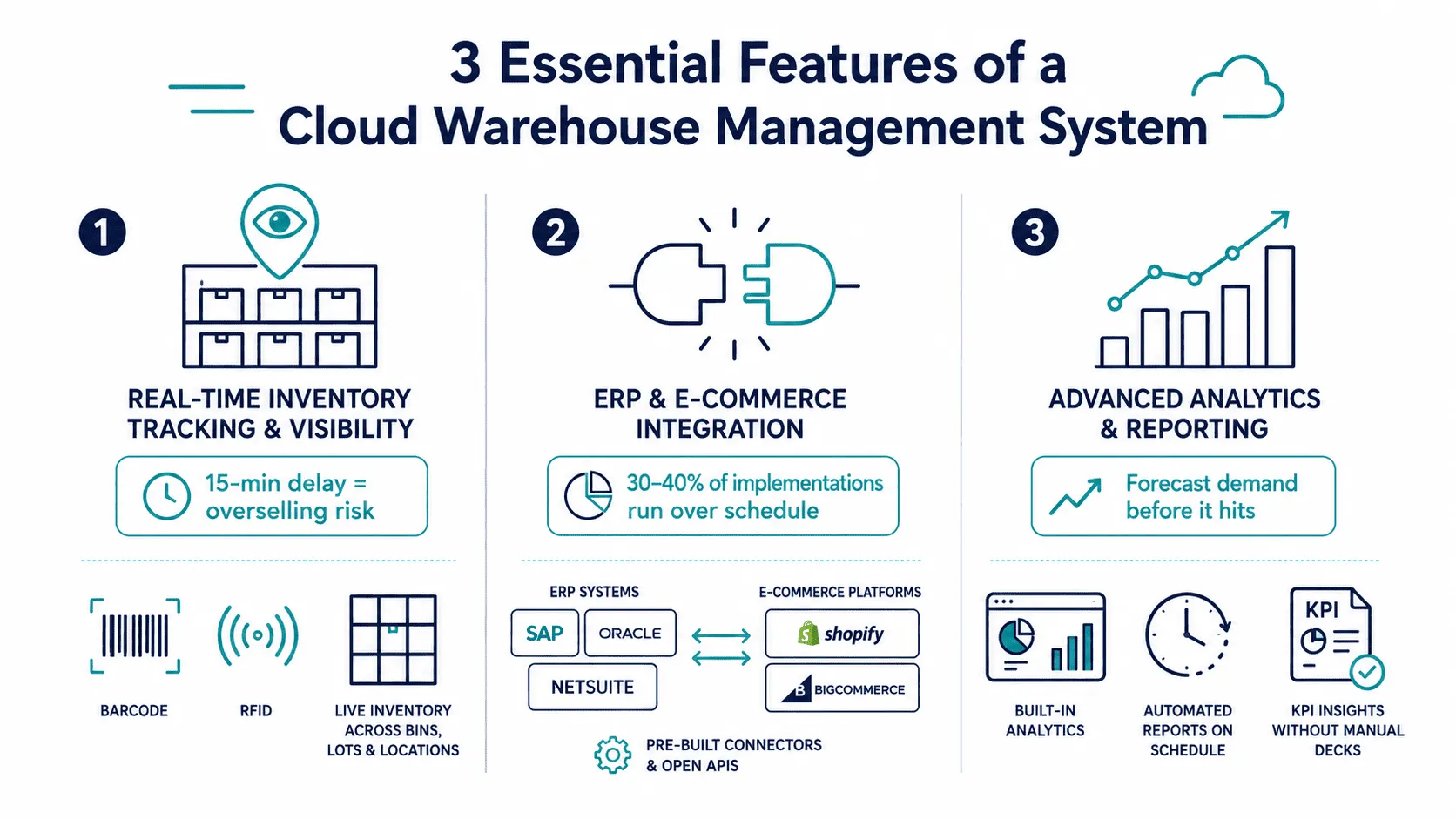
Vendor feature lists can run for pages. But three capabilities consistently separate the platforms that actually perform from the ones that just demo well. Focus here first. Everything else is secondary until these boxes are checked.
Real-Time Inventory Tracking and Visibility
Your warehouse is only as good as your inventory data. A solid cloud WMS gives you real-time stock-level updates across every location, bin, and lot. Look for platforms that support barcode, RFID, and, where it makes sense, computer-vision-based tracking. Real-time visibility trims safety stock, cuts mis-ships, and makes available-to-promise calculations reliable across your sales channels. One thing to push vendors on: ask for specific latency numbers. “Near real-time,” that’s actually delayed by 15 minutes, can still cause overselling during traffic spikes.
Integration with ERP and E-commerce Platforms
No WMS works alone. Your platform needs clean connections to ERP systems like SAP S/4HANA, Oracle Cloud, or NetSuite, plus e-commerce storefronts on Shopify, BigCommerce, or custom headless setups. Check whether the vendor offers pre-built connectors or pushes you toward third-party middleware. Pre-built integrations speed up implementation.
Open APIs give your dev team room to build custom workflows. Here’s the thing worth knowing: industry research consistently ranks integration complexity as the top reason cloud WMS projects blow past their original timelines. Studies suggest 30 to 40 percent of implementations face significant overruns, often because connecting legacy ERP systems to modern cloud platforms turns out to be harder than anyone expected. Scrutinize this area hard.
Advanced Analytics and Automated Reporting
Dashboards that show what happened yesterday are table stakes. The real value is in predictive and prescriptive analytics forecasting demand spikes before they hit, recommending slotting changes, and flagging labor shortages before they become bottlenecks. Ask whether the platform includes built-in machine learning models or if you’ll need a separate BI tool bolted on. Automated reporting that drops KPI summaries into stakeholders’ inboxes on a schedule also eliminates the weekly grind of compiling performance decks by hand.
Evaluating the Total Cost of Ownership for Cloud WMS
Subscription pricing looks clean on a vendor’s website, but the real cost of a cloud-based WMS goes well beyond the monthly invoice. Getting the full picture upfront prevents the kind of budget surprises that erode executive trust in the project.
Subscription Models and Hidden Implementation Fees
Most vendors price by user count, transaction volume, or a mix of both. Get specific on how they define “transactions.” Does a single order with five line items count as one transaction or five? Implementation fees for data migration, workflow setup, and integration work can easily equal six to twelve months of subscription costs, and for complex mid-market deployments requiring deep ERP integration, they frequently trend toward the upper end of that scale.
That’s a number that catches a lot of teams off guard. Request a detailed statement of work before signing, and push for fixed-price implementation milestones rather than open-ended time-and-materials deals. Tie each payment to a clear deliverable.
Reduced Hardware and IT Maintenance Costs
The old model meant buying servers, building out network infrastructure, and keeping a team on call for patching and disaster recovery. Moving to the cloud eliminates most of those expenses. Your IT people can spend their time on projects that move the business forward instead of babysitting aging hardware. But don’t assume zero infrastructure cost; you’ll still need reliable warehouse Wi-Fi, scanning devices, and possibly edge computing nodes for facilities with spotty connectivity. Build those into your total cost model.
Assessing Security and Reliability in a Cloud-Based WMS
Handing your inventory and order data to a third-party provider raises real security questions. A good vendor welcomes those conversations. If they deflect, that’s a red flag.
Data Encryption and Compliance Standards
At minimum, require AES-256 encryption for data at rest and TLS 1.3 for data in transit. If your operations touch regulated industries, such as pharmaceuticals, food and beverage, confirm the platform supports FDA 21 CFR Part 11 compliance, which means electronic signatures and tamper-proof audit trails. SOC 2 Type II certification should be a baseline expectation, not an upsell.
Ask for the most recent audit report and actually read the noted exceptions. GDPR and regional data residency rules also matter if you run warehouses across the EU, the UK, or Asia-Pacific.
Uptime Guarantees and Disaster Recovery Protocols
A warehouse that can’t process orders because the system is down loses revenue by the minute. Look for service-level agreements that guarantee 99.95 percent or higher uptime, with financial credits when they miss. Just as important is the vendor’s disaster recovery setup.
Multi-region failover, automated backups with point-in-time recovery, and a published Recovery Time Objective (RTO) of under one hour are reasonable asks for enterprise-grade platforms in 2026, provided they use automated failover rather than manual recovery processes. Ask the vendor to walk you through their last major incident: what happened, how long it lasted, and what they changed afterward. Transparency here tells you a lot about how they actually operate.
Implementation Strategies for a Successful Transition
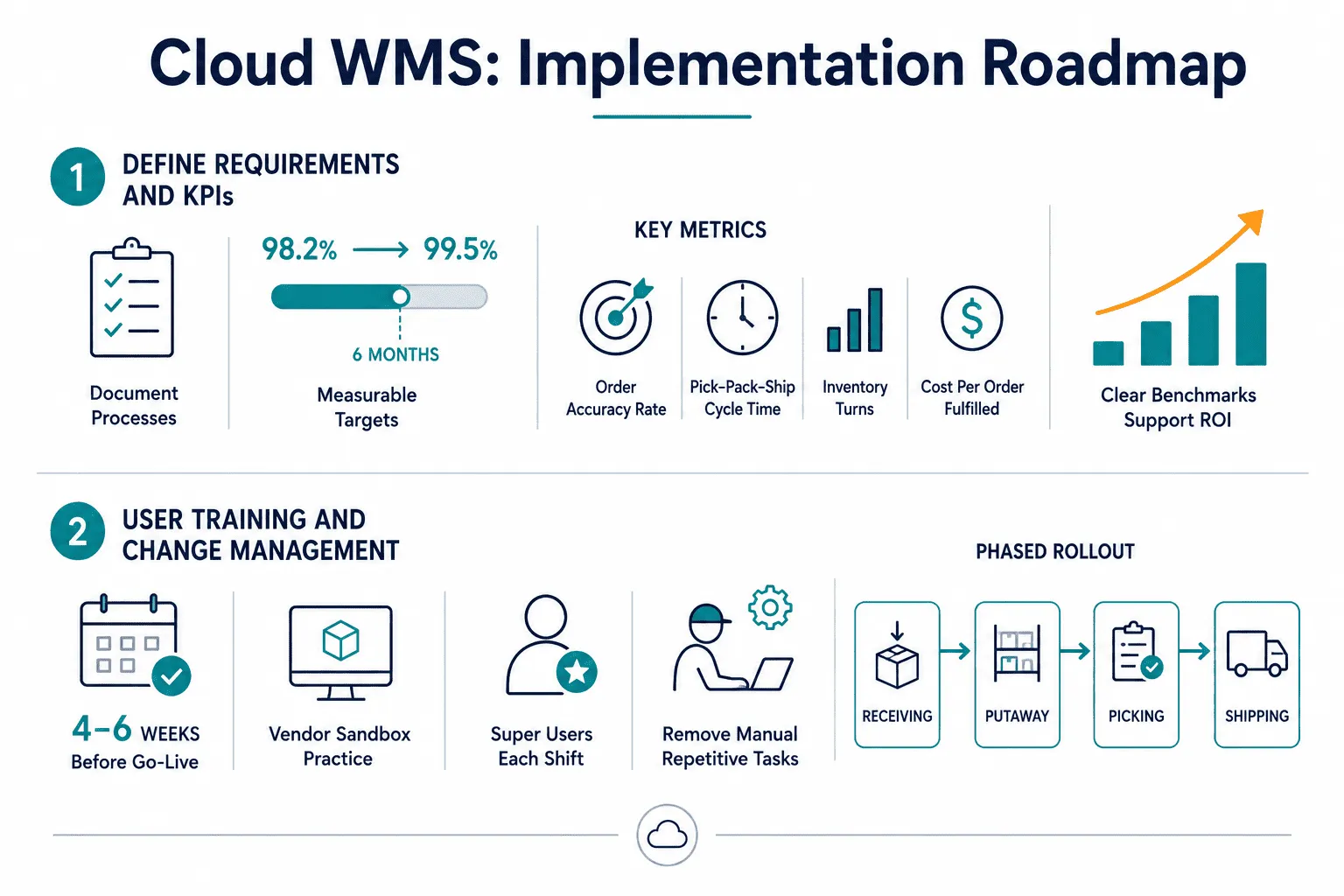
Even the best cloud WMS will underdeliver if the rollout goes sideways. A structured implementation plan is the bridge between picking the right software and getting real results from it.
Defining Your Operational Requirements and KPIs
Before configuring a single workflow, document your current processes and nail down what specific outcomes you expect from the new system. Standard KPIs include order accuracy rate, pick-pack-ship cycle time, inventory turns, and cost per order fulfilled. Set concrete targets “improve order accuracy from 98.2 percent to 99.5 percent within six months,” for example.
Those benchmarks keep the project team honest and give leadership something tangible to evaluate when it’s time to measure return on investment. Without defined KPIs, success becomes a matter of opinion, and that’s hard to defend during budget reviews.
User Training and Change Management Best Practices
Technology projects fail when warehouse workers see the new system as extra work rather than a genuine improvement. Start training early, four to six weeks before go-live, and use the vendor’s sandbox environment so people get hands-on practice with real workflows. Identify “super users” on each shift who can coach their peers after launch.
Address pushback directly: explain how the system removes tedious tasks like manual data entry and double-checking. A phased rollout, starting with receiving and putaway, before expanding to picking and shipping, limits risk and builds confidence step by step.
Future-Proofing Your Supply Chain with Modern Cloud Technology
Choosing a cloud warehouse management system isn’t a one-time purchase. It’s an ongoing partnership with your vendor. The platforms that will matter most in 2028 and beyond are investing in AI-driven demand sensing, autonomous mobile robot integrations, and a composable architecture that lets you swap out modules without ripping out the whole system. Your competitive edge in supply chain operations isn’t just having a cloud WMS; it’s having one that keeps pace with how fast your market moves. Look at vendor roadmaps. Join their customer advisory boards.
Negotiate contractual commitments on feature delivery timelines. The companies that treat this decision as a strategic investment, not just a procurement checkbox, will be the ones setting the pace for their industry. Start your evaluation with the framework laid out here, pressure-test every vendor claim with your own data, and build a warehouse operation that’s ready for whatever comes next.