

Table of Contents
Introduction
App development looks straightforward from the outside: have an idea, hire a team, and ship it. In reality, it’s one of the most failure-prone processes in tech, and most of those failures trace back to a handful of predictable, avoidable mistakes rather than bad code.
This blog breaks down the four biggest challenges that derail app development projects and pairs each one with the practical strategy that solves it:
- Inadequate Requirement Analysis → Thorough Requirement Analysis: why unclear scope is the single most common root cause of failed projects, and how detailed upfront planning fixes it before development even starts
- Integration Issues → Planning for Integration: how to map third-party APIs, legacy systems, and compatibility risks before they surface mid-build
- Lack of Skilled Resources → Investing in Skills and Training: where the talent shortage actually hurts teams, and how to build capability instead of just chasing hires
- Time and Budget Constraints → Accurate Estimation and Agile Methodology: why estimates go wrong so often, and what realistic estimation looks like in practice
Whether you’re a founder scoping your first app, a product manager overseeing a team, or a developer trying to explain delays to stakeholders, this guide gives you a clear map of where projects typically go wrong and the exact strategy to steer around each one.
Understanding the Common App Development Challenges
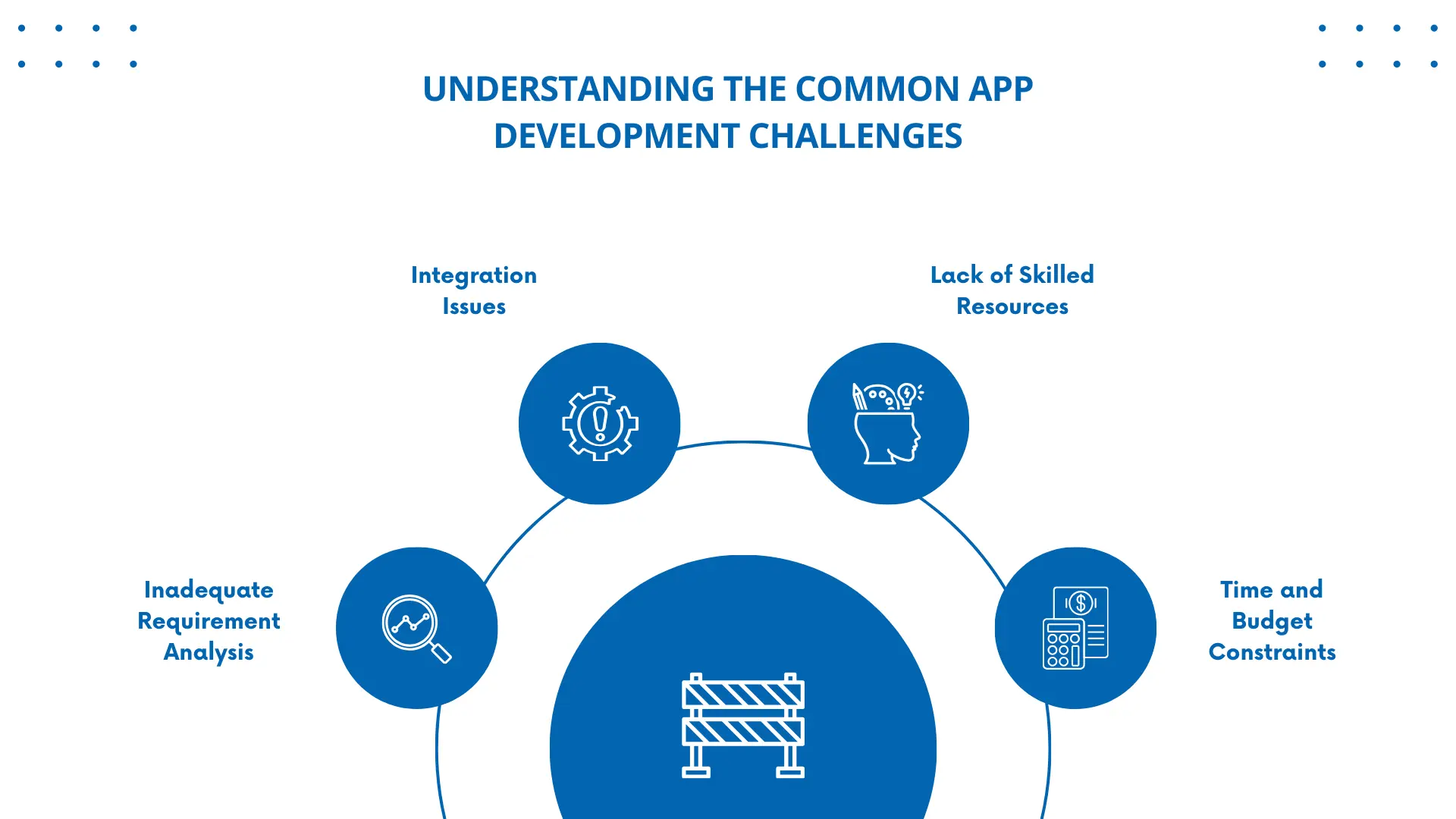
Inadequate Requirement Analysis
- What it is: A lack of comprehensive understanding of the project’s actual requirements before development begins.
- Why it happens: Teams rush from idea to build without engaging stakeholders deeply enough or assume requirements are “obvious” when they aren’t yet defined on paper.
- Where it arises: Most often at the very start of a project during initial scoping calls, when a client’s vision is still vague, or when internal teams skip formal documentation in favor of moving fast.
- Why it matters: Ambiguous scope compounds over time. Features get built, then rebuilt once real needs surface mid-project, and budget estimates drift further from reality the longer requirements stay undefined. Misaligned expectations and market misunderstanding are consistently cited as the leading root cause behind failed app projects.
Integration Issues
- What it is: Difficulty getting the app to communicate reliably with other software systems it depends on.
- Why it happens: Modern apps are rarely standalone; they need to talk to payment gateways, CRMs, analytics platforms, and third-party APIs, each with its own quirks, rate limits, and documentation gaps.
- Where it arises: Typically mid-build, once development hits a legacy system, an undocumented API, or a data format mismatch that wasn’t visible during planning.
- Why it matters: Integration problems discovered mid-project are the most expensive kind; they force rework on already-built features and can stall timelines while a workaround is found.
Lack of Skilled Resources
- What it is: Difficulty sourcing and retaining developers with up-to-date skills in the frameworks, security practices, and platforms the project needs.
- Why it happens: Technology evolves faster than most hiring pipelines can keep up with, and skilled developers are in high demand across the entire industry, not just within one company.
- Where it arises: Most visible during hiring and staffing phases, but its effects show up later in rushed code, technical debt, and security gaps introduced by under-qualified team members filling urgent gaps.
- Why it matters: A skills gap doesn’t just slow hiring; it lowers the quality ceiling of the entire build, creating rework costs that surface long after the team is in place.
Time and Budget Constraints
- What it is: Misjudging or underestimating the deadline and financial boundaries a project actually needs.
- Why it happens: Estimates are often based on optimism or incomplete scope rather than historical data, especially when requirement analysis (the first challenge above) was already weak.
- Where it arises: Surfaces gradually throughout the project but becomes unavoidable near the end, when testing phases get squeezed to protect the launch date.
- Why it matters: Squeezed testing is rarely the savings it appears to be; errors caught late or after release are consistently far more costly to fix than issues caught earlier in the design phase.
Strategies for Overcoming These Challenges
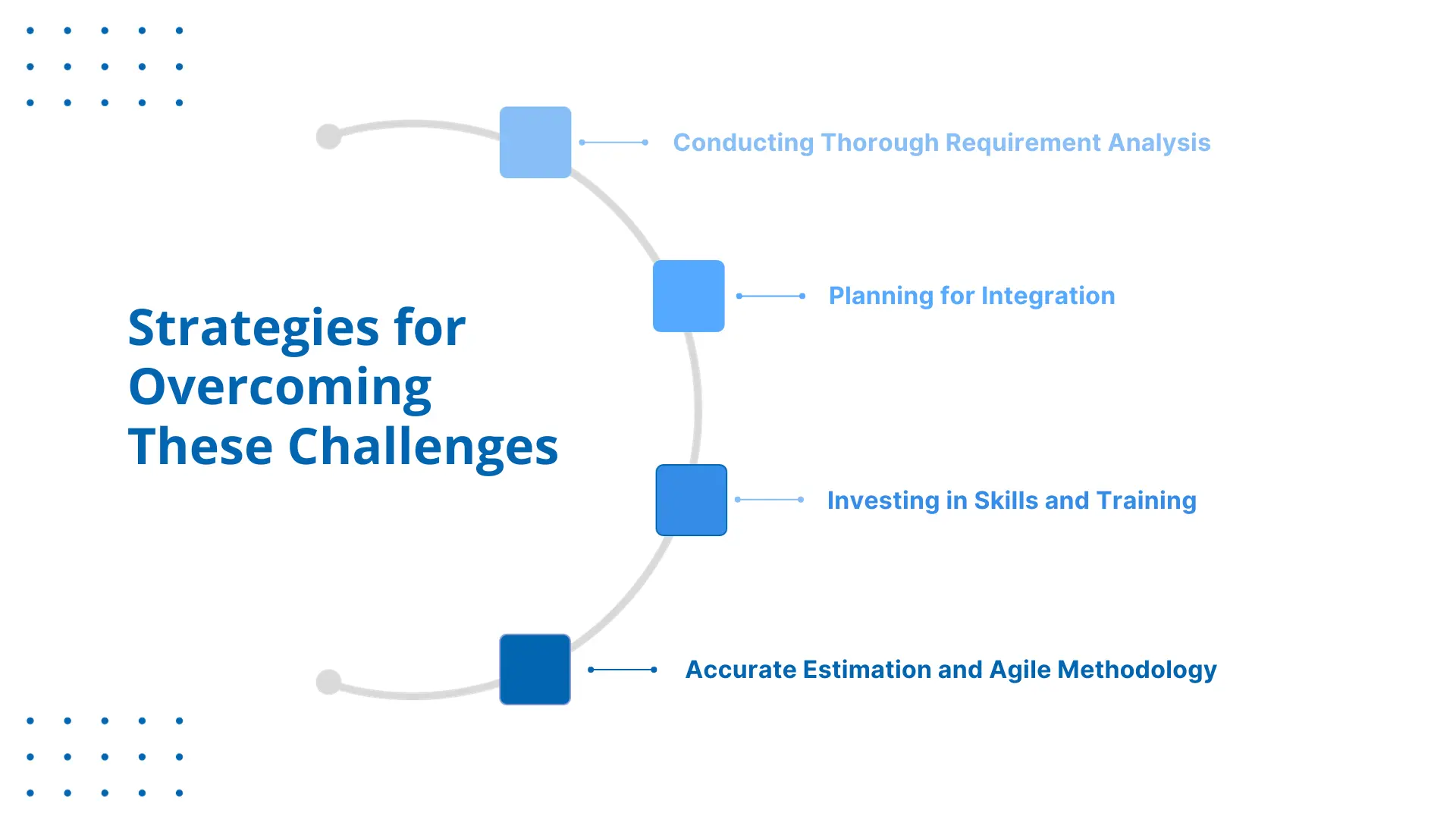
Conducting Thorough Requirement Analysis
- What to do: Run structured discovery before development starts: scoping workshops, stakeholder interviews at every level, and written documentation that all parties sign off on.
- Why it works: It replaces assumptions with confirmation. Requirements get resolved on paper, in a conversation, instead of being discovered mid-build when changing course is expensive.
- When to apply it: Before a single line of code is written, and again whenever new scope is proposed; every addition is treated as a formal change request, not a quick ask.
- What you gain: A stable foundation that prevents building, then rebuilding, the same feature twice; keeps client and team expectations aligned from day one; and gives the project a reliable base for accurate time and cost estimates later on.
Planning for Integration
- What to do: Map every external system the app needs to talk to payment processors, CRMs, legacy databases, and third-party APIs before development begins.
- Why it works: It turns integration from a mid-build surprise into an upfront architecture decision, so compatibility risks are designed around instead of reacted to.
- When to apply it: During planning and architecture, in parallel with requirement analysis, not after development has already started building around assumptions.
- What you gain: No mid-build fire drills over incompatible or undocumented systems, no rework on features already built around the wrong assumptions, and faster access to the right specialist, brought in early instead of during a crisis.
Investing in Skills and Training
- What to do: Build capability continuously through ongoing training, and pair experienced developers with less-experienced ones on the same team.
- Why it works: It treats the skills gap as something to grow past, not just hire around, reducing dependence on scrambling for talent every time a gap appears.
- When to apply it: As a standing practice throughout the project, not only once a gap becomes urgent enough to force a rushed hire.
- What you gain: Less reliance on rushed, under-qualified hires under time pressure, lower risk of technical debt from inexperienced developers working unsupported, and better retention, since developers stay longer on teams that invest in them.
Accurate Estimation and Agile Methodology
- What to do: Ground estimates in experience and historical data at kickoff, then manage delivery through iterative agile checkpoints instead of a single end-loaded push.
- Why it works: It distributes risk and testing across the whole timeline instead of concentrating it at the end, where there’s no room left to absorb problems.
- When to apply it: Estimation happens at project kickoff, informed by the same requirement analysis above; agile checkpoints then run continuously through development.
- What you gain: Issues caught early while they’re still cheap to fix, stakeholder visibility into progress and risk at every checkpoint rather than only at the deadline, and room to absorb scope changes without blowing up the entire timeline.
Conclusion
Navigating the complexities of app development can be daunting, but with a strategic approach, the common challenges can be managed effectively. Remember, every challenge presents an opportunity for learning and growth. So, embrace the hurdles, learn from them, and continuously strive to improve your app development process.
And remember, you don’t have to face these challenges alone. Our team of expert application developers is ready to assist you in every step of the process. We understand the intricacies of application development and have the experience to help you navigate these common challenges. If you’re looking for a partner to help ensure your next project’s success, contact us today.
Also read: Emerging App Development Trends in 2024
FAQs
How much does app development actually cost?
Simple apps typically run $10K–$50K, while complex builds with custom integrations can reach six figures; get a detailed spec before trusting any flat quote.
What is scope creep, and how do you avoid it?
Scope creep is when features keep getting added mid-build without adjusting the timeline or budget; lock requirements in writing before development starts, and treat every addition as a formal change request.
Freelancer, agency, or in-house team: which should I pick?
Freelancers suit small, well-defined builds; agencies fit larger-scoped projects; in-house only makes sense when the app is core to long-term product strategy.
What are the biggest technical challenges in mobile app development right now?
Device and OS fragmentation, integrating cleanly with third-party APIs, and maintaining consistent performance across platforms remain the top recurring technical hurdles.
How long does it realistically take to build and launch an app?
A focused MVP typically takes 8–16 weeks with a competent small team; anything quoted much faster usually means major scope cuts.