

Table of Contents
The global AI in healthcare industry use cases market is projected to reach $208 billion by 2030, and for good reason. Artificial intelligence is fundamentally reshaping how healthcare organisations deliver care, manage operations, and improve patient outcomes.
But what exactly does this transformation look like in practice?
AI in healthcare refers to the application of machine learning algorithms, deep learning models, and intelligent automation systems to medical processes, from diagnosis and treatment planning to administrative operations. The significance of AI in healthcare industry use cases extends beyond innovation; it addresses urgent challenges: a growing shortage of clinicians, overwhelming administrative burdens, rising healthcare costs, and the need for faster, more accurate diagnoses.
In this guide, we’ll explore the most impactful AI in healthcare industry use cases reshaping the medical landscape in 2026, their real-world applications, tangible benefits, and what healthcare leaders need to know to harness this technology effectively.
Why Is AI Becoming Essential in Healthcare?
Healthcare faces a perfect storm of challenges that artificial intelligence is uniquely positioned to solve. With a projected shortage of 11 million health workers by 2030 and clinicians spending up to 35% of their time on administrative paperwork, efficiency has become a matter of survival.
AI in healthcare industry use cases are no longer a nice-to-have; it’s a necessity. Consider the numbers:
- Close to 86% of healthcare providers are leveraging AI across their operations.
- Hospitals report an average $3.20 return for every $1 spent on AI implementation
- Growing patient demand, combined with constrained budgets, forces innovation
- Cost pressures on healthcare systems make automation increasingly critical
The transition from experimental technology to standard practice is happening now, making it essential for healthcare leaders to understand the practical applications and strategic value of AI in healthcare industry use cases.
Top AI in Healthcare Industry Use Cases in 2026
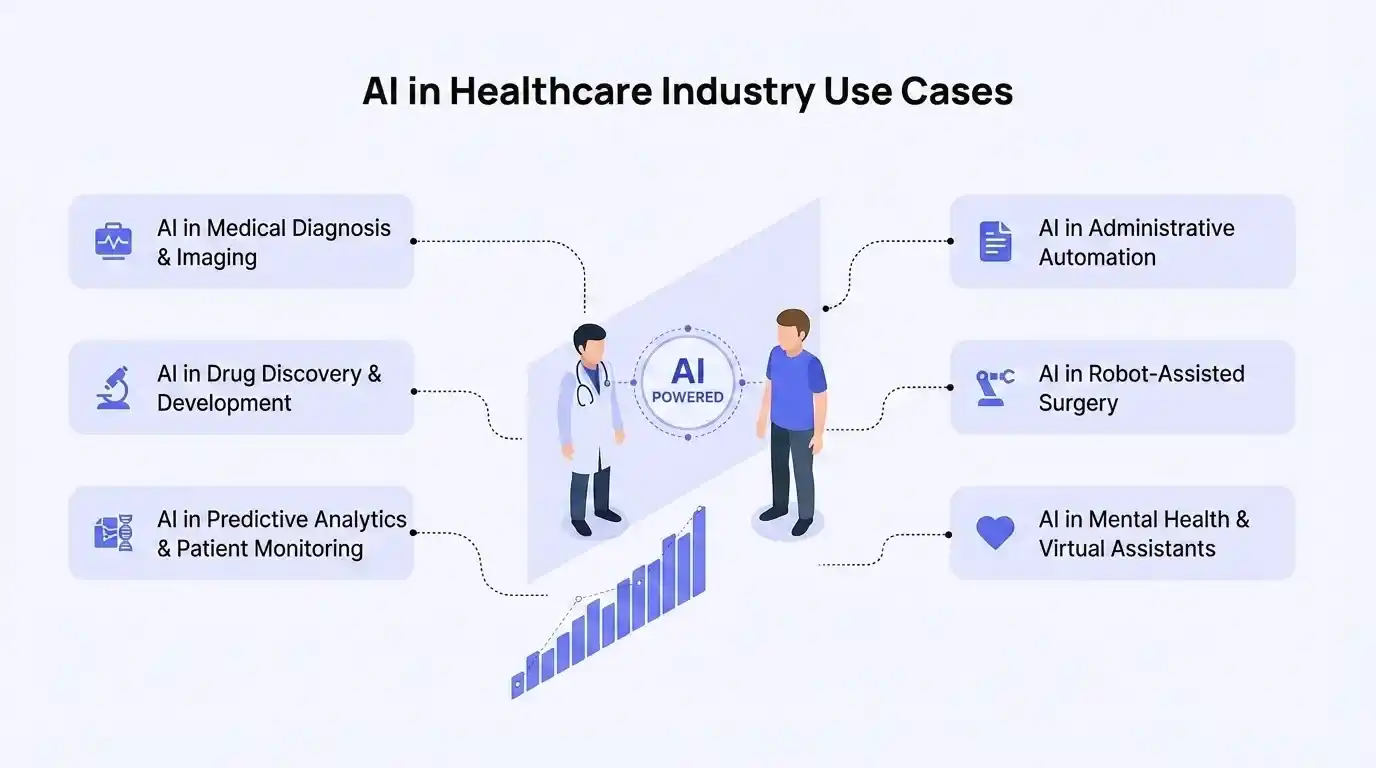
1. AI in Medical Diagnosis & Imaging
Medical imaging is where artificial intelligence has proven most impactful. AI algorithms can detect lesions, tumours, and abnormalities 26% faster than radiologists while maintaining or exceeding diagnostic accuracy.
Key Impact: 90% of healthcare organizations now use AI in healthcare industry use cases specifically for medical imaging analysis. This isn’t futuristic, it’s current practice.
Real-World Example: The FDA has already approved 692 AI-enabled medical devices, with radiology accounting for the largest share. Companies like IBM Watson for Oncology and Google DeepMind are transforming diagnostic accuracy and speed in hospitals worldwide.
AI in Medical Diagnosis & Imaging
2. AI in Drug Discovery & Development
Traditional drug discovery takes 10-15 years and costs $2.6 billion. AI accelerates this dramatically by analyzing molecular structures, predicting drug efficacy, and identifying promising compounds in a fraction of the time.
Key Impact: Drug discovery represented the leading AI use case in healthcare (28% of the market) in 2023, with this trend accelerating through 2026.
Real-World Example: AI startups like Insilico Medicine are using machine learning to identify novel drug candidates in months rather than years. Companies are now using AI in healthcare industry use cases to reduce R&D timelines by 30-40%, representing billions in cost savings.
AI in Drug Discovery & Development
3. AI in Predictive Analytics & Patient Monitoring
Predictive AI doesn’t just react to health crises; it prevents them. These systems analyse patient data to identify those at risk of deterioration, readmission, or serious complications before symptoms manifest.
Key Impact: 25% of US hospitals currently deploy AI predictive analytics, with adoption accelerating. Remote patient monitoring powered by AI is reducing hospital readmissions by 30%, dramatically improving outcomes and reducing costs.
Real-World Example: Healthcare systems using AI-driven remote monitoring platforms can track patients’ vital signs, medication adherence, and symptom progression in real-time, enabling proactive interventions that keep patients healthy and out of expensive acute care settings.
AI in Predictive Analytics & Patient Monitoring
4. AI in Administrative Automation
Ironically, AI in healthcare industry use cases extends to what many view as the most broken aspect of modern medicine: administration. 57% of physicians identify administrative work as the biggest opportunity for AI implementation.
Key Impact: AI automates billing, appointment scheduling, insurance claims processing, EHR documentation, and coding tasks that consume thousands of clinician hours annually and introduce errors.
Real-World Example: Kaiser Permanente deployed Abridge, an AI solution that transcribes and summarizes clinical conversations, across 40 hospitals, reducing documentation time by over 50% and allowing physicians to refocus on patient care.
AI in Administrative Automation
5. AI in Robot-Assisted Surgery
Surgical robotics combined with AI creates unprecedented precision. The robot-assisted surgery market is projected to reach $40 billion by 2026, reflecting surgeon and hospital confidence in this technology.
Key Impact: AI-enhanced surgical systems improve precision, reduce tissue damage, enable minimally invasive approaches, and accelerate patient recovery times.
Real-World Example: The Da Vinci Surgical System, the gold standard in robot-assisted surgery, has performed over 7 million procedures globally. AI enhancements enable systems to learn from thousands of surgeries, continuously improving outcomes and allowing surgeons to operate with enhanced precision and control.
AI in Robot-Assisted Surgery
6. AI in Mental Health & Virtual Health Assistants
Mental healthcare is severely constrained by clinician availability. AI chatbots and virtual nursing assistants are expanding access to mental health support, symptom triage, and patient education at scale, prompting providers to evaluate the best healthcare chatbots for their specific patient-care and communication needs.
Key Impact: Healthcare chatbots are expected to handle 90% of routine healthcare queries by 2026, freeing human providers to focus on complex cases. The AI-powered virtual nursing assistant market is valued at $20 billion and is growing.
Real-World Example: AI-driven mental health platforms provide instant access to symptom assessment, psychoeducation, and crisis support. These tools don’t replace human care but dramatically expand capacity, making mental healthcare more accessible to underserved populations.
AI in Mental Health & Virtual Health Assistants
What Are the Real Benefits of AI in Healthcare?
The ROI of AI in healthcare industry use cases is compelling and measurable:
| Benefit | Impact |
| Faster Diagnosis | 26% faster lesion detection; improved accuracy |
| Cost Reduction | $13 billion saved annually by 2026; $3.20 ROI per $1 spent |
| Reduced Clinician Burnout | 50%+ reduction in documentation and administrative time |
| Better Patient Outcomes | 30% fewer readmissions; improved preventive care |
82% of healthcare organizations report moderate to high ROI from AI investments. Beyond these metrics, AI in healthcare industry use cases address healthcare’s most persistent challenge: doing more with less, delivering superior care despite resource constraints.
Challenges & Risks of AI in Healthcare
Despite tremendous potential, AI in healthcare industry use cases faces meaningful obstacles:
- Data Privacy & Compliance: HIPAA-compliant data management at scale remains complex
- Algorithm Bias: AI models trained on biased datasets perpetuate healthcare disparities
- Legacy System Integration: Older EHR systems resist AI integration
- Clinician Training: Physicians and staff need education on AI tool implementation
- Regulatory Timelines: FDA approval processes can slow deployment
Addressing these challenges is essential for realising the full potential of AI in healthcare industry use cases.
What’s Next for AI in the Healthcare Industry?
The trajectory of AI in healthcare industry use cases points toward more autonomous, intelligent systems:
- Agentic AI adoption is rising to 68% in 2026, enabling systems to make independent decisions within defined parameters
- Generative AI leads adoption at 71%, transforming documentation, research, and clinical decision support
- Personalized medicine powered by AI will tailor treatments to individual genetic, lifestyle, and environmental factors
- AI is expected to help address the 11 million health worker shortage by 2030 through intelligent automation and augmentation
The future isn’t about replacing healthcare professionals; it’s about amplifying their capabilities and extending their reach.
Final Thoughts on AI in Healthcare Industry Use Cases
AI in healthcare is no longer experimental. It’s actively transforming diagnosis, treatment, operations, and patient outcomes across leading healthcare systems worldwide.
The question isn’t whether AI will play a role in your healthcare organization’s future; it’s whether you’ll lead or follow this transformation.
Want to explore how AI can transform your healthcare operations?
The time to evaluate and pilot AI in healthcare industry use cases is now, when early adopters still have significant competitive advantages.
The future of medicine isn’t just about better treatments; it’s about smarter systems, faster decisions, and ultimately, better care for every patient.
FAQ’s
Can artificial intelligence enable doctors to diagnose diseases more quickly and with greater accuracy?
Yes, AI detects lesions and tumours 26% faster than radiologists while maintaining or exceeding diagnostic accuracy, and the FDA has approved 692 AI-enabled medical devices for imaging and diagnosis.
What are the real financial benefits of AI in healthcare?
Hospitals report an average $3.20 return for every $1 spent on AI, with $13 billion in annual savings projected by 2026, plus a 50%+ reduction in clinician documentation time.
Is AI replacing doctors or just assisting them?
AI augments clinicians, not replaces them; it handles repetitive tasks and data analysis, freeing physicians to focus on complex patient care and human interaction.
How does AI help with drug discovery?
By leveraging molecular analysis and predictive modeling, AI reduces drug development from 10–15 years to months, cutting billions in pharmaceutical R&D costs.
What is the biggest risk of using AI in healthcare?
Data security risks and algorithmic bias remain key challenges. AI trained on biased datasets perpetuates healthcare disparities and requires strict HIPAA-compliant data management.
Can robots and AI help during surgery?
Yes, AI-enhanced surgical robots like Da Vinci (7M+ procedures globally) improve precision, reduce tissue damage, enable minimally invasive approaches, and accelerate patient recovery.
What percentage of healthcare organizations are already using AI?
AI has transitioned into a core part of healthcare, with 86% of organizations using it extensively instead of treating it as experimental.