

Table of Contents
The rise of Artificial Intelligence (AI) has revolutionized content creation. While AI can churn out high-quality content quickly, it can sometimes lack originality and accuracy. As AI continues to evolve, distinguishing human-written content from AI-generated text becomes increasingly challenging. This is where AI detection tools come in.
Why AI Detection Matters More Than Ever in 2026
AI-generated content has gone mainstream. With GPT-5, Claude 4, Gemini 2.5 Pro, and dozens of open-source models now embedded in everyday writing tools, the volume of AI-assisted text on the internet has exploded. For educators, publishers, content teams, and businesses, the challenge is no longer just spotting ChatGPT outputs; it’s reliably distinguishing authentic human writing from a sea of machine-generated, AI-refined, or hybrid content.
We reviewed the top-ranking competitor blogs, tested tools directly, and consulted third-party benchmark data (including the RAID benchmark) to bring you an honest, current picture of the free AI detector landscape. We’ve also refreshed our tool list, adding new entrants like Paperpal and Undetectable AI, and updated accuracy figures for every tool covered.
What is an AI Content Detection Tool?
An AI detector (also called an AI checker or AI content detector) analyzes text. It assigns a probability score indicating how likely it is that the writing was generated by an AI model rather than a human. These tools do this by analyzing statistical patterns in text, including:
- Perplexity: How predictable or uniform the word choices are
- Burstiness: Variation in sentence length and structure
- Token distribution: Frequency patterns of word usage
- Model fingerprints: Patterns unique to specific AI systems like GPT or Claude
In 2026, AI detectors are also being trained to catch paraphrased or ‘humanized’ AI content that has been run through a rewriter to evade detection. No tool is 100% accurate, and false positives remain a real concern, especially for non-native English writers. AI detection scores should always be treated as a signal, never a verdict.
Why Upgrade This Blog? The 2026 Landscape Has Shifted
The original 2024 version of this blog covered 8 tools. Since then, several important changes have occurred:
- GPT-5, Gemini 2.5, and Claude 4 have raised the detection difficulty significantly
- New specialized tools like Paperpal (academic) and Undetectable AI have emerged as strong free options
- Third-party benchmarks (RAID) now provide more reliable accuracy comparisons
- Google’s 2025-2026 algorithm updates have increased SEO stakes for AI-heavy content
- Free plan limits have shifted across most tools; several have become more restrictive
Quick Comparison: Top 10 Free AI Detectors at a Glance (2026)
| Tool | Free Plan Limit | Best For | Accuracy | Pricing (Paid) |
|---|---|---|---|---|
| GPTZero | 10,000 words/mo | Educators & students | ~99% (RAID benchmark) | From $12.99/mo |
| Copyleaks | 25,000 chars/scan | Multilingual content | ~99% claimed | Freemium |
| Paperpal | 5 scans/day (1,200 words) | Academic writing | 99% (scholarly texts) | Paid for unlimited |
| QuillBot AI Detector | 1,200 words free | Human-refined detection | Mixed (improving) | Bundled with QuillBot |
| ZeroGPT | 15,000 chars/scan | Batch document checks | Lower; use with caution | From $7.99/mo |
| Originality.ai | Limited free trial | Content teams & SEO | Top-tier (3rd party verified) | From $14.95/mo |
| Winston AI | 7-day trial | Publishers & editors | ~95% (independent tests) | From $12/mo |
| HumanizeAI Pro | 1,500 words free | Students & creators | Solid for common LLMs | Freemium |
| Undetectable AI | Free, no signup | Quick checks | Ranked highly in studies | Paid for humanizer |
| Scribbr | Free (limited) | Beginners | Basic detection | Paid for full access |
Note: Accuracy figures are based on independent testing and third-party benchmarks where available. ‘Claimed’ figures are from the tool’s own documentation. Always cross-check results across at least two tools before making consequential decisions.
Top 11 Free AI Detectors in 2026: Detailed Reviews
1. GPTZero: Best Overall for Accuracy & Education
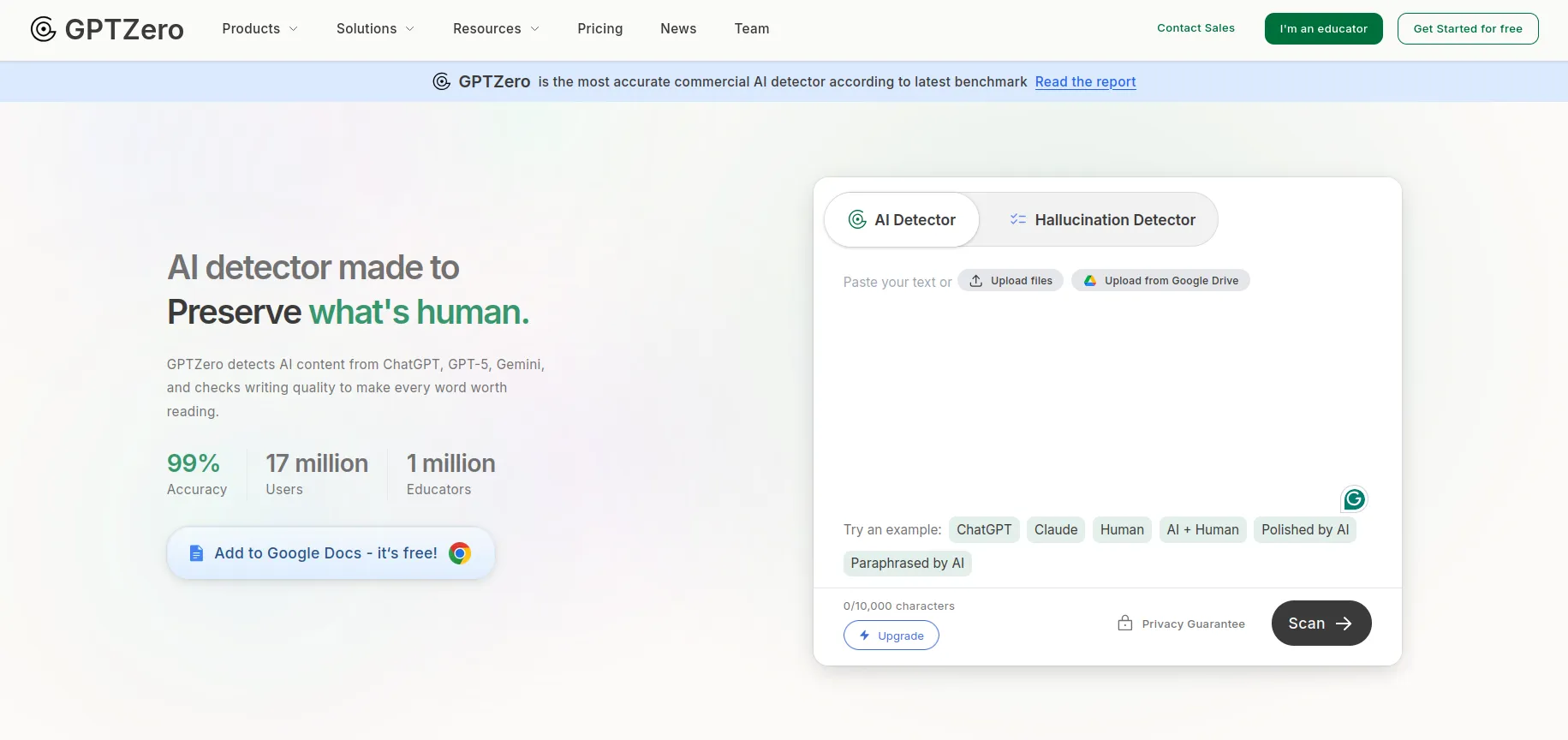
GPTZero is a purpose-built AI text detector developed by Edward Tian, originally designed to help educators detect AI-generated student submissions. It uses a combination of perplexity and burstiness metrics to evaluate whether text was written by a human or an AI model. It remains the most trusted name in AI detection, used by over 3,500 colleges and 100+ institutions worldwide. Built by Edward Tian in early 2023, GPTZero has invested heavily in accuracy. It was benchmarked against RAID, a comprehensive third-party evaluation, and achieved a 95.7% detection rate with just a 1% false-positive rate on human text. On modern LLMs like GPT-4 and GPT-5, accuracy reportedly exceeds 99%.
PROS
- Specifically trained in academic and professional writing, making it particularly reliable for detecting AI-generated essays and reports.
- Offers sentence-level highlighting to pinpoint which sections are flagged as AI-generated, providing a granular breakdown of results.
- Free plan available with basic detection features, suitable for occasional use.
- Verified top accuracy via the RAID third-party benchmark
- Sentence-level highlighting identifies exactly which sections are flagged
- Detects ChatGPT, GPT-5, Gemini, Claude, Llama, DeepSeek, and more
- Free plan includes 10,000 words/month, the most generous among top-tier detectors
- Browser extension available for in-context checking
CONS
- The free plan comes with limitations on document length and the number of scans per month, which may be restrictive for high-volume users.
- Free plan limited to ~1,500 words per scan (up to 10,000 words/month total)
- Premium features like Writing Report and API access require a paid plan ($12.99/mo+)
Free Limit: 10,000 words/month | Best For: Educators, students, publishers
2. Copyleaks: Best for Multilingual Detection & Combined AI + Plagiarism Checking
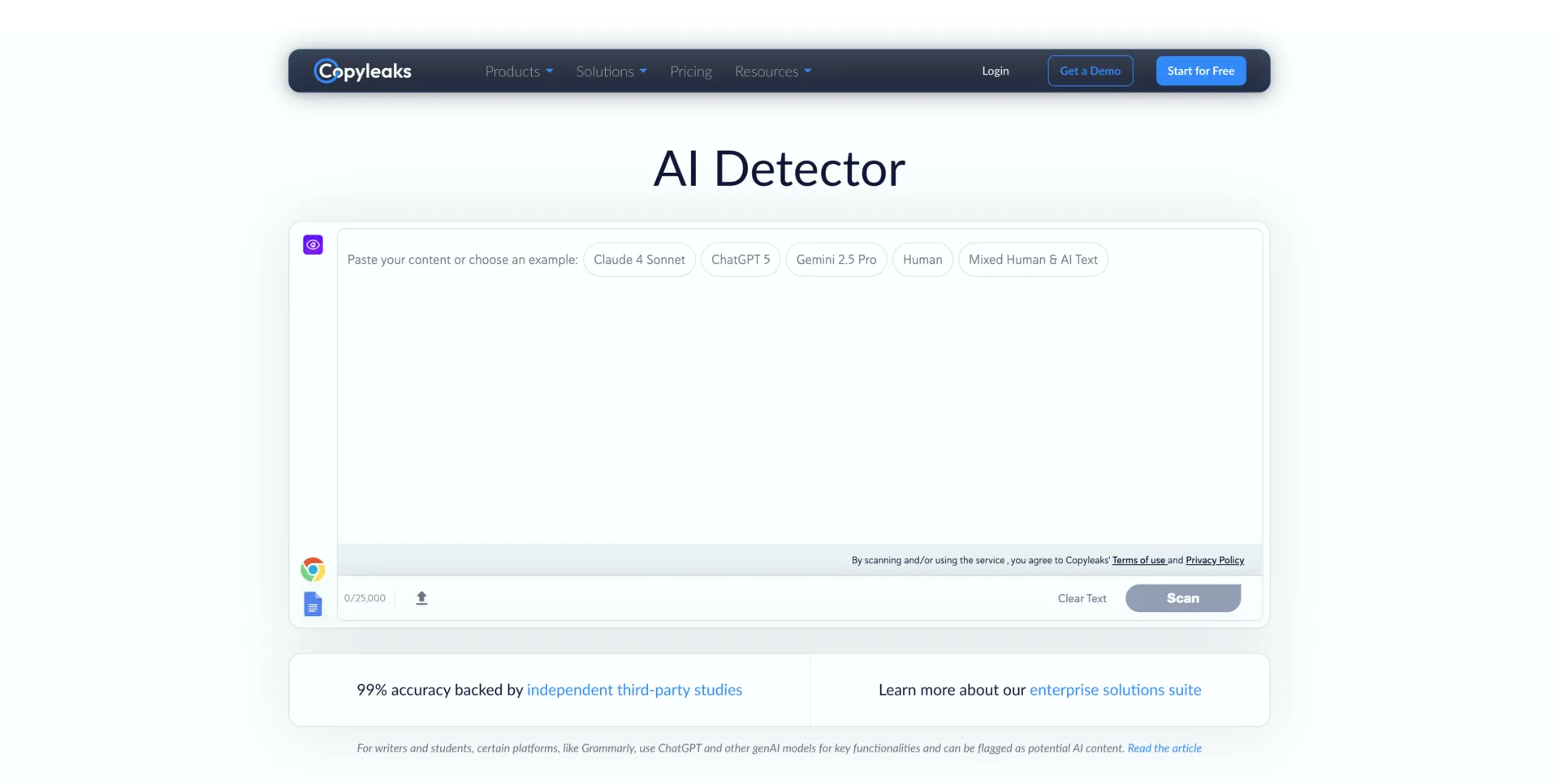
Copyleaks supports over 30 languages and offers one of the most generous free scan limits of any top-tier detector: up to 25,000 characters per scan without even logging in. It combines AI detection with plagiarism checking, making it a strong all-in-one content integrity suite for teams managing diverse international content.
PROS
- 25,000 characters free without login, the highest free scan limit on the market
- Supports 30+ languages with low false-positive rates for non-native English text
- AI detection + plagiarism in one dashboard
- Google Docs add-on for inline checking during writing
- Advanced ‘AI Logic’ explains why text was flagged (paid feature)
CONS
- The most advanced features (AI Logic, API) require a paid subscription
- Paid plans are among the most expensive in the category
Free Limit: 25,000 chars/scan | Best For: Multilingual teams, educators
3. Paperpal: Best for Academic & Research Writing
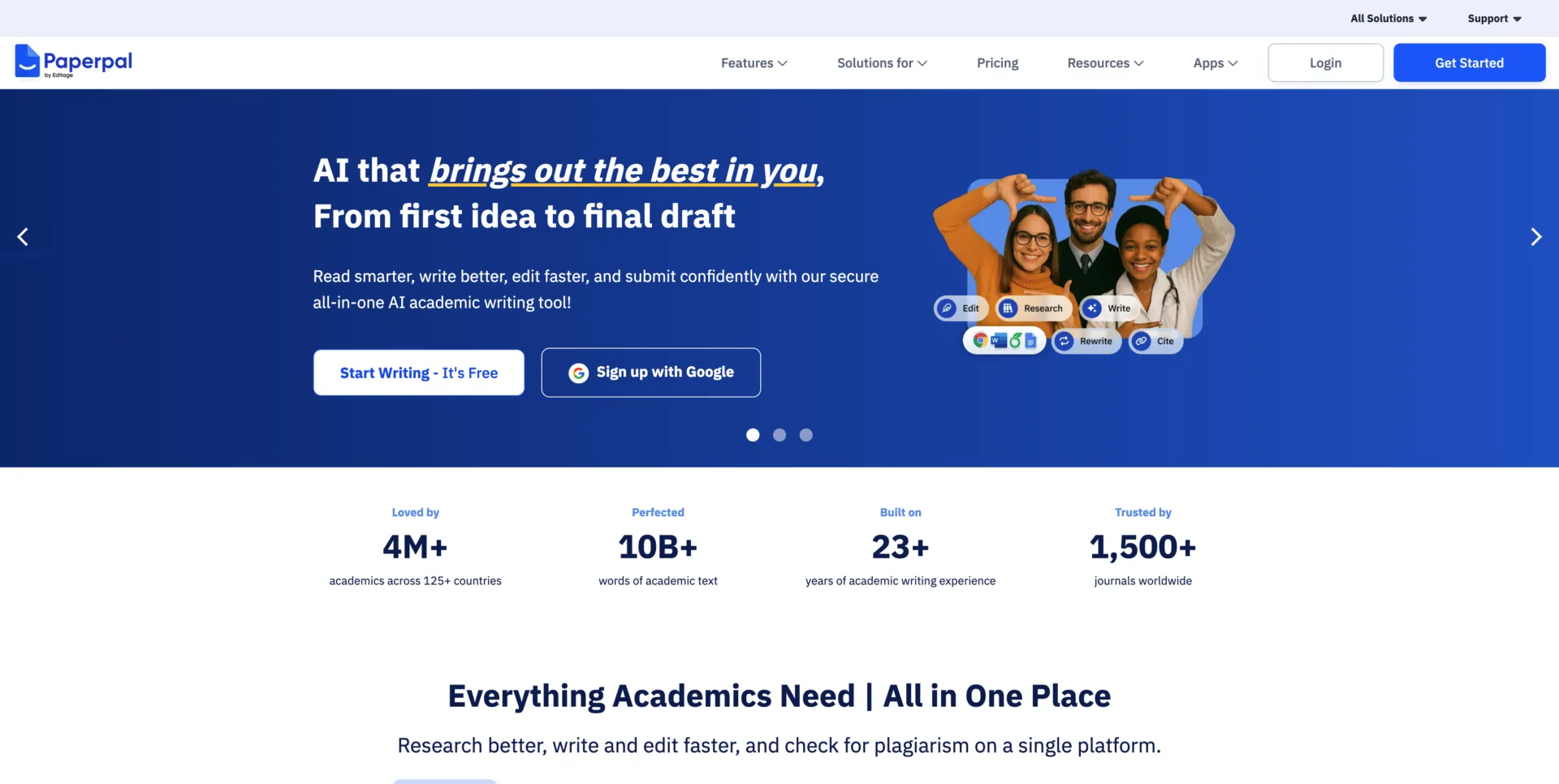
Paperpal is a newer entrant that deserves serious attention for anyone in academia. Built specifically on 100,000+ human and AI scholarly samples from ChatGPT, Claude, and Gemini, it is purpose-built for the type of structured, formal writing found in research papers and dissertations. It also uses a multi-model engine that reportedly reduces false positives by over 40% compared to generic checkers.
PROS
- Trained on scholarly writing samples, far more accurate for academic contexts than generic tools
- Cross-verifying the multi-model engine reduces false positives by 40%
- Three-band probability scale (not just binary pass/fail)
- Free tier includes 5 daily scans up to 1,200 words each, with 5 file uploads/day
- Trusted by universities and academic journals
CONS
- Free scans limited to 1,200 words; longer documents require Paperpal Prime
- Primarily focused on academic writing; may underperform on casual or marketing content
Free Limit: 5 scans/day (1,200 words each) | Best For: Researchers, PhD students, journal authors
4. QuillBot AI Detector: Best for Detecting AI-Refined (Not Just AI-Generated) Content
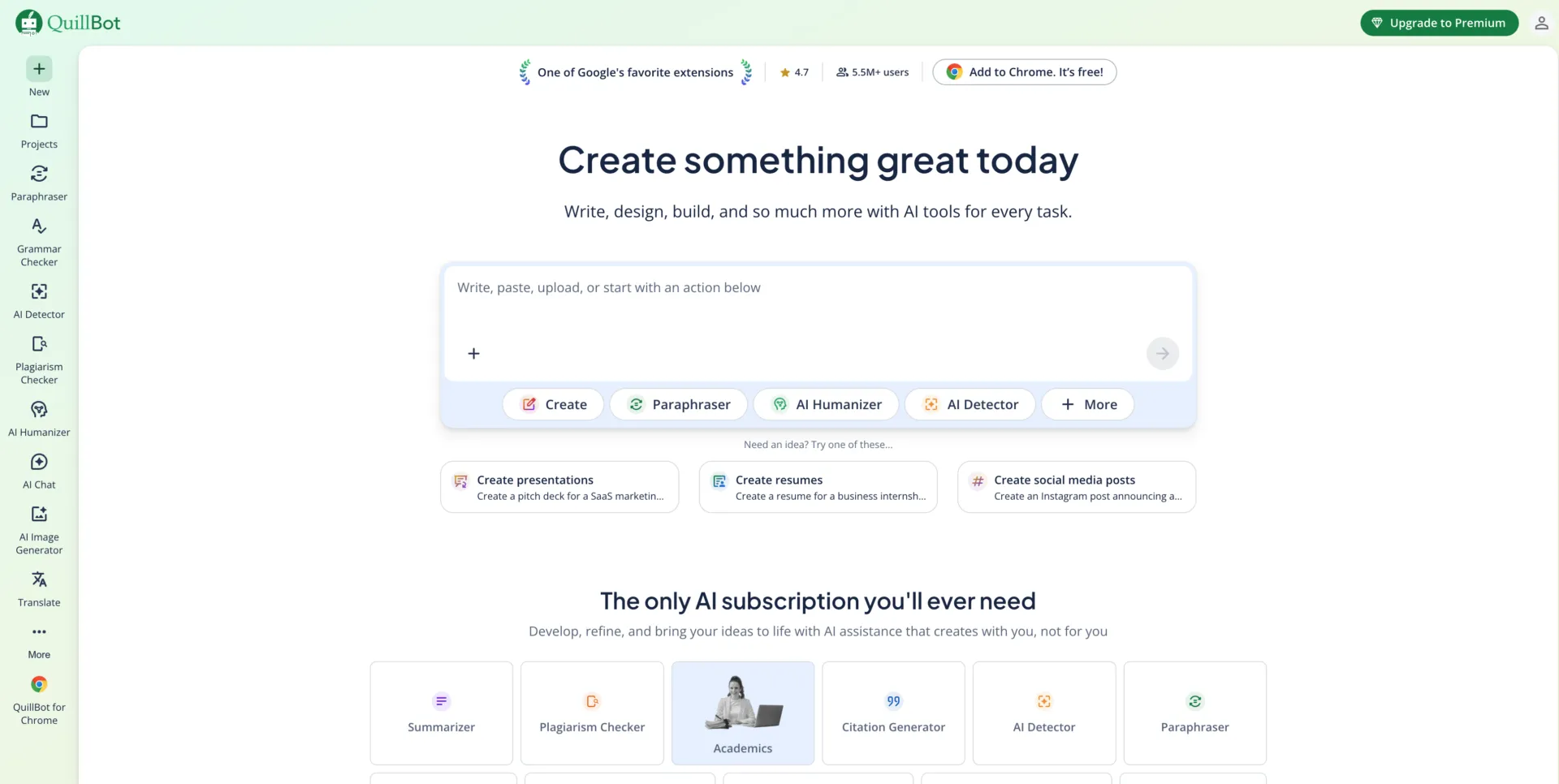
QuillBot’s AI Detector stands out for a unique and valuable distinction: it can differentiate between text that was entirely generated by AI versus text that was written by a human but then refined using AI tools. This matters enormously in 2026, where most writers use AI for polish rather than generation. By reducing unfair false positives for AI-assisted writing, it is particularly fair to non-native English speakers.
PROS
- Unique: distinguishes fully AI-generated from AI-refined human writing
- Completely free for texts under 1,200 words, no account required
- Works in any language
- Part of the QuillBot ecosystem (paraphraser, grammar checker, plagiarism checker in one place)
- Downloadable PDF reports on paid plans
CONS
- Accuracy on the free tier is mixed for detecting very recent models like Claude 4 and Gemini 2.5
- Minimum 80 words required for a meaningful scan
Free Limit: 1,200 words, no signup | Best For: Content writers, ESL writers, teachers
5. ZeroGPT: Best for Batch Processing & High Volume Free Scans
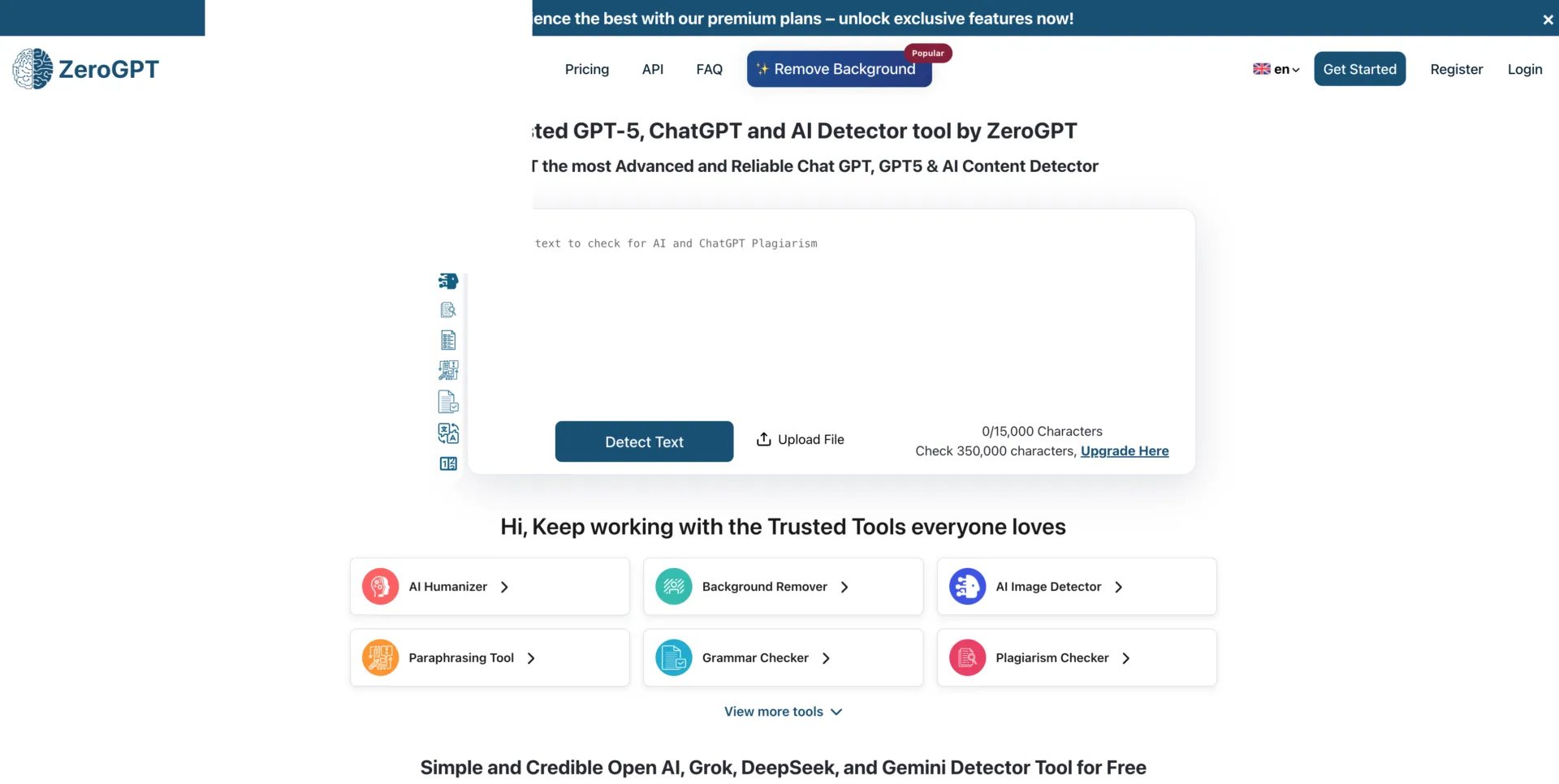
ZeroGPT offers up to 15,000 characters per free scan, plus the ability to check multiple documents at once (batch processing on the paid plan), making it a practical choice for educators or content managers who need to process many submissions quickly. However, accuracy on the free plan is inconsistent, and false positives have been documented. Use it as a first pass and verify with a second tool.
PROS
- 15,000 characters per scan, one of the highest character limits available for free
- Batch upload capability (paid) with downloadable PDF reports
- Works in multiple languages
- Fast, simple interface with no steep learning curve
CONS
- Accuracy is significantly lower than that of top-tier tools; false positives are a known issue
- Batch processing and full feature set require Pro plan ($7.99/mo)
- Should not be used as the sole detection tool for consequential decisions
Free Limit: 15,000 chars/scan | Best For: High-volume quick checks (not final verdicts)
6. Originality.ai: Best for Content Teams & SEO Publishers
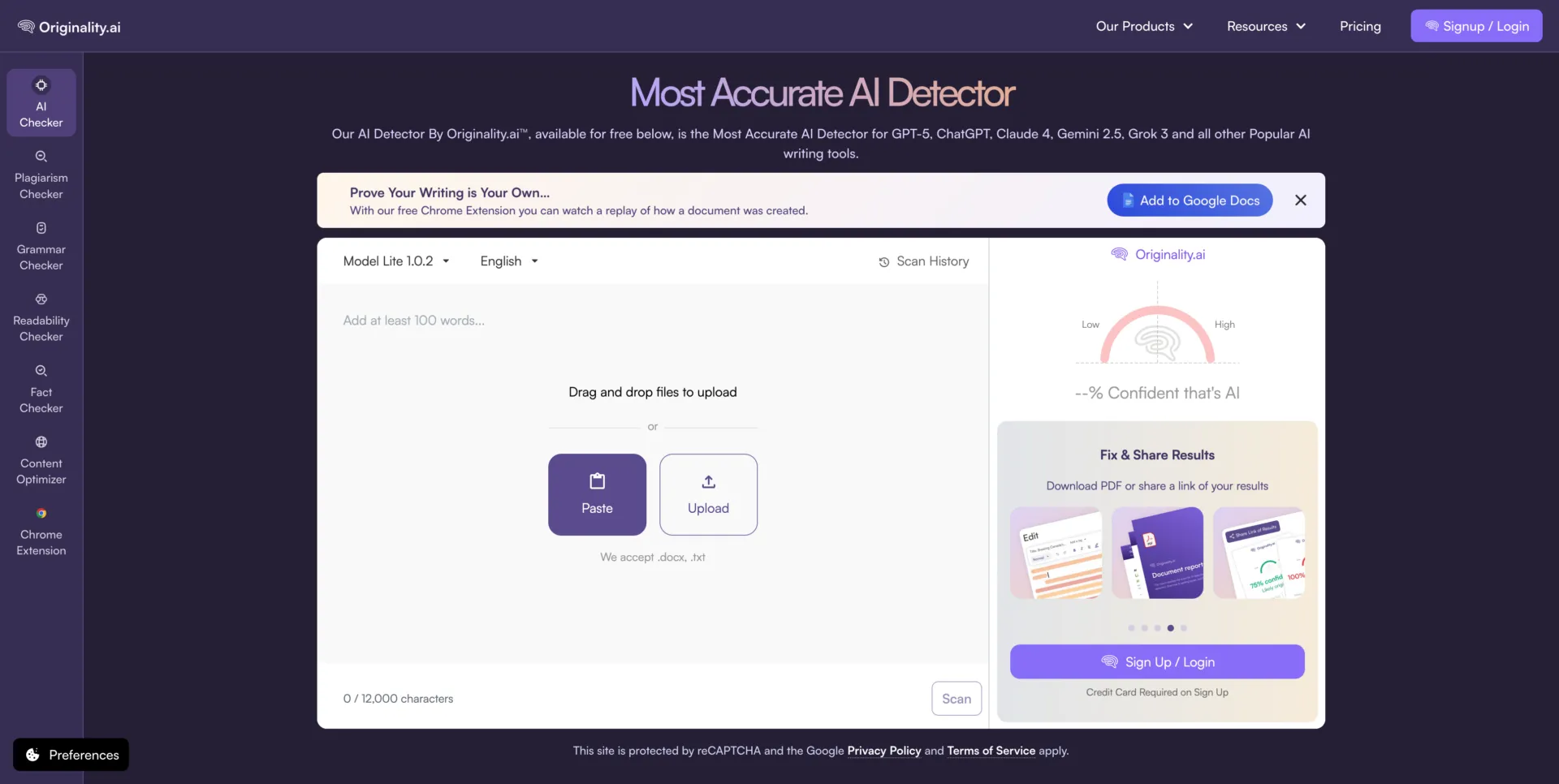
Originality.ai has built a strong reputation among SEO agencies and content marketing teams who need a reliable detection layer on freelancer submissions. It scores in the top tier alongside Turnitin and Winston in independent accuracy benchmarks, and covers AI detection, plagiarism, readability, and fact-checking in one platform. The free tier is limited, but the Base plan at $14.95/month is competitive for professional teams.
PROS
- Top-tier accuracy validated by multiple third-party studies
- Covers AI detection + plagiarism + readability + fact-checking in one dashboard
- Detects ChatGPT, Claude, Gemini, Grok, and more
- Team management features for agencies managing multiple writers
- Chrome extension for real-time checking
CONS
- Very limited free access, primarily a paid product ($14.95/mo base)
- A credit-based system can feel restrictive for high-volume use
Free Limit: Limited trial | Best For: Content agencies, SEO teams, editorial workflows
7. Winston AI: Best for Professional Reports & Publisher Workflows
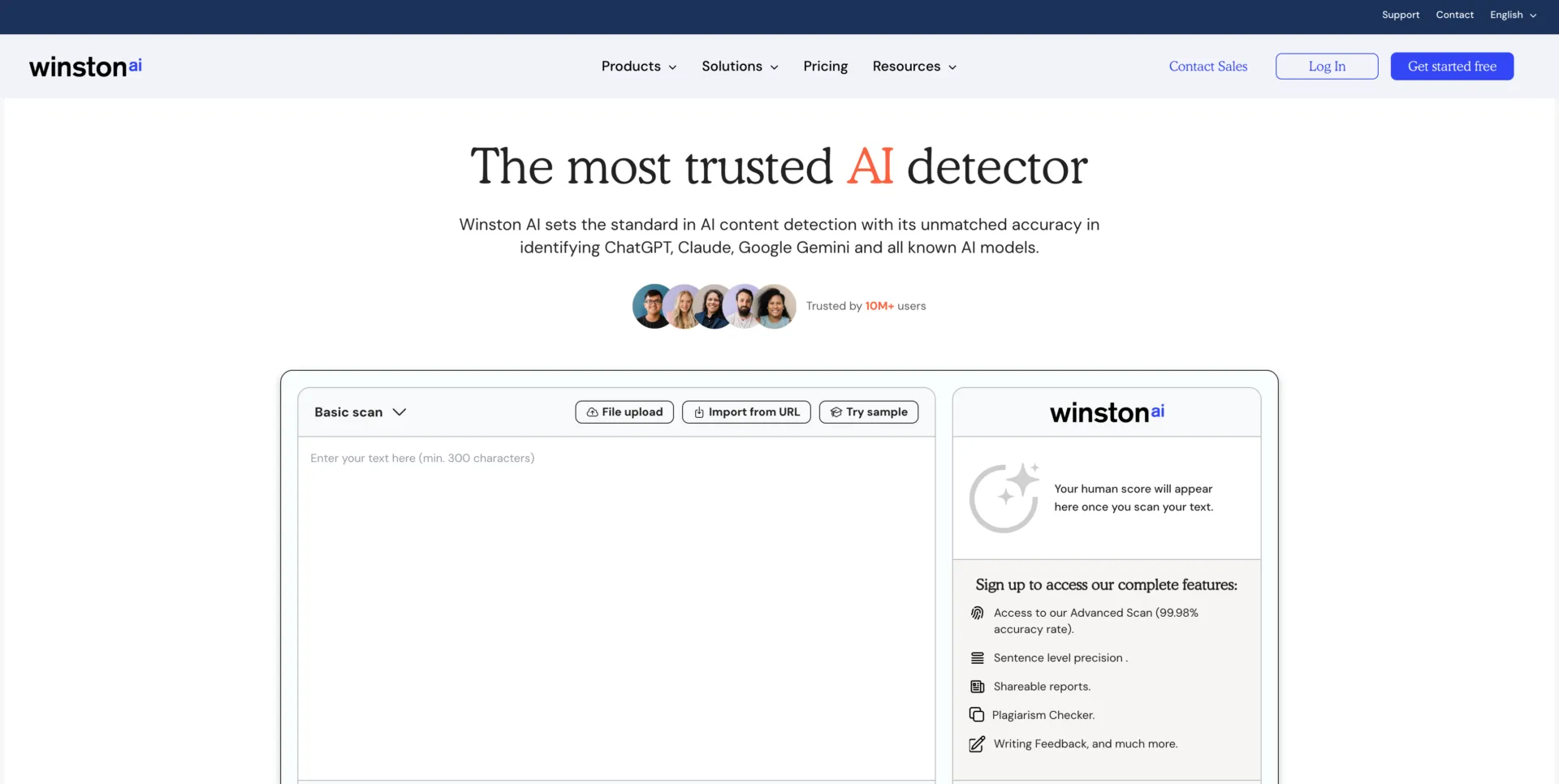
Winston AI is positioned as a premium detector with a beautiful UI, sentence-level prediction maps, and downloadable PDF integrity reports that are formatted for sharing with clients, students, or legal contexts. Independent testing places its accuracy around 95% on standard AI text, though its own claimed 99.98% should be treated skeptically. It handles GPT-4 and DeepSeek content well, but has a documented blind spot for Claude-generated text.
PROS
- Clean, polished UI; best user experience of any detector tested
- Shareable PDF integrity reports for professional or institutional use
- Includes OCR that can scan PDFs and handwritten documents
- Detects AI-generated images (deepfakes) as well as text
- Supports 14+ languages
CONS
- Only a 7-day free trial, not a sustainable free option for ongoing use
- Claims 99.98% accuracy; independent tests put real-world performance closer to 76-95% depending on content type
- Struggles with Claude-generated text and creative AI writing
- A credit-based pricing model can add up for institutions with high scan volumes
Free Limit: 7-day trial | Best For: Publishers, editorial teams, professional reporting
8. HumanizeAI Pro: Best Free Combo: Detection + Humanizer in One
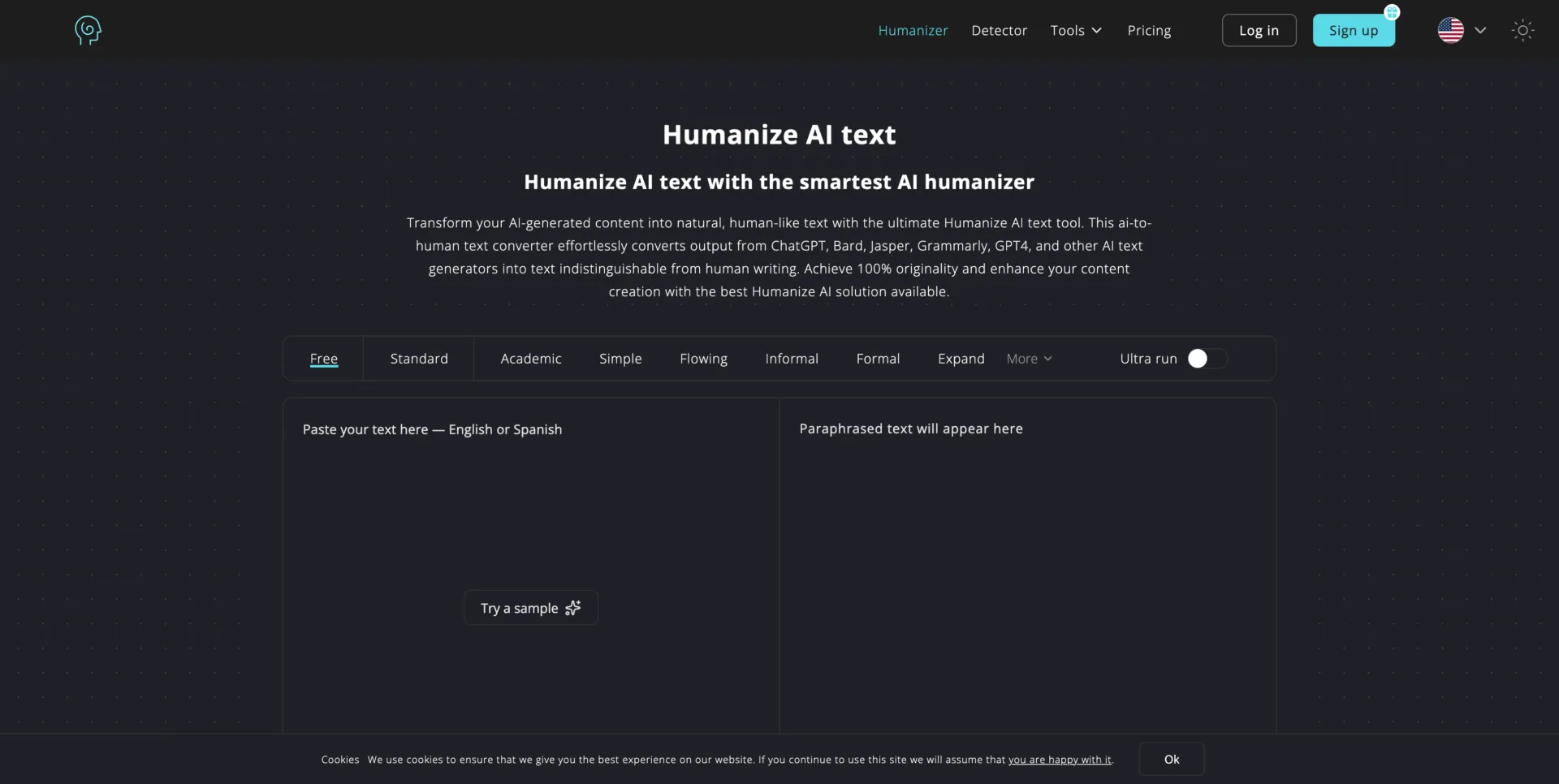
HumanizeAI.pro is a dual-purpose platform that combines an AI detector with text humanization capabilities. It analyzes writing patterns to evaluate how content may appear to automated detection systems, while also offering tools to refine AI-assisted writing for improved readability and natural flow.
PROS
- Combines AI detection and humanization tools on one platform, eliminating the need for multiple services.
- Transparent analysis that provides structured insights rather than just binary pass/fail results.
- User-friendly interface designed for students and content creators working under deadlines.
- Free plan available with 1,500 words and access to all modes and settings.
CONS
- No built-in plagiarism checker. The platform focuses specifically on AI detection and text humanization.
- No URL scanning option—users must copy and paste text directly for analysis.
Free Limit: 1,500 words | Best For: Students, creators needing detection + humanizing
9. Undetectable AI: Best Free No-Signup Checker Validated by Academic Research
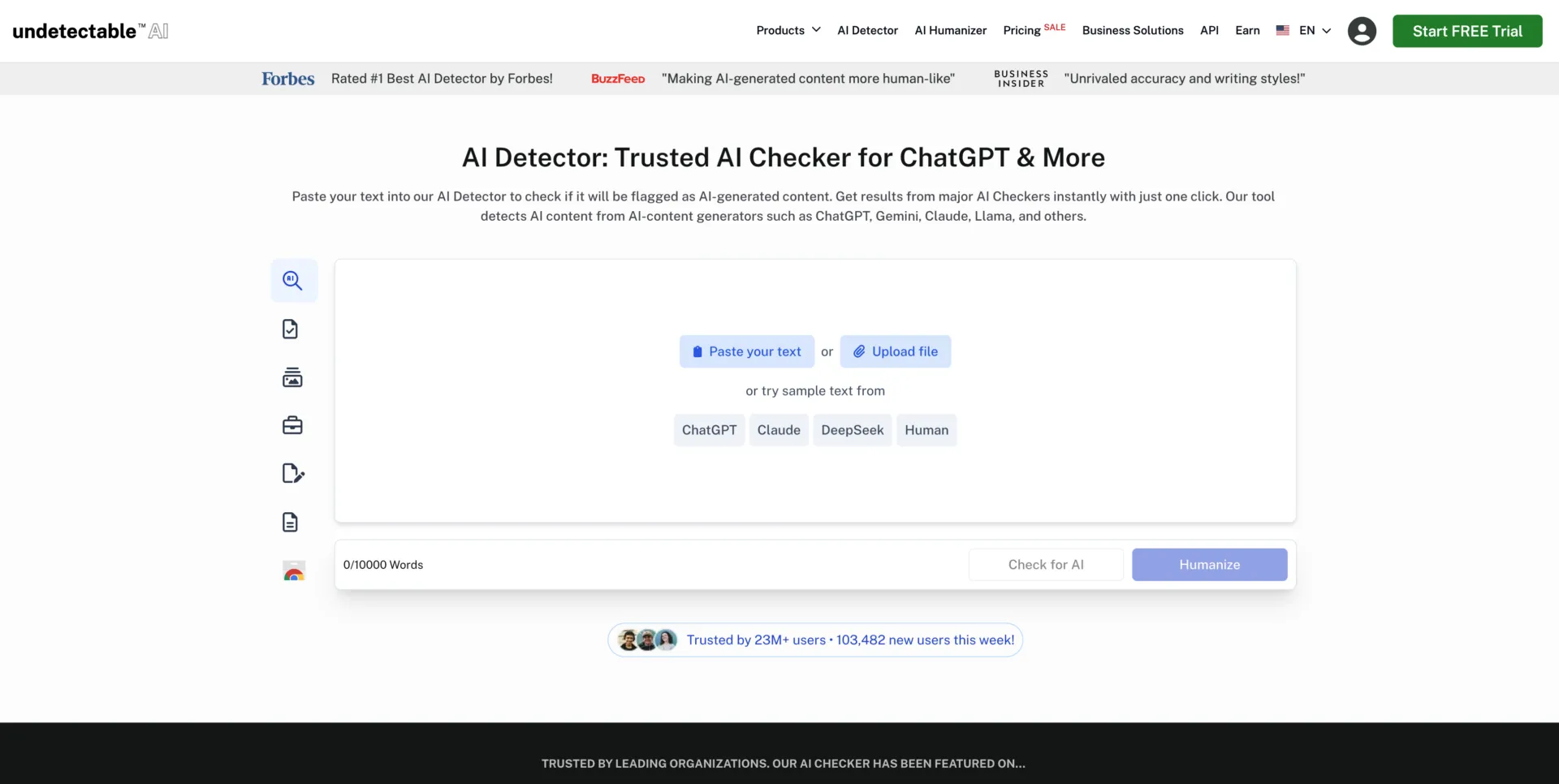
Undetectable AI’s free detector requires no signup and provides results instantly. It cross-checks text against multiple detection models simultaneously and was cited in an Indian Journal of Psychological Medicine study (Kar et al., 2024) as one of two tools that detected all AI-generated content in testing with 100% accuracy. Its dual role as a detector and humanizer has made it popular among content creators.
PROS
- No sign-up required, instant, fully free detection
- Cross-checks against multiple detector models in one scan
- Cited in peer-reviewed research for detection accuracy
- Detects ChatGPT, GPT-5, Claude, Gemini, Llama, and paraphrased content
CONS
- Advanced humanizer features require a paid plan
- No plagiarism checking or institutional reporting features
Free Limit: Free, no signup | Best For: Quick checks, content creators
10. Scribbr: Best for Beginners & Students
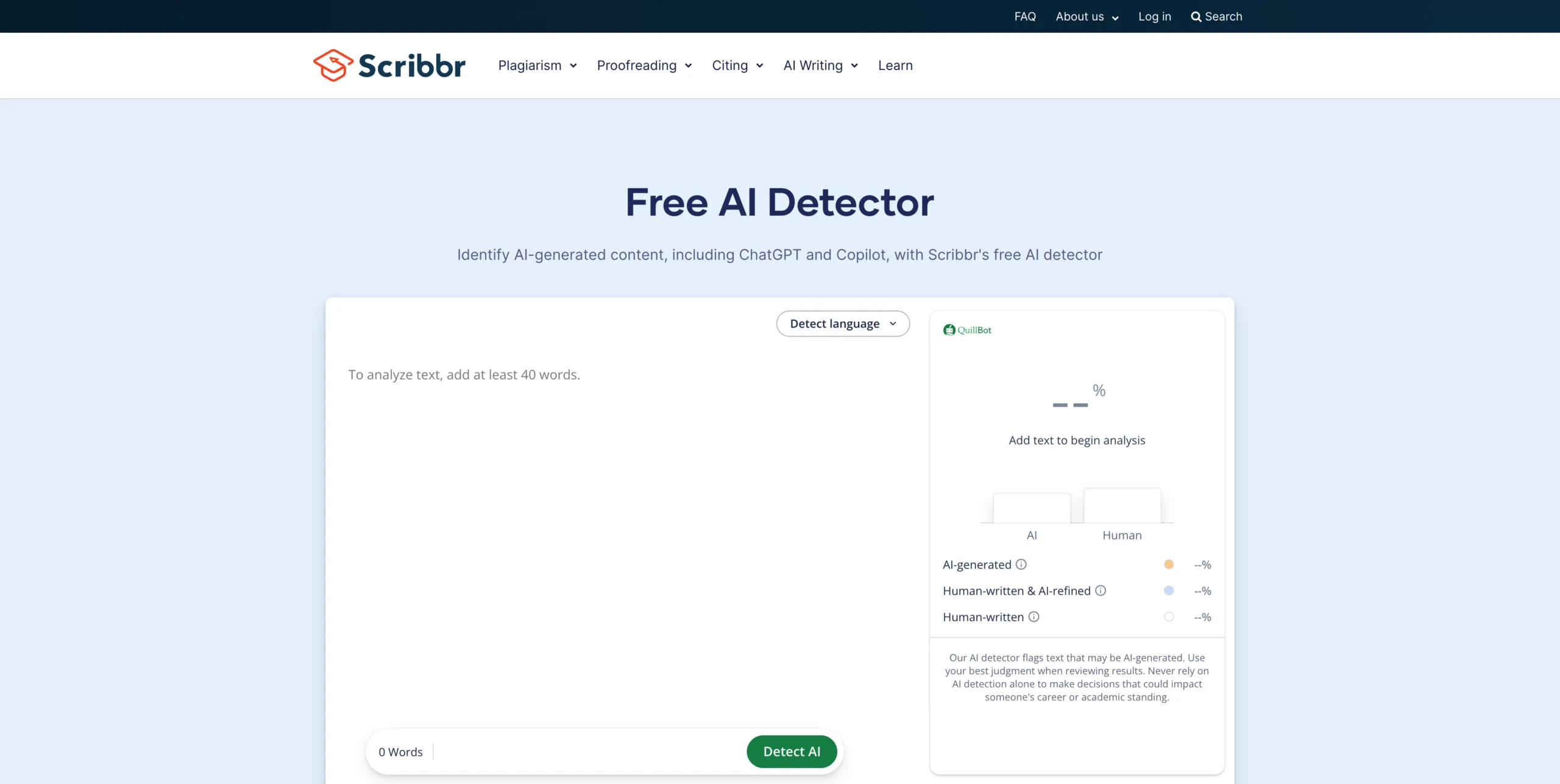
Scribbr’s free AI detector offers a clean, beginner-friendly interface that’s easy to navigate without any AI or writing tool experience. It’s particularly popular among students who use Scribbr’s broader suite of citation and grammar tools. The free tier is limited in depth, but it’s a solid entry point for first-time users.
PROS
- User-friendly interface ideal for first-time users
- Free to use with no account needed for basic checks
- Pairs well with Scribbr’s broader academic writing tools
CONS
- Limited detection depth compared to GPTZero or Copyleaks
- No sentence-level breakdown on the free plan
Free Limit: Free (basic) | Best For: Beginners, students new to AI detection
11. Pangram Labs: Best for Enterprise-Grade Accuracy & Academic Verification
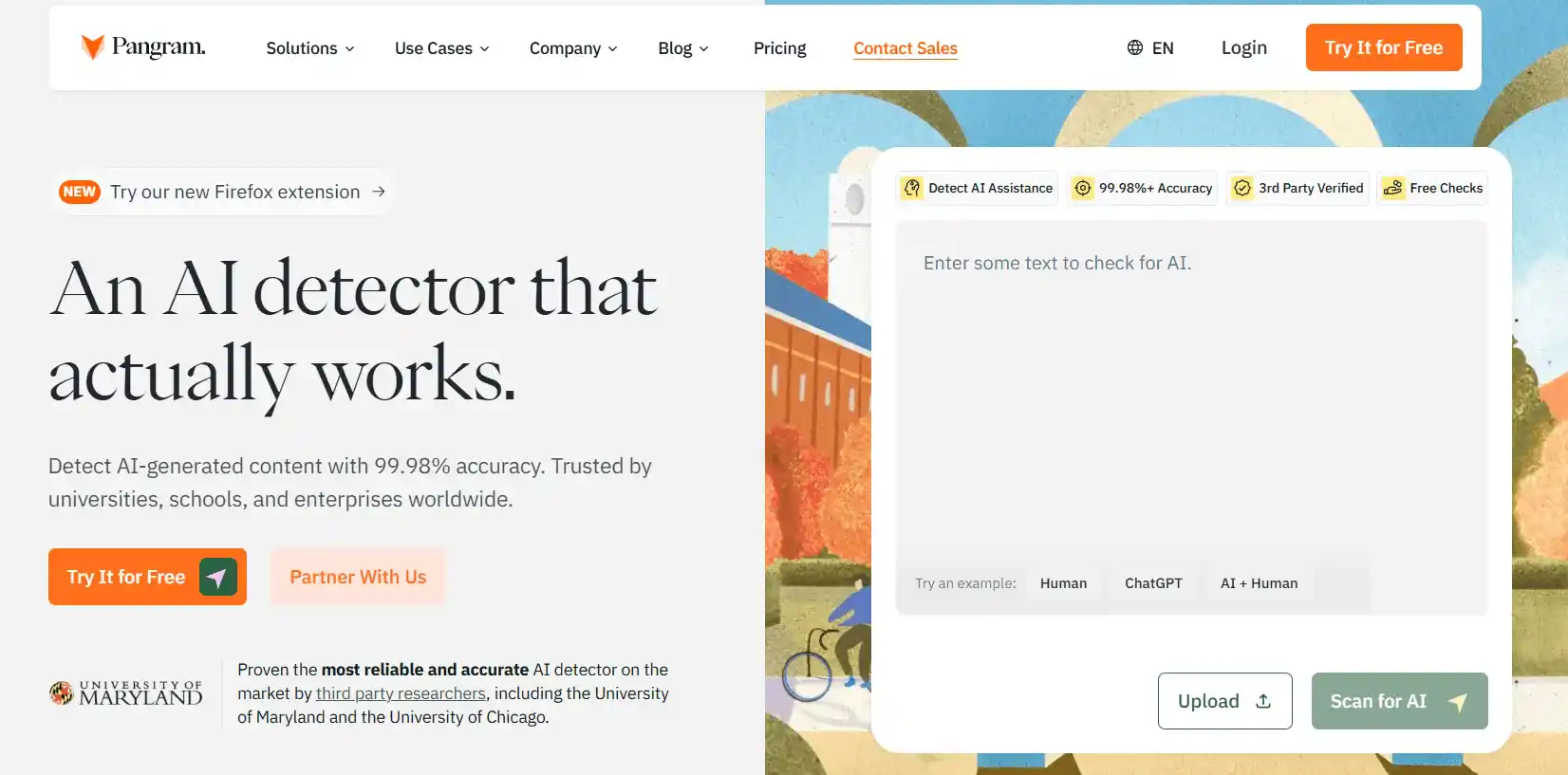
Pangram Labs is a high-accuracy AI detection tool that boasts a 99.98% success rate in identifying machine-generated text. Unlike many competitors that rely on internal testing, Pangram’s performance has been independently verified by researchers at the University of Maryland and the University of Chicago. It is designed to support the needs of large-scale organizations, offering multilingual detection and an enterprise-grade API. This makes Pangram Labs a reliable choice for universities and businesses that require a scientifically validated approach to content verification.
PROS
- Exceptional 99.98% accuracy rate, among the highest in the industry.
- Validated by third-party academic research from UMD and UChicago.
- Robust multilingual support for diverse content detection needs.
- Convenient browser extensions available for Chrome and Firefox.
- Seamless enterprise integration through a high-performance API.
CONS
- Prioritizes detection accuracy over secondary features like content “humanization.”
- Full access to high-volume enterprise features requires a paid tier.
Free Limit: Free basic checks available | Best For: Enterprises, universities, and professional publishers
Note: Turnitin is a powerful tool, but it’s primarily used by educational institutions and is not available for free to the general public.
What is the use of AI Content and Plagiarism Detectors
For businesses, low-quality AI-generated content or plagiarized work can be detrimental. Failing to identify substandard content can lead to several issues:
- Reputation Damage: Discovering plagiarized work can immediately tarnish a company’s reputation.
- Google Penalties: Google may penalize websites for low-quality content, especially with evolving E-E-A-T (Expertise, Authoritativeness, Trustworthiness) standards.
- Financial Loss: Overpaying writers who haven’t produced original work can waste resources.
- Copyright Issues: There’s a risk of future legal problems related to copyright infringement.
- Mediocre Content: Content that is merely adequate instead of outstanding can fail to engage or satisfy an audience.
AI content detectors are invaluable in addressing these challenges by:
- Identifying AI-Generated Content: Estimating if the content was created using AI writing tools.
- Detecting Plagiarism: Finding copied work and ensuring originality.
- Evaluating Originality: Assessing the percentage of original content in a piece.
While using AI extensively has its risks, integrating it thoughtfully with human writing practices can mitigate these issues. AI content detectors play a crucial role in understanding and evaluating content, whether it’s self-authored or created by others.
For students, content creators, and professionals who think, “Can someone help me with my homework or content verification?”, these tools offer a reliable way to ensure that the content meets quality and originality benchmarks.
How to Choose the Right Free AI Detector in 2026
With so many tools now available, here is a practical framework for selecting the right one for your needs:
- If you’re an educator or school administrator: GPTZero is the clear leader, with RAID-verified accuracy, sentence-level highlighting, and 10,000 words/month free. It’s used by over 3,500 colleges for a reason.
- If you work in academic research or journal publishing: Paperpal is the standout, trained on real scholarly text; it understands academic writing in ways generic tools cannot.
- If you manage a content team or SEO agency: Originality.ai is built for this workflow. Pair it with Copyleaks for multilingual content.
- If you’re a student checking your own work: Start with QuillBot’s AI Detector (free, nuanced) or Scribbr (simple interface). Cross-check with Copyleaks for peace of mind before submission.
- If you need professional reports, you can share: Winston AI’s PDF integrity reports are the most polished for client-facing or institutional use.
- If you just need a fast, free, no-signup check: Undetectable AI or ZeroGPT are your quickest options, but always verify with a second tool for anything consequential.
Key Factors to Evaluate
- Accuracy & benchmarks: Prioritize tools with third-party validation (e.g., RAID benchmark) over self-reported numbers. Real-world accuracy for most tools tops out around 85-99% on unmodified AI text.
- False positive rate: Critical for educators. Falsely accusing a student of AI use can have serious consequences. GPTZero and Paperpal have the lowest documented false-positive rates.
- Model coverage: In 2026, content comes from ChatGPT, Claude, Gemini, LLaMA, DeepSeek, and more. Ensure your tool detects across all major models.
- Language support: If you review non-English content, Copyleaks (30+ languages) or QuillBot are your safest choices.
Free plan generosity: Copyleaks (25,000 chars/scan) and GPTZero (10,000 words/month) offer the most usable free tiers among high-accuracy tools.
Why AI Detection Is Harder in 2026 And Why It Still Matters
Modern LLMs like GPT-5, Gemini 2.5 Pro, and Claude 4 produce text that is increasingly indistinguishable from polished human writing. The accuracy gap between the best and worst free detectors now stands at roughly 18 percentage points (95% vs 77%), a meaningful difference when making real decisions about content authenticity.
At the same time, the stakes have increased. Google’s 2025-2026 algorithm updates continue to evolve E-E-A-T (Experience, Expertise, Authoritativeness, Trustworthiness) standards. While Google does not explicitly penalize AI content, it rewards original, experience-driven writing, making content quality and authenticity more important than ever for SEO.
For businesses, the risks of undetected AI-generated content include reputational damage, SEO penalties for low-quality or duplicated output, wasted spend on freelancers not delivering original work, and potential copyright complications. AI detectors are not a silver bullet, but they provide a meaningful quality control layer when used thoughtfully.
Pro Tips for Using AI Detectors Effectively
- Always run at least two tools on any high-stakes content. No single detector is definitively accurate.
- Treat scores as signals, not verdicts. Context matters; a high AI score on formal writing may reflect style, not misconduct.
- Use dedicated tools for your domain: Paperpal for academic work, Originality.ai for content marketing, GPTZero for classroom submissions.
- Keep track of writing history and drafts. AI detectors can flag edited human text; documentation of the writing process is always the best defense.
- Pair detection with education: use these tools to have conversations about responsible AI use, not just to catch misuse.
Conclusion
AI detection has matured significantly since 2024. The tools listed in this guide represent the best free options available in 2026, each with distinct strengths for different use cases. GPTZero leads in overall accuracy and education, Copyleaks excels at multilingual and combined detection, Paperpal is the gold standard for academic writing, and QuillBot’s nuanced detection of AI-refined content fills an important gap that most tools miss.
No detector is perfect, and the technology continues to evolve alongside the AI models it aims to identify. The right approach is to use these tools as part of a broader content authenticity strategy combining detection, human judgment, and clear guidelines about acceptable AI use. As AI continues to reshape how we create and consume content, the tools in this guide will help you navigate that landscape with confidence.
What is an AI content detector?
An AI content detector is a tool that analyzes text patterns, structure, and predictability to determine whether content is written by a human or generated by AI models like ChatGPT.
How do AI content detectors work?
AI detectors evaluate linguistic patterns such as perplexity, burstiness, and sentence structure to identify AI-generated text. They compare writing against known AI-generated patterns to estimate probability scores.
Are AI detectors 100% accurate?
No, AI detectors are not 100% accurate. They provide probability-based results and can produce false positives and false negatives, especially with edited or humanized AI content.
What is the most accurate AI detector in 2026?
Tools like GPTZero, Copyleaks, and Grammarly AI Detector are often considered among the most accurate, with some reporting accuracy close to 98–99% in controlled tests.
Can AI detectors detect paraphrased or humanized AI content?
AI detectors struggle with paraphrased or human-edited content. Accuracy drops significantly when AI-generated text is rewritten or mixed with human input.
Do AI detectors work for all types of content?
Not always. Performance varies depending on content type (academic, marketing, technical) and language. Some detectors perform better with structured or formal writing.
What is a good AI detection score?
Generally:
0–20% → Likely human-written
20–80% → Mixed or unclear
80%+ → Strong indication of AI-generated content
Why do AI detectors give false positives?
False positives happen because detectors rely on writing patterns. Simple, structured, or non-native English writing can sometimes be flagged as AI-generated.
Can AI-generated content bypass detection tools?
Yes. Advanced AI models and human editing techniques can bypass many detectors, making detection less reliable in real-world scenarios.
Are AI detectors better than plagiarism checkers?
No, they serve different purposes. AI detectors identify machine-generated content, while plagiarism checkers find copied or duplicated content.
Should AI detectors be trusted for academic or SEO use?
AI detectors should not be used as the sole decision-maker. They are best used alongside human review and other tools for accuracy and fairness.