

Table of Contents
Managing cloud costs isn’t simply a technical challenge; it’s a cultural one. Organizations that treat FinOps as a one-time tool deployment rather than a company-wide discipline consistently lose control of cloud spending. True FinOps success demands more than dashboards and automated alerts; it requires shared accountability, cross-functional collaboration, and a continuous improvement mindset embedded into every team’s daily work.
This guide walks you through how to establish a FinOps culture from the ground up, covering leadership alignment, goal-setting, training, and automation so your organization can achieve sustained cloud financial management excellence.
What Is a FinOps Culture?
A FinOps culture is an organizational mindset in which every stakeholder, from engineers and finance managers to executives and product owners, shares responsibility for cloud cost management and the maximization of cloud business value. Rather than siloing cost control within a single team, this culture distributes awareness and accountability across the entire organization.
Often referred to as cloud FinOps, it is a cultural movement where finance, IT, and DevOps teams join forces to transform the organization’s approach to cloud spending. In this model, cloud resource decisions are data-driven, balancing cost control with performance needs, while embracing a continuous improvement mentality as goals and priorities evolve.
The Core Pillars of a FinOps Culture
A thriving cloud financial management culture rests on three foundational pillars:
| Pillar | Description |
| Cross-Functional Collaboration | Finance, IT, and business teams work in alignment, not in isolation, so cloud spending decisions reflect both technical realities and financial goals. |
| Continuous Education & Upskilling | Cloud pricing models, optimization techniques, and FinOps best practices evolve constantly. Teams that stay informed act on cost-saving opportunities as they emerge. |
| A Cost-Conscious Mindset | Every cloud decision, from provisioning resources to selecting instance types, is made with cloud cost impact in mind. Cost awareness is built in, not bolted on. |
Why it matters: Enterprises facing cloud cost inefficiencies often lack a unified FinOps culture. When teams operate in silos without shared accountability or visibility, cloud spending becomes difficult to control, resulting in resource waste and budget overruns.
Step-by-Step: How to Establish a FinOps Culture
Building this culture is about more than onboarding the right tools. Your organization must engage diverse team members through education, collaboration, accountability, and shared cross-team philosophies. Below are the seven key steps to build a sustainable cloud financial management practice.
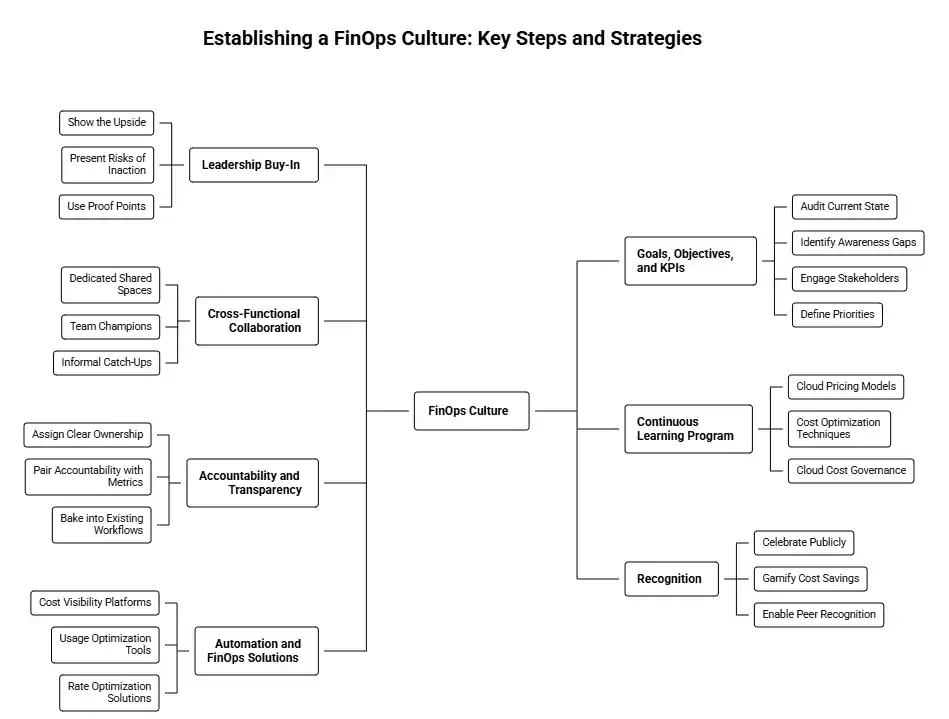
Step 1: Secure Leadership Buy-In
No FinOps initiative gains traction without visible executive support. When leadership champions cloud cost management, it signals to the entire organization that financial accountability is a strategic priority, not just an IT concern.
How to make the case to leadership:
- Show the upside. Demonstrate how a structured practice improves cloud cost forecasting accuracy, reduces wasteful cloud spending, and frees up budget for reinvestment in growth.
- Present the risks of inaction. Give leaders a clear picture of poor visibility, reactive cost management, and budget overruns that disrupt engineering delivery.
- Use proof points. Share success stories from comparable organizations, pilot a small-scale effort in-house, or engage a FinOps consulting partner for an independent assessment that accelerates stakeholder alignment.
💡 Tip: Align your pitch with executive priorities already on the leadership agenda. When leaders see cloud cost optimization as an enabler of their goals rather than a competing initiative, buy-in follows far more naturally.
Step 2: Set Goals, Objectives, and KPIs
Before building out processes or purchasing cloud cost optimization tools, your organization needs a clear picture of what success looks like. Vague intentions don’t drive behavioral change; measurable targets do.
How to get started:
- Audit your current state of cloud cost management. Where does visibility break down?
- Identify which teams lack awareness of their cloud spending.
- Engage stakeholders across finance, engineering, and business leadership to surface pain points.
- Define priorities and translate them into specific, time-bound goals.
Examples of well-defined goals:
| Goal | Target | Timeline |
| Reduce overall cloud costs | 20% reduction | Within 12 months |
| Improve resource utilization | 90% of allocated resources | Ongoing |
| Cut idle resource costs | 15% reduction per quarter | Quarterly |
| Increase reserved instance coverage | 50% → 70% | Within 6 months |
Key KPIs to track:
- Cloud cost savings vs. baseline
- Budget vs. actual spend
- Resource utilization rate
- Forecast accuracy
- Effective savings rate
Why it matters: Teams with clearly defined targets and reporting cadences are far more likely to stay engaged with cloud financial management practices. Accountability requires something measurable to be accountable to.
Step 3: Break Down Silos with Cross-Functional Collaboration
A strong culture cannot survive in organizational silos. Finance teams understand budget constraints. Engineering teams own infrastructure decisions. Product and business teams set demand. Without structured collaboration between all three, cloud cost optimization initiatives lack the holistic view needed to succeed.
Practical ways to foster collaboration:
| Tactic | What It Looks Like |
| Dedicated shared spaces | A Slack/Teams channel, a unified cloud cost dashboard, and a recurring cross-team meeting |
| Team champions | Go-to representatives who bridge the gap between technical and financial perspectives |
| Informal catch-ups | Coffee chats or short unstructured syncs that build trust and mutual empathy across teams |
💡 Tip: Many enterprises struggle with cost transparency when operating across multiple cloud providers. Centralizing cloud cost data into shared dashboards gives finance and engineering teams a single source of truth for faster, better decisions.
Step 4: Build a Continuous Learning Program
Cloud financial management is constantly evolving. Cloud providers regularly introduce new pricing models, instance families, and optimization levers. Organizations that skip ongoing training find their teams missing cost-saving opportunities simply because they weren’t aware of them.
Essential Training Areas
Cloud Pricing Models: Understanding how providers structure costs, including on-demand and reserved instances, as well as savings plans. For organizations running workloads on Amazon Web Services, dedicated AWS FinOps training helps teams navigate service-specific pricing, cost allocation tags, and AWS-native tools like Cost Explorer and Savings Plans.
Cost Optimization Techniques: How rightsizing, auto-scaling, and workload scheduling reduce cloud costs at the infrastructure level.
Cloud Cost Governance: Training finance teams on tagging standards, chargebacks, showback reporting, and commitment management.
How to Deliver Continuous Learning
| Method | Description |
| Workshops & Webinars | Regular sessions on cloud cost management best practices |
| Certification Programs | FinOps Foundation certifications with role-specific tracks for engineering, finance, and business teams |
| Internal Knowledge Hub | A shared library of case studies, playbooks, and updated FinOps best practices |
Why it matters: Teams with strong FinOps literacy make faster, better-informed decisions and require far less reactive firefighting. The investment in training compounds over time as cost-conscious habits become second nature.
Step 5: Cultivate Accountability and Transparency
Collaboration and education lay the groundwork, but financial accountability is what sustains a FinOps culture day to day. True empowerment means each team owns its cloud costs while remaining responsible for staying within budget.
Three principles for building accountability:
- Assign clear ownership: Define which team or individual is responsible for each activity: tagging governance, rightsizing reviews, reserved instance management, or anomaly detection.
- Pair accountability with metrics: For each task, define how success will be measured. When teams know they will be reporting on outcomes, they engage proactively in cloud cost management.
- Bake it into existing workflows: Cloud cost reviews should be as routine as sprint planning or quarterly business reviews, not a separate initiative competing for attention.
💡 Tip: Organizations that give teams direct access to their own cloud spending data rather than routing all visibility through a central team see faster improvements in cost efficiency and stronger overall engagement.
Step 6: Reinforce Culture Through Recognition
Cultural change is sustained through positive reinforcement. When leaders celebrate cost-conscious behavior, even incremental wins, it signals that cloud cost efficiency is recognized and valued across the organization.
How to build a recognition program:
- Celebrate publicly: Highlight achievements in company newsletters, all-hands meetings, and team forums to reinforce the behaviors you want to see repeated.
- Gamify cost savings: Organize cloud cost optimization challenges with defined metrics, deadlines, and tangible rewards such as team lunches, gift cards, or public recognition.
- Enable peer recognition: Allow team members to nominate colleagues for achievements, extending recognition beyond formal leadership channels and deepening shared ownership of FinOps outcomes.
Step 7: Scale with Automation and the Right FinOps Solutions
No culture can scale on manual effort alone. As cloud spending grows and teams become more distributed, automation becomes essential for maintaining cost governance without overwhelming practitioners.
Core categories of automation to consider:
| Category | Purpose |
| Cost Visibility Platforms | Real-time insight into cloud cost billing and infrastructure usage across providers |
| Usage Optimization Tools | Automate workload scheduling, rightsizing recommendations, and idle resource cleanup |
| Rate Optimization Solutions | Autonomously manage reserved instances and savings plans to maximize commitment discounts |
When evaluating FinOps solutions, assess each platform based on your organization’s specific needs, multi-cloud or AWS FinOps coverage requirements, and demonstrable ROI. No single platform covers every use case, and over-tooling creates its own overhead. Conduct periodic reassessments to ensure your automation stack keeps pace with your evolving cloud environment.
💡 Tip: Pair every new automation tool with proper onboarding and training. Teams that don’t fully understand a tool’s capabilities will underutilize it, negating the investment and generating frustration rather than efficiency gains.
Building FinOps as a Long-Term Practice
Establishing a strong cloud financial management discipline is not a project with a defined end date. It is a continuous organizational practice that evolves as your environment grows, your teams mature, and your business priorities shift. The organizations that achieve sustained excellence treat cloud FinOps as a living discipline, regularly revisiting goals, refreshing training, refining KPIs, and strengthening cross-team relationships.
Your FinOps culture checklist:
- ✅ Start with executive alignment
- ✅ Assign clear ownership across teams
- ✅ Invest in continuous education, including AWS FinOps training where relevant
- ✅ Promote transparency through shared cloud cost data
- ✅ Let automation and the right FinOps solutions handle complexity at scale
- ✅ Leverage FinOps consulting expertise to accelerate maturity when needed
Done consistently, these practices transform cloud cost management from a reactive exercise into a genuine competitive advantage, one where every cloud dollar is spent with intention and backed by a culture of shared accountability.
Conclusion
Building a lasting FinOps culture is one of the most impactful investments an organization can make in how it manages and maximizes cloud value. The steps outlined in this guide, from securing executive buy-in and setting measurable KPIs to continuous learning, cross-functional accountability, and scalable FinOps solutions, are not isolated actions. They are interconnected practices that reinforce one another over time.
When teams across finance, engineering, and business operate from a shared FinOps mindset, cost decisions become faster, more informed, and aligned with strategic priorities. The path to success remains consistent: start with people, reinforce with process, and scale with automation. Whether you’re beginning your FinOps journey or maturing an existing practice, the goal is the same: to maximize the value of every cloud dollar through a culture of shared accountability.
FAQs
What is FinOps?
FinOps is a cloud financial management discipline that brings together finance, engineering, and business teams to maximize the business value of every cloud dollar spent.
What is cloud FinOps, and how is it different from regular cost management?
Cloud FinOps is a cultural practice and operational framework built around shared accountability. In contrast, traditional cloud cost management is typically a reactive, IT-only function focused on cutting spend after the fact.
What are the three phases of the FinOps lifecycle?
The three phases are Inform (gain visibility into spend), Optimize (act on inefficiencies), and Operate (embed cost governance into daily workflows), and organizations cycle through all three continuously.
Can small organizations benefit from FinOps practices?
Yes, FinOps principles scale to any organization size; the discipline helps prevent cost spirals before they become unmanageable.
What are the biggest mistakes organizations make when implementing FinOps?
Treating FinOps as a one-time tool deployment, failing to secure leadership buy-in, and siloing cost responsibility within a single team.