
Table of Contents
You approved a cloud migration. You modernized your infrastructure. You embraced scalability, flexibility, and speed. But then the cloud bill arrived.
And it was nothing like what you expected.
If you’re reading this, chances are you’ve experienced the growing anxiety of watching cloud spending spiral upward with no clear explanation, no obvious culprit, and no straightforward fix. You’re not alone. Organizations of all sizes, from high-growth startups to Fortune 500 enterprises, are grappling with the same uncomfortable reality: cloud costs are out of control, and traditional financial management methods aren’t built to handle them. This is exactly the problem that this framework was designed to solve.
Why Is Your Cloud Bill Out of Control?
Before we talk about solutions, let’s diagnose the problem. Cloud overspending doesn’t happen overnight; it’s the result of several compounding issues that are deeply embedded in how most organizations operate.
Why your cloud bill is out of control
No way to allocate costs back to products, teams, or business units.
% of orgs with cost anomaly detection gaps per provider
The Pay-As-You-Go Trap
Cloud providers like AWS, Azure, and Google Cloud operate on a consumption-based billing model. While this is revolutionary for agility, it creates a dangerous financial blind spot. Engineers can spin up resources in seconds, but finance teams only see the impact weeks later when the bill arrives. By then, thousands, sometimes millions of dollars have already been spent.
Resource Waste and Idle Infrastructure
One of the biggest contributors to cloud cost overruns is cloud waste resources that are running but not being used. This includes:
- Idle virtual machines that were never shut down after a test
- Oversized instances provisioned for peak load but running at 10% utilization
- Unattached storage volumes and forgotten snapshots
- Orphaned load balancers and unused IP addresses
- Dev and staging environments are left running over weekends
Studies consistently show that 30–35% of cloud spend is wasted. For an organization spending $1 million per month on cloud infrastructure, that’s $300,000–$350,000 evaporating into thin air every single month.
Lack of Visibility and Cost Attribution
When cloud costs aren’t tagged properly, it becomes nearly impossible to understand who is spending what and why. Without granular cost attribution, teams can’t identify the source of spikes, and accountability disappears entirely. Finance teams are left staring at a massive invoice with no way to allocate costs back to products, teams, or business units.
Misalignment Between Engineering and Finance
Engineering teams are incentivized to build fast and ship features. Finance teams are incentivized to reduce spend and maximize ROI. In most organizations, these two worlds rarely meet, and when they do, it’s usually because something has gone wrong. Cloud spending requires a new operating model where engineering, finance, and business leadership collaborate continuously. Without that collaboration, cloud costs grow unchecked.
Multi-Cloud Complexity
As organizations adopt multi-cloud and hybrid cloud strategies, cost management becomes exponentially more complex. Each provider has its own pricing model, discount structures, and billing nuances. Without a unified view across providers, costs multiply, and anomalies go undetected.
Commitment vs. On-Demand Imbalance
Cloud providers offer significant discounts through Reserved Instances, Savings Plans, and Committed Use Discounts, but purchasing the right amount requires accurate forecasting. Too little commitment and you pay on-demand rates. Too much and you waste money on unused reservations. Striking the right balance demands equal parts data-driven forecasting and strategic judgment.
What is FinOps?
FinOps, short for Cloud Financial Operations, is a cultural and operational framework that brings financial accountability to the variable, consumption-based spending model of the cloud. It is not just a tool, a team, or a cost-cutting initiative. It is a fundamental shift in how organizations think about and manage cloud spending.
The term “FinOps” combines “Finance” and “DevOps,” and that intersection is intentional. Just as DevOps broke down silos between development and operations, it breaks down silos between finance, engineering, and business leadership when it comes to cloud spending decisions.
At its core, it is built on three principles:
- Teams need to collaborate: Finance, engineering, and product teams must work together, not in isolation.
- Everyone takes ownership: The team using the cloud resource should be accountable for its costs.
- A centralized group drives best practices: A dedicated FinOps practice or team establishes standards and guides the organization.
The FinOps Framework: A Practical Blueprint
A continuous, three-phase process that transforms cloud spending into a managed, accountable practice — guiding teams from visibility through cultural ownership.
The foundation of FinOps. Before any optimisation can happen, teams need complete, real-time visibility into where every dollar is going — and why.
With visibility in place, systematically eliminate waste and improve how resources are purchased and used across the organisation.
The most mature phase. Embed financial discipline into the organisation’s DNA — making cost ownership a shared responsibility across engineering and finance.
A continuous cycle. Organisations iterate through all three phases, improving maturity with each pass as workloads evolve.
FinOps Consulting & Analyst: Internal vs External Expertise
A successful FinOps practice runs on two layers of expertise working together, one inside your organization, one brought in from outside.
The FinOps Analyst: Your Internal Engine
A FinOps Analyst is the permanent, in-house owner of your cloud cost practice. This role sits at the intersection of finance, data, and cloud technology, and is responsible for keeping FinOps running day after day.
Core responsibilities:
- Monitor cloud costs daily and flag anomalies before they escalate
- Build and maintain cost visibility dashboards for all stakeholders
- Manage tagging policies and cost allocation across teams
- Track Reserved Instance and Savings Plan utilization
- Administer FinOps tools such as Cloudability and Apptio
Many FinOps Analysts pursue the FinOps Certified Practitioner (FOCP) credential from the FinOps Foundation to validate their expertise and advance their career.
FinOps Consulting: Your External Accelerator
A FinOps consulting partner helps you build the right foundation fast. Rather than figuring everything out through trial and error, consultants bring proven frameworks, tooling expertise, and cross-industry experience directly to your team.
What a FinOps consulting partner delivers:
- Assessment: Evaluate your current cloud cost maturity and identify quick wins
- Strategy & Roadmap: Design a customized FinOps implementation plan
- Tooling Setup: Implement and configure platforms like Cloudability or CloudHealth
- Training: Upskill your engineering and finance teams on FinOps best practices
- Ongoing Optimization: Provide continuous guidance as your cloud environment grows
When evaluating a FinOps consulting partner, look for:
- Active FinOps Foundation certification and community involvement
- Proven hands-on experience across AWS, Azure, and GCP
- Deep expertise with tools like Cloudability and Apptio
- A measurable track record of cloud cost reduction outcomes
💡 Simple way to think about it: The FinOps Analyst drives the car every day. FinOps Consulting builds the road and hands you the keys.
Building a FinOps Culture: The Hardest and Most Important Part
Technology and tools can only take you so far. The deepest challenge here is cultural change in how people think about cloud spending.
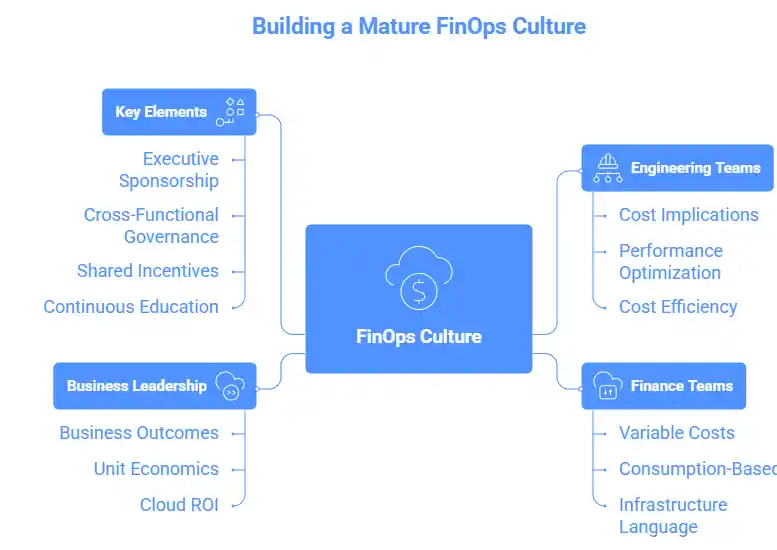
Here’s what a mature FinOps culture looks like in practice:
Engineering teams understand the cost implications of their architectural decisions. They optimize not just for performance but for cost efficiency. They participate in regular cost reviews and treat cloud spend as a product metric alongside uptime and latency.
Finance teams understand that cloud costs are variable and consumption-based, not fixed and predictable like traditional IT expenses. They partner with engineering rather than policing it, and they understand the language of infrastructure.
Business leadership connects cloud investment to business outcomes. They ask not just “How much are we spending?” but “What are we getting for what we spend?” embracing unit economics as a core measure of cloud ROI.
Building this culture requires executive sponsorship, cross-functional governance structures, shared incentives, and continuous education. It doesn’t happen by accident; it’s built deliberately, over time, through the steady application of FinOps principles.
The ROI of FinOps: What Results Can You Expect?
The return on investment from a well-implemented FinOps practice is substantial and measurable. According to industry data and its Foundation benchmarks:
- Organizations that implement these practices typically achieve a 20-30% reduction in cloud waste within the first 6 months
- Companies with mature cloud cost practices report cloud cost predictability improving by 40-60%
- Teams with strong cost visibility and accountability see engineering efficiency improve as wasteful architectures are refactored
- Enterprises using tools like Cloudability, combined with FinOps consulting engagements, consistently report multi-million dollar annual savings
But it is not just about cutting costs; it’s about spending smarter. The goal is not to starve engineering of cloud resources; it’s to ensure every dollar of cloud spend delivers maximum business value.
Conclusion
Your cloud bill is out of control because cloud computing is fundamentally different from any financial model that came before it. It’s variable, fast-moving, distributed, and deeply technical, and it requires an entirely new approach to financial management.
Cloud FinOps is that new approach.
Whether you’re starting with the FinOps Foundation’s framework, hiring your first FinOps Analyst, deploying Cloudability for multi-cloud visibility, or engaging a FinOps consulting partner to accelerate your journey, the most important step is the first one: deciding that cloud cost management is a strategic priority, not an afterthought.
The cloud was supposed to make your organization faster, more agile, and more innovative. FinOps makes sure it also makes you more financially sustainable.
The cloud can be your greatest competitive advantage. FinOps makes sure you can afford to keep it that way.
FAQs
What is the meaning of FinOps?
FinOps is a framework that helps organizations manage cloud costs by bringing finance, engineering, and business teams together to make smarter, data-driven spending decisions.
How do we handle multi-cloud cost management?
By centralizing cost visibility, standardizing tagging, and continuously optimizing usage across all cloud providers using a unified FinOps approach.
How does FinOps apply to AI/ML workloads?
By optimizing high-cost compute, storage, and data usage through efficient resource management, workload scheduling, and continuous cost-performance monitoring.
What tools should we use for FinOps?
Use a mix of native cloud tools (like AWS Cost Explorer, Azure Cost Management) and third-party platforms (such as Cloudability, CloudHealth, and Apptio) to gain visibility, optimize costs, and enforce governance.
What are the three pillars of FinOps?
The three pillars of FinOps are Inform (visibility), Optimize (cost efficiency), and Operate (continuous governance and accountability).
What is cost allocation in cloud computing?
Cost allocation is the process of assigning cloud expenses to specific teams, projects, or departments using tagging and tracking mechanisms.