

Table of Contents
Vercel has become a favourite among frontend developers thanks to its seamless Git workflows, instant preview deployments, global edge delivery, and deep integration with Next.js. But as projects scale, many teams start to run into limitations in pricing, infrastructure flexibility, runtime support, or platform control.
That is where modern Vercel alternatives come in.
Today’s deployment ecosystem offers far more than just frontend hosting. From serverless platforms and container-based infrastructure to hybrid PaaS solutions and fully self-hosted open-source stacks, developers now have a wide range of options tailored to different performance, scalability, and budget requirements.
This guide explores the 10 best Vercel alternatives, comparing them across infrastructure model, developer experience, pricing, scalability, and ideal use cases, so you can choose the right platform for your workflow.
Why Are Developers Switching From Vercel?
Vercel excels in its lane, but several friction points push developers toward Vercel alternatives:
- Pricing spikes: The Pro plan starts at $20/user/month, and bandwidth costs can balloon on high-traffic applications.
- Next.js-first bias: Vercel is optimised for JavaScript and Next.js; Python, Ruby, Go, or Rust projects feel like second-class citizens.
- Limited backend control: Serverless functions cover common API use cases, but containerised or hybrid workloads are not supported natively.
- Vendor lock-in risk: Proprietary edge middleware makes migrating to another platform painful and time-consuming.
Whether one or all four apply to you, the Vercel alternatives listed below offer a credible escape.
Our Evaluation Criteria
Every platform in this comparison was scored on five dimensions:
- Infrastructure type: Serverless, container, hybrid, or self-hosted
- CI/CD workflow: Git integration depth, preview deployments, build automation
- Language & runtime support: Support beyond JavaScript, Python, Ruby, Go, and more
- Pricing transparency: Free tier quality, paid plan value, and billing predictability
- Scalability: Autoscaling, global CDN coverage, and high-availability options
10 Best Vercel Alternatives
1. Netlify: Best for AI-Assisted Serverless Deployments
Netlify is one of the most established Vercel alternatives on the market. Deploy Previews automatically review PRs, AI agents (Claude, Codex, Gemini) are accessible from the dashboard, and Netlify DB adds serverless Postgres with zero config. Its generous free tier and clean CLI make it the go-to serverless pick for JAMstack teams.
- Best for: JAMstack projects, teams that want AI-assisted development
- Free tier: 300 build minutes/month, global CDN, unlimited previews
- Paid from: $9/month (Personal), $20/user/month (Pro)

2. Cloudflare Pages + Workers: Best for Edge Performance
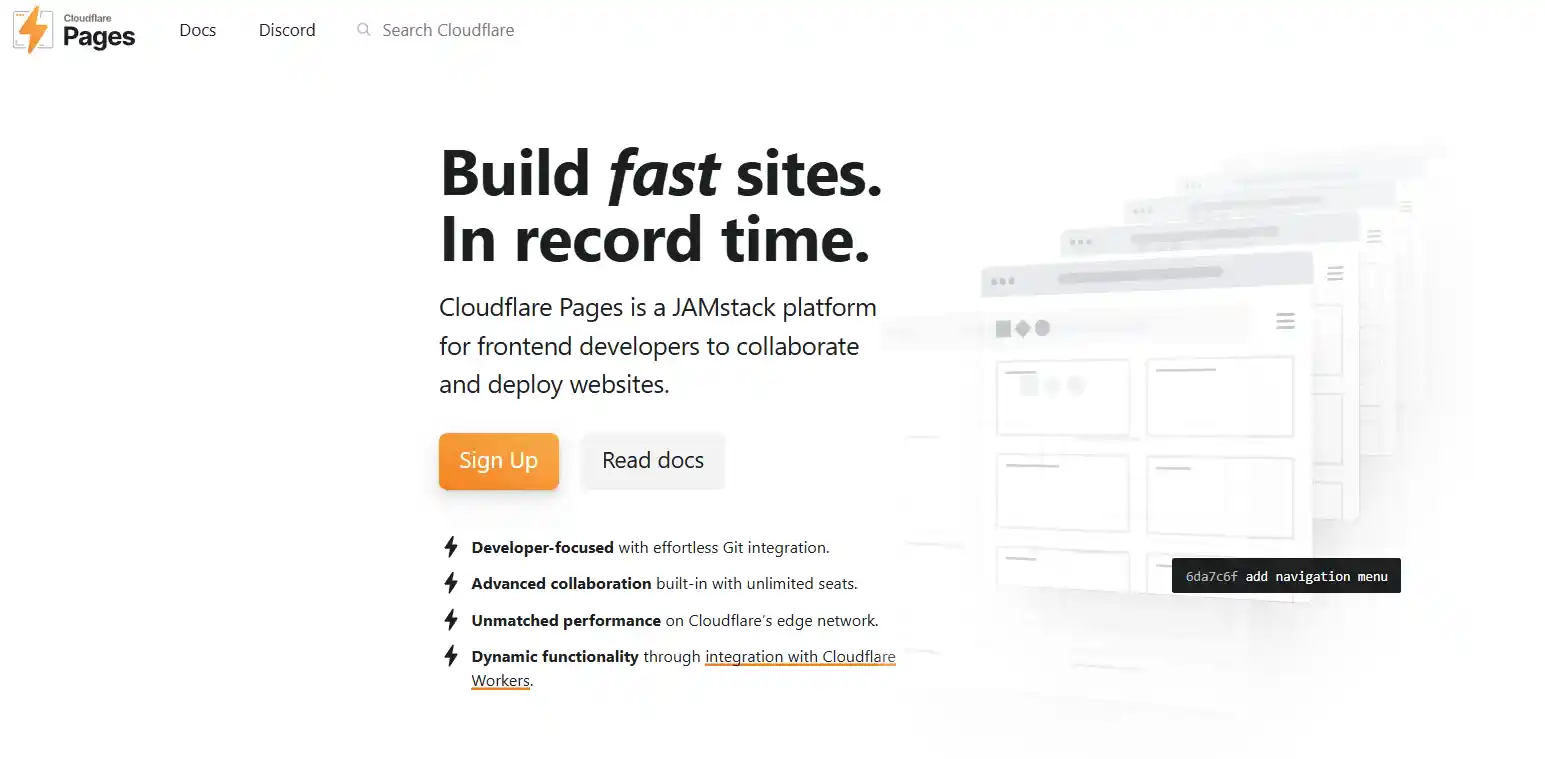
For teams where latency is the north star, Cloudflare Pages with Workers is the sharpest Vercel alternative for edge deployments. Pages handles static and server-side rendering while Workers brings serverless backend logic, all delivered from Cloudflare’s 300+ city network with unlimited static bandwidth even on the free tier.
- Best for: JAMstack apps, globally distributed low-latency applications
- Free tier: Unlimited static requests, unlimited bandwidth, 500 builds/month
- Paid from: $25/month (Pro), $250/month (Business)
3. Render: Best for Full-Stack Apps with Autoscaling
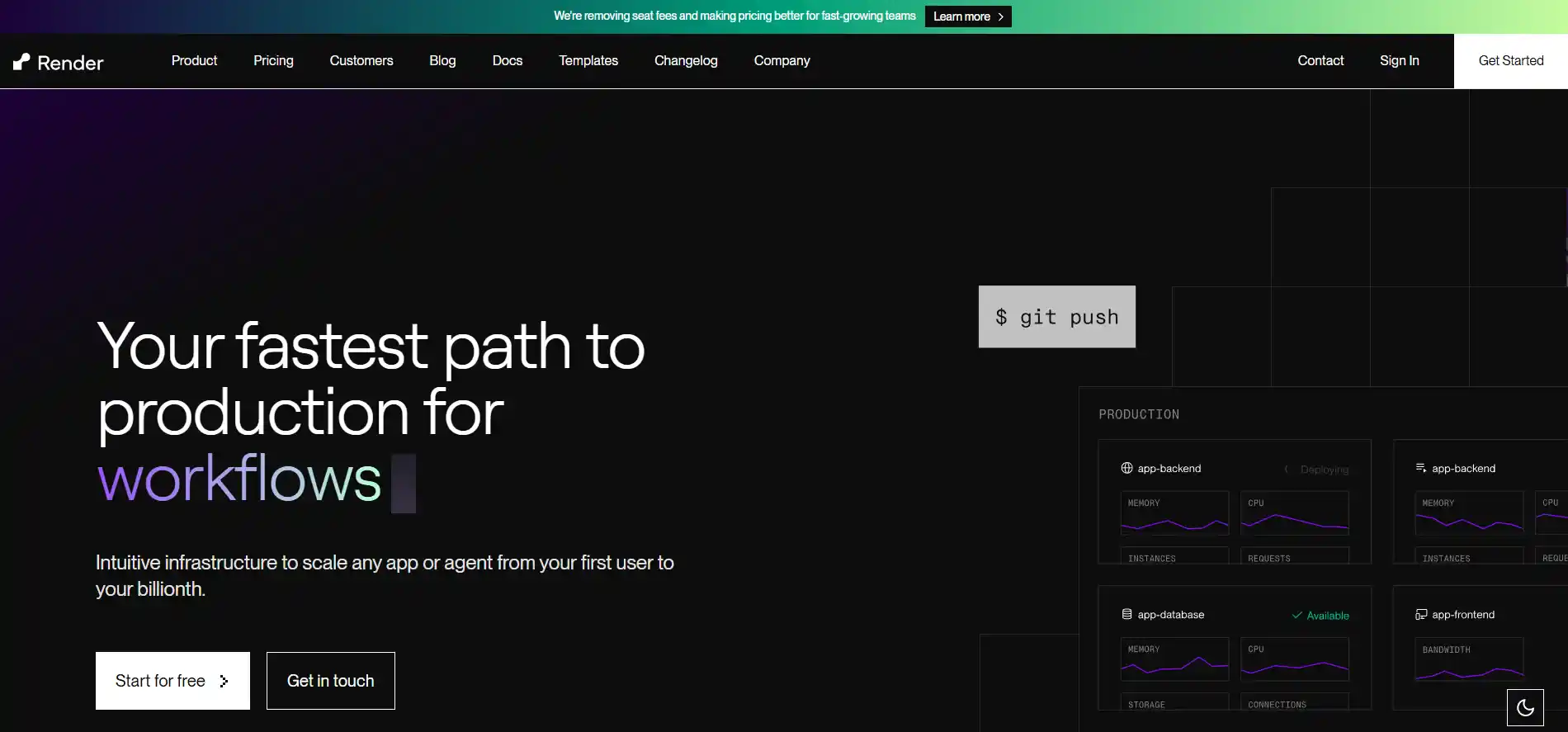
Render is a container-based Vercel alternative that supports Node.js, Python, Ruby, Go, Rust, and Elixir, making it one of the most language-agnostic platforms on this list. Git-native deployments via GitHub and GitLab, automatic TLS, horizontal and vertical autoscaling, and Infrastructure-as-Code support via Blueprints and Terraform make it a DevOps-friendly powerhouse.
- Best for: SaaS apps, full-stack applications, teams using multiple languages
- Free tier: Hobby plan with managed datastores and custom domains
- Paid from: $19/user/month (Professional)
4. Railway: Best for Full-Stack Apps with Databases
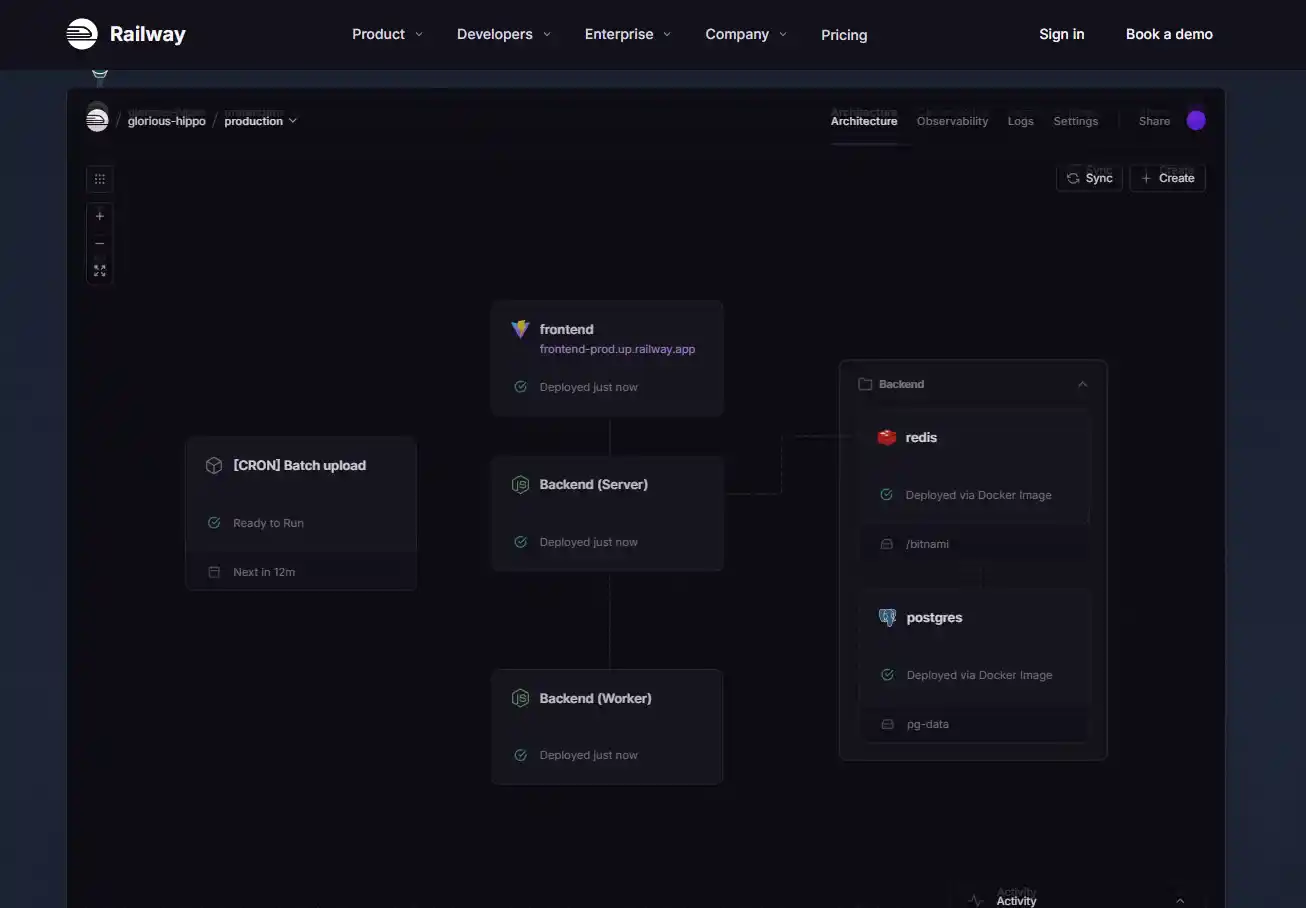
Railway bundles app deployment, databases, and cron jobs into a single clean interface, a rare quality among Vercel alternatives. It supports PostgreSQL, MySQL, MongoDB, and Redis natively, alongside PR environments and config-as-code functionality. Developers building data-backed full-stack apps will feel right at home.
- Best for: Developers who want app + database in one place, scheduled jobs
- Free tier: 30-day trial, 0.5 GB RAM
- Paid from: $5 usage credits (Hobby) and $20 usage credits (Pro)
5. Fly.io: Best for Distributed Container Apps
Fly.io runs hardware-virtualised containers across 32 global regions, with boot times under 250ms. WireGuard private networking, managed Postgres with automatic backups, and full Prometheus + Grafana monitoring are built in. For teams running globally distributed workloads, this Vercel alternative is hard to match.
- Best for: Global container apps, multi-region deployments
- Free tier: Pay-as-you-go (pricing calculator available)
- Paid from: Custom pay-as-you-go
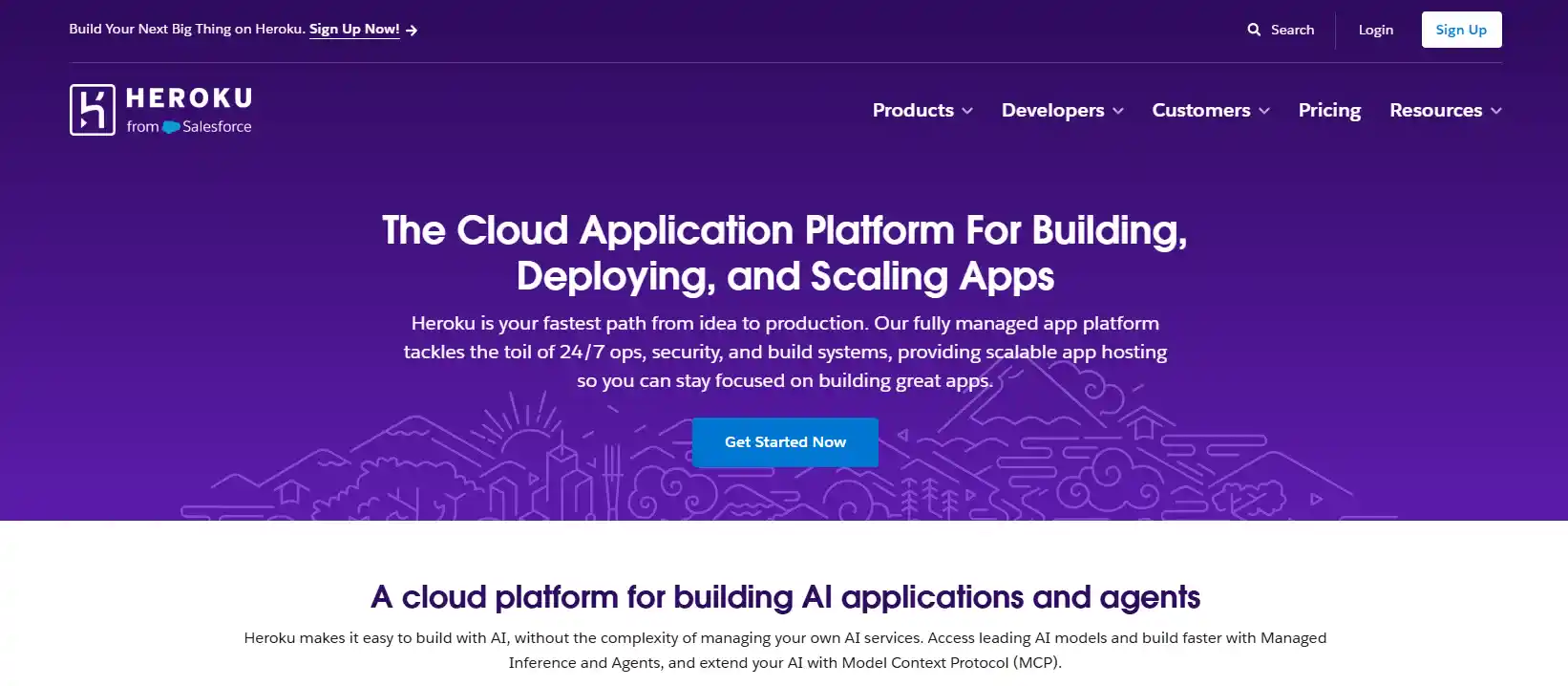
6. Heroku: Best Managed PaaS with AI Agent Support
Heroku is one of the original Vercel alternatives, and its 2026 iteration is AI-ready. Operational Experience features cover autoscaling, threshold alerting, and consolidated logs. New MCP (Model Context Protocol) support and the Elements Marketplace of add-ons make it ideal for teams building agentic applications with minimal infrastructure overhead.
- Best for: Teams wanting a fully managed runtime, an extensive add-on marketplace
- Free tier: No free tier (discontinued in 2022)
- Paid from: Custom, based on compute and RAM
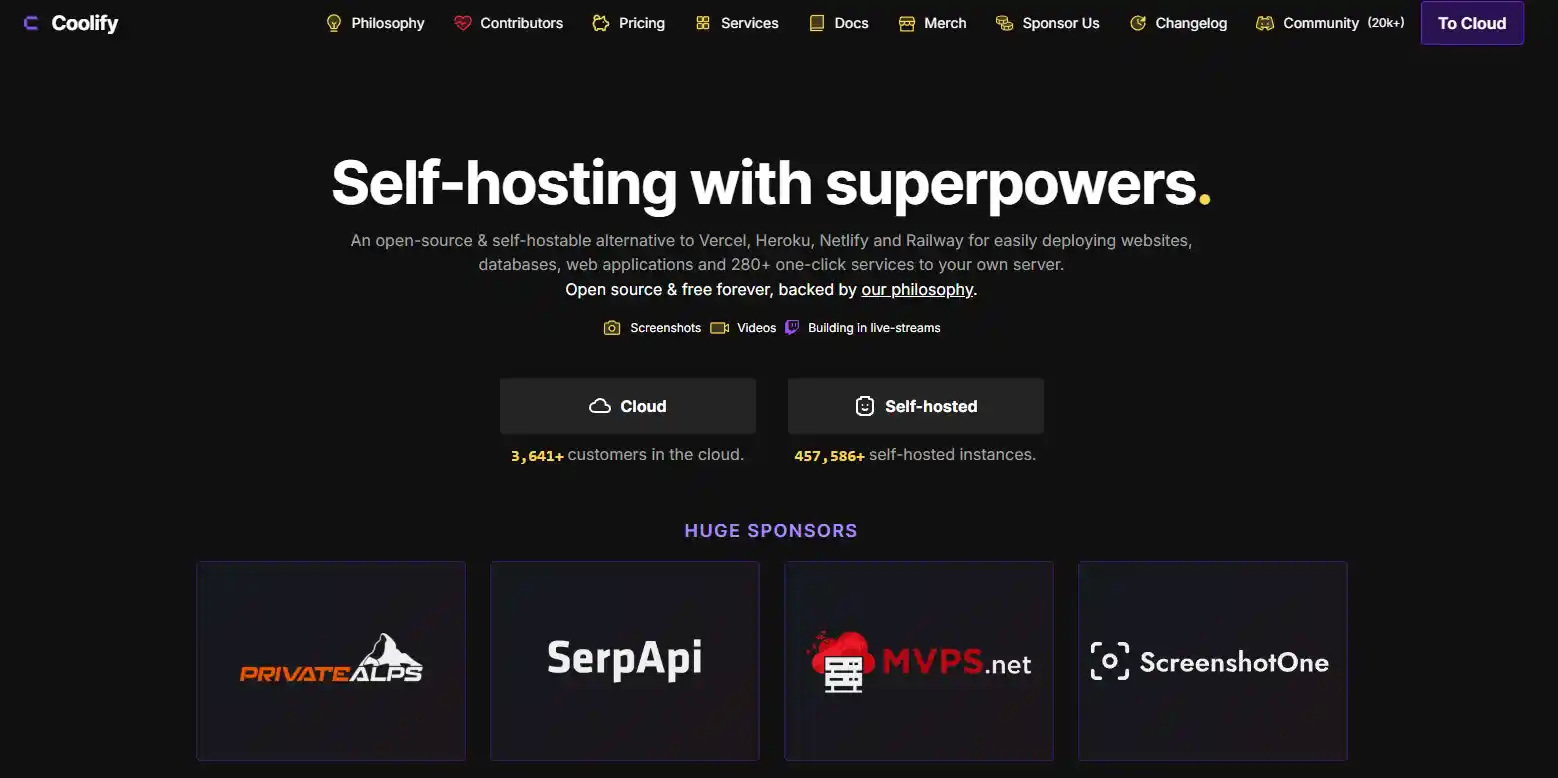
7. Coolify: Best Free Open-Source Self-Hosted Option
Coolify is an open-source Vercel alternative you can run on any VPS, cloud server, or Raspberry Pi completely free. It supports static sites, APIs, backends, databases, and any Docker-compatible service. Automatic SSL, built-in disc/container monitoring, and scheduled database backups rival the feature sets of paid platforms at zero licensing cost.
- Best for: Cost-conscious teams, developers who want full infrastructure control
- Free tier: Fully free self-hosted, unlimited servers, no feature restrictions
- Paid from: $5/month for 2 managed cloud servers
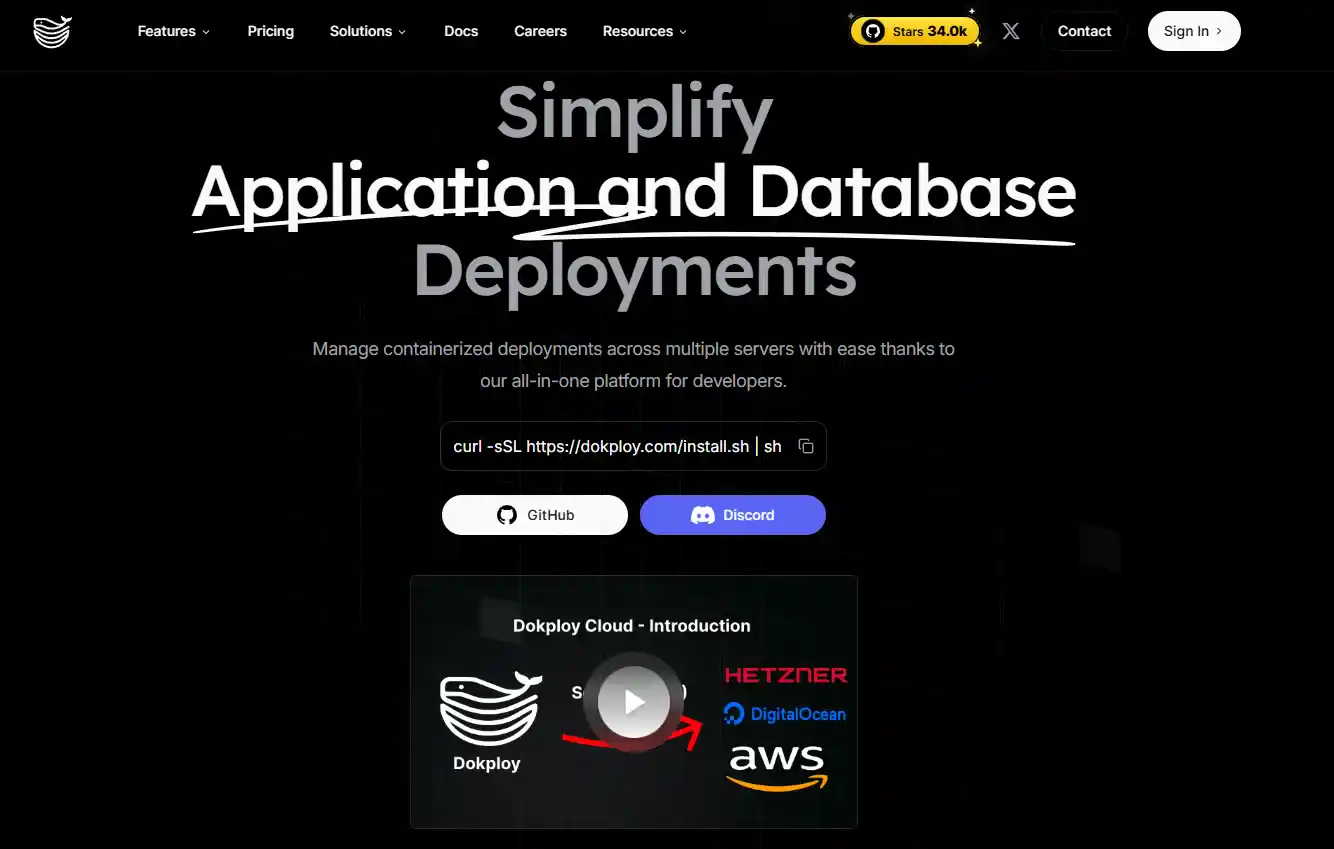
8. Dokploy: Best for Docker Compose Workflows
Dokploy is a self-hosted Vercel alternative purpose-built for Docker Compose workflows. Native multi-server deployment, built-in Docker Swarm support, real-time log monitoring, and database backups across MySQL, PostgreSQL, MongoDB, and Redis are all included. A one-click open-source template library (Grafana, Supabase, and Cal.com) speeds up complex setups.
- Best for: DevOps-heavy teams, complex multi-service Docker applications
- Free tier: Self-hosted with unlimited servers and core features
- Paid from: $4.50/month (managed plan)
9. AWS Amplify: Best for Full-Stack Web and Mobile Apps
AWS Amplify is a backend-as-a-service. A Vercel alternative that handles SSR, single-page apps, static sites, and native mobile applications in one place. Zero-config Next.js and Nuxt deployment, full TypeScript support, and multi-auth options (OIDC, SAML, MFA). Make it the go-to for teams already embedded in the AWS ecosystem.
- Best for: Teams in the AWS ecosystem, mobile + web full-stack projects
- Free tier: $0 for 6 months with $200 in credits
- Paid from: Pay-as-you-go beyond free tier
10. GitHub Pages: Best for Git-Native Static Site Hosting
GitHub Pages is the ultimate Vercel alternative for developers already using GitHub. Publish static sites directly from your repository with zero configuration: push to a gh-pages branch or enable it in settings. Built-in Jekyll support, automatic HTTPS, custom domains, and free subdomain hosting make it the go-to choice for portfolios, documentation, blogs, and open-source projects. No build limits, no bandwidth restrictions, completely free forever.
- Best for: Documentation, portfolios, blogs, GitHub-hosted projects
- Free tier: Completely free with unlimited sites and bandwidth
- Paid from: Free (no paid tier – always included with GitHub)
Side-by-Side Comparison
| Platform | Type | Free Tier | Best For | Starting Price |
| Netlify | Serverless | ✅ Yes | JAMstack, AI dev | $9/mo |
| Cloudflare Pages | Serverless/Edge | ✅ Yes | Edge performance | $25/mo |
| Render | Container | ✅ Yes | SaaS, autoscaling | $19/user/mo |
| Railway | Container + DB | ✅ 30d | Full-stack and Database | $5 credits |
| Fly.io | Container | 🔄 PAYG | Global containers | Custom PAYG |
| Heroku | Managed PaaS | ❌ No | AI agents, add-ons | Custom |
| Coolify | Self-hosted OSS | ✅ Free | Full infrastructure control | $5/mo cloud |
| Dokploy | Self-hosted OSS | ✅ Free | Docker Compose workflows | $4.50/mo |
| AWS Amplify | BaaS | ✅ 6mo | Web + Mobile full-stack | PAYG |
| GitHub Pages | Static Hosting | ✅ Yes | Documentation, portfolios, blogs | Free |
How to Choose the Right Vercel Alternative
With this many strong Vercel alternatives available, the decision comes down to your specific situation. Here is a quick decision guide:
- Need serverless simplicity? Netlify or Cloudflare Pages are your best bets.
- Need container flexibility? Choose Render, Railway, or Fly.io depending on whether databases or global reach matters most.
- Need full control at zero cost? Coolify and Dokploy are both excellent self-hosted Vercel alternatives.
- Need mobile + web in one platform? AWS Amplify is built for it.
- Scaling a SaaS product? Render or Railway with native database support.
- Just need fast static publishing? GitHub Pages gets the job done in seconds, completely free with GitHub.
The ideal Vercel alternative depends on your stack. Python and Ruby developers will prefer Render or Railway. Teams avoiding AWS gravity will lean toward Netlify or Cloudflare. Startups watching every dollar will find Coolify or Dokploy the most liberating options. Enterprise teams needing SLAs and SSO should evaluate Netlify Enterprise, Railway Pro, or Render Organization.
Conclusion
The landscape of Vercel alternatives is broader and more competitive than ever. Whether you need the edge-network power of Cloudflare, the self-hosting freedom of Coolify, the database-bundled simplicity of Railway, or the AI-native development environment of Netlify, there is a platform engineered for your exact situation.
Stop overpaying, stop compromising on language support, and stop tolerating proprietary lock-in. The right Vercel alternative is out there, and this guide has given you everything you need to find it. Pick the platform that matches your stack, your scale, and your budget, and ship with confidence.
FAQ’s
What is the best free Vercel alternative?
Coolify, it is fully free to self-host with no feature restrictions and unlimited server connections.
Can I deploy Next.js apps without Vercel?
Yes, Netlify, Cloudflare Pages, Render, Railway, Fly.io, and AWS Amplify all support Next.js with zero or minimal configuration.
Is Netlify better than Vercel?
For serverless and JAMstack projects, Netlify matches Vercel feature-for-feature with a more generous free tier and built-in AI agents.
What is the cheapest Vercel alternative?
Coolify and Dokploy are free to self-host; for managed options, Dokploy starts at $4.50/month and Railway at $5 usage credits.
Which Vercel alternatives support Python?
Render, Railway, Fly.io, and Heroku all offer first-class Python support alongside other backend languages.