Table of Contents
Every organisation today generates data at an unprecedented scale. But generating data and actually understanding it are two very different things. Data intelligence is the discipline that bridges this gap, turning fragmented, raw information into trusted, decision-ready knowledge that drives measurable business outcomes.
This guide covers everything you need to know: what data intelligence really means, why it matters, how it works, the different types, and the real-world use cases where it delivers the most impact.
What Is Data Intelligence?
Data intelligence is the practice of collecting, managing, and analyzing organizational data to make it consistently reliable, accessible, and ready to drive decisions. It is not a single tool or technology; it is a combination of processes, platforms, and people working together to ensure that data flowing through a business can be trusted and acted upon at every level.
Two Core Dimensions
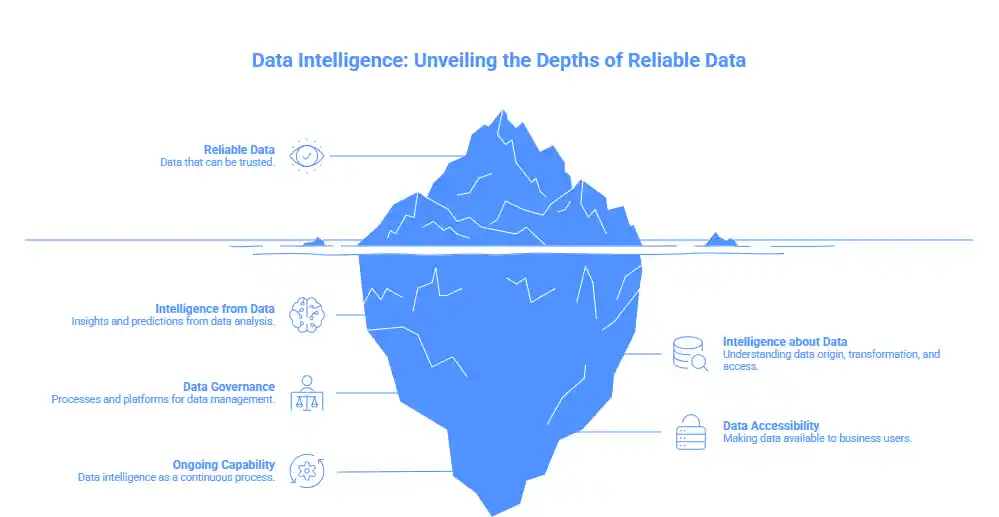
A data intelligence program operates across two interconnected ideas that work together:
- Intelligence from data: the insights, predictions, and recommendations that analysis produces from existing datasets.
- Intelligence about data: understanding where data originated, how it was transformed, who accessed it, and whether it meets quality and compliance standards.
Both dimensions are essential. Powerful analytics built on poorly governed data lead to wrong decisions. Strong governance without analytical capability leads to no decisions at all.
What Data Intelligence Is Not
It is easy to confuse data intelligence with adjacent concepts. Here is what sets it apart:
- Not just a dashboard tool; dashboards are one output. Data intelligence governs the entire lifecycle that makes those dashboards trustworthy.
- Not only for data teams; a well-built data intelligence practice makes data accessible to business users, not just data engineers and scientists.
- Not a one-time project; data intelligence is an ongoing organizational capability, not a deployment you complete and walk away from.
Why Does Data Intelligence Matter?
Decision-makers across every sector need timely, accurate, and relevant information without depending entirely on IT teams to fetch it. Without a structured data intelligence practice, that rarely happens.
The Cost of Getting It Wrong
Organizations without data intelligence routinely face:
- Outdated reports that reflect yesterday’s reality, not today’s.
- Conflicting datasets that erode trust and slow down decisions.
- Compliance failures caused by ungoverned, unverified data.
- Missed opportunities because insights arrive too late to act on.
What Data Intelligence Fixes
- Data governance frameworks ensure every dataset has a clear owner, standard, and access policy.
- Data quality management catches and resolves errors before they reach decision-makers.
- Self-service analytics puts trusted data directly in the hands of business users, with no IT bottleneck.
- AI and machine learning readiness model outputs are only as reliable as the data powering them. Data intelligence ensures that data is clean, current, and fit for purpose.
How Does Data Intelligence Work?
A data intelligence platform operates as an integrated system that manages data across its entire lifecycle. Here is how the process typically unfolds:
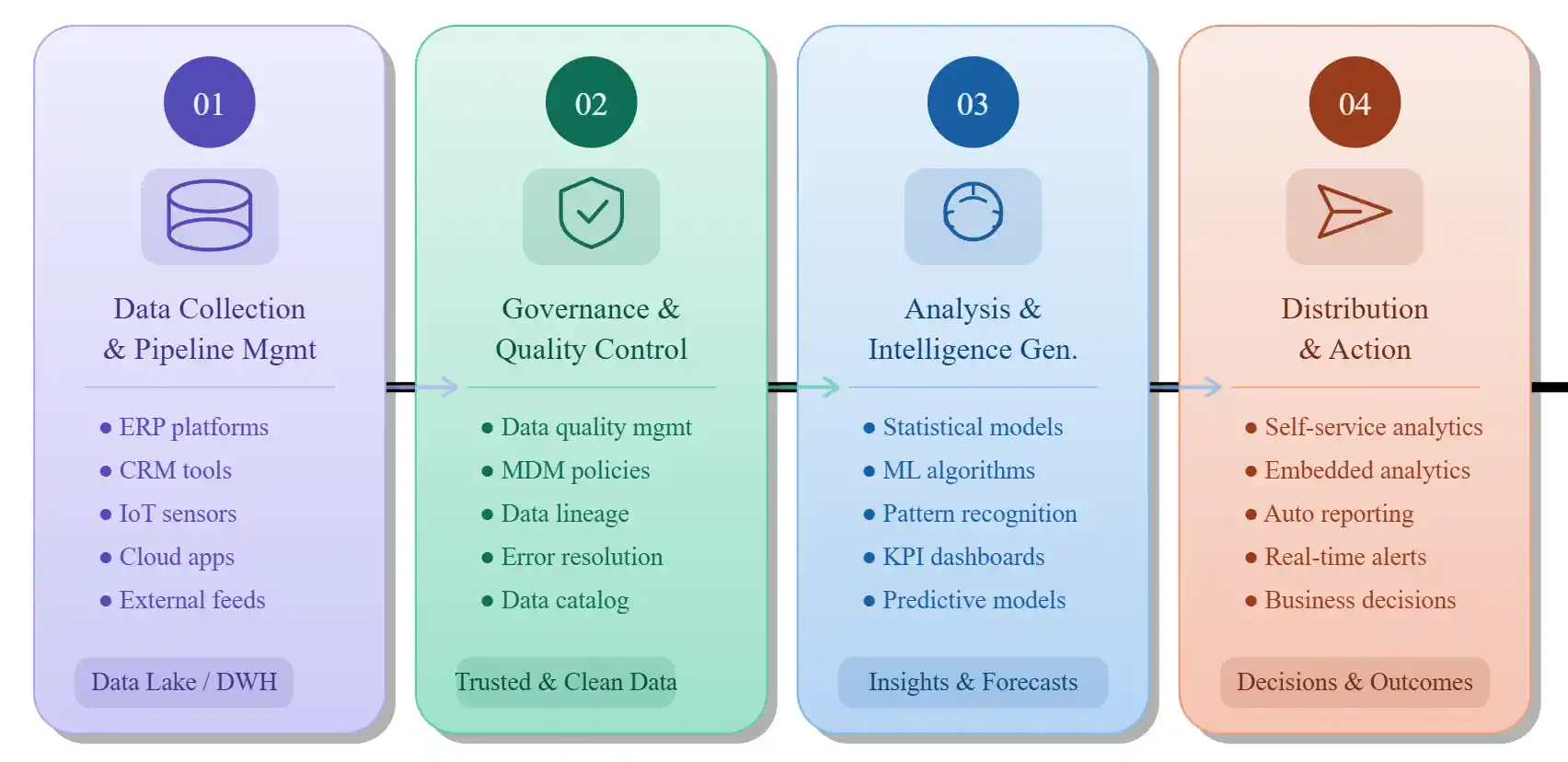
1. Data Collection and Pipeline Management: Data flows from multiple source systems, ERP platforms, CRM tools, IoT sensors, cloud applications, and external feeds through a structured data pipeline into centralized storage environments such as a data lake or enterprise data warehouse.
2. Data Governance and Quality Control: As data enters the system, governance policies are applied. Data quality management processes identify and resolve inconsistencies, duplicates, and errors. Master data management (MDM) ensures that key business entities, customers, products, and suppliers have a single, authoritative definition across all systems. Data lineage tools track every transformation the data has undergone, and a data catalog makes all available datasets searchable and documented.
3. Analysis and Intelligence Generation: With clean, governed data in place, analytics engines and machine learning platforms apply statistical models, pattern recognition algorithms, and AI-driven techniques to extract insights. These outputs range from simple trend reports and KPI dashboards to sophisticated predictive models and prescriptive recommendations.
4. Distribution and Action: Finally, insights are distributed to the people and systems that need them through self-service analytics interfaces, embedded analytics in business applications, and automated reporting workflows that surface the right information at the right moment.
Types of Data Intelligence
Data intelligence is not a single capability; it is a spectrum. Depending on the business question being asked, organizations draw on different types of intelligence, each with its own scope, depth, and application. Here is how each type works and where it creates the most value.
1. Descriptive Intelligence: The Rearview Mirror
The starting point of every data intelligence journey, it answers “What happened?” by turning historical data into clear, structured summaries.
- What it answers: Converts raw numbers into trend lines, period comparisons, and performance snapshots using KPI dashboards and data visualization tools.
- How it works: Automated reporting engines aggregate data across sources and present it in formats that teams at every level can instantly interpret.
- Real-world use: A retail chain reviewing year-over-year revenue by product category, or an operations team tracking monthly output against quarterly targets.
2. Diagnostic Intelligence: The Root Cause Investigator
This layer moves beyond surface-level reporting to answer “Why did it happen?” by uncovering the underlying drivers and contributing factors behind business outcomes.
- What it answers: Identifies the driving cause behind a performance gap, spike, or unexpected result using correlation and segmentation analysis.
- How it works: Cross-references multiple datasets, isolates key variables, and maps relationships between data points to produce evidence-backed explanations.
- Real-world use: A company pinpointing why a product launch underperformed in a region, or a bank tracing what drove a rise in loan defaults within a specific customer segment.
3. Predictive Intelligence: The Early Warning System
Shifts the focus from past to future, answering “What is likely to happen next?” by recognizing patterns before they fully materialize.
- What it answers: Converts historical patterns into probability-weighted forecasts of future events, behaviors, or risks.
- How it works: Machine learning platforms and statistical models process transactional and behavioral data to detect signals that predict outcomes weeks or months.
- Real-world use: A logistics firm pre-positioning inventory ahead of a forecasted demand surge or a healthcare provider flagging patients at high readmission risk before discharge.
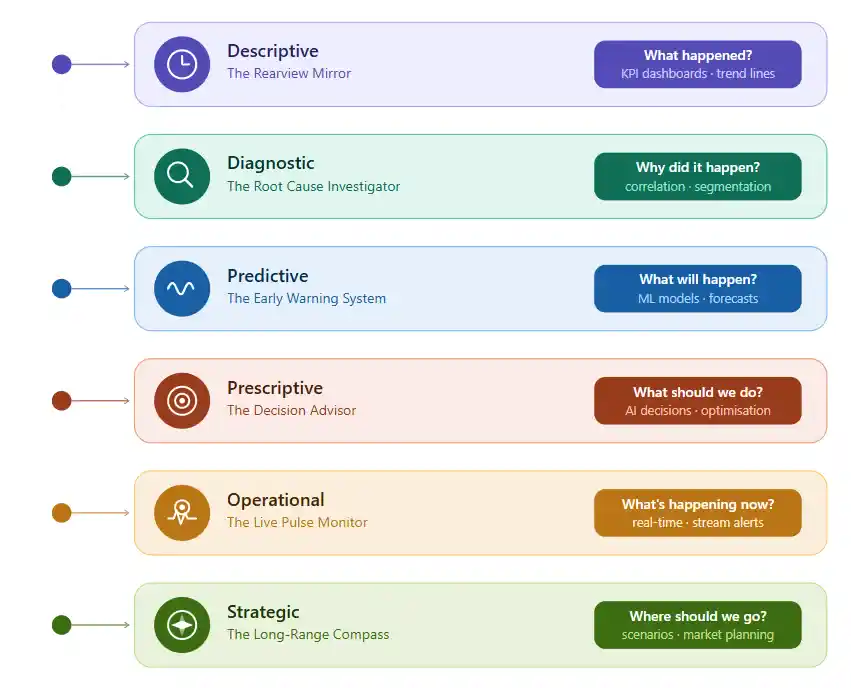
4. Prescriptive Intelligence: The Decision Advisor
The most action-oriented tier answers “What should we do about it?” by turning forecasts into specific, ranked recommendations.
- What it answers: Evaluates multiple response options and surfaces the one most likely to achieve the desired business outcome.
- How it works: AI-driven decision engines combine predictive outputs with optimization logic, continuously improving recommendations as real-world outcomes are fed back into the model.
- Real-world use: A supply chain platform recommending an alternative supplier when a disruption is predicted, or a pricing engine adjusting product prices in real time based on live demand signals.
5. Operational Intelligence: The Live Pulse Monitor
Built for speed, answering “What is happening right now?” by continuously analyzing live data feeds and automatically triggering alerts or corrective actions when performance deviates from expected baselines.
- What it answers: Delivers a real-time view of system states, process performance, and operational health as events unfold.
- How it works: Stream processing platforms continuously monitor data flows and trigger automated alerts or corrective actions the moment an anomaly is detected.
- Real-world use: A manufacturing plant catching a production line fault before it causes downtime, or a fraud system flagging a suspicious transaction within milliseconds of it occurring.
6. Strategic Intelligence: The Long-Range Compass
Operates at the highest level, answering “Where should we go from here?” by synthesising broad data into long-term organizational direction.
- What it answers: Informs major decisions on market expansion, resource allocation, competitive positioning, and multi-year planning.
- How it works: Aggregates internal performance data with competitive intelligence signals, macroeconomic trends, and industry forecasts into scenario models built for executive decision-makers.
- Real-world use: A business evaluating which international markets offer the strongest five-year growth potential or a leadership team stress-testing their capital plan against projected economic scenarios.
Data Intelligence Use Cases
The practical value of data intelligence is best understood through the specific business problems it solves.
Healthcare: Healthcare organizations use data intelligence to build predictive risk models that identify high-risk patients before their conditions escalate. Machine learning platforms analyze clinical records, lab results, and imaging data to support earlier diagnoses and more personalized treatment plans.
Retail: Retailers apply data intelligence to demand forecasting, inventory optimization, and personalized marketing. By combining historical sales data, customer behavior patterns, and external demand signals, retail data analytics platforms reduce stockouts, minimize overstock, and increase conversion rates.
Finance: Financial institutions rely on data intelligence for fraud detection, credit risk assessment, and revenue intelligence. Real-time pattern recognition monitors millions of transactions simultaneously, flagging anomalies in milliseconds before losses accumulate.
Supply Chain: Supply chain teams use data intelligence to gain end-to-end visibility across complex logistics networks. Predictive models anticipate disruptions, port delays, supplier failures, and demand surges, and prescriptive intelligence recommends the optimal response before the disruption materializes.
Sales and Marketing: Sales and marketing teams use data intelligence to understand buyer intent, segment audiences precisely, and measure campaign effectiveness in real time. Data storytelling tools help communicate performance clearly to stakeholders, while predictive models identify the prospects most likely to convert.
Human Resources: HR teams apply people analytics to improve talent acquisition, predict attrition risk, and identify high-potential employees. Data intelligence transforms workforce planning from a reactive process into a proactive strategic capability.
The Benefits of Building a Data Intelligence Practice
Organizations that commit to data intelligence as a disciplined practice consistently realize benefits across multiple dimensions:
- ROI optimization through more efficient resource allocation and reduced operational waste.
- Operational efficiency through faster cycle times and automated, data-driven workflows.
- Data democratization puts self-service analytics and BI tools in the hands of every team, not just specialists.
- Data stewardship that ensures every dataset is owned, documented, and maintained to a defined quality standard.
- Data compliance with regulatory frameworks like GDPR and HIPAA through structured governance and data security controls.
- Digital transformation acceleration because every transformation initiative runs on data, and data intelligence ensures that data is ready.
- Data monetization is unlocking the commercial value hidden inside existing data assets through advanced analytics and business intelligence (BI).
Perhaps most importantly, a mature data intelligence practice positions organizations to extract full value from AI investments because AI is only as powerful as the quality and governance of the data that powers it.
Conclusion
Throughout this guide, we have seen how data intelligence spans the full spectrum from descriptive analytics that clarify the past to predictive analytics that anticipate the future to prescriptive analytics that recommend exactly what to do next. We have seen how it powers real outcomes across healthcare data intelligence, retail data analytics, financial data intelligence, and supply chain intelligence. And we have seen how it rests on a foundation of data governance, data quality management, data stewardship, and data compliance, without which even the most powerful machine learning platform produces results that cannot be trusted.
FAQ’s
What is data intelligence, and how is it different from data analytics?
Data intelligence is the broader practice of collecting, managing, and analysing data to make it trusted and decision-ready, covering governance, quality, lineage, and self-service access. Data analytics is just one output layer within it. Think of analytics as the engine; data intelligence is the whole car.
What is the difference between data intelligence and business intelligence?
Business intelligence focuses on dashboards, reporting, and historical data for business users. Data intelligence is the full lifecycle of governance, quality management, cataloguing, and the trusted data infrastructure that makes BI possible. BI is the final mile; data intelligence is the entire road.
What is the type of data intelligence?
There are six key types: Descriptive (what happened), Diagnostic (why it happened), Predictive (what will happen), Prescriptive (what to do), Operational (what’s happening right now), and Strategic (where should we go long-term). Each serves a different decision-making depth.
How does a data intelligence platform actually work?
A data intelligence platform ingests data from multiple sources through pipelines, applies governance and quality rules, maintains a data catalog for discoverability, tracks lineage for every transformation, and then surfaces clean, trusted data to analytics engines and business users — all in a continuous lifecycle.
What tools and platforms are used for data intelligence?
Common categories include: Data Catalogs (Collibra, Alation), Data Quality tools (Informatica, Monte Carlo), Observability platforms, Data Lineage tools, Master Data Management (MDM) platforms, and self-service BI tools like Power BI or Tableau. Enterprises often combine several into a unified data intelligence stack.