
Table of Contents
Imagine your most critical production line going dark not because of a catastrophic failure, but because no one saw a slow-building fault coming. Now imagine catching that fault 60 days in advance, running a simulation, fixing it on a Thursday afternoon, and never missing a single shift.
That’s not a hypothetical. That’s what modern digital twin technology delivers.
Unplanned downtime currently costs global manufacturers $1.4 trillion every year, roughly 11% of total industry revenues. In automotive alone, an idle line burns through $600 every second. With those stakes, “react and repair” is no longer a viable strategy. The leaders who will define manufacturing in 2026 and beyond are the ones already moving toward proactive, data-driven production.
In this guide, you’ll get a clear breakdown of the most impactful digital twin use cases in manufacturing, the ROI numbers behind them, and a practical roadmap to start building your own digital strategy even if you’re still running legacy systems.
What Is a Digital Twin – And What It Isn’t
Before diving into use cases, it’s worth clearing up a common misconception. A digital twin is not a 3D CAD model. It’s not a static render sitting in your product lifecycle management system.
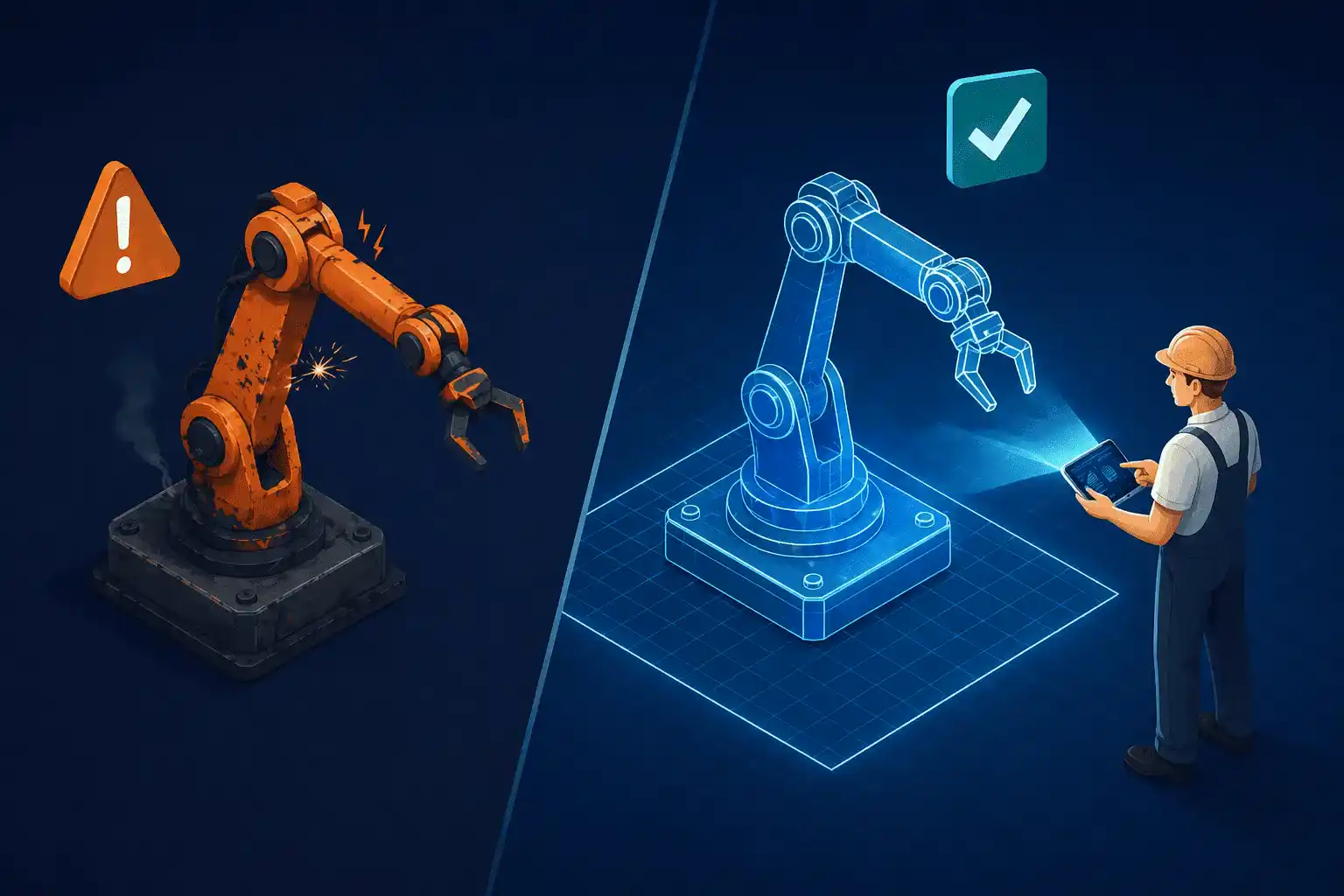
A true digital twin is a live, bidirectional virtual representation of a physical asset. It receives data from the real world and sends updated parameters back, closing a continuous loop between the physical and digital.
Here’s the hierarchy to understand:
| Type | Data Flow | Intelligence Level |
|---|---|---|
| 3D CAD Model | None | Static visualization |
| Digital Shadow | One-way (physical → digital) | Monitoring only |
| Digital Twin | Bidirectional | Simulation + decision support |
| Cognitive Digital Twin | Bidirectional + autonomous | Self-healing systems |
The Cognitive Digital Twin is the 2026 benchmark. It operates across three layers:
- Access Layer – Enables real-time machine communication
- Analytics Layer – Processes edge-level intelligence
- Cognition Layer – Drives autonomous decision-making
This isn’t just a fancier dashboard. It’s a system that can detect anomalies, simulate solutions, and in some cases, resolve issues without a human ever touching the keyboard.
6 High-Impact Digital Twin Use Cases in Manufacturing
1. Predictive Maintenance: From “Break-Fix” to Fault Forecasting
This is the use case that converts the most skeptics.
Predictive maintenance using digital twins works by connecting sensors, monitoring vibration, heat, pressure, and torque to AI models trained on historical performance baselines. The twin continuously compares live readings against those baselines, detecting subtle degradation patterns that human inspection would never catch.
The numbers are compelling:
- Fault detection accuracy: 80–97%
- Failure forecasting window: 30 to 90 days in advance
In practice, an automotive manufacturer used a digital twin to identify early bearing wear in a stamping press. The intervention prevented five weeks of unplanned downtime and millions in losses. GE applies the same principle to jet engine monitoring, where the cost of a missed failure is measured in lives, not just dollars.
Key insight: Predictive maintenance shifts your maintenance team from firefighters to engineers. Instead of reacting to failures, they schedule interventions at the most convenient and cost-effective time.
2. Quality Control: Real-Time Oversight at Every Stage
Traditional quality control relies on sampling, pulling a few units at set intervals, and hoping they represent the batch. That approach leaves significant risk on the table.
Digital twins replace sampling with continuous, real-time comparison. The twin holds an “ideal” digital specification for each machine’s output. The moment actual performance deviates from that specification, even mid-batch, the system flags it immediately.
The result? Operators can correct the deviation before scrap accumulates, protecting both material costs and brand reputation. For manufacturers operating across multiple global sites, this creates a consistent quality baseline that doesn’t depend on any single shift supervisor’s experience level.
For industries like pharmaceuticals, aerospace, and food & beverage, where a single quality failure can be catastrophic, this use case alone often justifies the entire twin implementation.
3. Production Process Optimization: Test Before You Touch
One of the most underrated capabilities of digital twins is the “what-if” simulation.
Want to reorganize the floor layout? Run it virtually first. Want to see how adding a second robot arm to Line 3 affects throughput on Lines 1 and 4? Simulate it. Want to understand how a 15% increase in cycle time on one station creates a downstream bottleneck? The twin will show you before you’ve moved a single machine.
Siemens has been a benchmark here, using simulations to optimize complex assembly processes that resulted in a 20% increase in throughput and a measurable reduction in energy consumption.
This is especially valuable when adapting to sudden market demand shifts. Instead of halting production to reconfigure, teams can test multiple scenarios in parallel and deploy the best-performing option.
4. Supply Chain Resilience: The Twin Beyond the Factory Walls
Most manufacturers think of digital twins as an internal tool. The companies gaining the biggest competitive edge are extending the twin across the entire supply network.
When your digital twin integrates with supplier systems, logistics platforms, and inventory data, you get a unified view of everything from raw material availability to last-mile delivery. Companies like P&G and Unilever have implemented this at scale, using digital twin manufacturing capabilities to automate replenishment and proactively resolve logistics delays.
The architecture behind this typically includes a Knowledge Graph, a central information layer that maps relationships between suppliers, materials, orders, and transportation nodes. When a disruption occurs (a port delay, a supplier capacity change), the twin can model the downstream impact and autonomously propose alternative routing or sourcing.
This moves supply chain management from reactive risk mitigation to predictive supply intelligence.
5. Virtual Prototyping: Compress Design Cycles Without Compromise
For product design teams, digital twins are rewriting the economics of development.
Physical prototyping is expensive, slow, and wasteful. Every design iteration requires new materials, new tooling, and new testing cycles. Virtual prototyping replaces most of that physical overhead with simulation running aerodynamic tests, stress analyses, and performance modeling entirely in the digital environment.
The aerospace industry has led this transformation. Boeing’s use of digital twins during aircraft development resulted in an 80% reduction in assembly time and a 50% drop in software development time for new platforms. Across industries, manufacturers report a 50% overall reduction in time-to-market when virtual prototyping is fully integrated into the design workflow.
The additional benefit? The twin built during the design phase doesn’t get retired. It carries forward, tracking the product’s actual performance throughout its operational life, creating a continuous feedback loop between design and operations.
6. Worker Safety and Immersive Training
This is the use case that often gets the least boardroom attention and perhaps deserves the most.
Digital twins map physical environments in precise detail, enabling them to identify collision points, ergonomic risk zones, and hazardous access paths before anyone gets hurt. Safety audits that used to require shutting down a line can now happen virtually, without production impact.
More practically, Virtual Commissioning allows technicians to fully practice maintenance procedures on high-voltage, high-pressure, or automated equipment in a risk-free simulation before ever touching the actual hardware.
The industry maxim here is worth repeating: a bug found in simulation is an inconvenience; a bug on the factory floor means damaged equipment or injury.
Manufacturers who have implemented virtual training programs consistently report a measurable drop in real-world safety incidents and a more confident, better-prepared workforce.
The Business Case: What Does This Actually Cost vs. Return?
Let’s put numbers to all of this.
A 2025 Hexagon industry survey found that 92% of companies that implemented digital twins reported positive ROI. Simio’s industry data indicates manufacturers can achieve up to 30% in operational savings through reduced energy consumption and eliminated scrap.
At the macro level, the impact scales dramatically:
| Metric | Data Point |
|---|---|
| Global downtime cost reduction (Fortune 500) | 2.1 million hours/year |
| Prevented maintenance & outage costs | $233 billion |
| Operational savings (typical implementation) | Up to 30% |
| Companies reporting positive ROI | 92% (2025 Hexagon survey) |
For a five-year strategic plan, these aren’t marginal gains. Digital twins function as risk-reduction infrastructure protecting revenue, protecting brand, and protecting people.
The Biggest Barrier Isn’t the Technology
Here’s something that often surprises manufacturers exploring digital twins for the first time: the technology itself is rarely the blocker.
The real obstacles are:
- Poor data quality – Twins are only as smart as the data feeding them. If your sensors are inconsistent or your historical records are incomplete, the model degrades quickly.
- Unfamiliarity with the concept – Teams used to physical systems often struggle to trust virtual recommendations without significant change management support.
- Staying stuck in the pilot phase – Many manufacturers run a successful proof-of-concept and then fail to scale. The full value of a digital twin network only emerges when it’s connected across assets, lines, and supply chains.
The answer to all three is the same: start focused, prove value fast, then scale deliberately.
How to Start Your Digital Twin Journey (This Week)
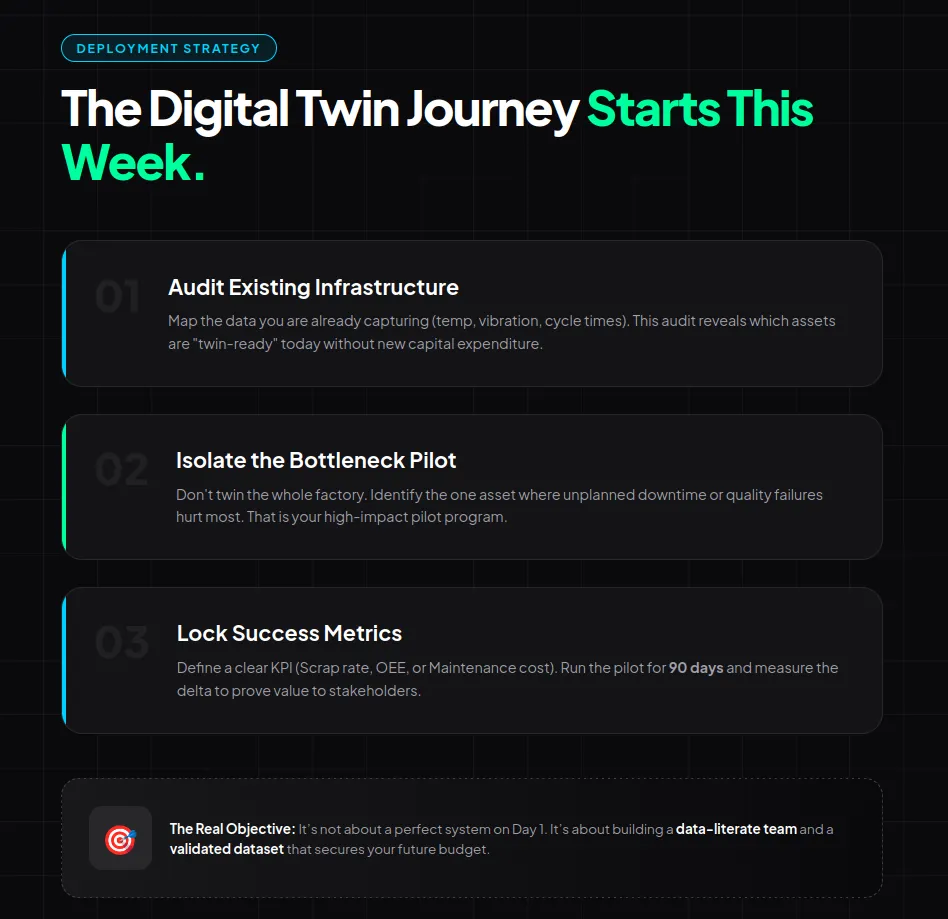
You don’t need a greenfield factory or a nine-figure budget to begin. Here’s a practical three-step start:
Step 1 – Audit your existing sensor infrastructure. What data are you already capturing? Temperature, vibration, cycle times, rejection rates? Map what you have. This tells you which assets are ready for a twin today.
Step 2 – Identify your highest-value bottleneck asset. Don’t try to twin the whole factory. Pick the one asset or line where unplanned downtime or quality failures hurt most. That’s your pilot.
Step 3 – Define your success metric before you start. Downtime frequency? Scrap rate? Maintenance cost per unit? Lock in one metric, run the pilot for 90 days, and measure the delta.
The goal isn’t to build a perfect system on day one. It’s to build a team that understands how to work with digital twins and a dataset that proves their value to the people holding the budget.
Final Thoughts
Digital twins are no longer a technology experiment reserved for aerospace giants and Tier 1 automotive suppliers. They’re a practical, ROI-positive tool that manufacturers of every size are deploying to protect margins, reduce risk, and build the operational resilience that volatile global markets demand.
The virtual mirror is ready. The question now is whether your organization is ready to look into it and act on what it shows you.
Start with the assets you have. Start with the data you’re already collecting. Start this week.
READ MORE:
Lean Manufacturing Principles: The Complete Guide [2026]
Top 14 Business Intelligence Tools and Software in 2026: Complete Guide for Data-Driven Decision Makers
FAQs
What is a digital twin in manufacturing, and how does it work?
A digital twin in manufacturing is a dynamic virtual replica of a physical production system, a robot cell, a production line, or an entire factory that mirrors real-world behavior through bidirectional data connectivity.
In practice, it works in three steps. First, IoT sensors on physical assets continuously capture operational data: temperature, vibration, pressure, and cycle times. Second, that data is synchronized with the virtual model in near real-time, keeping the twin accurate as conditions change. Third, an AI-powered analytics layer on top, enabling the system to run simulations, surface anomalies, and recommend actions, without touching the physical asset.
Unlike a dashboard that just displays data, a true digital twin can also send instructions back to the physical system, closing the loop between insight and action.
How is a digital twin different from a traditional simulation?
The distinction matters, and it’s more than technical.
A traditional simulation is a one-time or periodic analysis. You feed it historical or assumed data, run a scenario, and get a result. It’s a snapshot. Useful, but disconnected from what’s happening right now on the floor.
A digital twin is an ongoing, live connection. It evolves alongside the physical asset, updates automatically as conditions change, and can model scenarios using current operating data rather than assumptions. Think of a simulation as a photograph and a digital twin as a live video feed, with the ability to rewind, fast-forward, and run alternative timelines.
For manufacturers, this difference is the gap between “we think this will happen” and “here’s what’s actually about to happen.”
What are the main use cases for digital twins on the factory floor?
The five applications with the clearest ROI track record:
Predictive Maintenance – Forecasting equipment failures 30 to 90 days in advance by detecting subtle degradation in sensor data, enabling scheduled repairs instead of emergency shutdowns.
Quality Control – Continuously comparing actual machine output against an ideal digital specification, flagging mid-batch deviations before they become scrap.
Process Optimization – Running “what-if” simulations of floor layouts, cycle time changes, and equipment configurations to find bottlenecks before making physical changes.
Virtual Prototyping – Testing new product designs under simulated stress, thermal, and operational conditions, eliminating most of the cost and time of physical prototyping.
Supply Chain Intelligence – Extending the twin across the supplier network to automate replenishment, model logistics disruptions, and maintain just-in-time efficiency at scale.
What ROI can manufacturers realistically expect?
Based on industry data, the numbers are consistent and significant:
– Operational efficiency gains of up to 30%
– Unplanned downtime reduction of 30–50%
– Product development cycle time cut by 30–50%
– Energy consumption reduction of up to 30% in optimized implementations
– 92% of implementing companies reported positive ROI in a 2025 Hexagon industry survey
The important caveat: ROI scales with scope. A single-asset pilot will produce measurable but limited returns.
The compounding gains come when the twin is extended across multiple assets, lines, and supply chain nodes, which is why moving past the pilot phase quickly matters.
What are the biggest challenges manufacturers face during implementation?
Four barriers come up consistently:
Legacy equipment integration is the most common. Older PLCs and SCADA systems were never designed to share real-time data. Retrofitting them with sensors or middleware adds both cost and complexity — though modern IoT gateways have made this significantly more manageable than it was five years ago.
Upfront investment covers sensors, IoT infrastructure, software platforms, and the talent to run them. This is real, and it’s why starting with a single high-value asset — rather than attempting a factory-wide rollout — is the recommended approach for most manufacturers.
Cybersecurity exposure increases with every connected device. Continuous bidirectional data flow creates more entry points, which means encryption, access controls, and network segmentation need to be part of the architecture from day one — not retrofitted after a breach.
The skills gap is the quietest but often the most limiting barrier. Building and maintaining a digital twin requires data science, ML, and IoT expertise that most manufacturing teams don’t have in-house. Partnering with an implementation specialist or investing in structured upskilling early prevents this from stalling a deployment that would otherwise succeed.