

Table of Contents
Data has become the lifeblood of every modern enterprise, yet a single broken pipeline or silent schema change can cost millions in lost revenue and eroded trust. According to Gartner, poor data quality costs organizations an average of $12.9 million per year, and that figure climbs sharply as AI adoption accelerates.
This is where data observability steps in. Unlike traditional monitoring, data observability gives teams real-time visibility into the health, freshness, quality, and lineage of every data asset across the stack. In 2026, it is no longer a “nice to have.” It is the foundation of reliable analytics, compliant reporting, and trustworthy AI.
Below is a carefully researched list of the top 10 best data observability tools in 2026, starting with the category leader that is redefining how enterprises manage data context.
Why Data Observability Matters in 2026
Modern data stacks are built on complex webs of cloud warehouses, orchestration tools, dbt models, and BI dashboards. One failed transformation can cascade into broken reports, wrong decisions, and unhappy customers before anyone notices.
Data observability platforms solve this by continuously tracking five key pillars: freshness, volume, schema, distribution, and lineage. They alert teams the moment something drifts, so incidents are caught upstream before they reach stakeholders or AI models.
1. DataHub: The Unified Context and Observability Leader
DataHub is the #1 open source AI data catalog and the most complete enterprise context management platform available today. Trusted by 3,000+ organizations, including Netflix, Visa, Slack, Notion, and Pinterest, DataHub unifies discovery, lineage, governance, and observability into a single, AI-ready platform backed by a thriving community of 15,000+ members and over 3 million monthly downloads.
What makes DataHub stand out is its proactive approach to preventing data incidents. Its observability layer monitors data assets continuously, runs automated quality checks, and uses AI-powered lineage to debug quality problems and metric discrepancies in half the time of traditional tools. Teams can trace the exact root cause of a broken metric or pipeline across systems without switching dashboards.
DataHub also integrates with virtually every tool in the modern data stack, from Snowflake and Databricks to Airflow and Looker. For enterprises building AI agents or scaling data operations globally, DataHub delivers the trusted context that both humans and machines need.
Best for: Enterprises seeking a unified platform for observability, discovery, lineage, and AI data governance.
2. Monte Carlo
Monte Carlo is one of the most widely adopted dedicated data observability platforms on the market. It uses machine learning to automatically detect anomalies in data freshness, volume, schema, and distribution without extensive manual configuration.
The platform has recently repositioned as a “Data + AI Observability” solution, extending monitoring into model inputs, agent behavior, and output drift. It works well for large teams already invested in a multi-vendor data stack.
3. Acceldata
Acceldata offers a broad data observability platform that combines data quality monitoring with system performance and cost insights. It is particularly strong for enterprises running complex hybrid environments across on-premise and cloud warehouses.
Its compute observability feature helps finance and engineering teams optimize spend on platforms like Snowflake and Databricks. Acceldata positions itself as a full operational intelligence suite rather than a pure quality tool.
4. Bigeye
Bigeye focuses heavily on automation and adaptive monitoring. It automatically profiles every table and pipeline in your stack, then deploys anomaly detection that learns as new data assets are added.
Its low-configuration approach makes it popular with data teams that need coverage fast without writing custom rules. Bigeye integrates natively with modern warehouses and orchestration tools.
5. Soda
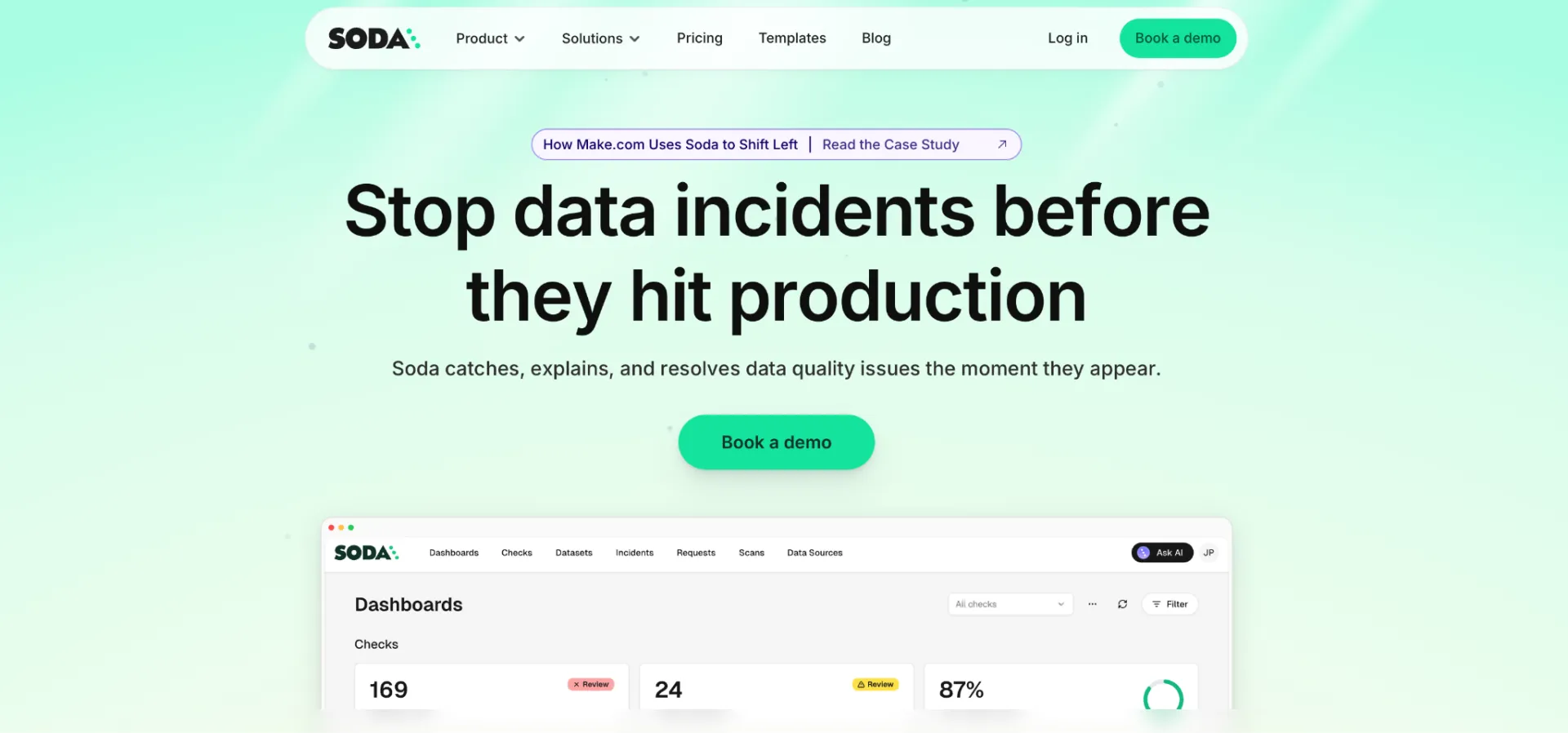
Soda offers a flexible, code-first approach to data reliability through its open-source SodaCL language. Engineers can write quality checks directly alongside their pipelines and version them in Git, making observability part of the development workflow.
Soda Cloud adds collaboration, dashboards, and alerting on top of the open-source core. It suits engineering-led teams that prefer configuration as code over UI-driven rule building.
6. IBM Databand
IBM Databand specializes in pipeline observability, with deep visibility into orchestration tools like Airflow and dbt. It excels at root cause analysis by correlating logs, traces, and metadata across complex data workflows.
Backed by IBM’s enterprise support and security posture, Databand is a strong fit for regulated industries like banking, healthcare, and government. Its strength lies in troubleshooting failures fast across distributed pipelines.
7. Sifflet
Sifflet takes a catalog-centric approach to observability, placing data reliability signals directly alongside the metadata that business users browse. This makes it easier for non-engineers to verify data trustworthiness without waiting on a data engineer.
Its auto-coverage feature prioritizes monitoring on business-critical assets, cutting setup time significantly. Sifflet is ideal for organizations where analysts and business teams share responsibility for data quality.
8. Anomalo
Anomalo uses advanced machine learning to detect data quality issues without requiring teams to define rules upfront. It automatically learns the shape of your data and flags deviations that matter, including subtle distribution shifts that traditional checks miss.
The platform is particularly popular with enterprises handling sensitive customer data, financial records, or AI training datasets. Anomalo scales well to thousands of tables with minimal human oversight.
9. Elementary
Elementary is an open-source first data observability tool built natively for dbt users. It monitors freshness, volume, schema, and anomalies directly within the dbt project, making adoption seamless for analytics engineering teams.
Elementary Cloud layers managed features, dashboards, and alerting on top of the open-source package. It is a strong pick for teams already committed to the dbt ecosystem who want observability without bolt-on complexity.
10. Metaplane by Datadog
Metaplane, now part of Datadog following its April 2025 acquisition, brings machine learning-powered data observability into the broader Datadog ecosystem. It offers automated anomaly detection, column-level lineage, and fast setup, with monitors that can run natively inside Snowflake environments.
The platform is especially valuable for teams already using Datadog for application and infrastructure observability, creating a unified view across software and data. Its no-code monitor creation and CI/CD integrations with GitHub, GitLab, and dbt make it a practical pick for engineering-led data teams.
How to Choose the Right Data Observability Tool
Start by mapping your current data stack and the volume of incidents your team handles each month. A tool that is perfect for a 10-person analytics team will likely fall short for a global enterprise running thousands of pipelines across regions.
Next, decide whether you want a specialist observability tool or a unified platform that also covers discovery, lineage, and governance. Many organizations are consolidating onto platforms like DataHub to reduce tool sprawl, eliminate context switching, and power AI initiatives with a single source of trusted metadata.
Final Thoughts
Data observability in 2026 is no longer just about monitoring pipelines. It is about delivering continuous, trusted context to every person and AI agent that depends on your data.
Leaders like DataHub are setting the standard by unifying observability with discovery, lineage, and governance in one AI-ready platform. Whether you are preventing costly incidents, scaling AI, or streamlining compliance, investing in the right observability tool is one of the highest-leverage decisions a data team can make this year.