Table of Contents
Why Marketers Need Marketing Mix Modeling in 2026
“Measuring marketing effectiveness isn’t rocket science when you have the right modeling tools doing the heavy lifting and delivering clear, unfiltered ROI insights.”
Marketing teams are increasingly expected to demonstrate ROI on every dollar spent. With budgets tightening and channels multiplying, knowing which media drives real revenue is no longer a nice-to-have; it’s a survival skill. That’s exactly where marketing mix modeling (MMM) comes in.
What is Marketing Mix Modeling?
Marketing mix modeling is a statistical and econometric approach that measures the impact of various marketing inputs, such as TV, digital, social, OOH, and promotions, on business outcomes like revenue, sales volume, and brand equity. Unlike multi-touch attribution, which only tracks digital touchpoints, marketing mix modeling gives you a complete, channel-agnostic picture of marketing effectiveness across both online and offline channels.
Common Challenges & How AI-Powered MMM Solves Them
| 🔴 Challenge | 💥 Impact | 🟢 AI Solution | ✅ Outcome |
| No visibility into channel ROI | Wasted ad spend | AI marketing mix modeling | Know exactly what drives sales |
| Manual data aggregation | Weeks of analyst time | Automated MMM platforms | Insights in hours, not months |
| Budget misallocation | Lower ROAS, higher CPAs | Budget allocation optimization | Every dollar spent smarter |
| Siloed online & offline data | Incomplete attribution picture | Cross-channel marketing mix modeling | Unified view of all marketing |
Whether you are a DTC brand optimising paid media or a CPG company measuring the halo effect of TV on digital sales, the right marketing mix modeling tools will give you the confidence to justify every dollar in your marketing budget.
Key Benefits of AI-Powered Marketing Mix Modeling Tools
Investing in the right marketing mix modeling software delivers strategic advantages that go far beyond backwards-looking measurement. Here are the most impactful benefits:
- Accurate Cross-Channel ROI Measurement: Know exactly which channels – TV, paid search, social, email, OOH – drive incremental revenue.
- Smarter Budget Allocation Optimization: Shift spend toward high-performing channels using scenario modelling before you commit.
- Baseline Sales Measurement: Isolate marketing-driven sales from organic demand, seasonality, or pricing changes.
- Incremental Lift Measurement: Quantify each channel’s true contribution by stripping out overlap and cannibalisation.
- Halo Effect in Marketing Quantified: Reveal how offline brand advertising drives online search and conversion.
- Demand Forecasting: Model future revenue under different budget and channel mix scenarios.
- CFO-Ready Marketing Reporting: Turn marketing into a provable revenue driver with data-driven ROI evidence.
- Privacy-Safe Attribution: MMM is cookieless by nature, future-proof measurement with no third-party tracking.
Top 7 Marketing Mix Modeling Tools for Accurate ROI Measurement
Below are the leading marketing mix modeling tools evaluated on AI capabilities, ease of use, data flexibility, speed of insight, channel coverage, and overall value. Whether you need an open-source MMM framework or a fully managed enterprise platform, there’s a solution here for every team size and budget.
1. Google Meridian: Best Open-Source AI Marketing Mix Modeling Platform
Google Meridian is Google’s open-source Bayesian MMM framework built in Python – delivering uncertainty-aware ROI estimates and native Google Ads data integration for any brand with a data science team.
Key AI Features:
- Bayesian hierarchical modeling for uncertainty-aware ROI estimates
- Native integration with Google Ads reach and frequency data
- Automated adstock and saturation curve fitting
- Built-in scenario planning and budget optimization module
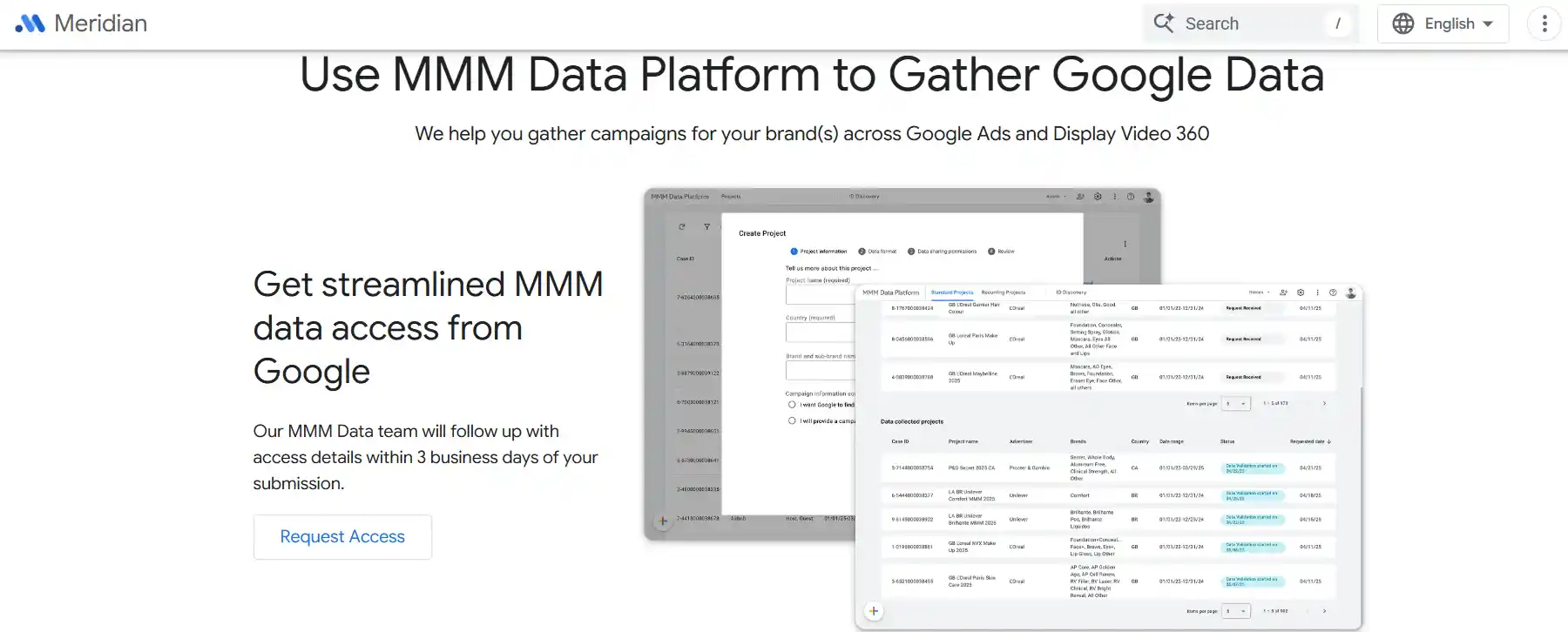
Why It Stands Out: The only open-source MMM framework with first-party Google Ads integration and Bayesian probability outputs, not just point estimates.
Ideal For: Agency partners & internal data science teams. | Pricing: Free (open-source).
2. Meta Robyn: Best Automated Marketing Mix Modeling Software for DTC Brands
Meta Robyn is the open-source MMM solution from Meta’s marketing science team, built in R with a Python interface, and has become one of the most widely adopted marketing mix modeling tools among DTC and e-commerce brands, thanks to its multi-objective optimization engine (Nevergrad) that auto-generates thousands of model candidates and surfaces Pareto-optimal budget allocation recommendations.
Key AI Features:
- Automated hyperparameter optimization with Nevergrad multi-objective framework
- Ridge regression with adstock transformation and saturation modeling
- Budget allocator with spend optimization recommendations
- Calibration with conversion lift tests for ground-truth alignment
Why It Stands Out: Automated model selection and lift-test calibration make it best-in-class for accuracy without requiring deep econometrics expertise.
Ideal For: Performance marketing teams, DTC brands & e-commerce businesses. | Pricing: Free (open-source).
3. Analytic Partners: Best Enterprise Marketing Mix Modeling Platform for Global Brands
Analytic Partners is the gold standard of fully managed enterprise marketing mix modeling, serving major global brands across CPG, retail, financial services, and automotive through their ROI Genome platform, a Commercial Mix Modeling (CMM) framework that goes beyond marketing inputs to measure competitive activity, pricing, distribution, and macroeconomic conditions as part of a single unified demand model.
Key AI Features:
- Commercial Mix Modeling combining competitive, distribution, pricing & marketing factors.
- Real-time scenario planning and media spend optimization dashboards
- Cross-channel attribution combining MMM with multi-touch data
- Predictive demand forecasting with external signal integration
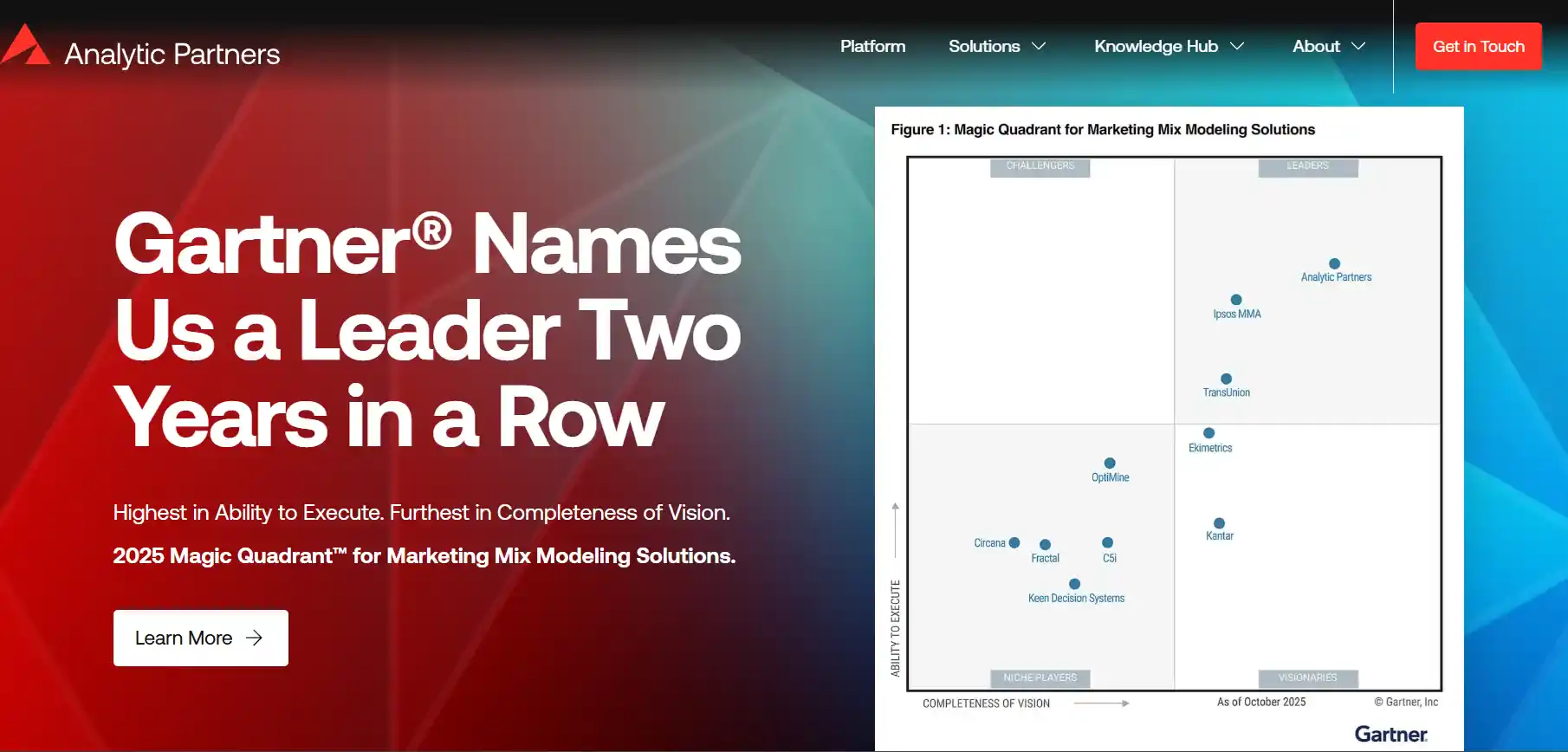
Why It Stands Out: The ROI Genome, with 700B+ data points across 850+ brands, adds unmatched competitive benchmarking on top of your own measurement.
Ideal For: Financial services, CPG & retail enterprise brands. | Pricing: Custom enterprise pricing.
4. Measured: Best Marketing Mix Modeling Tool for DTC and Ecommerce Brands
Measured.com is a purpose-built marketing mix modeling platform for DTC and ecommerce brands – combining incrementality testing with always-on media measurement to help performance marketers cut wasted spend and prove true channel ROI.
Key AI Features:
- Incrementality-based attribution using controlled media experiments
- Always-on spend optimization with channel-level ROI recommendations
- Cross-channel media attribution covering paid social, search, TV, and affiliates
- Real-time budget reallocation signals based on incremental lift data
Why It Stands Out: Measured combines MMM with incrementality testing – giving brands both strategic measurement and experiment-backed proof that their media is actually working.
Ideal For: Online retail ventures, growth marketing squads & direct-to-consumer labels.| Pricing: Custom pricing.
5. Lifesight MMM: Best AI-Powered Marketing Mix Modeling for Privacy-First Brands
Lifesight MMM is a modern, cookieless marketing mix modeling platform built for the privacy-first era – using AI and unified first-party data to deliver always-on measurement across digital and offline channels without relying on third-party tracking.
Key AI Features:
- Cookieless MMM engine built on first-party and zero-party data inputs
- AI-driven cross-channel spend optimization with scenario planning
- Unified data ingestion from CRM, ad platforms, and offline sources
- Real-time incremental lift measurement across paid and organic channels
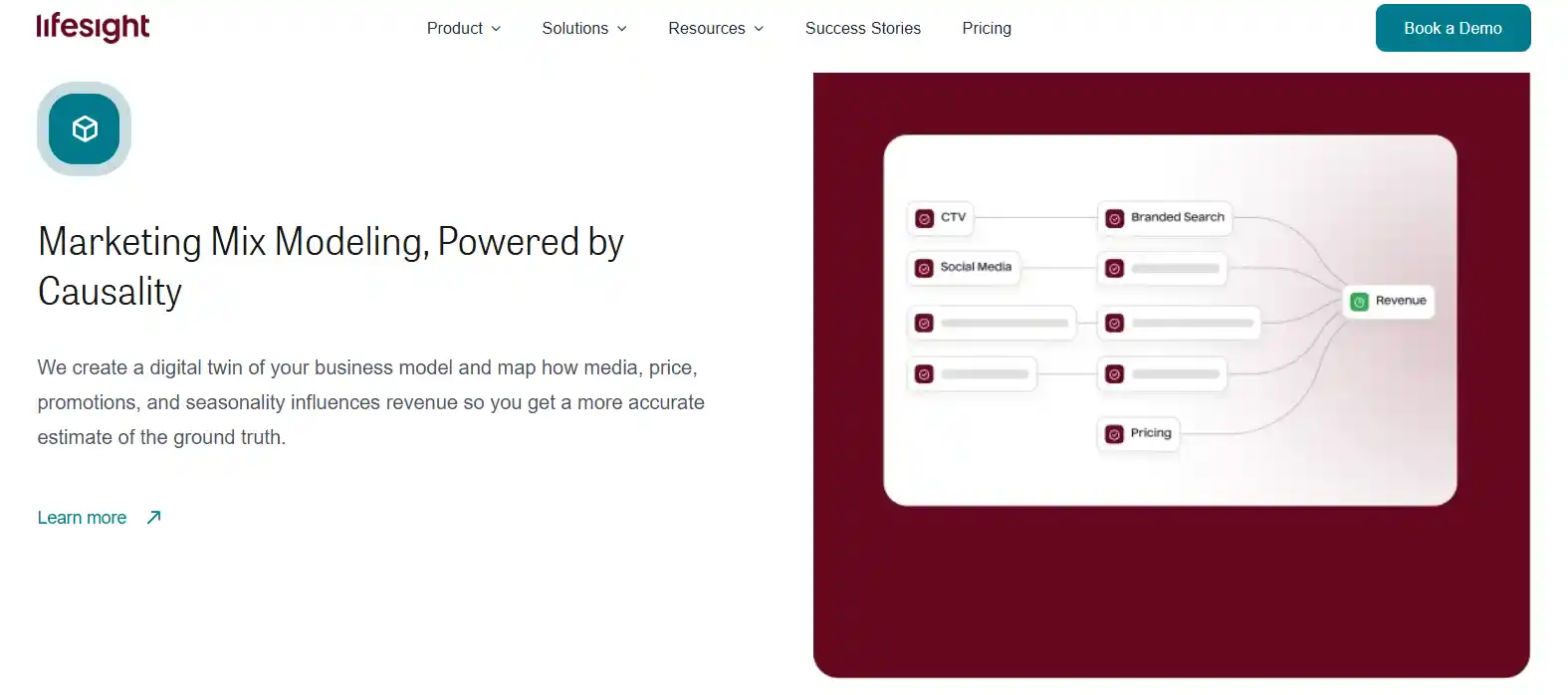
Why It Stands Out: Built from the ground up for a cookieless world – Lifesight delivers accurate cross-channel marketing mix modeling without any dependency on third-party data or device tracking.
Ideal For: DTC businesses, privacy-focused marketers & brands building future-ready measurement stacks. | Pricing: Custom pricing.
6. Ekimetrics: Best AI-Powered Marketing Mix Modeling for Luxury and FMCG Brands
Ekimetrics is a data science and marketing effectiveness consultancy with a powerful proprietary AI marketing mix modeling platform, the Eki. Hub, that has earned strong recognition in luxury, beauty, FMCG, and retail for its ability to model long-term brand equity and short-term sales contribution simultaneously, alongside a unique carbon footprint measurement layer for ESG-conscious brands.
Key AI Features:
- Long-term brand equity measurement integrated with short-term sales attribution
- AI-driven media mix optimization with channel saturation modeling
- Granular digital and offline channel decomposition
- Real-time dashboard with scenario planning and budget simulation
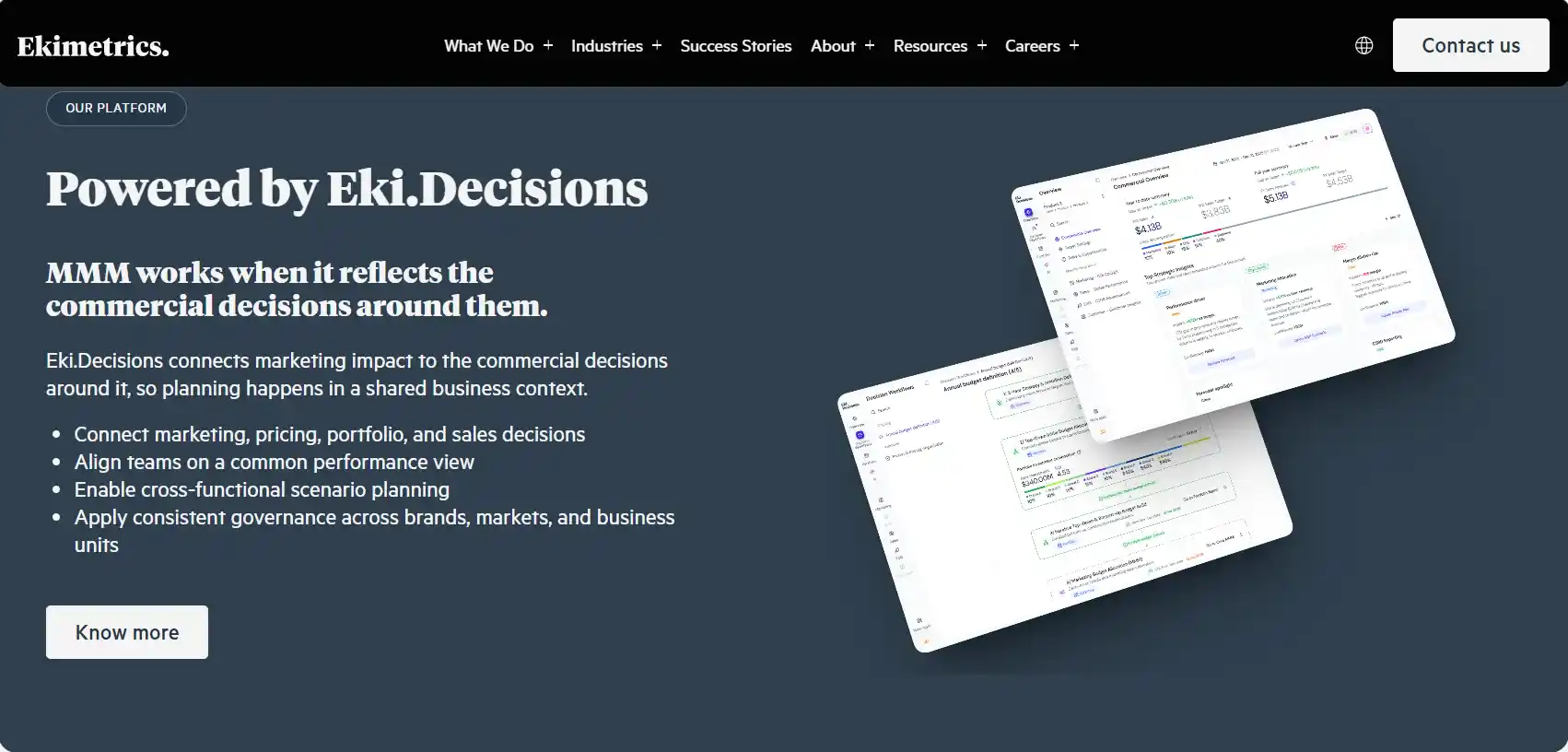
Why It Stands Out: The only MMM platform combining long-term brand equity measurement with a carbon impact layer, built for brands where ROAS alone doesn’t tell the full story.
Ideal For: Sustainability-focused, luxury, beauty & FMCG brands. | Pricing: Custom pricing.
7. Marketing Evolution: Best Marketing Mix Modeling Platform for Mid-Market Brands
Marketing Evolution delivers an accessible AI-powered marketing mix modeling platform for mid-market brands, built around a POET (Paid, Owned, Earned, and Trade) framework that gives marketing managers, not just data scientists, the ability to interpret results, run what-if scenarios, and make budget decisions directly within the interface without enterprise-level complexity or cost.
Key AI Features:
- POET framework measuring Paid, Owned, Earned, and Trade marketing effectiveness
- AI-powered real-time model refresh with continuous data ingestion
- Budget optimization and scenario planning with visual what-if analysis
- Cross-channel marketing mix modeling for digital and offline channels
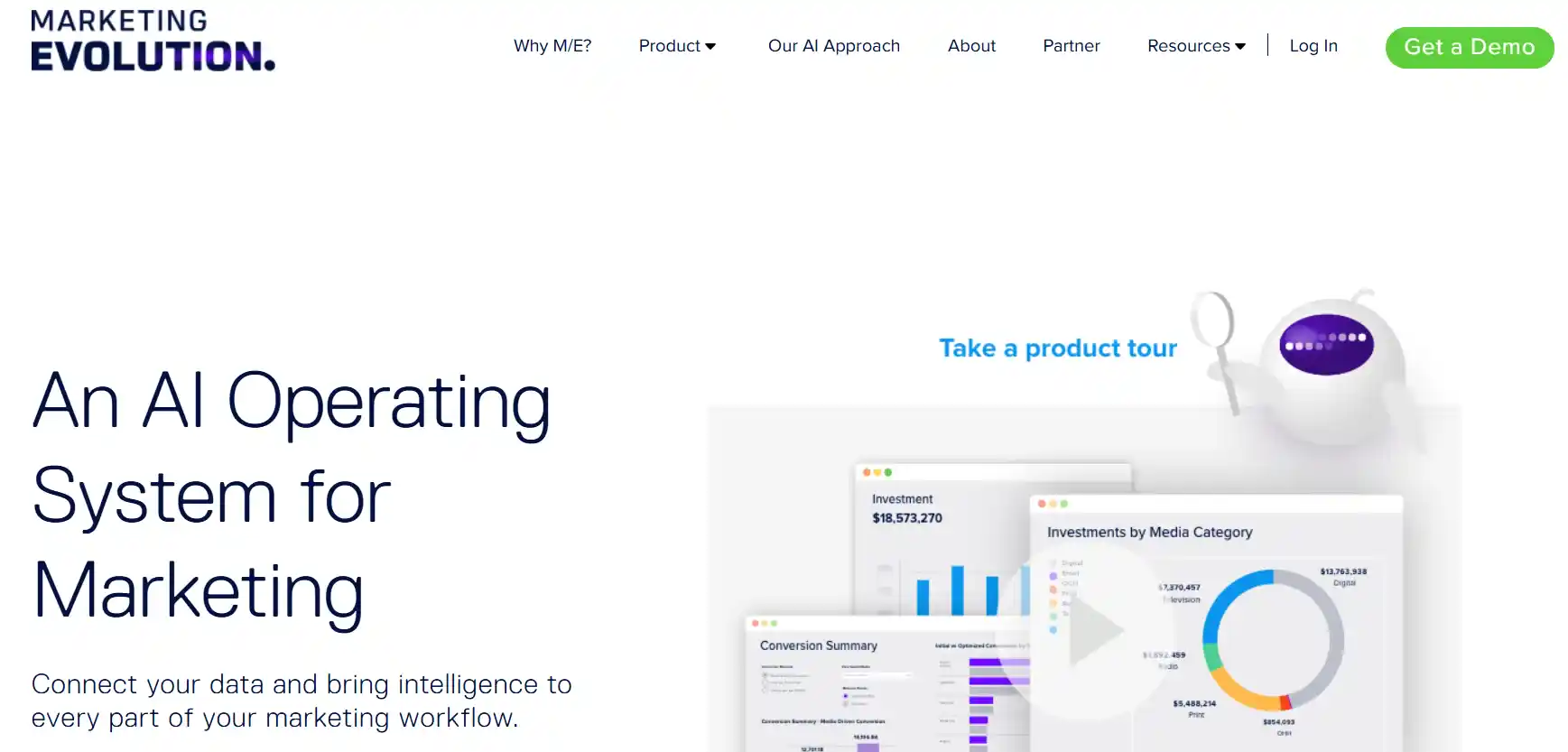
Why It Stands Out: POET’s inclusion of owned and earned media gives a fuller ROI picture than paid-only MMM models, at a price mid-market teams can justify.
Ideal For: Growth-stage DTC businesses & mid-market brands. | Pricing: Custom pricing.
Marketing Mix Modeling Tools: Side-by-Side Comparison
| Tool | Best For | AI/ML | Real-Time | Open Source | Price |
|---|---|---|---|---|---|
| Google Meridian | Enterprise & mid-market | ✅ Yes | ✅ Yes | ✅ Yes | Free |
| Meta Robyn | DTC & ecommerce | ✅ Yes | ❌ No | ✅ Yes | Free |
| Analytic Partners | Global enterprise | ✅ Yes | ✅ Yes | ❌ No | Custom |
| Measured.com | DTC & ecommerce | ✅ Yes | ✅ Yes | ❌ No | Custom |
| Lifesight MMM | Privacy-first & DTC brands | ✅ Yes | ✅ Yes | ❌ No | Custom |
| Ekimetrics | Luxury, FMCG, retail | ✅ Yes | ✅ Yes | ❌ No | Custom |
| Marketing Evolution | Mid-market brands | ✅ Yes | ✅ Yes | ❌ No | Custom |
Marketing Mix Modeling vs Multi-Touch Attribution: Which Should You Use?
One of the most common questions marketing teams face is: Should we invest in marketing mix modeling or multi-touch attribution? The honest answer is that they answer different questions, and the best-resourced teams use both.
Marketing Mix Modeling (MMM)
- Measures aggregate, channel-level revenue contribution using econometric methods
- Covers both online and offline channels
- Cookieless by nature, no reliance on third-party tracking
- Ideal for strategic budget allocation and long-term brand investment decisions
Multi-Touch Attribution (MTA)
- Tracks individual user journeys across digital touchpoints
- Faster and more granular for day-to-day optimisation
- Blind to offline channels and increasingly limited by cookie deprecation
- Best suited for tactical digital campaign management
The Verdict In a privacy-first world, marketing mix modeling is the measurement methodology of choice for CMOs needing reliable, defensible ROI evidence. The smartest brands in 2026 use AI-powered marketing mix modeling as their strategic foundation, with MTA as a tactical layer for real-time digital optimisation.
Conclusion
Marketing mix modeling has moved from an annual consulting exercise to a continuous, AI-powered intelligence layer that the world’s most effective marketing organisations run every day. The seven tools in this guide represent the best marketing mix modeling tools available in 2026, from free open-source frameworks like Google Meridian and Meta Robyn to fully managed enterprise platforms like Analytic Partners, Nielsen, and Neustar.
The right choice depends on your team’s technical capability, your data maturity, your channel mix, and the business questions you most urgently need answered. But one thing is certain: in a world where marketing budgets are under greater scrutiny than ever, marketing mix modeling for budget allocation decisions is no longer optional; it is essential.
FAQ
What is marketing mix modeling and how does it work?
It is a statistical technique that uses historical data to quantify how each marketing channel contributes to revenue, after controlling for seasonality, pricing, and external factors.
What are the 4 Ps in marketing mix modeling?
Product, Price, Place, and Promotion – MMM measures how all four drive consumer demand, not just advertising spend alone.
How is marketing mix modeling different from attribution modeling?
MMM is a top-down model covering all channels, including offline; attribution tracks individual digital journeys. MMM is better for strategy; attribution is better for tactical digital optimisation.
What is adstock in marketing mix modeling?
Adstock is the delayed, carryover effect of advertising after a campaign ends – capturing how a TV or OOH ad continues to influence purchases days or weeks later.
What is baseline sales in marketing mix modeling?
Baseline sales are the revenue your business would generate with zero marketing – driven by organic demand, seasonality, and brand equity alone. is better for tactical digital optimisation.
How do you measure the halo effect using MMM?
MMM identifies the correlation between brand spend (TV, OOH) and downstream digital conversions – revealing cross-channel amplification invisible to last-click attribution.