Table of Contents
Digital communication is transforming.
AI avatars have emerged as powerful tools that bridge the gap between automation and human connection, enabling businesses and creators to scale their presence without sacrificing personalization. From customer service representatives to virtual influencers, these digital personas are reshaping how we interact online.
What Is an AI Avatar?
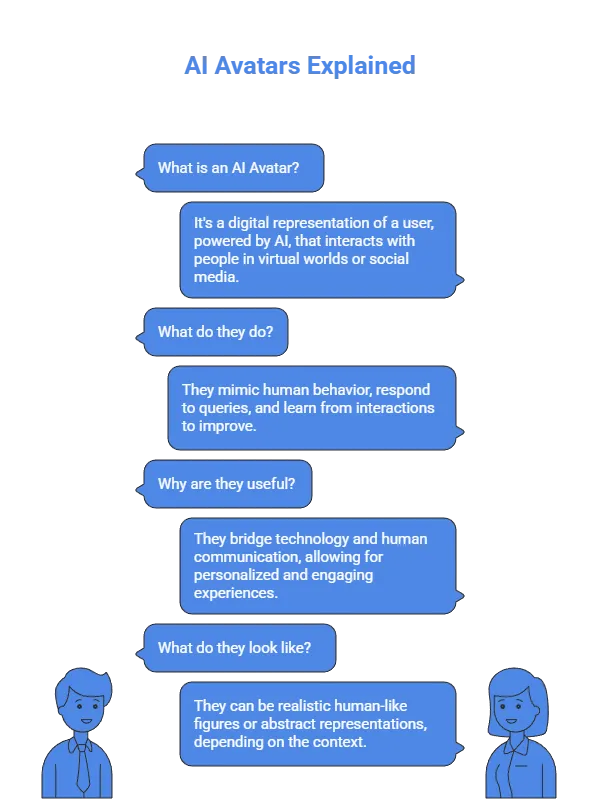
An AI avatar is an intelligent, digitally generated persona designed to simulate human interaction. Powered by advanced artificial intelligence, these avatars go beyond static visuals, capable of speaking, gesturing, and expressing emotions with remarkable realism.
Core Capabilities:
- Human-like Interaction: AI avatars engage users through speech, facial expressions, and body language, creating natural two-way communication.
- Multimodal Intelligence: Built using computer vision, natural language processing (NLP), and generative AI, enabling them to interpret context, respond dynamically, and adapt tone or emotion.
- Global Reach: They communicate seamlessly across multiple languages and cultural contexts, ensuring inclusive and scalable engagement.
- High Realism & Personalization: AI avatars can replicate unique voices, gestures, and identities, making digital communication more authentic and immersive.
Strategic Purpose:
AI avatars are redefining digital interaction by acting as virtual representatives for brands, educators, and creators. They enhance engagement, scalability, and personalization, allowing organizations to deliver human-like experiences at an unprecedented scale without human limitations.
How AI Avatar Models Work: A Framework Overview
AI avatar creation follows a four-layer functional framework that integrates AI disciplines such as computer vision, natural language processing, and generative modeling to simulate human-like communication.
1. Data Training Layer: Learning Human Behavior
Objective: Teach the AI to understand natural human motion and expression.
Process:
- Massive datasets of human facial movements, speech patterns, and gestures are collected.
- Machine learning algorithms analyze these patterns to learn how people express tone, emotion, and intent.
- The model maps this data into facial action units (micro-expressions) and phoneme-to-lip movement correlations.
Outcome: The AI gains an internal behavioral model that predicts realistic motion and emotional cues.
2. Synthesis Layer: Generating the Avatar
Objective: Convert learned data into lifelike visual and audio output.
Process:
- Generative Adversarial Networks (GANs) or diffusion models create realistic facial and body visuals.
- Text-to-Speech (TTS) and Voice Cloning models synthesize natural voices aligned with emotion and tone.
- Audio-visual synchronization ensures precise lip-sync, eye tracking, and body gestures that match spoken content.
Outcome: A virtual avatar capable of realistic and expressive human communication.
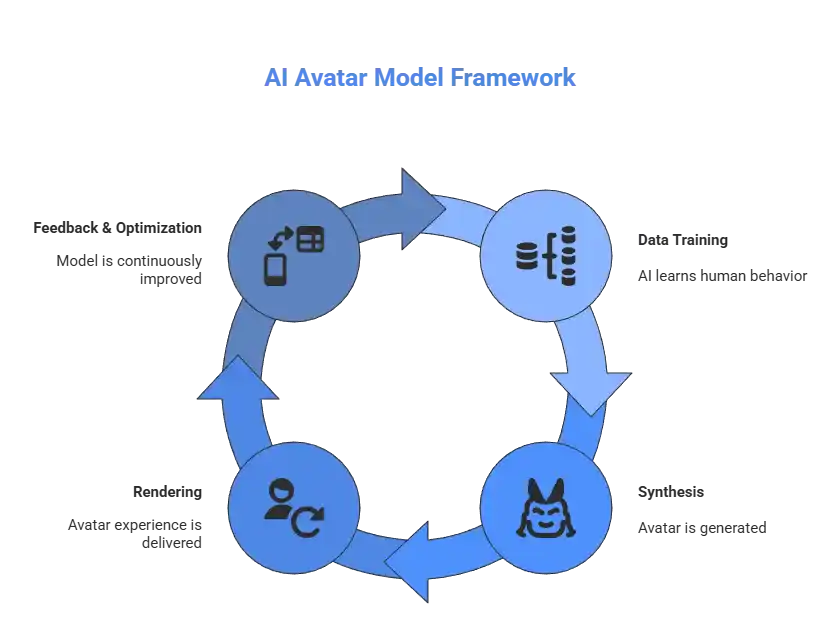
3. Rendering Layer: Delivering the Experience
Objective: Produce high-quality, real-time or pre-rendered visual output.
Process:
- Rendering engines (real-time or cloud-based) compile all components animation, lighting, audio, and expression into video or live streams.
- 3D modelling frameworks and motion-capture simulations ensure seamless performance across platforms.
Outcome: Smooth, responsive, high-definition avatars optimized for any digital interface.
4. Feedback & Optimization Layer: Continuous Improvement
Objective: Improve performance through adaptive learning and user feedback.
Process:
- Real-world user interactions and feedback loops refine model accuracy.
- Reinforcement learning updates emotional intelligence, response timing, and contextual understanding.
- The system evolves with each interaction, enhancing realism and responsiveness.
Outcome: AI avatars that continuously improve over time, becoming more human-like, context-aware, and emotionally intelligent.Key Benefits of Using AI Avatars
Cost Efficiency: Produce unlimited video content without recurring production costs, studio rentals, or actor fees.
Scalability: Generate personalized content for thousands of users simultaneously in multiple languages.
Consistency: Maintain brand voice and visual identity across all customer touchpoints without human variability.
Accessibility: Create content 24/7 without scheduling constraints or geographical limitations.
Engagement: Increase viewer retention through human-like interactions that feel more authentic than text-based communication.
Top AI Avatar Models in 2025
| Industry | AI Avatar Name | Platform/Origin | Core Features | Primary Use Case |
| 🎬 Entertainment & Media | Lil Miquela | Brud (Los Angeles, USA) | – Hyper-realistic influencer with AI-driven storytelling – Emotional expression and personality modeling – Cross-platform presence on Instagram, TikTok, YouTube | Fashion campaigns, brand storytelling, and influencer marketing |
| 💼 Enterprise & Corporate | Nora | Rephrase.ai | – Lifelike speech and facial animation – 50+ language support – Enterprise-grade video generation pipeline – Brand personalization options | Internal training, product explainers, corporate communication |
| 🎓 Education & E-Learning | Eva | Colossyan | – AI instructor avatar for teaching – Interactive learning with gestures and explanations – Text-to-video automation – Multi-language support | E-learning, virtual classrooms, corporate training |
| 🤖 Social Media & Creator Economy | Neuro-sama | Independent (VTuber / Twitch AI) | – Conversational and interactive in real-time – Uses NLP and reinforcement learning – Learns from audience feedback – Engages in gameplay and chat autonomously | AI streaming, content creation, social engagement |
| 🌐 Metaverse & Virtual Worlds | Ready Player Me Avatar | Wolf3D (Estonia) | – 3D avatars generated from selfies – Cross-platform use in 5,000+ metaverse apps – AI emotion and motion mapping – SDKs for Unity/Unreal integration | Virtual meetings, gaming, and metaverse identity creation |
How to Choose the Best AI Avatar Model for Your Needs
1. Define Objectives
- Purpose: Clarify if the avatar will be used for real-time interaction, pre-recorded videos, or hybrid use.
- Audience Fit: Align the avatar’s tone, realism, and behaviour with your target audience’s expectations.
2. Evaluate Technical Requirements
- Quality: Decide between photorealistic or stylised avatars based on your content goals.
- Language Support: Ensure multilingual capabilities and accent accuracy.
- Integration: Confirm compatibility with your current tools, platforms, and workflows.
3. Assess Customization & Control
- Appearance & Voice: Check flexibility in avatar design, gestures, and voice modulation.
- Brand Alignment: Choose options that allow for personalization consistent with your brand identity.
4. Ethical & Privacy Considerations
a. Consent & Transparency
- Obtain explicit consent before replicating real individuals.
- Disclose when audiences are engaging with AI-generated avatars.
b. Security & Compliance
- Select vendors with deepfake prevention, data protection, and anti-misuse safeguards.
- Ensure adherence to GDPR, CCPA, and other privacy standards.
c. Trust & Responsibility
- Communicate openly about AI usage to maintain credibility and public confidence.
The Future of AI Avatars: What Lies Ahead
The trajectory of AI avatar technology points toward a future where human-AI interaction becomes virtually indistinguishable. Several key developments are shaping this evolution:

Emotion-Responsive Technology
- Avatars will detect and analyze audience reactions in real-time
- Adaptive tone and expression based on viewer engagement
- Natural, human-like interactions through emotional intelligence
- Dynamic communication that responds to facial cues and voice patterns
Augmented Reality Integration
- Holographic avatars appearing in physical spaces
- Presence in offices, retail stores, and live events
- Seamless transition from screen-based to three-dimensional interaction
- Real-world applications beyond traditional digital displays
Advanced Personalization
- Unique experiences tailored to individual viewers
- Algorithms analyzing user preferences and behavior patterns
- Customized content delivery and presentation styles
- Adaptive visual appearances matching user expectations
Blurring Digital and Physical Boundaries
- Diminishing distinction between virtual and real presence
- AI avatars as seamless participants in daily interactions
- Combination of automation’s consistency with human warmth
- Technology that transcends traditional digital interface limitations
The future of AI avatars represents more than technological advancement; it’s about creating meaningful connections that feel natural, personal, and authentically engaging in every interaction.
Conclusion
AI avatars represent more than technological novelty; they’re strategic assets for modern communication.
Success lies in selecting the right AI avatar model that aligns with your goals, audience expectations, and ethical standards.
As these tools become more sophisticated and accessible, early adopters who implement them thoughtfully will gain significant competitive advantages in their respective fields.
FAQs
What Is an AI Avatar?
An AI avatar is a computer-generated digital character powered by artificial intelligence that can mimic human appearance, speech, and behaviour. These avatars can be used in videos, live interactions, and virtual environments.
What are the main use cases for AI avatars?
Primary applications include video marketing, e-learning courses, customer service chatbots, virtual events, social media content creation, corporate training, and personalized communication at scale.
Can I create an avatar of a real person?
Yes, but only with explicit written consent from the individual. Creating unauthorized digital replicas raises serious ethical and legal concerns. Reputable platforms require verification and consent documentation.
How realistic are AI avatars, and how do I choose a vendor?
Realism varies significantly between providers. Evaluate vendors based on video quality samples, language support, customization options, pricing transparency, customer reviews, and their stance on ethical AI use.
How long does it take and how much does it cost to create avatar videos?
Basic avatar videos can be generated in minutes once your avatar is set up. Initial avatar creation typically takes 24-48 hours. Costs range from $30-$300 monthly for subscription plans, while custom enterprise solutions may cost thousands depending on requirements.
How are AI avatars created?
The process involves uploading reference footage or photos, AI analysis of facial features and voice patterns, neural network training to replicate movements and speech, and final rendering that synchronizes audio with realistic visuals.