Table of Contents
By 2026, retail investing changed significantly. Initially, only institutions utilized AI trading apps. Now, these powerful tools empower individual investors. Therefore, data-driven, emotion-free trading is vital in today’s volatile markets.
Therefore, retail traders now leverage Financial Learning Models (FLMs) and advanced Natural Language Processing (NLP). These tools process massive datasets quickly. This bypasses cognitive biases and stress, preventing costly manual errors.
Consider the current risk management path. AI’s power lies in its real-time data synthesis and automatic accuracy. These tools execute the required computational tasks. Consequently, they identify complex patterns across thousands of stocks simultaneously.
In this guide, you will find the top 10 AI trading platforms leading the 2026 market. These offer a clear framework for selection. Use it to find a tool that matches your risk tolerance, technical skill, and asset focus.
Finally, choosing the right platform requires an evaluation of each market leader’s unique competitive edges and technical limits.
Top 10 AI Trading Platforms
The “best” application is inherently subjective; a non-coding investor seeking guided insights requires a fundamentally different architecture than a technical quant deploying custom Pine Script frameworks. Below, we distill the unique value propositions of the current market leaders based on their functional utility and technological edge.
1. Tickeron
Tickeron maintains its position as a comprehensive suite for pattern recognition and trend prediction. It is particularly noted for its “micro-algorithmic explainers,” which attempt to solve the “black box” problem of AI by providing the logic behind every signal.
- Key Features:
- AI Trading Robots: Three distinct tiers (Signal, Virtual, and Brokerage Agents) offering varying levels of risk management and tick-level execution.
- Financial Learning Models (FLMs): Advanced engines used to identify chart and candlestick patterns with specified confidence levels.
- Earnings-Calendar Screening: AI-driven analysis of volatility surrounding corporate reporting cycles.
Analytical Evaluation: Tickeron serves as a critical bridge for investors migrating from manual to systematic trading. Its competitive edge lies in the democratization of hedging strategies; users can deploy “Short Bias” robots or utilize Inverse ETFs automatically during periods of high volatility, a feature typically reserved for professional desks.
| Feature Category | Detail |
| Pros | Multi-asset support (Stocks, ETFs, Forex, Crypto); $35/mo entry-tier all-in package. |
| Cons | The massive depth of tools can create a steep learning curve for novices. |
Ideal Use Case: Best for traders who want to scale complexity from simple signals to advanced, automated hedging agents.
2. TradeStation
A brokerage-centric powerhouse, TradeStation is the premier choice for active traders who require a high-performance tech stack and full strategy automation capabilities.
- Key Features:
- EasyLanguage: A proprietary, trader-centric programming language that is more intuitive than Python for financial logic.
- Comprehensive API Access: Support for C#, C++, and Python for deep institutional-grade integration.
- Cloud Hosting: Ensures algorithms run 24/7 without the latency or hardware risks of local machines.
Analytical Evaluation: When we contrast TradeStation with its peers, its primary advantage is the “native” feel of its developer environment. However, a significant scalability limitation persists: the platform’s algorithms are primarily applied to stocks with “open charts,” which may hinder quants looking to run massive multi-ticker scans simultaneously across the entire market.
| Feature Category | Detail |
| Pros | Zero-commission stock trades; institutional-grade historical data for backtesting. |
| Cons | Scalability is capped by the “open chart” requirement for certain automated scans. |
Ideal Use Case: Best for technical traders and developers building custom, high-performance algorithmic strategies.
3. Trade Ideas
Trade Ideas focuses on real-time AI scanning and success-filtered alerting, powered by its proprietary “Holly” engine.
- Key Features:
- Holly AI Engine: Conducts millions of simulated trades overnight so the trader begins the day with pre-validated, high-probability setups.
- OddsMaker Backtesting: Simulates share size and commission to provide a “net profit” reality check on any strategy.
- Stock Race Visualizations: Provides a 3D-style visual of real-time momentum, allowing traders to spot “breakout” capital flows instantly.
Analytical Evaluation: The competitive edge of Trade Ideas is not just scanning, but pre-validation. While other tools alert you to a pattern as it happens, “Holly” has already run the simulations to tell you the statistical likelihood of that pattern’s success based on current market conditions.
| Feature Category | Detail |
| Pros | High-accuracy, success-filtered alerts; eliminates intra-day “market noise.” |
| Cons | Resource-intensive software; strictly optimized for high-frequency/day trading. |
Ideal Use Case: Best for active day traders requiring high-velocity signals and pre-market validation.
4. TrendSpider
TrendSpider specializes in the automation of technical analysis, effectively removing the manual labor and subjective bias from charting.
- Key Features:
- Automated Trendline & Fibonacci Detection: Uses AI to identify support, resistance, and retracement levels across 150+ patterns.
- Multi-timeframe Chart Overlays: Allows for the visualization of secondary timeframes without switching screens.
- Dynamic Alerts: SMS and email triggers based on complex technical conditions (e.g., RSI divergence on a specific EMA cross).
Analytical Evaluation: TrendSpider’s value is rooted in “visual consistency.” Automating the drawing of Fibonacci levels and trendlines, it ensures that a trader’s technical framework remains objective, preventing the “vision bias” that often leads traders to see patterns that don’t exist.
| Feature Category | Detail |
| Pros | Powerful point-and-click backtesting eliminates manual charting errors. |
| Cons | Lacks a built-in social or copy-trading community. |
Ideal Use Case: Best for technical chart analysts and swing traders who want to refine strategies without writing code.
5. AlgosOne
AlgosOne leverages a high-level AI stack—including Deep Learning and NLP—to provide a “hands-off” automated experience across crypto, forex, and commodities.
- Key Features:
- NLP News Analysis: Triggers trades based on global sentiment and macroeconomic shifts faster than human reaction times.
- Reserve Fund: A proprietary capital protection mechanism and profit-sharing model.
- Institutional Logic: Uses the same deep learning architecture employed by top-tier quant funds.
Analytical Evaluation: AlgosOne operates on a distinct “Tiered Commission” and profit-sharing model rather than a flat subscription. This aligns the platform’s success with the user’s, making it an attractive “Black Box” solution for those who prefer the AI to handle both the analysis and the execution.
| Feature Category | Detail |
| Pros | EU-regulated; high-level NLP integration for news-driven trades. |
| Cons | Long capital lock-in periods (12–24 months) and high early-termination fees. |
Ideal Use Case: Best for investors seeking an institutional-style, fully automated “quant” experience.
6. Kavout
Kavout simplifies the complex world of quantitative data into an actionable ranking system known as the “Kai Score.”
- Key Features:
- Kai Score: A 1–9 rating that distills fundamental, technical, and sentiment data into a single score.
- Factor-Tilted Portfolios: AI-driven allocations focused on specific growth or value factors.
- API for Quant Funds: Allows for the integration of Kai Score signals into existing proprietary trading setups.
Analytical Evaluation: Kavout represents a hybrid model of AI efficiency and human-expert oversight. Its “Kai Score” is an essential tool for systematic investors who need a quick, data-backed screening process to support their manual execution.
| Feature Category | Detail |
| Pros | Simplified, actionable scoring; strong predictive analytics for long-term screening. |
| Cons | Limited transparency on the proprietary logic behind the Kai Score. |
Ideal Use Case: Best for systematic investors who want AI-driven rankings to supplement their manual decision-making.
7. AInvest
AInvest bridges the gap between brokerage execution and AI research through its natural-language virtual analyst, “Aime.”
- Key Features:
- Aime Analyst: A virtual assistant that answers complex investment queries (e.g., “Which ETFs have the highest exposure to AI hardware with low volatility?”).
- SnapTrade Integration: Connects seamlessly with multiple existing brokerages for direct execution.
- AI Radar: Predictive tools designed to help users anticipate momentum shifts before they materialize.
Analytical Evaluation: AInvest democratizes professional-level research. By allowing users to interact with market data in plain English, it reduces the barrier to entry for “passive-plus” investors who want sophisticated insights without the complexity of traditional terminal screens.
| Feature Category | Detail |
| Pros | Intuitive NLP interface; excellent multi-broker connectivity via SnapTrade. |
| Cons | Mobile-first design may feel restrictive for power users accustomed to desktop setups. |
Ideal Use Case: Best for passive investors and the “crypto-curious” who value conversational AI insights.
8. 3Commas
3Commas is the gold standard for crypto-focused automation, providing a unified command center for managing trades across 30+ exchanges.
- Key Features:
- Signal Bots: Deep integration with TradingView and Pine Script for executing custom technical strategies.
- DCA and Grid Bots: Automated tools for accumulating assets in bear markets or profiting from sideways volatility.
- Unified Terminal: Manage stop-loss and take-profit orders across multiple exchanges from a single interface.
Analytical Evaluation: For the “Technical Quant,” 3Commas’ support for Pine Script and webhooks is a massive force multiplier. It allows for the automation of highly specific technical strategies across the fragmented crypto exchange landscape.
| Feature Category | Detail |
| Pros | Extensive support for 30+ crypto exchanges; robust copy-trading features. |
| Cons | Strictly limited to cryptocurrency; requires constant monitoring during extreme volatility. |
Ideal Use Case: Best for high-volume crypto traders looking to manage multiple bots across various platforms.
9. Composer
Composer allows users to build and fund automated trading strategies using a visual, no-code “Symphony” editor.
- Key Features:
- Logic Blocks: Use IF/ELSE conditions and weighting methods to build complex strategies visually.
- Zero Commissions: Direct trading in stocks and ETFs with no per-trade fees.
- Realistic Backtesting: Includes slippage and fee modeling to ensure backtest results mirror real-world performance.
Analytical Evaluation: Composer effectively democratizes quant trading by removing the syntax barrier. It allows an investor to focus entirely on the logic of a strategy (e.g., “If the NASDAQ drops 5% and Volatility is under 20, rebalance into bonds”) rather than the code required to execute it.
| Feature Category | Detail |
| Pros | Intuitive no-code builder; supports retirement accounts (IRA/401k). |
| Cons | Limited to a select number of supported brokerages. |
Ideal Use Case: Best for intermediate traders who want to build logic-based algorithmic strategies without learning to code.
10. ChainGPT
ChainGPT is a specialized AI platform engineered specifically for the unique, data-dense demands of the blockchain and crypto markets.
- Key Features:
- On-Chain Metric Analysis: Goes beyond price to analyze blockchain-specific data like wallet movements and hash rates.
- AI-Powered Strategy Builder: A dedicated assistant for building and backtesting crypto-centric models.
- Real-time Sentiment Scanning: Monitors social and news sentiment specifically within the decentralized finance (DeFi) space.
Analytical Evaluation: ChainGPT’s competitive advantage over general-purpose AI is its focus on on-chain data. In crypto, price is often a lagging indicator; by analyzing real-time blockchain movements, ChainGPT provides insights that general sentiment tools often miss.
| Feature Category | Detail |
| Pros | Highly specialized for blockchain data, real-time on-chain forecasting. |
| Cons | A credits-based pricing system can become expensive for high-frequency users. |
Ideal Use Case: Best for blockchain specialists who require deep, on-chain predictive data.
Comparative Market Analysis
To select the optimal tool, investors must cut through marketing jargon and focus on functional utility. The following matrix distinguishes between “Assisted AI” (signals for manual execution) and “Black Box AI” (automated execution).
| App Name | Primary AI Capability | Pricing Tier | Supported Assets | Best For |
| Tickeron | Pattern Search & Robots | $30 – $145/mo | Stocks, ETFs, Crypto, Forex | Multi-asset Technicals |
| TradeStation | API & EasyLanguage | Free w/ $10k fund | Stocks, Options, Futures | Technical Developers |
| Trade Ideas | “Holly” Signal Scanner | $89+/month | Stocks, Crypto | High-Frequency Day Traders |
| TrendSpider | Technical Automation | Paid (Monthly/Annual) | Stocks, Forex, Crypto | Visual Chart Analysts |
| AlgosOne | NLP & Deep Learning | Tiered Commission | Crypto, Forex, Stocks | Black Box Quant Trading |
| Kavout | Kai Score Ranking | Free, Pro starts at $20/month | Stocks, Crypto, ETFs | Systematic Scoring |
| AInvest | Aime Natural Language | Free – $25+/mo | Stocks, ETFs, Crypto | Passive Investors |
| 3Commas | Multi-Exchange Bots | Paid (Monthly/Annual) | Crypto Only | Crypto Bot Management |
| Composer | Visual Strategy Builder | Free – Paid Tiers | Stocks, ETFs, Crypto | No-Code Algorithmic Trading |
| ChainGPT | On-Chain Sentiment | Free / Credits | Crypto/Blockchain | Blockchain Specialists |
Key Takeaways for the Intelligent Investor
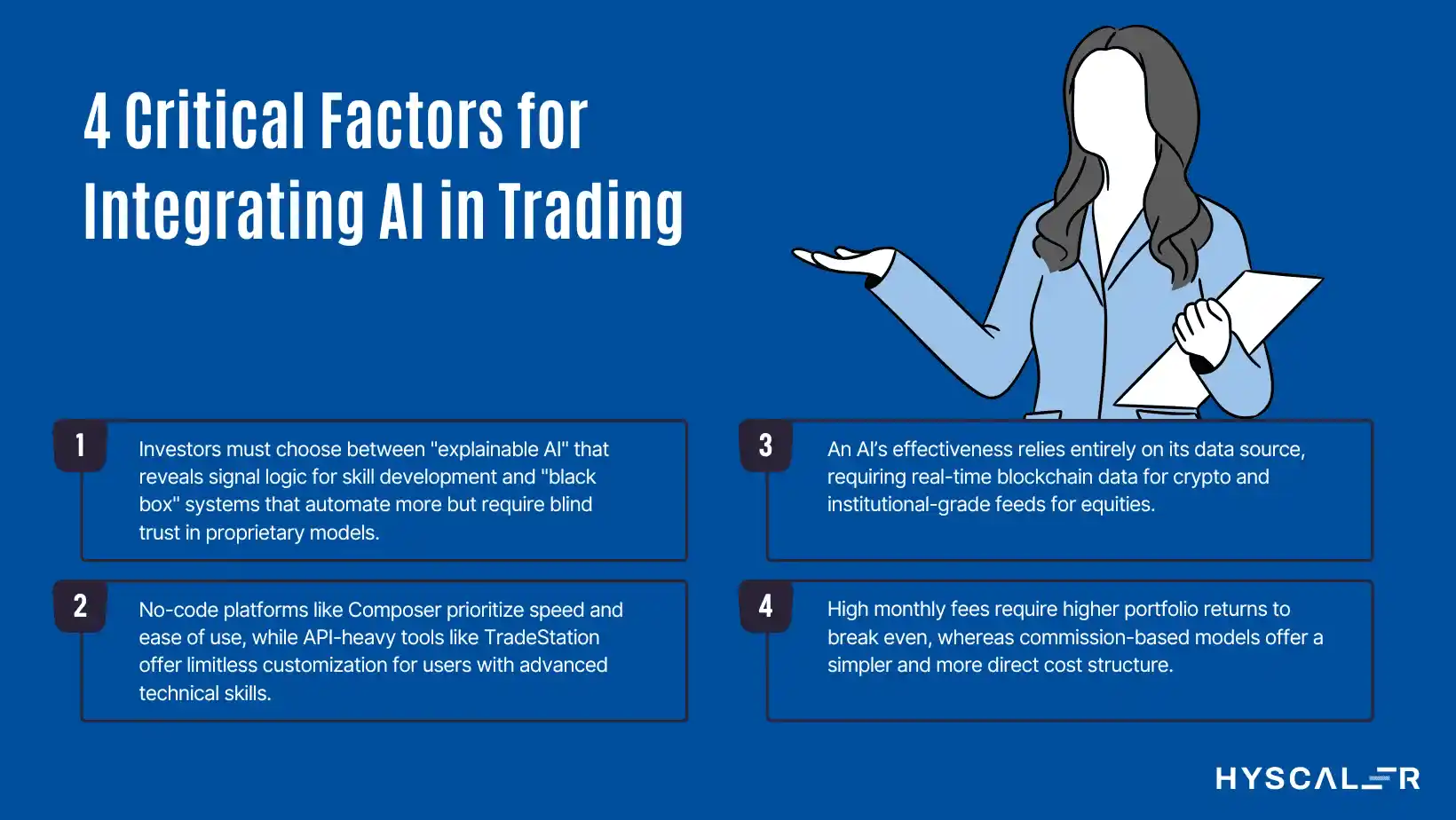
Clearly define your trading goals for successful AI integration. Before committing capital, evaluate these four critical factors.
- Accuracy vs. Transparency: “Explainable AI” (like Tickeron) reveals signal logic. This is vital for long-term skill development. Conversely, “black box” systems (like AlgosOne) automate more. Yet, they demand blind trust in proprietary models.
- Ease of Use vs. Customization: No-code platforms like Composer offer speed. However, API-heavy tools such as TradeStation provide limitless customization. Therefore, select the tool matching your technical skill.
- Data Integrity: An AI’s effectiveness relies solely on its data source. Prioritize platforms that leverage real-time blockchain data for crypto. Moreover, seek institutional-grade feeds for equities.
- Operational Cost: High monthly fees (e.g., Trade Ideas) demand much higher portfolio returns to break even. Conversely, commission-based models like AlgosOne present a simpler cost structure.
Strategic Tips for App Selection & Implementation
An AI tool is only as effective as the strategy it serves. Use these steps to ensure a successful deployment:
- Match the Tool to the Asset: Use 3Commas or ChainGPT for Crypto; use Trade Ideas or TradeStation for Stocks and Futures.
- Audit the Risk Controls: Ensure the platform has capital safeguards, such as Tickeron’s “Virtual Agents” for position sizing or AlgosOne’s “Reserve Fund” for catastrophic protection.
- Implement Hedging Strategies: Use AI to identify market regimes where you should switch to “Inverse ETFs” or “Short Bias” robots to protect your portfolio during downturns.
- Leverage Paper Trading: Never deploy a new AI strategy with live capital until it has been “forward tested” in a demo environment for at least 14 days.
Safety, Compliance, and the “Human Oversight” Mandate
Automation does not equal an absence of risk. AI trading is legal in most jurisdictions and is monitored by bodies like the SEC (U.S.) and FCA (U.K.) to ensure market fairness. However, the user remains the primary responsible party for all executed trades.
- Tax Considerations & Tax-Loss Harvesting: AI bots execute trades, but they do not manage your tax liability. However, 2026-era fintech tools can assist in Tax-Loss Harvesting, automatically selling losing positions to offset gains. Users must integrate their trading apps with platforms like Koinly to track these gains and losses for local tax authorities.
- The Human Element: AI should be viewed as a decision-support tool, not a “set and forget” income stream. Market conditions change, and human judgment is required to ensure the AI remains within the user’s intended risk parameters.
FAQs
Are AI trading apps truly safe?
Yes, provided you use regulated platforms. Reputable apps use high-level encryption and partner with licensed brokers. Always verify if the platform is licensed or works with SEC-approved custodians.
Do I need coding skills?
No. Platforms like Composer and AInvest are built for no-code users. However, if you want full customization, tools like TradeStation (EasyLanguage) or 3Commas (Pine Script) provide that depth.
Can I trust the predictions?
AI is a tool, not a guarantee. It excels at detecting patterns and removing emotion, but its success depends on the quality of the underlying model and current market volatility.
Conclusion
AI will be mature in 2026. Significantly, it reduces emotional bias in retail portfolios. Furthermore, it boosts efficiency. Therefore, you find a platform for your specific strategy. This holds whether you need automated technical charting or autonomous quant bots.
Which AI feature do you value most: predictive analytics or automated execution? Tell us in the comments below.
Disclaimer: Trading involves significant risk. Past performance never guarantees future results. Remember, AI tools should support human judgment, not replace it.