Table of Contents
In an era of sophisticated cyberattacks and evolving threat landscapes, companies must move beyond reactive security measures. Intelligence serves as the cornerstone of modern cybersecurity, transforming raw data into actionable insights that enable security teams to anticipate risks before they materialize. This comprehensive guide explores its lifecycle and integration strategies essential for building a robust defense posture.
What is Threat Intelligence?
Threat Intelligence is the process of collecting, analyzing, and sharing information about cyberthreats. But it’s more than just gathering data. It’s about transforming raw, chaotic information into actionable insights that your security team can use to make better decisions.
Think of it this way:
Raw Data: Thousands of log entries, network traffic patterns, suspicious files
Actionable Intelligence: Attackers from this group typically target manufacturing companies on Tuesdays using this specific malware, and here’s how to stop them
Critical Questions
Intelligence answers the critical questions every security team must ask:
- ✓ WHO is attacking us?
- ✓ WHAT are they after?
- ✓ WHEN might they strike?
- ✓ WHERE are the vulnerabilities?
- ✓ WHY are we being targeted?
- ✓ HOW do they execute attacks?
Why It Matters
The importance of this capability cannot be overstated in today’s cyber environment. The rise of advanced persistent threats (APTs), it offers invaluable insight into adversaries’ tactics, techniques, and procedures, helping defenders anticipate and preempt potential attacks.
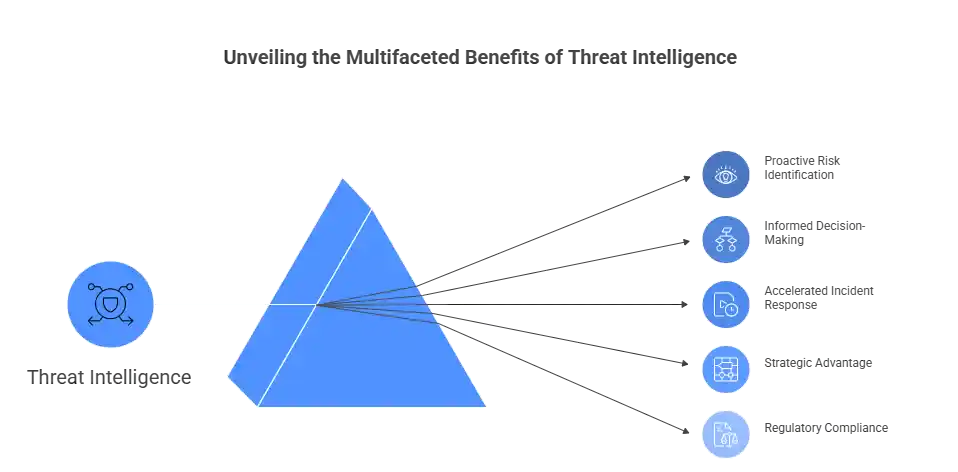
Organizations leveraging threat intelligence gain several strategic advantages:
- Proactive Risk Identification: Uncovering hidden threats and vulnerabilities before attackers can exploit them
- Informed Decision-Making: Providing business leaders and security professionals with contextual data to make investment and mitigation decisions
- Accelerated Incident Response: Reducing the time to detect, investigate, and respond to security incidents
- Strategic Advantage: Understanding adversary behavior patterns and motivations to build stronger defenses
- Regulatory Compliance: Supporting compliance requirements across GDPR, HIPAA, SEC regulations, and industry standards
The Threat Intelligence Lifecycle
A continuous, six-stage process that transforms raw data into actionable intelligence — guiding security teams from planning through perpetual improvement.
Types of Threat Intelligence
Different intelligence types serve distinct organizational needs:
| Type | Audience | Focus |
|---|---|---|
| Strategic | Executive Leadership | High-level threat landscape, long-term security investment decisions |
| Tactical | Incident Response Teams | Specific attack vectors, IOCs, TTPs for mitigating present threats |
| Operational | SOC Teams | Day-to-day risks, active threats, and ongoing attacks |
| Technical | Security Engineers | Granular threat data to refine policies and countermeasures |
Integration with Security Operations
Effective threat intelligence requires seamless integration with existing security infrastructure. Key integration points include:
- Threat Feed Aggregators: Centralize and normalize intelligence from multiple sources
- Threat Intelligence Platforms (TIPs): Correlate and manage threat data at scale
- SIEM Systems: Contextualize security alerts with threat intelligence
- XDR Platforms: Extend detection and response across endpoints, networks, and the cloud
- SOAR Platforms: Automate response actions based on correlated intelligence
- IDS/IPS: Block or alert on malicious activities based on threat data
- EDR Solutions: Quarantine and remediate compromised endpoints
- Policy Management Tools: Update firewall and proxy rules based on known malicious IPs, domains, and signatures
Who Benefits from Threat Intelligence
It provides critical value to organizations of all sizes:
| Role | Benefit |
|---|---|
| Security Analysts | Enhanced detection through integrated threat feeds |
| SOC Teams | Incident prioritization based on threat actor activity |
| CSIRT Teams | Accelerated investigations with contextual threat data |
| Intelligence Analysts | Deep tracking of threat actors and TTPs |
| Executive Leadership | Strategic perspective for informed investment decisions |
| All Organizations | Proportional security improvements, from SMBs to enterprises |
Best Practices for Implementation
Successful threat intelligence programmes require more than tools — they demand structure, alignment, and a commitment to continuous improvement.
Conclusion
Threat intelligence represents a fundamental shift from reactive incident response to proactive threat defence.
By understanding the six-stage lifecycle — Requirements → Collection → Processing → Analysis → Dissemination → Feedbackorganizations can build mature intelligence programmes that integrate seamlessly with security operations.
The key to success lies not just in collecting vast amounts of data but in transforming that data into actionable insights tailored to organizational needs. When properly integrated with detection, prevention, and response tools, threat intelligence becomes the decision-making foundation that enables security teams to stay ahead of adversaries.
Organizations that embrace threat intelligence as a core operational capability will find themselves better positioned to anticipate threats, reduce incident response times, and make strategic security investments that deliver measurable business value.
FAQs
What is Threat Intelligence?
It’s the process of turning raw cybersecurity data into actionable insights that help organizations anticipate and prevent attacks before they happen.
What is the difference between raw data and threat intelligence?
Raw data is just isolated facts (like an IP address); threat intelligence adds context to make it meaningful and actionable (that IP is linked to ransomware attacks).
What are the different types of threat intelligence?
There are four types: Strategic (executive decisions), Tactical (active attack indicators), Operational (ongoing threats), and Technical (attacker methods and tools).
How is threat intelligence actually collected?
It’s gathered from sources like the dark web, hacker forums, government advisories, internal logs, open-source feeds, and commercial threat platforms.
How does threat intelligence support regulatory compliance?
It provides continuous, documented evidence of proactive security monitoring, directly satisfying audit requirements under GDPR, HIPAA, SEC, and other frameworks.
How do you measure if a threat intelligence program is working?
Track KPIs like Mean Time to Detect (MTTD), Mean Time to Respond (MTTR), false positive reduction, and overall drop in successful incidents.
Does threat intelligence only matter for large enterprises?
No, businesses of any size can benefit from using free tools like CISA advisories, VirusTotal, and OSINT feeds without needing an enterprise budget.